ignition BUICK LUCERNE 2011 Repair Manual
[x] Cancel search | Manufacturer: BUICK, Model Year: 2011, Model line: LUCERNE, Model: BUICK LUCERNE 2011Pages: 450, PDF Size: 3.63 MB
Page 279 of 450
Black plate (25,1)Buick Lucerne Owner Manual - 2011
5. Remove the key from the ignition.
6. Secure the vehicle to the dolly.
7. Release the parking brake.
Towing a Trailer
{WARNING:
The driver can lose control when pulling a trailer if
the correct equipment is not used or the vehicle is
not driven properly. For example, if the trailer is
too heavy, the brakes may not work well—or
even at all. The driver and passengers could
be seriously injured. The vehicle may also be
damaged; the resulting repairs would not be
covered by the vehicle warranty. Pull a trailer only
if all the steps in this section have been followed.
Ask your dealer for advice and information about
towing a trailer with the vehicle.
Notice: Pulling a trailer improperly can damage the
vehicle and result in costly repairs not covered by
the vehicle warranty. To pull a trailer correctly,
follow the advice in this section and see your dealer
for important information about towing a trailer with
the vehicle. The vehicle can tow a trailer if it is equipped with
the proper trailer towing equipment. To identify the
trailering capacity of the vehicle, read the information
in
“Weight of the Trailer” that appears later in this
section. Trailering is different than just driving the
vehicle by itself. Trailering means changes in handling,
acceleration, braking, durability and fuel economy.
Successful, safe trailering takes correct equipment,
and it has to be used properly.
The following information has many time-tested,
important trailering tips and safety rules. Many of
these are important for the safety of the driver and
the passengers. So please read this section carefully
before pulling a trailer.
Load-pulling components such as the engine,
transmission, axles, wheel assemblies and tires are
forced to work harder against the drag of the added
weight. The engine is required to operate at relatively
higher speeds and under greater loads, generating
extra heat. The trailer also adds considerably to wind
resistance, increasing the pulling requirements.
5-25
Page 331 of 450
Black plate (45,1)Buick Lucerne Owner Manual - 2011
Notice:Ignoring these steps could result in costly
damage to the vehicle that would not be covered by
the warranty.
Trying to start the vehicle by pushing or pulling it
will not work, and it could damage the vehicle.
1. Check the other vehicle. It must have a 12-volt battery with a negative ground system.
Notice: Only use a vehicle that has a 12-volt system
with a negative ground for jump starting. If the other
vehicle does not have a 12-volt system with a
negative ground, both vehicles can be damaged.
2. Get the vehicles close enough so the jumper cables can reach, but be sure the vehicles are not
touching each other. If they are, it could cause a
ground connection you do not want. You would
not be able to start your vehicle, and the bad
grounding could damage the electrical systems.
To avoid the possibility of the vehicles rolling, set
the parking brake firmly on both vehicles involved
in the jump start procedure. Put an automatic
transmission in P (Park) or a manual transmission
in Neutral before setting the parking brake. Notice:
If the radio or other accessories are left on
during the jump starting procedure, they could be
damaged. The repairs would not be covered by
the warranty. Always turn off the radio and other
accessories when jump starting the vehicle.
3. Turn off the ignition on both vehicles. Unplug unnecessary accessories plugged into the
cigarette lighter or the accessory power outlet(s).
Turn off the radio and all lamps that are not
needed. This will avoid sparks and help save
both batteries. And it could save the radio!
4. Open the hood on the other vehicle and locate the positive (+) and negative (−) terminal locations on
that vehicle.
You will not see the battery of your vehicle under
the hood. It is located under the rear passenger's
seat. You will not need to access the battery for
jump starting. The remote positive (+) terminal is
for that purpose. See Engine Compartment
Overview
on page 6‑14for location.
6-45
Page 342 of 450
Black plate (56,1)Buick Lucerne Owner Manual - 2011
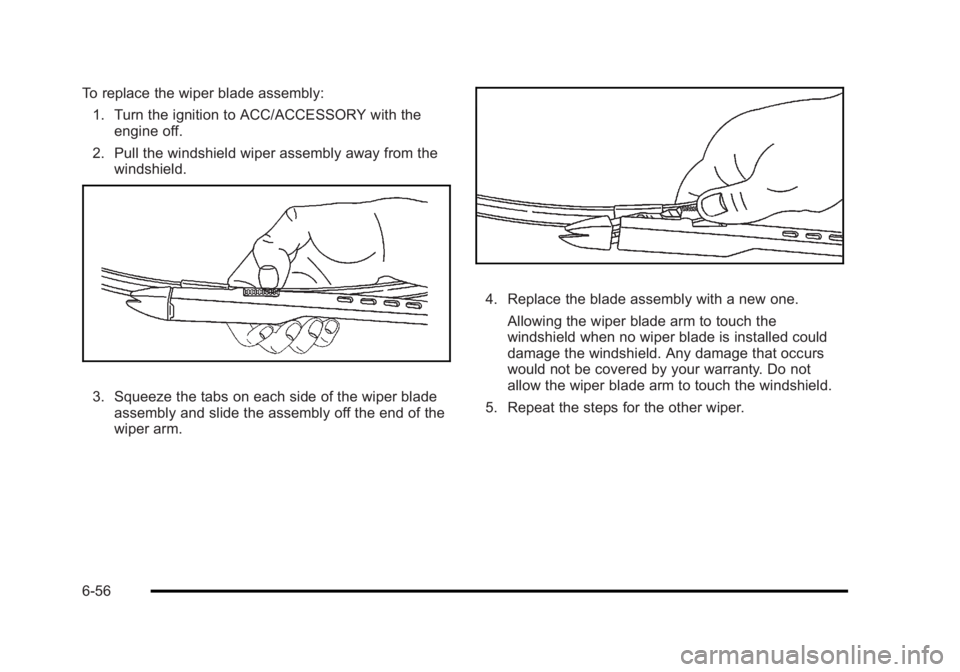
To replace the wiper blade assembly:1. Turn the ignition to ACC/ACCESSORY with the engine off.
2. Pull the windshield wiper assembly away from the windshield.
3. Squeeze the tabs on each side of the wiper bladeassembly and slide the assembly off the end of the
wiper arm.
4. Replace the blade assembly with a new one.
Allowing the wiper blade arm to touch the
windshield when no wiper blade is installed could
damage the windshield. Any damage that occurs
would not be covered by your warranty. Do not
allow the wiper blade arm to touch the windshield.
5. Repeat the steps for the other wiper.
6-56
Page 353 of 450
Black plate (67,1)Buick Lucerne Owner Manual - 2011
If the warning light comes on, stop as soon as possible
and inflate the tires to the recommended pressure
shown on the tire loading information label. See
Loading the Vehicle on page 5‑18.
A message to check the pressure in a specific tire
displays in the Driver Information Center (DIC). The
low tire pressure warning light and the DIC warning
message come on at each ignition cycle until the tires
are inflated to the correct inflation pressure. Using the
DIC, tire pressure levels can be viewed by the driver.
For additional information and details about the DIC
operation and displays seeDIC Operation and Displays
on page 4‑42andDIC Warnings and Messageson
page 4‑49.
The low tire pressure warning light may come on in
cool weather when the vehicle is first started, and then
turn off as the vehicle is driven. This could be an early
indicator that the air pressure is getting low and needs
to be inflated to the proper pressure. A Tire and Loading Information label shows the size
of the original equipment tires and the correct inflation
pressure for the tires when they are cold. See
Loading
the Vehicle
on page 5‑18, for an example of the Tire
and Loading Information label and its location on your
vehicle. Also see Inflation - Tire Pressure on page 6‑64.
Your vehicle's TPMS can warn you about a low tire
pressure condition but it does not replace normal tire
maintenance. See Tire Inspection and Rotation
on
page 6‑70and Tires on page 6‑57.
Notice: Tire sealant materials are not all the same.
A non-approved tire sealant could damage the
TPMS sensors. TPMS sensor damage caused by
using an incorrect tire sealant is not covered by the
vehicle warranty. Always use only the GM-approved
tire sealant available through your dealer or
included in the vehicle.
Factory-installed Tire Inflator Kits use a GM approved
liquid tire sealant. Using non-approved tire sealants
could damage the TPMS sensors. See Tire Sealant and
Compressor Kit
on page 6‑80for information regarding
the inflator kit materials and instructions.
6-67
Page 354 of 450
Black plate (68,1)Buick Lucerne Owner Manual - 2011
TPMS Malfunction Light and Message
The TPMS will not function properly if one or more of
the TPMS sensors are missing or inoperable. When
the system detects a malfunction, the low tire pressure
warning light flashes for about one minute and then
stays on for the remainder of the ignition cycle. A DIC
warning message also displays. The malfunction light
and DIC warning message come on at each ignition
cycle until the problem is corrected. Some of the
conditions that can cause these to come on are:
.One of the road tires has been replaced with the
spare tire. The spare tire does not have a TPMS
sensor. The malfunction light and the DIC message
should go off after the road tire is replaced and
the sensor matching process is performed
successfully. See "TPMS Sensor Matching
Process" later in this section.
.The TPMS sensor matching process was not done
or not completed successfully after rotating the
tires. The malfunction light and the DIC message
should go off after successfully completing the
sensor matching process. See "TPMS Sensor
Matching Process" later in this section.
.One or more TPMS sensors are missing or
damaged. The malfunction light and the DIC
message should go off when the TPMS sensors
are installed and the sensor matching process is
performed successfully. See your dealer for
service.
.Replacement tires or wheels do not match the
original equipment tires or wheels. Tires and
wheels other than those recommended could
prevent the TPMS from functioning properly. See
Buying New Tires on page 6‑72.
.Operating electronic devices or being near facilities
using radio wave frequencies similar to the TPMS
could cause the TPMS sensors to malfunction.
If the TPMS is not functioning properly, it cannot detect
or signal a low tire condition. See your dealer for
service if the TPMS malfunction light and DIC message
comes on and stays on.
6-68
Page 355 of 450
Black plate (69,1)Buick Lucerne Owner Manual - 2011
TPMS Sensor Matching Process
Each TPMS sensor has a unique identification code.
The identification code needs to be matched to a new
tire/wheel position after rotating the vehicle’s tires or
replacing one or more of the TPMS sensors. Also, the
TPMS sensor matching process should be performed
after replacing a spare tire with a road tire containing
the TPMS sensor. The malfunction light and the DIC
message should go off at the next ignition cycle. The
sensors are matched to the tire/wheel positions, using a
TPMS relearn tool, in the following order: driver side
front tire, passenger side front tire, passenger side rear
tire, and driver side rear. See your dealer for service or
to purchase a relearn tool.
There are two minutes to match the first tire/wheel
position, and five minutes overall to match all four tire/
wheel positions. If it takes longer, the matching process
stops and must be restarted.
The TPMS sensor matching process is:1. Set the parking brake.
2. Turn the ignition to ON/RUN with the engine off.
3. Press the Remote Keyless Entry (RKE) transmitter's lock and unlock buttons at the same
time for approximately five seconds. The horn
sounds twice to signal the receiver is in relearn
mode and TIRE LEARNING ACTIVE message
displays on the DIC screen. 4. Start with the driver side front tire.
5. Place the relearn tool against the tire sidewall,
near the valve stem. Then press the button to
activate the TPMS sensor. A horn chirp confirms
that the sensor identification code has been
matched to this tire and wheel position.
6. Proceed to the passenger side front tire, and repeat the procedure in Step 5.
7. Proceed to the passenger side rear tire, and repeat the procedure in Step 5.
8. Proceed to the driver side rear tire, and repeat the procedure in Step 5. The horn sounds two times to
indicate the sensor identification code has been
matched to the driver side rear tire, and the TPMS
sensor matching process is no longer active. The
TIRE LEARNING ACTIVE message on the DIC
display screen goes off.
9. Turn the ignition to LOCK/OFF.
10. Set all four tires to the recommended air pressure level as indicated on the Tire and Loading
Information label.
6-69
Page 395 of 450
Black plate (109,1)Buick Lucerne Owner Manual - 2011
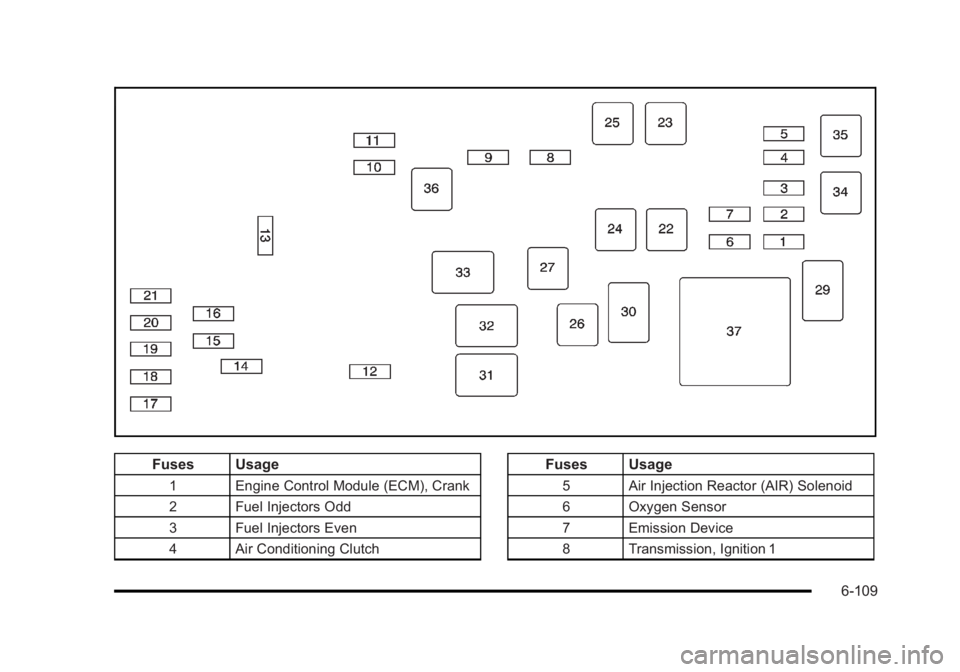
Fuses Usage
1 Engine Control Module (ECM), Crank
2 Fuel Injectors Odd
3 Fuel Injectors Even
4 Air Conditioning Clutch
Fuses Usage
5 Air Injection Reactor (AIR) Solenoid
6 Oxygen Sensor
7 Emission Device
8 Transmission, Ignition 1
6-109
Page 396 of 450
Black plate (110,1)Buick Lucerne Owner Manual - 2011
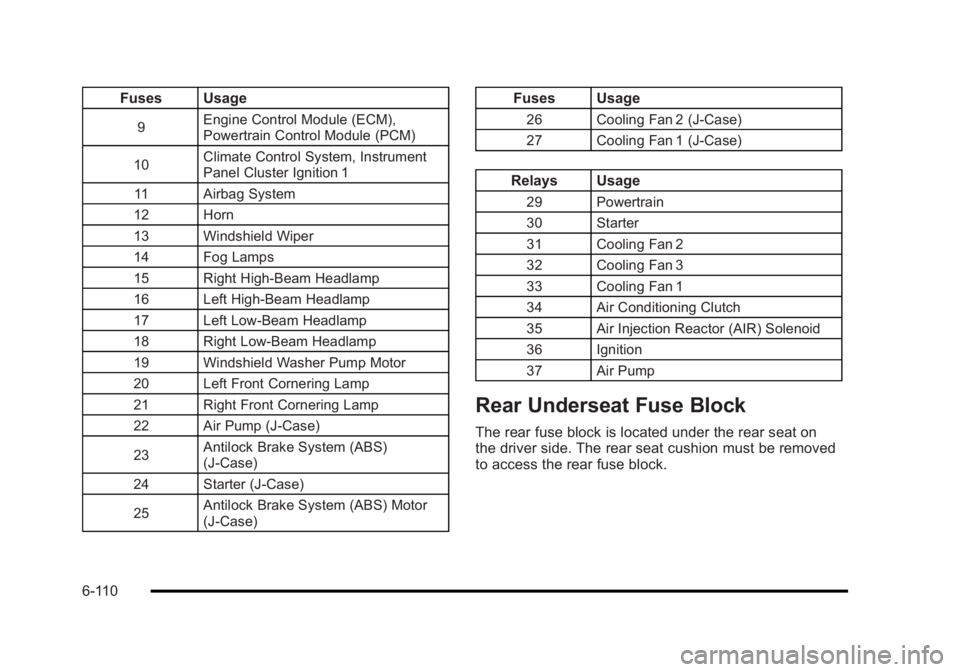
Fuses Usage
9Engine Control Module (ECM),
Powertrain Control Module (PCM)
10 Climate Control System, Instrument
Panel Cluster Ignition 1
11 Airbag System
12 Horn
13 Windshield Wiper
14 Fog Lamps
15 Right High-Beam Headlamp
16 Left High-Beam Headlamp
17 Left Low-Beam Headlamp
18 Right Low-Beam Headlamp
19 Windshield Washer Pump Motor
20 Left Front Cornering Lamp
21 Right Front Cornering Lamp
22 Air Pump (J-Case)
23 Antilock Brake System (ABS)
(J-Case)
24 Starter (J-Case)
25 Antilock Brake System (ABS) Motor
(J-Case)
Fuses Usage
26 Cooling Fan 2 (J-Case)
27 Cooling Fan 1 (J-Case)
Relays Usage
29 Powertrain
30 Starter
31 Cooling Fan 2
32 Cooling Fan 3
33 Cooling Fan 1
34 Air Conditioning Clutch
35 Air Injection Reactor (AIR) Solenoid
36 Ignition
37 Air Pump
Rear Underseat Fuse Block
The rear fuse block is located under the rear seat on
the driver side. The rear seat cushion must be removed
to access the rear fuse block.
6-110
Page 400 of 450
Black plate (114,1)Buick Lucerne Owner Manual - 2011
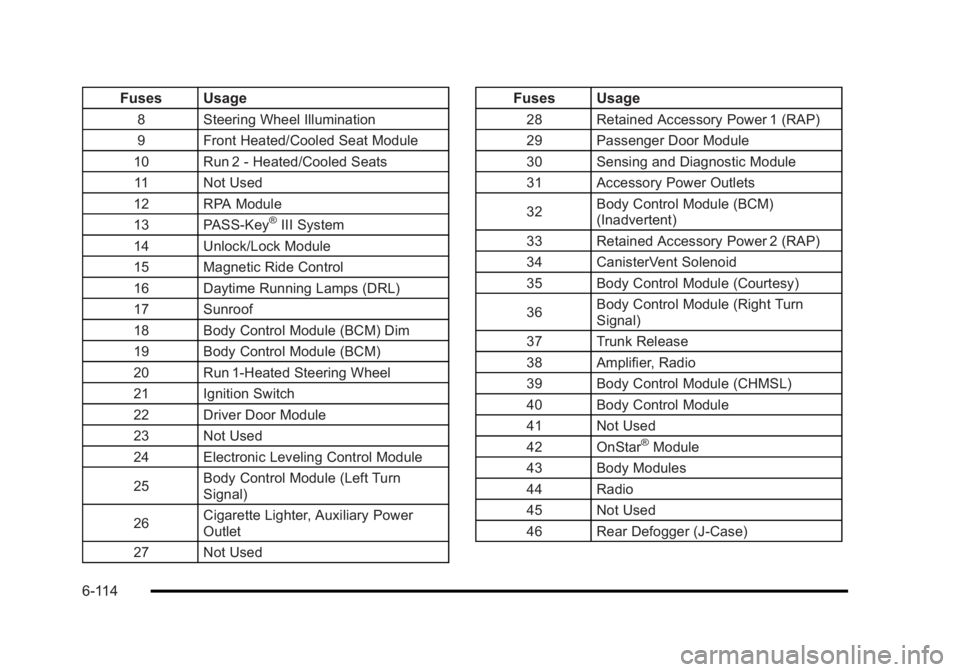
Fuses Usage
8 Steering Wheel Illumination
9 Front Heated/Cooled Seat Module
10 Run 2 - Heated/Cooled Seats 11 Not Used
12 RPA Module
13 PASS-Key
®III System
14 Unlock/Lock Module
15 Magnetic Ride Control
16 Daytime Running Lamps (DRL)
17 Sunroof
18 Body Control Module (BCM) Dim
19 Body Control Module (BCM)
20 Run 1-Heated Steering Wheel
21 Ignition Switch
22 Driver Door Module
23 Not Used
24 Electronic Leveling Control Module
25 Body Control Module (Left Turn
Signal)
26 Cigarette Lighter, Auxiliary Power
Outlet
27 Not Used
Fuses Usage
28 Retained Accessory Power 1 (RAP)
29 Passenger Door Module
30 Sensing and Diagnostic Module
31 Accessory Power Outlets
32 Body Control Module (BCM)
(Inadvertent)
33 Retained Accessory Power 2 (RAP)
34 CanisterVent Solenoid
35 Body Control Module (Courtesy)
36 Body Control Module (Right Turn
Signal)
37 Trunk Release
38 Amplifier, Radio
39 Body Control Module (CHMSL)
40 Body Control Module
41 Not Used
42 OnStar
®Module
43 Body Modules
44 Radio
45 Not Used
46 Rear Defogger (J-Case)
6-114
Page 409 of 450
Black plate (5,1)Buick Lucerne Owner Manual - 2011
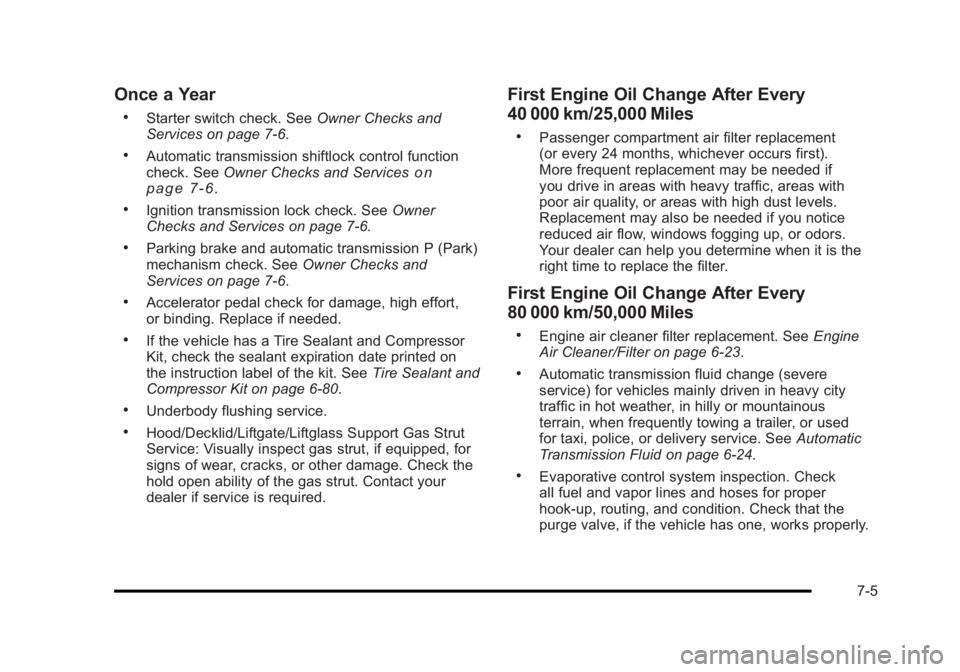
Once a Year
.Starter switch check. SeeOwner Checks and
Services on page 7‑6.
.Automatic transmission shiftlock control function
check. See Owner Checks and Serviceson
page 7‑6.
.Ignition transmission lock check. See Owner
Checks and Services on page 7‑6.
.Parking brake and automatic transmission P (Park)
mechanism check. See Owner Checks and
Services on page 7‑6.
.Accelerator pedal check for damage, high effort,
or binding. Replace if needed.
.If the vehicle has a Tire Sealant and Compressor
Kit, check the sealant expiration date printed on
the instruction label of the kit. See Tire Sealant and
Compressor Kit on page 6‑80.
.Underbody flushing service.
.Hood/Decklid/Liftgate/Liftglass Support Gas Strut
Service: Visually inspect gas strut, if equipped, for
signs of wear, cracks, or other damage. Check the
hold open ability of the gas strut. Contact your
dealer if service is required.
First Engine Oil Change After Every
40 000 km/25,000 Miles
.Passenger compartment air filter replacement
(or every 24 months, whichever occurs first).
More frequent replacement may be needed if
you drive in areas with heavy traffic, areas with
poor air quality, or areas with high dust levels.
Replacement may also be needed if you notice
reduced air flow, windows fogging up, or odors.
Your dealer can help you determine when it is the
right time to replace the filter.
First Engine Oil Change After Every
80 000 km/50,000 Miles
.Engine air cleaner filter replacement. See Engine
Air Cleaner/Filter on page 6‑23.
.Automatic transmission fluid change (severe
service) for vehicles mainly driven in heavy city
traffic in hot weather, in hilly or mountainous
terrain, when frequently towing a trailer, or used
for taxi, police, or delivery service. See Automatic
Transmission Fluid on page 6‑24.
.Evaporative control system inspection. Check
all fuel and vapor lines and hoses for proper
hook‐up, routing, and condition. Check that the
purge valve, if the vehicle has one, works properly.
7-5