headlights BUICK PARK AVENUE 1993 User Guide
[x] Cancel search | Manufacturer: BUICK, Model Year: 1993, Model line: PARK AVENUE, Model: BUICK PARK AVENUE 1993Pages: 340, PDF Size: 18.17 MB
Page 188 of 340
Driving in Fog, Mist and Haze
r
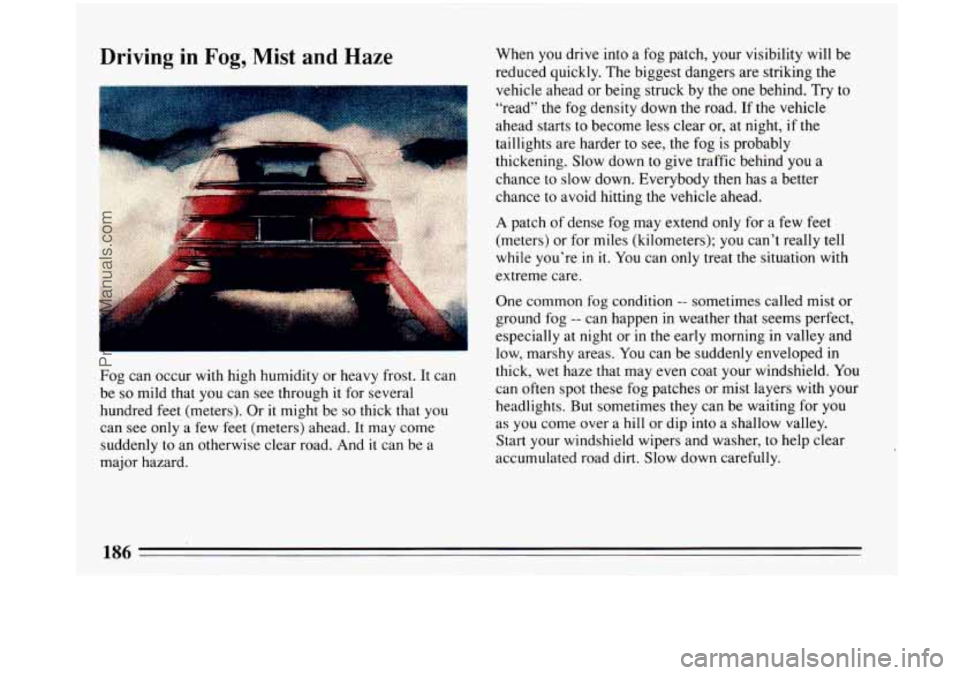
Fog can occur with high humidity or heavy frost. It can
be
so mild that you can see through it for several
hundred feet (meters). Or it might be
so thick that you
can
see only a few feet (meters) ahead. It may come
suddenly to an otherwise clear road. And it can be
a
major hazard. When you
drive into a fog patch, your visibility will be
reduced quickly. The biggest dangers are striking the
vehicle ahead or being struck by the one behind. Try to
"read" the fog density down the road.
If the vehicle
ahead starts
to become less clear or, at night, if the
taillights are harder
to see, the fog is probably
thickening. Slow down
to give traffic behind you a
chance to slow down. Everybody then has a better
chance to avoid hitting the vehicle ahead.
A patch of dense fog may extend only for a few feet
(meters) or for miles (kilometers); you can't really tell
while you're
in it. You can only treat the situation with
extreme care.
One common
fog condition -- sometimes called mist or
ground fog
-- can happen in weather that seems perfect,
especially at night or in the early morning in valley and
low, marshy areas. You can be suddenly enveloped in
thick, wet haze that may even coat your windshield. You
can often spot these fog patches or mist layers with your
headlights. But sometimes they can be waiting for you
as you come over a hill or dip into a shallow valley.
Start
your windshield wipers and washer, to help clear
accumulated road dirt. Slow down carefully.
ProCarManuals.com
Page 189 of 340
Tips on Driving in Fog
If you get caught in fog, turn your headlights on low
beam, even
in daytime. You’ll see -- and be seen --
better.
Don’t
use your high beams. The light will bounce off
the water droplets that make up fog and reflect back at
you.
Use your defogger. In high humidity, even a light
buildup of moisture on the inside of the glass will cut
down on your already limited visibility.
Run your
windshield wipers and washer occasionally. Moisture
can build up on the outside glass, and what seems to be
fog may actually be moisture
on the outside of your
windshield.
Treat dense fog as an emergency. Try to find a place
IO
pull off the road. Of course you want to respect
another’s property, but you might need
to put something
between you and moving vehicles
-- space, trees,
telephone poles, a private driveway, anything that
removes
you from other traffic.
If visibility is near zero and
you must stop but are
unsure whether you are away from the road, turn your
lights on, start your hazard warning flashers, and sound
your horn at intervals or when you hear approaching
traffic. Pass
other vehicles in fog only if you
can see far enough
ahead to pass safely. Even then, be prepared to delay
your pass if you suspect the fog is worse up ahead.
If
other vehicles try to pass you, make it easy for them.
City Driving
L
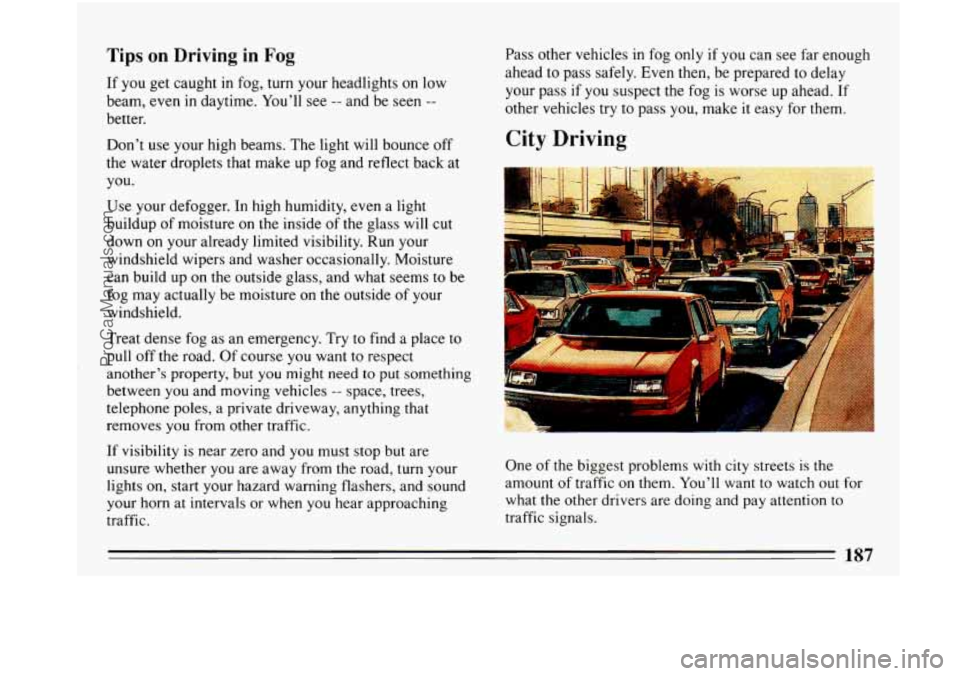
One of the biggest problems with city streets is the
amount
of traffic on them. You’ll want to watch out for
what
the other drivers are doing and pay attention to
traffic signals.
187
ProCarManuals.com
Page 202 of 340
A CAUTION:
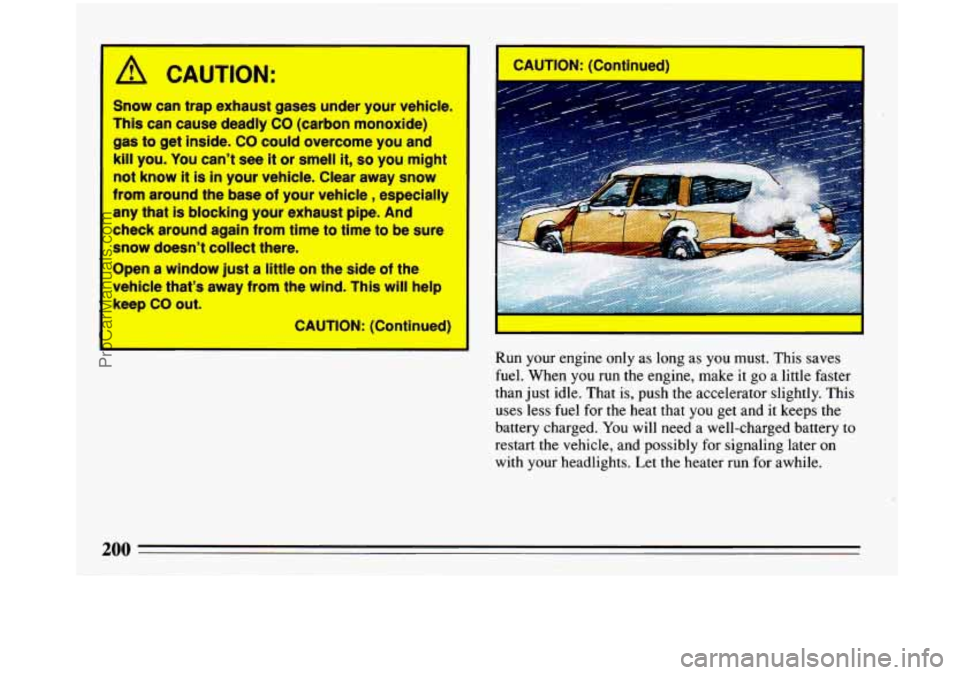
Snow can trap exhaust gases under your vehicle.
This can cause deadly
CO (carbon monoxide)
gas to get inside. CO could overcome you and
kill you. You can’t see it or smell it, so you might
not know it is in your vehicle. Clear away snow
from around the base of your vehicle, especially
any that
is blocking your exhaust pipe. And
check around again from time to time to be sure
snow doesn’t collect there.
Open
a window just a little on the side of the
vehicle that’s away from the wind. This will help
keep CO out.
CAUTION: (Continued)
LCAUTION:
Run your engine only as long as you must. This saves
fuel. When you run the engine, make it go a little faster
than just idle. That is, push the accelerator slightly. This
uses less fuel for the heat that you get and it keeps the
battery charged. You will need a well-charged battery
to
restart the vehicle, and possibly for signaling later on
with your headlights. Let the heater run for awhile.
ProCarManuals.com
Page 291 of 340
There are additional fuses located behind the right sound
insulator panel on the passenger side. If these require
service, see your Buick dealer.
Maxifuse/Relay Center
To check the fuses in this underhood fuse center, turn
the two knobs
1/4 turn counterclockwise and remove the
cover. The inside of
the cover has a chart that explains
the features and controls governed by each fuse and
relay.
The PASS-Key 'I1
TM fuse is located in the right side relay
center.
Headlights
The headlight wiring is protected by a circuit breaker in
the underhood fuse center. An electrical overload will
cause
the lights to go on and off, or in some cases to
remain
off. If this happens, have your headlight wiring
checked right away.
*
Windshield Wipers
The windshield wiper motor is protected by a circuit
breaker and a fuse. If the motor overheats due to heavy
snow, etc., the wiper will stop until the motor cools. If
the overload is caused by some electrical problem and
not snow, etc., be sure to get it fixed.
Power Windows and Other Power Options
Circuit breakers in the fuse panel protect the power
windows and other power accessories. When
the current
load is too heavy, the circuit breaker opens and closes,
protecting the circuit until the problem is fixed or goes
away.
ProCarManuals.com