towing BUICK PARK AVENUE 1993 User Guide
[x] Cancel search | Manufacturer: BUICK, Model Year: 1993, Model line: PARK AVENUE, Model: BUICK PARK AVENUE 1993Pages: 340, PDF Size: 18.17 MB
Page 207 of 340
Driving with a Trailer
Towing a trailer requires a certain amount of experience.
Before setting
out for the open road, you’ll want to get
to know your rig. Acquaint yourself with the feel of
handling and braking with the added weight of the
trailer. And always keep in mind that the vehicle
you are
driving is now a good deal longer and not nearly
so
responsive as your vehicle is by itself.
Before you start, check the trailer hitch and platform,
safety chains, electrical connector, lights, tires and
mirror adjustment.
If the trailer has electric brakes, start
your vehicle and trailer moving and then apply the
trailer brake controller by hand
to be sure the brakes are
working. This lets you check your electrical connection
at the same time.
Passing
During your trip, check occasionally to be sure that the
load is secure, and that the lights and any trailer brakes
are still working.
Following Distance
Stay at least twice as far behind the vehicle ahead as you
would when driving your vehicle without a trailer. This
can help you avoid situations that require heavy braking
and sudden turns. You’ll
need more passing distance up ahead when
you’re towing a trailer. And, because you’re a good deal
longer, you’ll need to go much farther beyond the
passed vehicle before you can return to your lane.
Backing Up
Hold the bottom of the steering wheel with one hand.
Then, to move the trailer
to the left, just move that hand
to the
left. To move the trailer to the right, move your
hand to the right. Always back up slowly and, if
possible, have someone guide you.
Making Turns
When you’re turning with a trailer, make wider turns
than normal. Do this
so your trailer won’t strike soft
shoulders, curbs, road signs, trees, or other objects.
Avoid jerky or sudden maneuvers. Signal well
in
advance.
lbrn Signals When Towing a Trailer
When you tow a trailer, your vehicle has to have a
different turn signal flasher and extra wiring. The green
arrows on your instrument panel will flash whenever
you signal a turn or lane change. Properly hooked up,
ProCarManuals.com
Page 208 of 340
the trailer lights will also flash, telling other drivers
you’re about to turn, change lanes or stop.
When towing a trailer, the green arrows
on your
instrument panel will flash for turns even
if the bulbs on
the trailer are burned out. Thus, you may think drivers
behind you are seeing your signal when they are not. It’s
important to check occasionally to be sure the trailer
bulbs are still working.
Your vehicle has bulb warning lights. When you plug
trailer lights into your vehicle’s lighting system, its bulb warning lights may not
let you know if one of your
lights goes
out. So, when you have trailer lights plugged
in, be sure
to check your vehicle and trailer lights from
time to time to be sure they’re-all working. Once
you
disconnect the trailer lights, the bulb warning lights
again can
tell you if one of your vehicle lights is out.
Driving On Grades
Reduce speed and shift to a lower gear before you start
down a long
or steep downgrade. If you don’t shift
down, you might have to use your brakes
so much that
they would get hot and no longer work well. On
a long uphill grade, shift down to
“D or 3” (Drive)
and reduce your speed to around
45 mph (70 km/h) to
reduce the possibility of engine and transaxle
overheating.
Parking on Hills
You really should not park your vehicle, with a trailer
attached,
on a hill. If something goes wrong, your rig
could start to move. People can be injured, and both
your vehicle and the trailer can be damaged.
But
if you ever have to park your rig on a hill, here’s
how to do it:
1. Apply your regular brakes, but don’t shift into “F’”
(Park) yet.
2. Have someone place chocks under the trailer wheels.
3. When the wheel chocks are in place, release the
regular brakes until the chocks absorb the load.
4. Reapply the regular brakes. Then apply your parking
brake, and
then shift to “P’ (Park).
5. Release the regular brakes.
ProCarManuals.com
Page 209 of 340
When You Are Ready to Leave After
Parking on
a Hill
1. Apply your regular brakes and hold the pedal down
while you:
Start your engine;
0 Shift into a gear; and
0 Release the parking brake.
2. Let up on the brake pedal.
3. Drive slowly until the trailer is clear of the chocks.
4. Stop and have someone pick up and store the chocks.
Maintenance When Trailer Towing
Your vehicle will need service more often when you’re
pulling a trailer. See the Maintenance Schedule for more
on this. Things that are especially important in trailer
operation are automatic transaxle fluid (don’t overfill),
engine oil, belt, cooling system, and brake adjustment.
Each
of these is covered in this manual, and the Index
will help
you find them quickly. If you’re trailering, it’s
a good idea to review these sections before
you start
your trip.
Check periodically to see that all hitch nuts and bolts are
tight.
ProCarManuals.com
Page 211 of 340
@ Part 5 Problems on the Road
=I i
~~
Here you’ll find what to do about some problems that can occur on the road .
Part 5 includes:
Hazard Warning Flashers
............................................................ 210
OtherWarningDevices
............................................................. 211
“Jump”Starting
.................................................................... 212
TowingYourBuick
................................................................ 217
Engineoverheating
................................................................ 221
IfaTireGoesFlat
................................................................. 228
ChangingaFlatTire
................................................................ 229
CompactSpareTire
................................................................ 237
If You’re Stuck
in Sand, Mud, Ice or Snow .............................................. 239
209
...... c-~ ~
ProCarManuals.com
Page 219 of 340
Towing Your Car
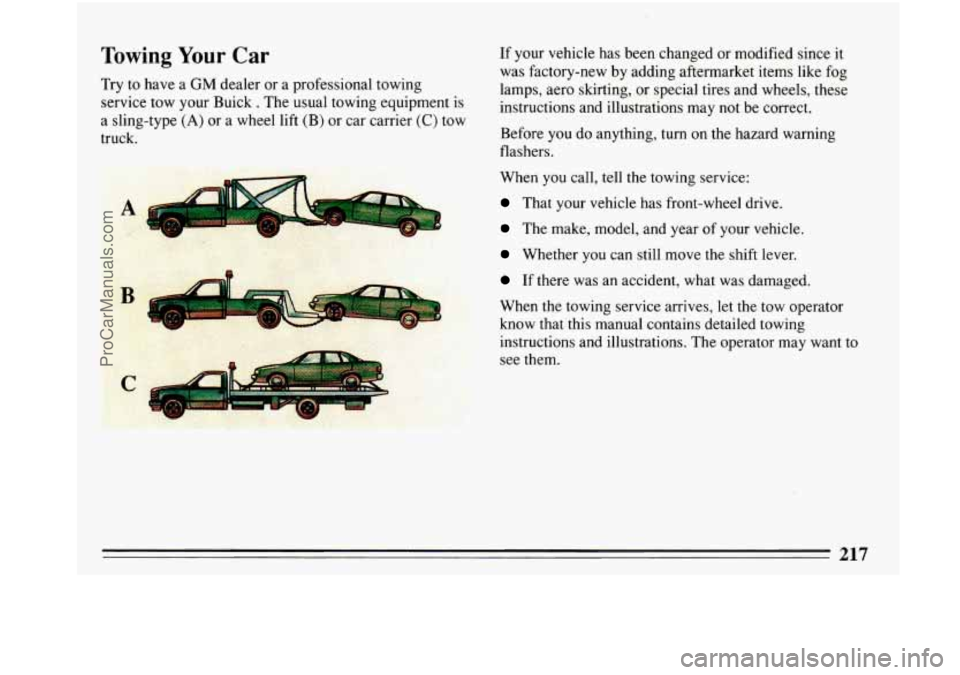
Try to have a GM dealer or a professional towing
service tow your Buick
. The usual towing equipment is
a sling-type
(A) or a wheel lift (B) or car carrier (C) tow
truck.
If your vehicle has been changed or modified since it
was factory-new by adding aftermarket items like fog
lamps, aero skirting, or special tires and wheels, these
instructions and illustrations may not be correct.
Before you do anything,
turn on the hazard warning
flashers.
When you call, tell the towing service:
That your vehicle has front-wheel drive.
The make, model, and year of your vehicle.
Whether you can still move the shift lever.
If there was an accident, what was damaged.
When the towing service arrives, let the tow operator
know that this manual contains detailed towing
instructions and illustrations. The operator may want to
see them.
217
ProCarManuals.com
Page 220 of 340
r /r CAUTION:
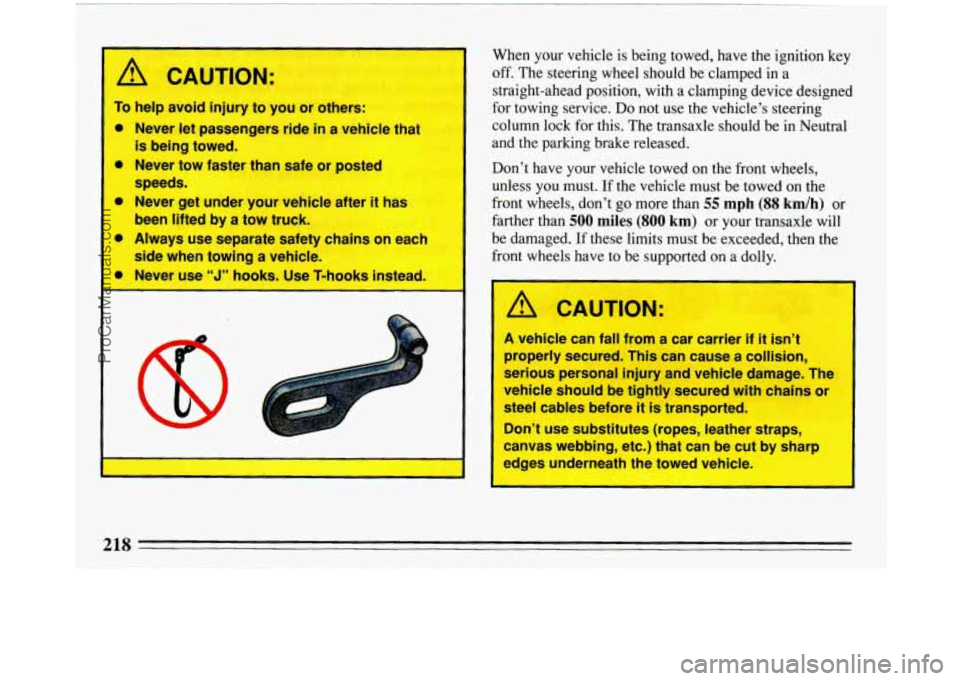
To help avoid injury to you or others:
0 Never let passengers ride in a vehicle that
0 Never tow faster than safe or posted
0 Never get under your vehicle after it has
0 Always use separate safety chains on each
is being towed.
speeds.
been lifted by
a tow truck.
side when ?owing
a vehicle.
V
t
When your vehicle is being towed, have the ignition key
off. The steering wheel should be clamped in a
straight-ahead position, with a clamping device designed
for towing service.
Do not use the vehicle’s steering
column lock for this. The transaxle should be in Neutral
and the parking brake released.
Don’t have
your vehicle towed on the front wheels,
unless you must.
If the vehicle must be towed on the
front wheels, don’t go more than
55 mph (88 kdh) or
farther than
500 miles (SO0 km) or your transaxle will
be damaged. If these limits must be exceeded, then the
front wheels have to be supported on a dolly.
A CAUTION:
A vehicle can fall from a car carrier if it isn’t
properly secured. This can cause a collision,
serious personal injury and vehicle damage. The
vehicle should be tightly secured with chains or
steel cables before it is transported.
Don’t use substitutes (ropes, leather straps,
canvas webbing, etc.) that can be cut by sharp
edges underneath the towed vehicle.
218
ProCarManuals.com
Page 221 of 340
Front Towing Hook- JPS
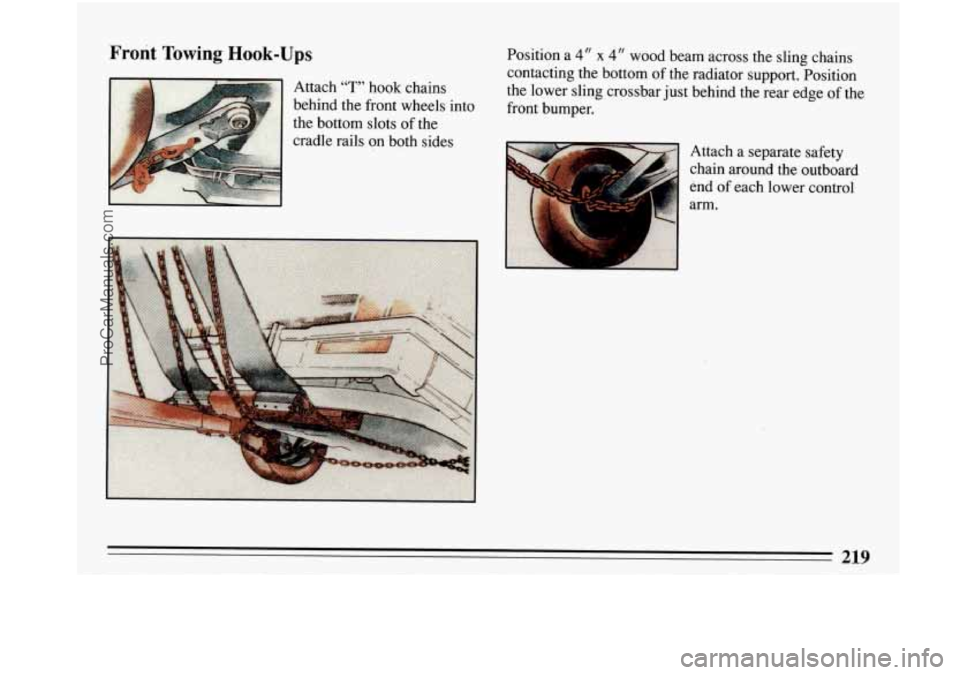
Attach "T" hook chains
behind the front wheels into
the bottom
slots of the
cradle rails on both sides Position a
4" x 4" wood beam
across the sling chains
contacting the bottom of the radiator support. Position
the lower sling crossbar just behind the rear edge of the
front bumper.
219
ProCarManuals.com
Page 222 of 340
Rear Towing Hook-Ups
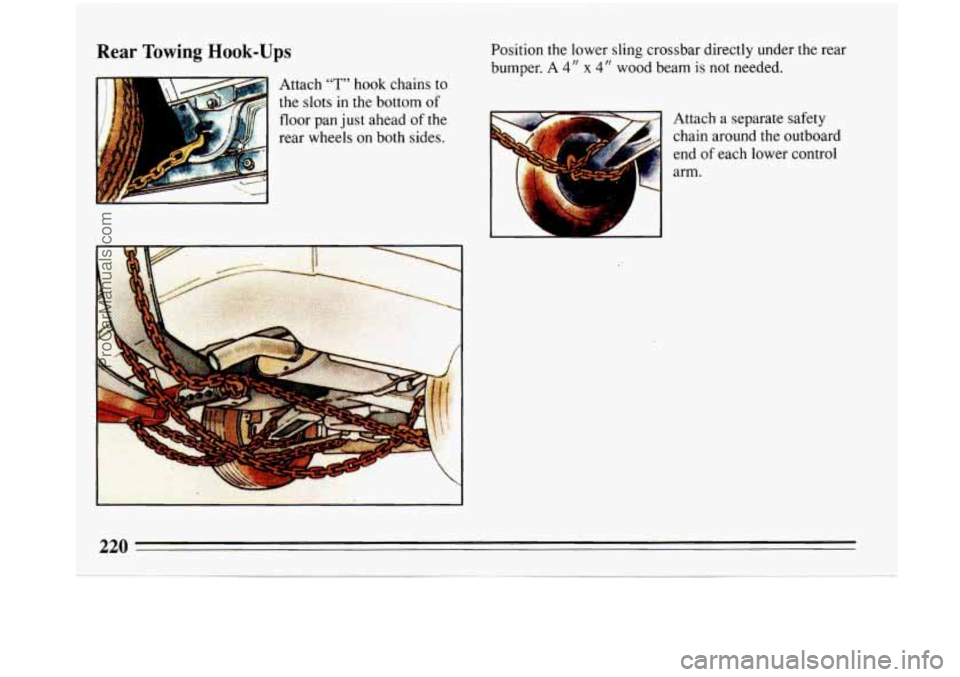
Attach '7"' hook chains to
the slots in the bottom
of
floor pan just ahead of the
rear wheels
on both sides. Position the lower sling crossbar directly under the rear
bumper. A
4" x 4" wood beam is not needed.
Attach a separate safety
chain around the outboard
end
of each lower control
arm.
220
ProCarManuals.com
Page 241 of 340
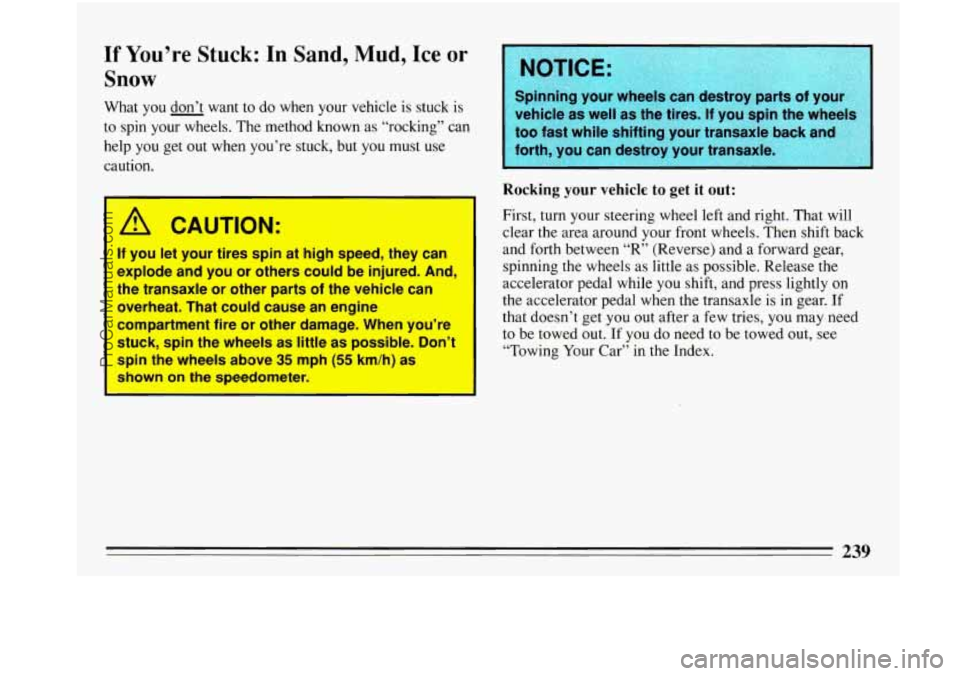
If You’re Stuck: In Sand, Mud, Ice or
Snow
What you don’t want to do when your vehicle is stuck is
to spin your wheels. The method known as “rocking” can
help
you get out when you’re stuck, but you must use
caution.
I A CAUTION:
If you let your tires spin at high speed, they can
explode and you or others could be injured. And,
the transaxle or other parts of the vehicle can
overheat. That could cause an engine
compartment fire or other damage. When you’re
stuck, spin the wheels as little as possible. Don’t
spin the wheels above
35 mph (55 km/h) as
shown
on the speedometer.
I = I
Spinning your wheels lestroy par __ of your
vehicle as well as the tires. If you spin the whe
too fast while shifting your transaxle back
forth, you can destroy your transaxle.
Rocking your vehicle to get it out:
First, turn your steering wheel left and right. That will
clear the area around your front wheels. Then shift back
and forth between
“R” (Reverse) and a forward gear,
spinning the wheels as little as possible. Release the
accelerator pedal while you shift, and press lightly on
the accelerator pedal when the transaxle is
in gear. If
that doesn’t get
you out after a few tries, you may need
to be towed out.
If you do need to be towed out, see
“Towing Your Car”
in the Index.
ProCarManuals.com
Page 300 of 340
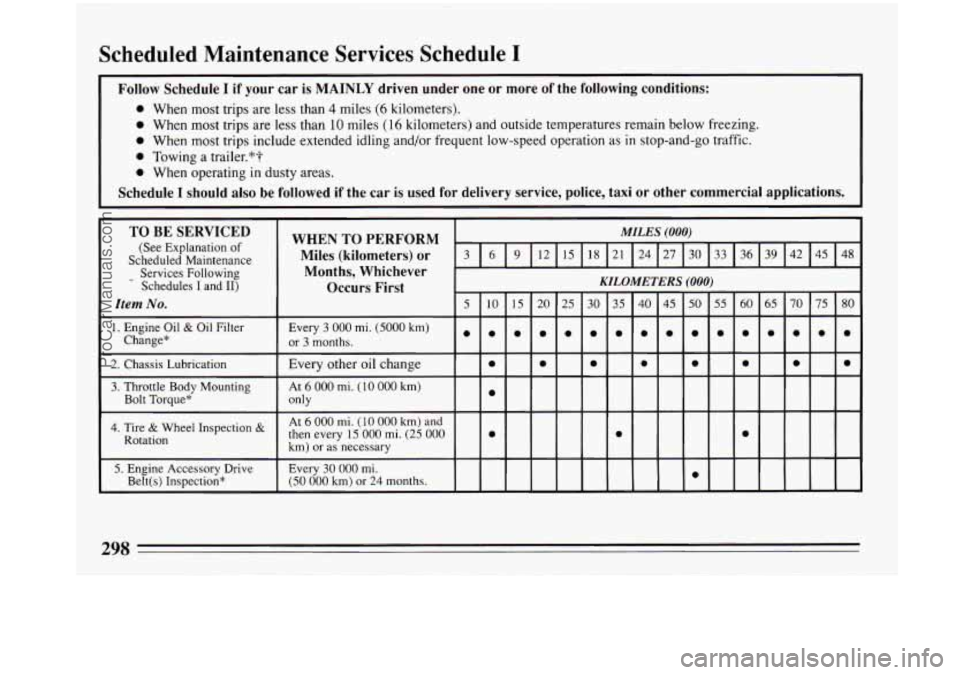
Scheduled Maintenance Services Schedule I
Follow Schedule I if your car is MAINLY driven under one or more of the following conditions:
0 When most trips are less than 4 miles (6 kilometers).
0 When most trips are less than 10 miles (16 kilometers) and outside temperatures remain below freezing.
0 When most trips include extended idling and/or frequent low-speed operation as in stop-and-go traffic.
0 Towing a trailer."?
0 When operating in dusty areas.
Schedule I should also be followed if the car is used for delivery service, police, taxi or other commercial applications.
TO BE SERVICED
(See Explanation of
Scheduled Maintenance
Services Following
- Schedules I and 11)
Item No.
1. Engine Oil & Oil Filter
Change*
2. Chassis Lubrication
3. Throttle Body Mounting
Bolt Torque*
4. Tire & Wheel Inspection &
Rotation
5. Engine Accessory Drive
Belt(s) Inspection*
ProCarManuals.com