warning light BUICK PARK AVENUE 1993 Owner's Manual
[x] Cancel search | Manufacturer: BUICK, Model Year: 1993, Model line: PARK AVENUE, Model: BUICK PARK AVENUE 1993Pages: 340, PDF Size: 18.17 MB
Page 208 of 340
the trailer lights will also flash, telling other drivers
you’re about to turn, change lanes or stop.
When towing a trailer, the green arrows
on your
instrument panel will flash for turns even
if the bulbs on
the trailer are burned out. Thus, you may think drivers
behind you are seeing your signal when they are not. It’s
important to check occasionally to be sure the trailer
bulbs are still working.
Your vehicle has bulb warning lights. When you plug
trailer lights into your vehicle’s lighting system, its bulb warning lights may not
let you know if one of your
lights goes
out. So, when you have trailer lights plugged
in, be sure
to check your vehicle and trailer lights from
time to time to be sure they’re-all working. Once
you
disconnect the trailer lights, the bulb warning lights
again can
tell you if one of your vehicle lights is out.
Driving On Grades
Reduce speed and shift to a lower gear before you start
down a long
or steep downgrade. If you don’t shift
down, you might have to use your brakes
so much that
they would get hot and no longer work well. On
a long uphill grade, shift down to
“D or 3” (Drive)
and reduce your speed to around
45 mph (70 km/h) to
reduce the possibility of engine and transaxle
overheating.
Parking on Hills
You really should not park your vehicle, with a trailer
attached,
on a hill. If something goes wrong, your rig
could start to move. People can be injured, and both
your vehicle and the trailer can be damaged.
But
if you ever have to park your rig on a hill, here’s
how to do it:
1. Apply your regular brakes, but don’t shift into “F’”
(Park) yet.
2. Have someone place chocks under the trailer wheels.
3. When the wheel chocks are in place, release the
regular brakes until the chocks absorb the load.
4. Reapply the regular brakes. Then apply your parking
brake, and
then shift to “P’ (Park).
5. Release the regular brakes.
ProCarManuals.com
Page 212 of 340
Hazard Warning Flashers
I
7 '. . ..
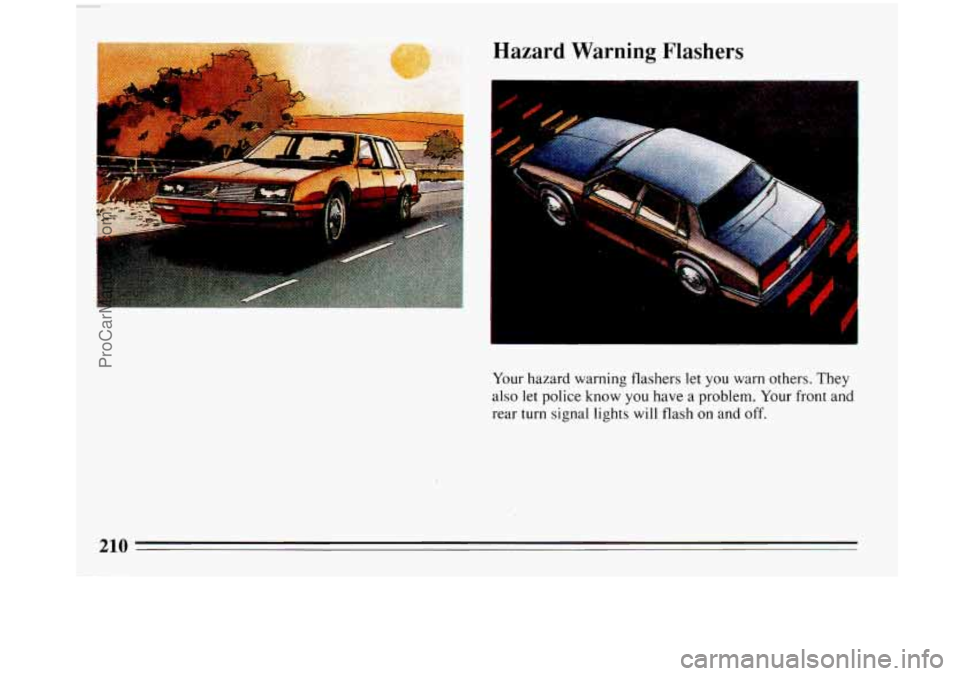
Your hazard warning flashers let you warn others. They
also let police know you have a problem. Your front and
rear turn signal lights will flash on and
off.
210
ProCarManuals.com
Page 213 of 340
, >., :,
, , . ..,
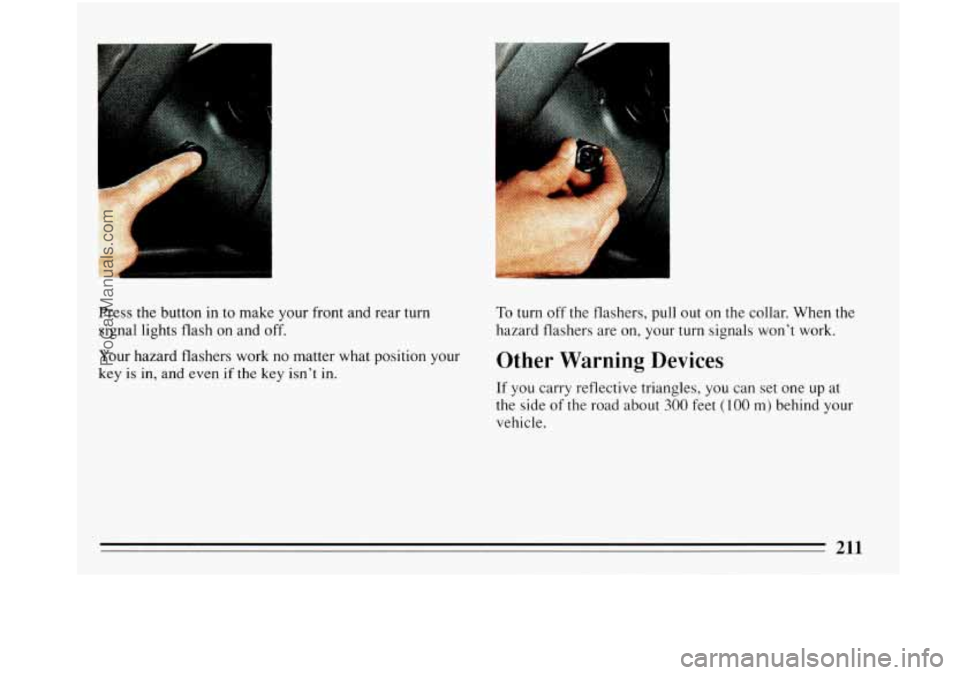
Press the button in to make your front and rear turn
signal lights flash on and off.
Your hazard flashers work no matter what position your
key is
in, and even if the key isn't in.
To turn off the flashers, pull out on the collar. When the
hazard flashers are on, your turn signals won't work.
Other Warning Devices
If you carry reflective triangles, you can set one up at
the side
of the road about 300 feet (100 m) behind your
vehicle.
211
ProCarManuals.com
Page 223 of 340
Engine Overheating
You will find the warning light about a hot engine on
your Buick instrument panel and if you have the
optional gage cluster,
a coolant temperature gage.
You will also find a low coolant warning light
on your
Buick instrument panel.
If Steam Is Coming From Your Engine:
A CAUTION:
- _earn from an overheated engine can burn you
badly, even
if you just open the hood. Stay away
from the engine
if you see or hear steam coming
.. -m it. Just turn it off and get everyone away
from the vehicle until it cools down. Wait until
there
is no sign of steam or coolant before
opening the hood.
If you keep driving when your engine is
overheated, the liquids in
it can catch fire. You or
others could be badly burned. Stop your engine
if it overheats, and get out of the vehicle until the
sngine is cool.
- -
If No Steam Is Coming From Your Engine:
If you get the overheat warning but see or hear no
steam, the problem may not be too serious. Sometimes
the engine can get a little
too hot when you:
Climb a long hill on a hot day.
Stop after high speed driving.
Idle for long periods in traffic.
Tow a trailer.
221
ProCarManuals.com
Page 239 of 340

Don’t try to put a wheel cover on your compact spare
tire.
It won’t fit. Store the wheel cover in the trunk until
you have the
flat tire repaired or replaced.
I NOTICE:
Now put all the equipment back in the trunk.
WHEEL WRENCH
A CAU I ION:
Storing a jack, a tire or other equilpment in the
passenger compartment of the vehicle could
cause injury. In a sudden stop or collision, loose
equipment cowtd strike someone. Store all these
in the proper
place.
Compact Spare Tire
Although the compact spare was fully inflated when
your vehicle was new, it can lose air after a time. Check
the inflation pressure regularly. It should be
60 psi (420
kPa). The compact spare is made to go up to 3,000 miles
(5000 km), so you can finish your trip and have your
full-size tire repaired
or replaced where you want. Of
course, it’s best to replace your spare with a full-size tire
as soon as you can. Your spare will last longer and be in
good shape
in case you need it again.
Your anti-lock brake system warning light may come on
when
you are driving with a compact spare. See
“Anti-Lock Brake System Warning Light’’ in the Index.
237
ProCarManuals.com
Page 260 of 340
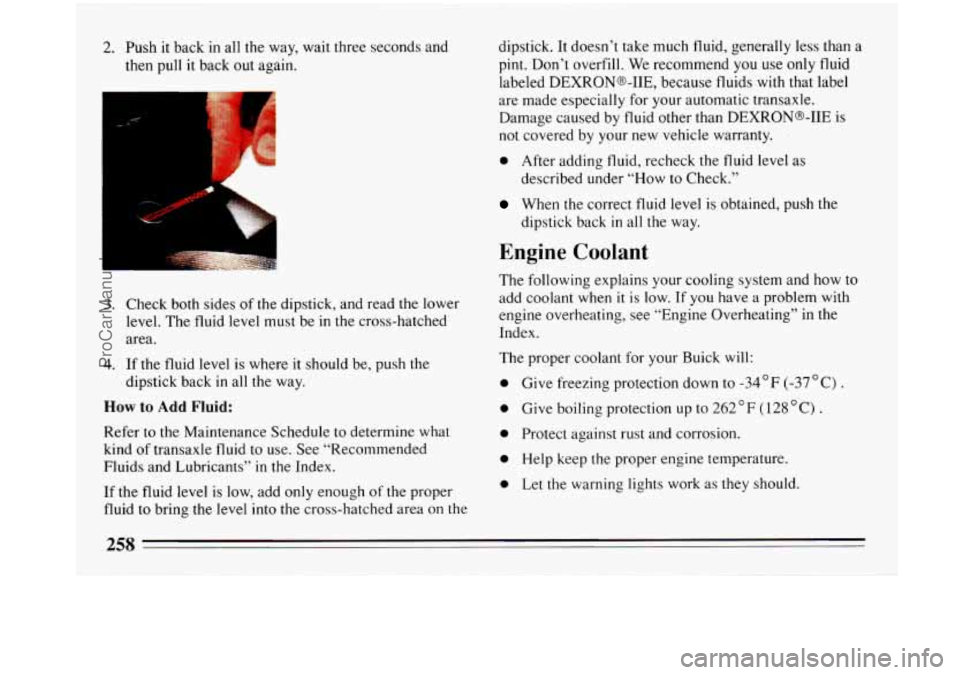
2. Push it back in all the way, wait three seconds and
then pull it back out again.
3. Check both sides of the dipstick, and read the lower
level. The fluid level must be in the cross-hatched
area.
4. If the fluid level is where it should be, push the
dipstick back
in all the way.
How to Add Fluid:
Refer to the Maintenance Schedule to determine what
kind of transaxle fluid to use. See “Recommended
Fluids and Lubricants” in the Index.
If the fluid level is low, add only enough of the proper
fluid to bring the level
into the cross-hatched area on the dipstick, It
doesn’t take much fluid, generally less than a
pint. Don’t overfill. We recommend
you use only fluid
labeled DEXRONWIE, because
fluids with that label
are made especially for your automatic transaxle.
Damage caused by fluid other than DEXRONB-IIE is
not covered by your new vehicle warranty.
0 After adding fluid, recheck the fluid level as
described under “How to Check.”
When the correct fluid level is obtained, push the
dipstick back
in all the way.
Engine Coolant
The following explains your cooling system and how to
add coolant when
it is low. If you have a problem with
engine overheating, see “Engine Overheating” in the
Index.
The proper coolant for your Buick will:
0 Give freezing protection down to -34°F (-37 “C) .
0 Give boiling protection up to 262 F ( 128 ” C) .
0 Protect against rust and corrosion.
0 Help keep the proper engine temperature.
0 Let the warning lights work as they should.
ProCarManuals.com
Page 266 of 340
that sooner or later your brakes won’t work well, or
won’t work at all.
So, it isn’t a good idea to “top off’
your brake fluid. Adding brake fluid won’t correct
a
leak. If you add fluid when your linings are worn, then
you’ll have
too much fluid when you get new brake
linings. You should add
(or remove) brake fluid, as
necessary, only when work is done
on the brake
hydraulic system.
I-
A CAUTION:
If you have too much brake fluid, it can spill on
the engine. The fluid will burn
if the engine is hot
enough. You or others could be burned, and your
vehicle could be damaged. Add brake fluid only
when work is done on the brake hydraulic
system.
When your brake fluid falls to a low level, your brake
warning light will come on and a chime will sound.
What to Add:
When you do need brake fluid, use only DOT-3 brake
fluid
-- such as Delco Supreme 11 @ (GM part
No.1052535). Use new brake fluid from a sealed
container only.
Replacing Brake System Parts
The braking system on a modern vehicle is complex. Its
many parts have to be
of top quality and work well
together if the vehicle is to have really good braking.
Vehicles we design and test have top-quality GM brake
parts in them, as your Buick does when it is new. When
you replace parts of your braking system
-- for example,
when your brake linings wear down and you have to
have new ones put
in -- be sure you get new genuine
GM replacement parts.
If you don’t, your brakes may no
longer work properly. For example,
if someone puts in
brake linings that are wrong for your vehicle, the
ProCarManuals.com
Page 293 of 340
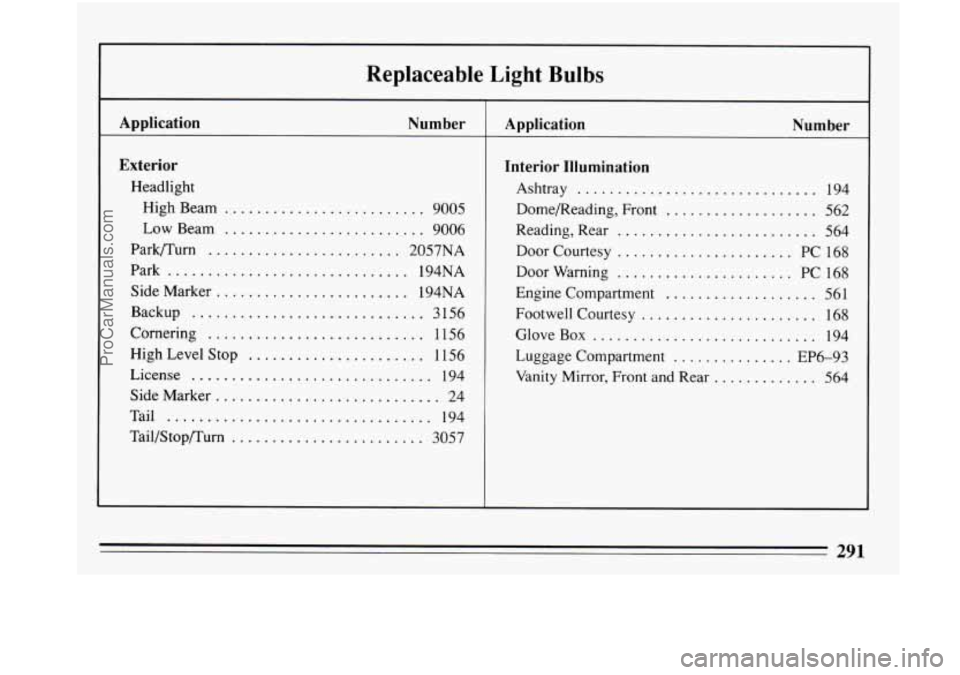
Replaceable Light Bulbs
Application Number
Exterior
Headlight High Beam
......................... 9005
Low Beam
......................... 9006
Park/Turn
........................ 2057NA
Park
.............................. 194NA
Side Marker
........................ 194NA
Backup
............................. 3156
Cornering
........................... 1156
High Level Stop
...................... 1156
License
.............................. 194
Side Marker
............................ 24
Tail
................................. 194
Tail/Stop/Turn
........................ 3057
Application Number
Interior Illumination
Ashtray .............................. 194
Dome/Reading. Front
................... 562
Reading. Rear
......................... 564
Door Courtesy
...................... PC 168
Door Warning
...................... PC 168
Engine Compartment
................... 561
Footwell Courtesy
...................... 168
GloveBox
............................ 194
Luggage Compartment
............... EP6-93
Vanity Mirror. Front and Rear
............. 564
ProCarManuals.com
Page 311 of 340
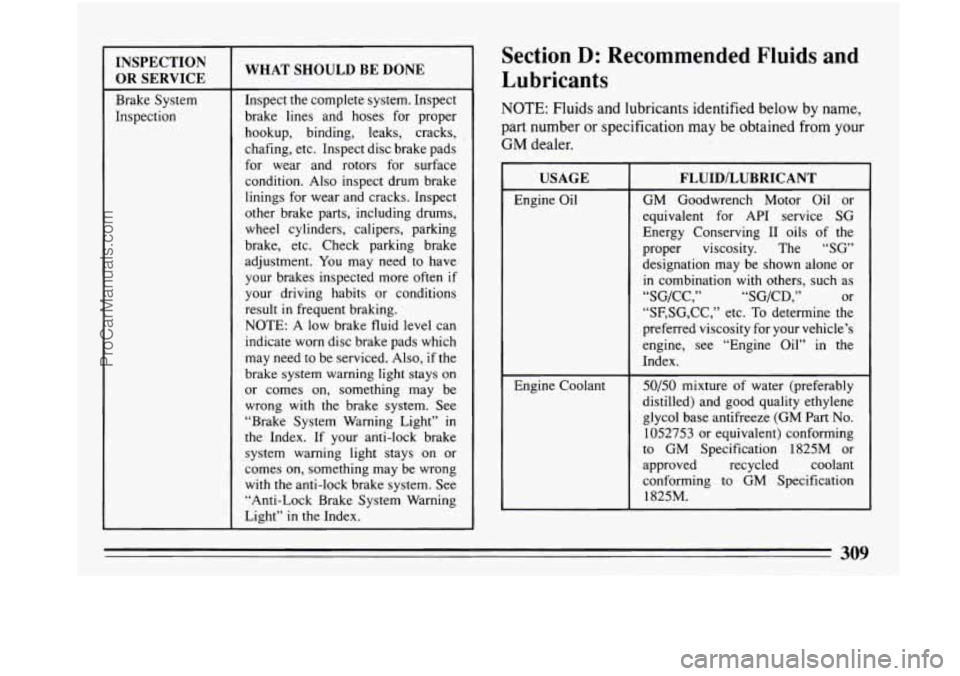
INSPECTION
OR SERVICE
Brake System
Inspection
WHAT SHOULD BE DONE
Inspect the complete system. Inspect
brake lines and hoses for proper
hookup, binding, leaks, cracks, chafing, etc. Inspect disc brake pads
for wear and rotors for surface
condition. Also inspect drum brake
linings for wear and cracks. Inspect
other brake parts, including drums,
wheel cylinders, calipers, parking
brake, etc. Check parking brake
adjustment.
You may need to have
your brakes inspected more often
if
your driving habits or conditions
result
in frequent braking.
NOTE: A low brake fluid level can
indicate worn disc brake pads which
may need
to be serviced. Also, if the
brake system warning light stays on
or comes
on, something may be
wrong with
the brake system. See
“Brake System Warning Light”
in
the Index. If your anti-lock brake
system warning light stays on or
comes on, something may be wrong
with
the anti-lock brake system. See
“Anti-Lock Brake System Warning
Light”
in the Index.
Section D: Recommended Fluids and
Lubricants
NOTE: Fluids and lubricants identified below by name,
part number or specification may be obtained from your
GM dealer.
USAGE
Engine Oil
Engine Coolant
FLUID/LUBRICANT
GM Goodwrench Motor Oil or
equivalent for API service SG
Energy Conserving I1 oils of the
proper viscosity. The
“SG”
designation may be shown alone or
in combination with others, such as
“SG/CC,” “SG/CD,”
or
“SF,SG,CC,” etc. To determine the
preferred viscosity for your vehicle’s
engine, see “Engine Oil” in the
Index.
50/50 mixture of water (preferably
distilled) and good quality ethylene
glycol base antifreeze (GM
Part No.
1052753 or equivalent) conforming
to GM Specification 1825M or
approved recycled coolant
conforming to GM Specification
1825M.
ProCarManuals.com
Page 323 of 340
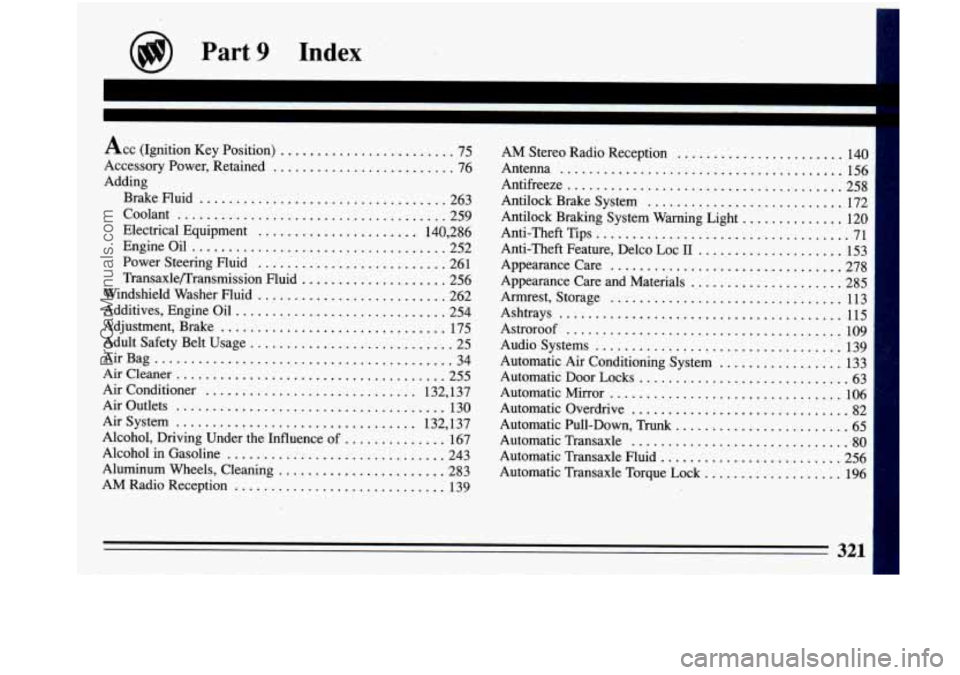
Part 9 Index
.
Ace (Ignition Key Position) ........................ 75
Accessory Power. Retained
......................... 76
Adding
Brake Fluid
.................................. 263
Coolant
..................................... 259
Electrical Equipment
...................... 140, 286
Engineoil
................................... 252
Power Steering Fluid
.......................... 261
Transaxle/Transmission Fluid
.................... 256
Windshield Washer Fluid
........................... 262
Additives, Engine Oil
............................. 254
Adjustment, Brake
............................... 175
Adult Safety Belt Usage
............................. 25
AirBag
.......................................... 34
Aircleaner
..................................... 255
Air Conditioner ............................. 132, 137
Air Outlets ..................................... 130
Air System
................................. 132, 137
Alcohol, Driving Under the Influence of
.............. 167
Alcohol
in Gasoline .............................. 243
Aluminum Wheels, Cleaning
....................... 283
AM Radio Reception ............................. 139 AM
Stereo Radio Reception
......................... 140
Antenna
....................................... 156
Antifreeze
...................................... 258
Antilock Brake System ........................... 172
Antilock Braking System Warning Light
.............. 120
Anti-TheftTips
................................... 71
Anti-Theft Feature, Delco LOC I1
.................... 153
Appearance Care
.................................. 278
Appearance Care and Materials
..................... 285
Armrest, Storage
................................ 113
Ashtrays
.. : ...................................... 115
Astroroof
...................................... 109
Audio Systems
.................................. 139
Automatic Air Conditioning System
................. 133
Automatic Door Locks
............................. 63
Automatic Mirror
................................ 106
Automatic Overdrive
.............................. 82
Automatic Pull-Down, Trunk
........................ 65
Automatic Transaxle
.............................. 80 I
Automatic Transaxle Fluid ......................... 256
Automatic Transaxle Torque Lock
................... 196
321
ProCarManuals.com