wheel BUICK PARK AVENUE 1993 Workshop Manual
[x] Cancel search | Manufacturer: BUICK, Model Year: 1993, Model line: PARK AVENUE, Model: BUICK PARK AVENUE 1993Pages: 340, PDF Size: 18.17 MB
Page 277 of 340
1/2) times as well on the government course as a tire
graded
100. The relative performance of tires depends
upon the actual conditions
of their use, however, and
may depart significantly from the norm due to variations
in driving habits, service practices and differences in
road characteristics and climate.
Traction - A, B, C
The traction grades, from highest to lowest are: A, B,
and C. They represent the tire’s ability to stop on wet
pavement as measured under controlled conditions
on
specified government test surfaces of asphalt and
concrete.
A tire marked C may have poor traction
performance.
Warning: The traction grade assigned to this tire is based
on braking (straight-ahead) traction tests and does not
include cornering (turning) traction.
Temperature - A, B, C
The temperature grades are A (the highest), B, and C,
representing the tire’s resistance to the generation of
heat and its ability
to dissipate heat when tested under
controlled conditions
on a specified indoor laboratory
test wheel. Sustained high temperature can cause the
material of the tire to degenerate and reduce tire
life, and
excessive temperature can lead to sudden tire failure. The grade
C corresponds to a
level of performance
which all passenger car tires must meet under the
Federal Motor Vehicle Safety Standard
No. 109. Grades
B and A represent higher levels of performance on the
laboratory test wheel than the minimum required by law.
Warning: The temperature grade for this tire is
established for a tire that is properly inflated and not
overloaded. Excessive speed, underinflation, or
excessive loading, either separately or in combination,
can cause heat buildup and possible tire failure.
Those grades are molded on the sidewalls
of passenger
car tires.
While the tires available as standard or optional
equipment on General Motors vehicles may vary with
respect to these grades, all such tires meet General
Motors performance standards and have been approved
for use on General Motors vehicles. All passenger type
(P Metric) tires must conform to Federal safety
requirements
in addition to these grades.
Wheel Alignment and Tire Balance
The wheels on your vehicle were aligned and balanced
carefully at the factory to give you the longest tire life
and best overall performance.
275
ProCarManuals.com
Page 278 of 340
In most cases, you will not need to have your wheels
aligned again. However, if
you notice unusual tire wear
or your vehicle pulling one way or the other, the
alignment may need to be reset.
If you notice your
vehicle vibrating when driving on a smooth road, your
wheels may need to be rebalanced.
Wheel Replacement
Replace any wheel that is bent, cracked or badly rusted.
If wheel nuts keep coming loose, the wheel, wheel bolts,
and wheel nuts should be replaced.
If the wheel leaks air
out, replace it (except some aluminum wheels, which
can sometimes be repaired). See your Buick dealer if
any
of these conditions exist.
Your dealer will know the kind
of wheel you need.
Each new wheel should have the same load carrying
capacity, diameter, width, offset, and be mounted
the
same way as the one it replaces.
If
you need to replace any of your wheels, wheel bolts,
or wheel nuts, replace them
only with new GM original
equipment parts. This way, you will be sure
to have the
right wheel, wheel bolts, and wheel nuts for your Buick
model.
A CAUTION:
Using the wrong replacement wheels, wheel
bolts, or wheel nuts on your vehicle can be
rngerous. It could affect the braking and
.. ~ndling of your vehicle, make your tires lose air
and make you lose control. You could have a
collision
in which you or others could be injured.
- ..ways use the correct wheel, wheel bolts, ~ d
I wheel nuts
for replacement.
I
1: NOTICE:
The wrong wheel can atso cause Droblems with
bearing life, brake cooling,
speedometer/odometer calibration, headllgb,,
aim, bumper height, vehicle ground clearance
and tire or tire chain clearance to the body an(
chassis.
ProCarManuals.com
Page 279 of 340
i
teplacement WFpels Tire Chains
I
/11 CAUTION:
Putting a used wheel on your vehicle is
dangerous. You can’t know how it’s been use#-. Jr
how many miles it’s been driven. It could fail
suddenly and cause an accident.
If you t--- re to
replace a wheel use anew
GM original
equipment wheel.
I
277
ProCarManuals.com
Page 285 of 340
Aluminum Wheels (If So Equipped)
Your aluminum wheels have a protective coating similar
to the painted surface
of your car. Don’t use strong
soaps, chemicals, chrome polish, or other abrasive
cleaners on them because
you could damage this
coating. After rinsing thoroughly, a wax may be applied.
I NOTICE:
If you have aluminum wheels, don’t use an
automatic vehicle wash that has hard silicon
carbide cleaning brushes. These brushes can
take
off the protective coating.
White Sidewall Tires
Your Buick dealer has a GM White Sidewall Tire
Cleaner. You can use a stiff brush with
it.
Weatherstrips
These are places where glass or metal meets rubber.
Silicone grease there will make them last longer, seal
better, and not stick or squeak. Apply silicone grease
with a clean cloth at least every six months.
Sheet Metal Damage
If your vehicle is damaged and requires sheet metal
repair or replacement, make sure the body repair shop
applies anti-corrosion material to the parts repaired or
replaced to restore corrosion protection.
Foreign Material
Calcium chloride and other salts, ice melting agents,
road oil and tar, tree sap, bird droppings, chemicals from
industrial chimneys, and other foreign matter can
damage your vehicle’s finish if they remain on painted
surfaces.
Use cleaners that are marked safe for painted
surfaces for these stains.
Finish Damage
Any stone chips, fractures or deep scratches in the finish
should be repaired right away. Bare metal will corrode
quickly and may develop into a major repair expense.
Minor chips and scratches can be repaired with touch-up
materials available from your dealer or other service
outlets. Larger areas of finish damage can be corrected
in your dealer’s body and paint shop.
ProCarManuals.com
Page 292 of 340
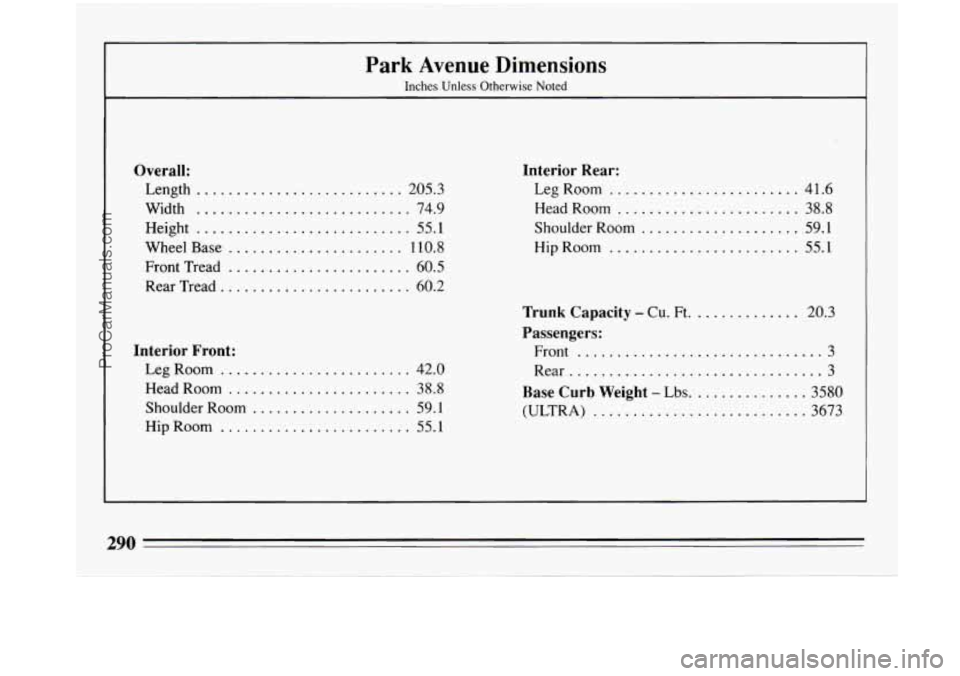
Park Avenue Dimensions
Inches Unless Otherwise Noted
Overall:
Length .......................... 205.3
Width
........................... 74.9
Height
........................... 55.1
Wheel Base
...................... 110.8
Front Tread
....................... 60.5
Rear Tread
........................ 60.2
Interior Front:
Leg Room ........................ 42.0
Head Room
....................... 38.8
Shoulder Room .................... 59.1
Hip Room ........................ 55.1
Interior Rear:
Leg Room ........................ 41.6
Head Room
....................... 38.8
Shoulder Room
.................... 59.1
Hip Room ........................ 55.1
Trunk Capacity . Cu . Ft .............. 20.3
Passengers:
Front ............................... 3
Rear ................................ 3
Base Curb Weight . Lbs ............... 3580
(ULTRA)
........................... 3673
ProCarManuals.com
Page 300 of 340
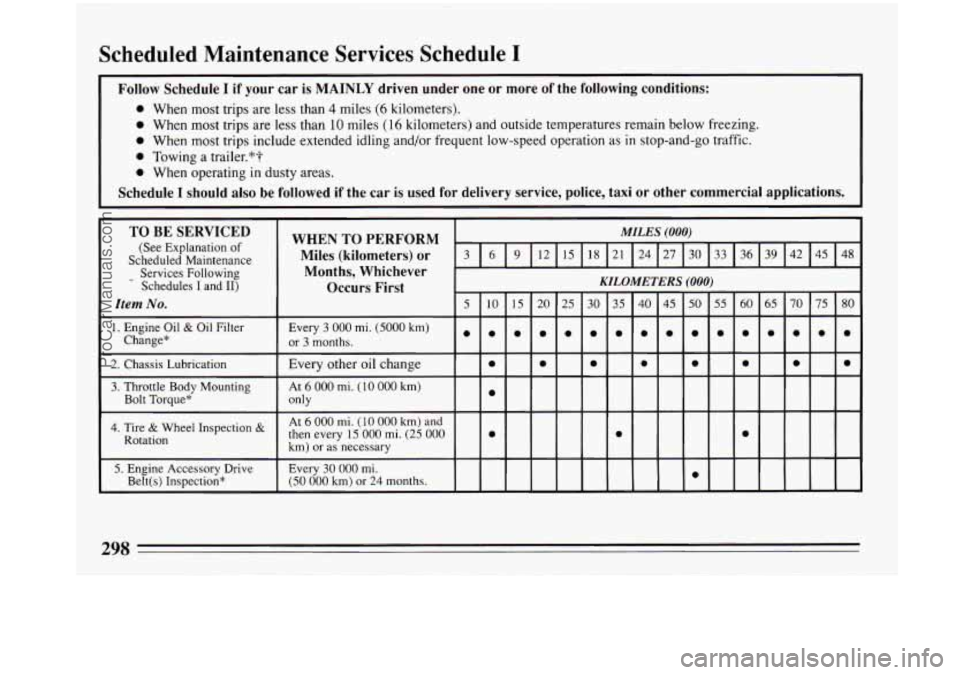
Scheduled Maintenance Services Schedule I
Follow Schedule I if your car is MAINLY driven under one or more of the following conditions:
0 When most trips are less than 4 miles (6 kilometers).
0 When most trips are less than 10 miles (16 kilometers) and outside temperatures remain below freezing.
0 When most trips include extended idling and/or frequent low-speed operation as in stop-and-go traffic.
0 Towing a trailer."?
0 When operating in dusty areas.
Schedule I should also be followed if the car is used for delivery service, police, taxi or other commercial applications.
TO BE SERVICED
(See Explanation of
Scheduled Maintenance
Services Following
- Schedules I and 11)
Item No.
1. Engine Oil & Oil Filter
Change*
2. Chassis Lubrication
3. Throttle Body Mounting
Bolt Torque*
4. Tire & Wheel Inspection &
Rotation
5. Engine Accessory Drive
Belt(s) Inspection*
ProCarManuals.com
Page 302 of 340
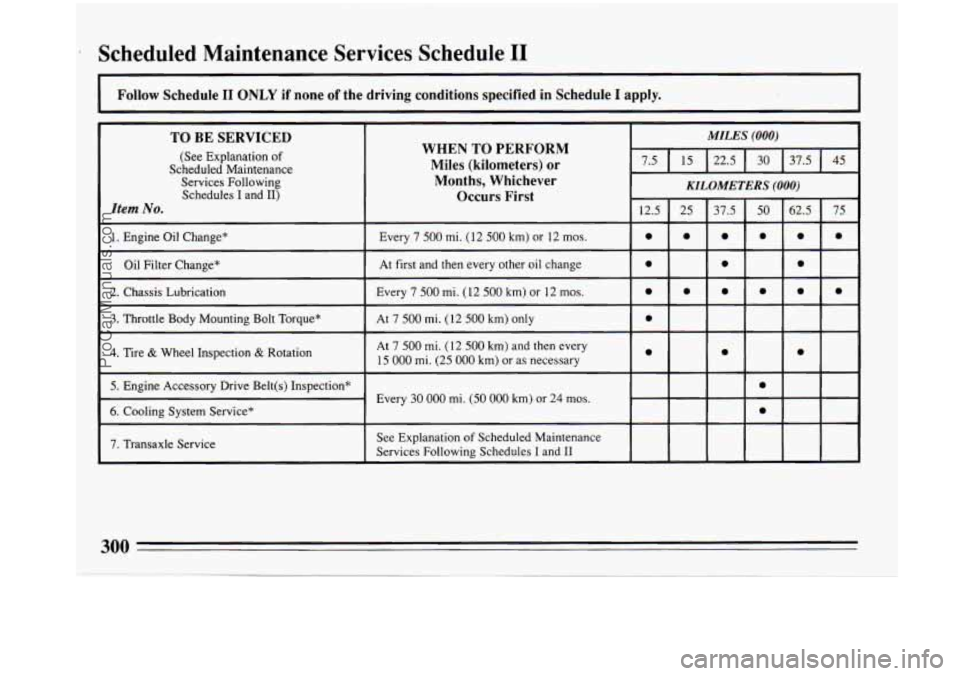
5 Scheduled Maintenance Services Schedule I1
~~
-11 ONLY if none of the driving conditions specified in Schedule I apply.
TO BE SERVICED
(See Explanation of
Scheduled Maintenance Services Following
Schedules
I and 11)
Item No.
1. Engine Oil Change*
Oil Filter Change*
2. Chassis Lubrication
3. Throttle Body Mounting Bolt Torque*
4. Tire & Wheel Inspection & Rotation
5. Engine Accessory Drive Belt(s) Inspection*
6. Cooling System Service*
7. Transaxle Service
WHEN TO PERFORM
Miles (kilometers) or
Months, Whichever
Occurs First
Every 7 500 mi. (12 500 km) or 12 mos.
At first and then every other oil change
Every
7 500 mi. ( 12 500 km) or 12 mos.
At
7 500 mi. (12 500 km) only
At
7 500 mi. (12 500 km) and then every
15
000 mi. (25 000 km) or as necessary
Every
30 000 mi. (50 000 km) or 24 mos.
See Explanation
of Scheduled Maintenance
Services Following Schedules
I and I1
MILES (000)
KILOMETERS (000)
25
.I.
I
62.5 75
0 0
0
0 0
0
ProCarManuals.com
Page 304 of 340
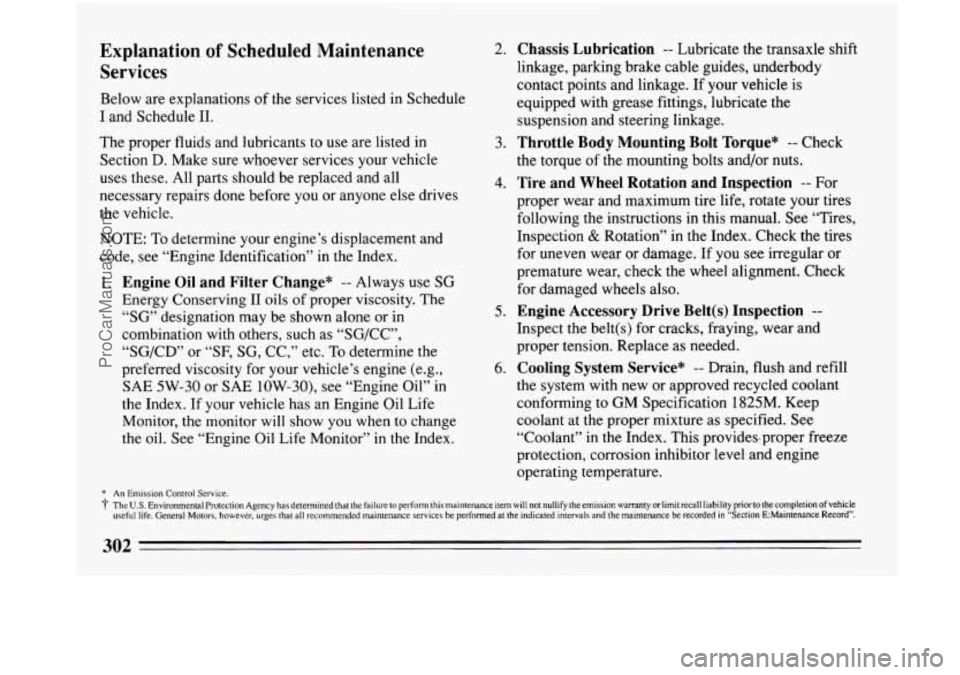
Explanation of Scheduled Maintenance
Services
Below are explanations of the services listed in Schedule
I and Schedule
11.
The proper fluids and lubricants to use are listed in
Section
D. Make sure whoever services your vehicle
uses these. All parts should be replaced and all
necessary repairs done before you or anyone else drives
the vehicle.
NOTE: To determine your engine’s displacement and
code, see “Engine Identification” in the Index.
1. Engine Oil and Filter Change* -- Always use SG
Energy Conserving I1 oils of proper viscosity. The
“SG” designation may be shown alone or in
combination with others, such as “SG/CC”,
“SG/CD” or
“SF, SG, CC,” etc. To determine the
preferred viscosity for your vehicle’s engine (e.g.,
SAE
5W-30 or SAE 10W-30), see “Engine Oil” in
the Index. If your vehicle has an Engine
Oil Life
Monitor,
the monitor will show you when to change
the oil. See “Engine Oil Life Monitor” in the Index.
* An Emission Control Service.
2.
3.
4.
5.
6.
Chassis Lubrication -- Lubricate the transaxle shift
linkage, parking brake cable guides, underbody
contact points and linkage. If your vehicle is
equipped with grease fittings, lubricate the
suspension and steering linkage.
Throttle Body Mounting Bolt Torque” -- Check
the torque
of the mounting bolts and/or nuts.
Tire and Wheel Rotation and Inspection -- For
proper wear and maximum tire life, rotate your tires
following the instructions in this manual. See “Tires,
Inspection
& Rotation” in the Index. Check the tires
for uneven wear or damage. If you see irregular or
premature wear, check the wheel alignment. Check
for damaged wheels also.
Engine Accessory Drive Belt(s) Inspection --
Inspect the belt(s) for cracks, fraying, wear and
proper tension. Replace as needed.
Cooling System Service* -- Drain, flush and refill
the system with new or approved recycled coolant
conforming to GM Specification
1825M. Keep
coolant at the proper mixture
as specified. See
“Coolant” in the Index. This provides.proper freeze
protection, corrosion inhibitor level and engine
operating temperature.
The U.S. Environmental Protection Agency has determined that the failure to perform this maintenance item will not nullify the emission warranty or limit recall liability prior to the completion of vehicle
useful life. General Motors, however, urges that all recommended maintenance services be performed at the indicated intervals and the maintenance be recorded in “Section E:Maintenance Record”.
302
ProCarManuals.com
Page 310 of 340
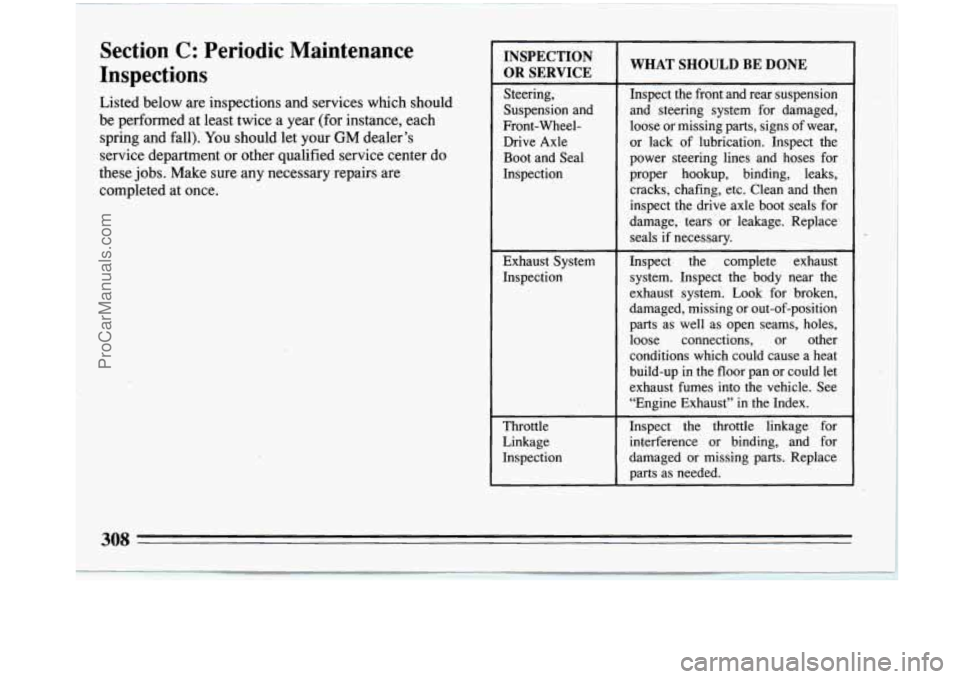
Section C: Periodic Maintenance
Inspections
Listed below are inspections and services which should
be performed at least twice a year (for instance, each
spring and fall). You should let your
GM dealer’s
service department or other qualified service center do
these
jobs. Make sure any necessary repairs are
completed at once.
INSPECTION
OR SERVICE
Steering,
Suspension and
Front-Wheel-
Drive Axle
Boot and Seal
Inspection
Exhaust System
Inspection
Throttle Linkage
Inspection
WHAT SHOULD BE DONE
Inspect the front and rear suspension
and steering system for damaged,
loose or missing parts, signs of wear,
or lack of lubrication. Inspect the
power steering lines and hoses for
proper hookup, binding, leaks,
cracks, chafing, etc. Clean and then
inspect the drive axle boot seals for
damage, tears or leakage. Replace-
seals if necessary.
Inspect the complete exhaust
system. Inspect the body near the
exhaust system. Look for broken,
damaged, missing or out-of-position
parts as well as open seams, holes,
loose connections, or other
conditions which could cause a heat
build-up in the floor pan or could let
exhaust fumes into the vehicle. See
“Engine Exhaust” in the Index.
Inspect the throttle linkage for
interference
or binding, and for
damaged
or missing parts. Replace
parts as needed.
308
ProCarManuals.com
Page 311 of 340
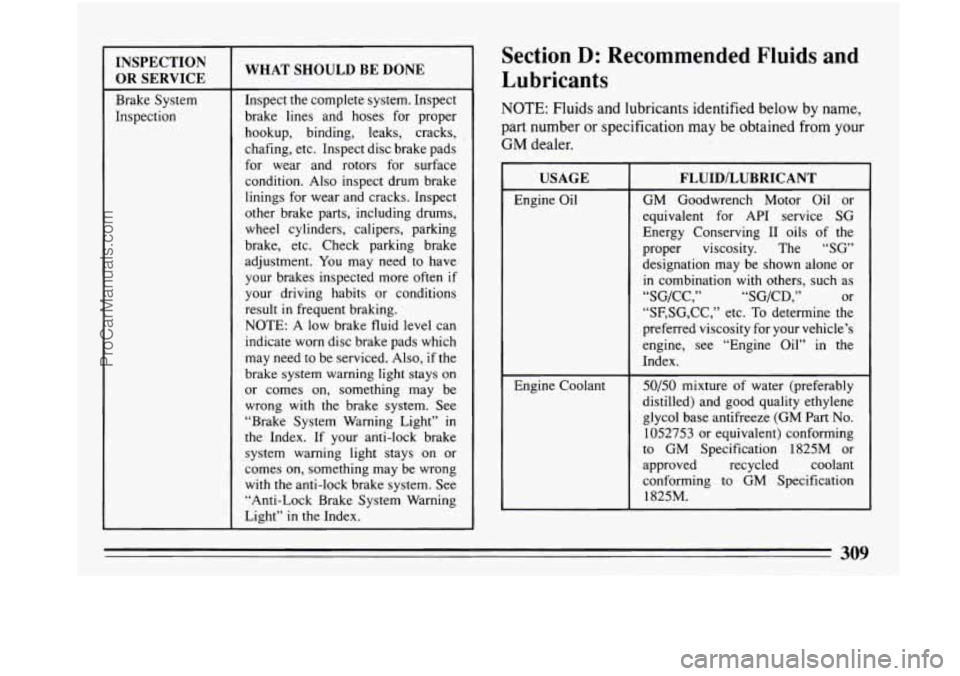
INSPECTION
OR SERVICE
Brake System
Inspection
WHAT SHOULD BE DONE
Inspect the complete system. Inspect
brake lines and hoses for proper
hookup, binding, leaks, cracks, chafing, etc. Inspect disc brake pads
for wear and rotors for surface
condition. Also inspect drum brake
linings for wear and cracks. Inspect
other brake parts, including drums,
wheel cylinders, calipers, parking
brake, etc. Check parking brake
adjustment.
You may need to have
your brakes inspected more often
if
your driving habits or conditions
result
in frequent braking.
NOTE: A low brake fluid level can
indicate worn disc brake pads which
may need
to be serviced. Also, if the
brake system warning light stays on
or comes
on, something may be
wrong with
the brake system. See
“Brake System Warning Light”
in
the Index. If your anti-lock brake
system warning light stays on or
comes on, something may be wrong
with
the anti-lock brake system. See
“Anti-Lock Brake System Warning
Light”
in the Index.
Section D: Recommended Fluids and
Lubricants
NOTE: Fluids and lubricants identified below by name,
part number or specification may be obtained from your
GM dealer.
USAGE
Engine Oil
Engine Coolant
FLUID/LUBRICANT
GM Goodwrench Motor Oil or
equivalent for API service SG
Energy Conserving I1 oils of the
proper viscosity. The
“SG”
designation may be shown alone or
in combination with others, such as
“SG/CC,” “SG/CD,”
or
“SF,SG,CC,” etc. To determine the
preferred viscosity for your vehicle’s
engine, see “Engine Oil” in the
Index.
50/50 mixture of water (preferably
distilled) and good quality ethylene
glycol base antifreeze (GM
Part No.
1052753 or equivalent) conforming
to GM Specification 1825M or
approved recycled coolant
conforming to GM Specification
1825M.
ProCarManuals.com