light BUICK PARK AVENUE 1993 Manual Online
[x] Cancel search | Manufacturer: BUICK, Model Year: 1993, Model line: PARK AVENUE, Model: BUICK PARK AVENUE 1993Pages: 340, PDF Size: 18.17 MB
Page 260 of 340
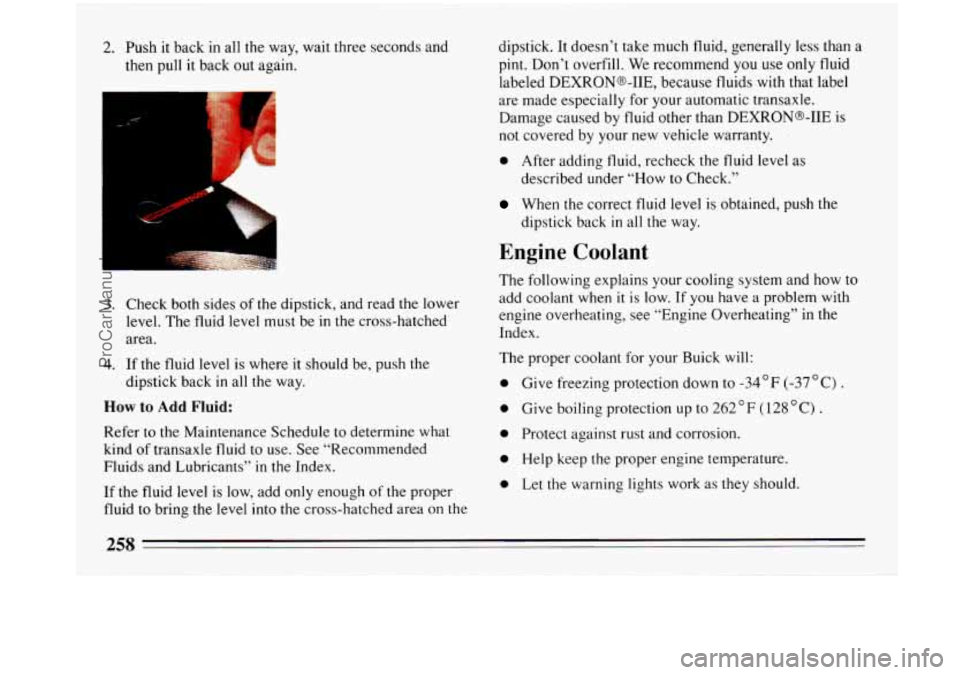
2. Push it back in all the way, wait three seconds and
then pull it back out again.
3. Check both sides of the dipstick, and read the lower
level. The fluid level must be in the cross-hatched
area.
4. If the fluid level is where it should be, push the
dipstick back
in all the way.
How to Add Fluid:
Refer to the Maintenance Schedule to determine what
kind of transaxle fluid to use. See “Recommended
Fluids and Lubricants” in the Index.
If the fluid level is low, add only enough of the proper
fluid to bring the level
into the cross-hatched area on the dipstick, It
doesn’t take much fluid, generally less than a
pint. Don’t overfill. We recommend
you use only fluid
labeled DEXRONWIE, because
fluids with that label
are made especially for your automatic transaxle.
Damage caused by fluid other than DEXRONB-IIE is
not covered by your new vehicle warranty.
0 After adding fluid, recheck the fluid level as
described under “How to Check.”
When the correct fluid level is obtained, push the
dipstick back
in all the way.
Engine Coolant
The following explains your cooling system and how to
add coolant when
it is low. If you have a problem with
engine overheating, see “Engine Overheating” in the
Index.
The proper coolant for your Buick will:
0 Give freezing protection down to -34°F (-37 “C) .
0 Give boiling protection up to 262 F ( 128 ” C) .
0 Protect against rust and corrosion.
0 Help keep the proper engine temperature.
0 Let the warning lights work as they should.
ProCarManuals.com
Page 262 of 340
To Check Coolant: When your engine is cold, the
coolant level should be at
“FULL COLD,” or a little
higher. When your engine is warm, the level should be
up to
“FULL HOT,” or a little higher.
If this light comes
on, it means you’re low on engine
coolant.
To Add Coolant: If you need more coolant, add the
proper mix at the coolant recovery .tank.
‘ CAUTION:
T‘urning the radiator pressure cap when the
engine and radiator are hot can allow steam and
scalding liquids to blow out and burn you badly.
With the coolant recovery tank, you will almost
never have to add coolant at the radiator. Never
turn the radiator pressure cap -- even a little -
#hen the engine and radiator are hot.
I
Add coolant mix at the recovery tank, but be careful not
to spill it.
A CAUTION:
You can be burned if you spill coolant on hot
engine parts. Coolant contains ethylene glycol,
and it will burn
if the engine parts are hot
enough. Don’t spill coolant on a hot engine.
ProCarManuals.com
Page 266 of 340
that sooner or later your brakes won’t work well, or
won’t work at all.
So, it isn’t a good idea to “top off’
your brake fluid. Adding brake fluid won’t correct
a
leak. If you add fluid when your linings are worn, then
you’ll have
too much fluid when you get new brake
linings. You should add
(or remove) brake fluid, as
necessary, only when work is done
on the brake
hydraulic system.
I-
A CAUTION:
If you have too much brake fluid, it can spill on
the engine. The fluid will burn
if the engine is hot
enough. You or others could be burned, and your
vehicle could be damaged. Add brake fluid only
when work is done on the brake hydraulic
system.
When your brake fluid falls to a low level, your brake
warning light will come on and a chime will sound.
What to Add:
When you do need brake fluid, use only DOT-3 brake
fluid
-- such as Delco Supreme 11 @ (GM part
No.1052535). Use new brake fluid from a sealed
container only.
Replacing Brake System Parts
The braking system on a modern vehicle is complex. Its
many parts have to be
of top quality and work well
together if the vehicle is to have really good braking.
Vehicles we design and test have top-quality GM brake
parts in them, as your Buick does when it is new. When
you replace parts of your braking system
-- for example,
when your brake linings wear down and you have to
have new ones put
in -- be sure you get new genuine
GM replacement parts.
If you don’t, your brakes may no
longer work properly. For example,
if someone puts in
brake linings that are wrong for your vehicle, the
ProCarManuals.com
Page 270 of 340
1
Loading Your Vehicle
The taillamp, sidemarker and back-up lights can now be
accessed. Two of the taillamp bulbs are on a tabbed
assembly. Squeeze the release in and pull the assembly
out. Pull the bulb straight out from the socket. To
replace the assembly, the tabs must be inserted into the
slots. Push the other end in until it locks into place.
To replace the third taillamp bulb and sidemarker bulb,
turn the socket
1/4 turn and pull it out. Pull the bulb
straight out from the socket.
The backup bulb can be replaced by squeezing the lock
on the socket, turning it
l/4 turn and pulling it out. Pull
the bulb straight out. Reverse the above steps
to
reassemble the light and the trunk trim.
Tm OCCUPANTS
VEHICLE CAP. WT.
TIRE-LOADING INFORMATION
FRT. CTR.
RR. TOTAL LBS.
.~ ~~ . . ~
KG-
MAX. LOADING
& GVWR SAME AS VEHICLE
CAPACITY WEIGHT XXX COLD TIRE
TIRE SIZE SPEED PRESSURE RTG PSVKPa
FRT.
RR.
SPA.
IF TIRES ARE HOT, ADD 4PSV28KPa
SEE OWNER'S MANUAL FOR ADDITIONAL
INFORMATION
ll]m\:l .$$;;r#, : M
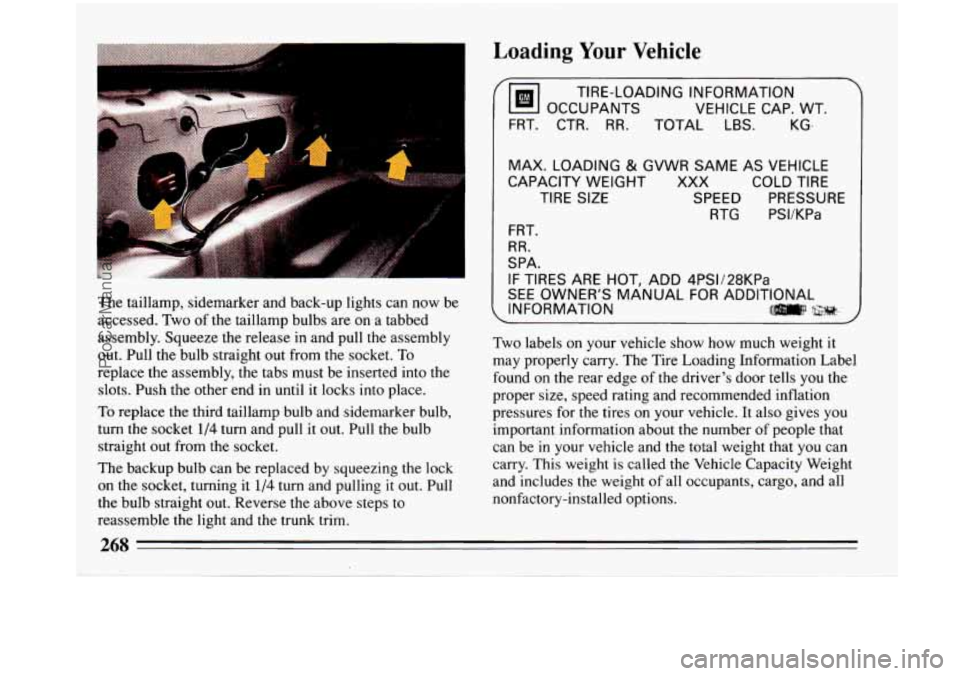
Two labels on your vehicle show how much weight it
may properly carry. The Tire Loading Information Label
found on the rear edge of the driver's door tells you the
proper size, speed rating and recommended inflation
pressures for the tires
on your vehicle. It also gives you
important information about the number
of people that
can be in your vehicle and the total weight that you can
carry. This weight
is called the Vehicle Capacity Weight
and includes the weight of all occupants, cargo, and all
nonfactory-installed options.
268
ProCarManuals.com
Page 281 of 340
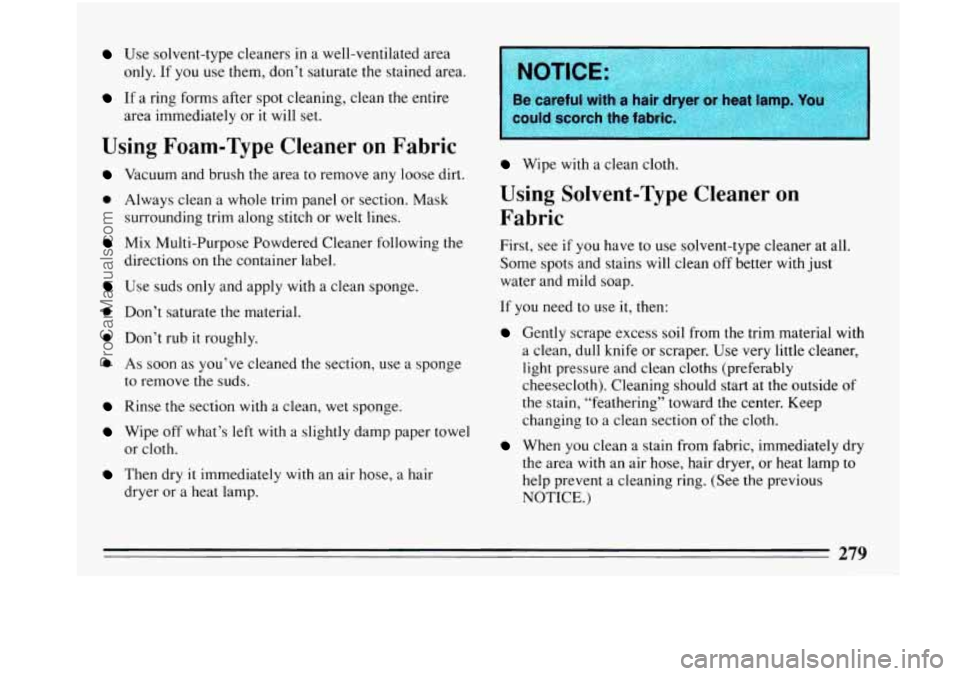
Use solvent-type cleaners in a well-ventilated area
If a ring forms after spot cleaning, clean the entire
only.
If you use them, don’t saturate the stained area.
area immediately or
it will set.
Using Foam-Type Cleaner on Fabric
Vacuum and brush the area to remove any loose dirt.
0 Always clean a whole trim panel or section. Mask
Mix Multi-Purpose Powdered Cleaner following the
Use suds only and apply with a clean sponge.
surrounding
trim along stitch or welt lines.
directions on the container label.
0 Don’t saturate the material.
0 Don’t rub it roughly.
0 As soon as you’ve cleaned the section, use a sponge
to remove
the suds.
Rinse the section with a clean, wet sponge.
Wipe off what’s left with a slightly damp paper towel
or cloth.
Then dry it immediately with an air hose, a hair
dryer or a heat lamp.
e careful with a hair dry
Wipe with a clean cloth.
Using Solvent-Type Cleaner on
Fabric
First, see if you have to use solvent-type cleaner at all.
Some spots and stains will clean
off better with just
water and mild soap.
If you need to use it, then:
Gently scrape excess soil from the trim material with
a clean, dull knife or scraper. Use very little cleaner,
light pressure and clean cloths (preferably
cheesecloth). Cleaning should start at
the outside of
the stain, “feathering” toward the center. Keep
changing
to a clean section of the cloth,
the area with an air hose, hair dryer, or heat lamp to
help prevent a cleaning ring. (See the previous
NOTICE.)
When you clean a stain from fabric, immediately dry
ProCarManuals.com
Page 282 of 340
Special Cleaning Problems
Greasy or Oily Stains: Like grease, oil, butter,
margarine, shoe polish, coffee with cream, chewing
gum, cosmetic creams, vegetable oils, wax crayon, tar
and asphalt.
Carefully scrape off excess stain.
0 Then follow the solvent-type instructions above.
0 Shoe polish, wax crayon, tar and asphalt will stain if
left on a vehicle seat fabric. They should be removed
as soon as possible. Be careful, because the cleaner
will dissolve them and may cause them
to bleed.
Non-Greasy Stains: Like catsup, coffee (black), egg,
fruit, fruit juice, milk, soft drinks, wine, vomit, urine and
blood.
0
0
0
Carefully scrape off excess stain, then sponge the
soiled area with cool water.
If a stain remains, follow the foam-type instructions
above.
If an odor lingers after cleaning vomit or urine, treat
the area with a waterbaking soda solution: 1
teaspoon (5 ml) of baking soda to 1 cup (250 ml) of
lukewarm water.
Finally, if needed, clean lightly with solvent-type
Combination Stains: Like candy, ice cream,
mayonnaise, chili sauce and unknown stains.
Carefully scrape off excess stain, then clean with
If a stain remains, clean it with solvent-type cleaner.
cleaner.
cool water and allow
to dry.
Cleaning Vinyl or Leather
Just use warm water and a clean cloth.
Rub with a clean, damp cloth to remove dirt. You
0 Things like tar, asphalt and shoe polish will stain if
may have to do it more than once.
you don’t get them off quickly. Use a clean cloth and
solvent-type vinyl/leather cleaner.
Cleaning the Top of the Instrument
Panel
Use only mild soap and water to clean the top surfaces
of the instrument panel. Sprays containing silicones or
waxes may cause annoying reflections in the windshield
and even make it difficult to see through the windshield
under certain conditions.
ProCarManuals.com
Page 289 of 340
Fuses and Circuit Breakers
The wiring circuits in your car are protected from short
circuits by a combination of fuses and circuit breakers.
This greatly reduces the chance of fires caused by
electrical problems.
If you ever have a problem on the road and don’t have a
spare fuse, you can “borrow” one of the correct value.
Just pick some feature
of your car that you can get along
without
-- like the radio or cigarette lighter -- and use its
fuse,
if it is of the value you need. Replace it as soon as
you can.
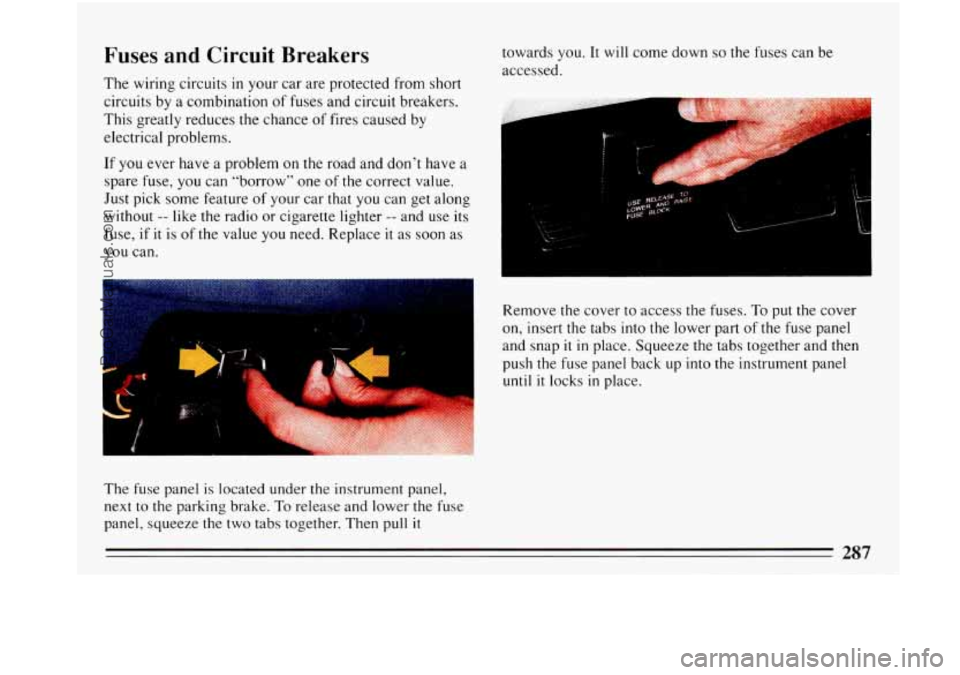
tl R
towards you. It will come down so the fuses can be
accessed.
Remove the cover to access the fuses.
To put the cover
on, insert the tabs into the lower part of the fuse panel
and snap
it in place. Squeeze the tabs together and then
push the fuse panel back up into the instrument panel
until it locks in place.
The fuse panel
is located under the instrument panel,
next to the parking brake.
To release and lower the fuse
panel, squeeze
the two tabs together. Then pull it
287
ProCarManuals.com
Page 290 of 340
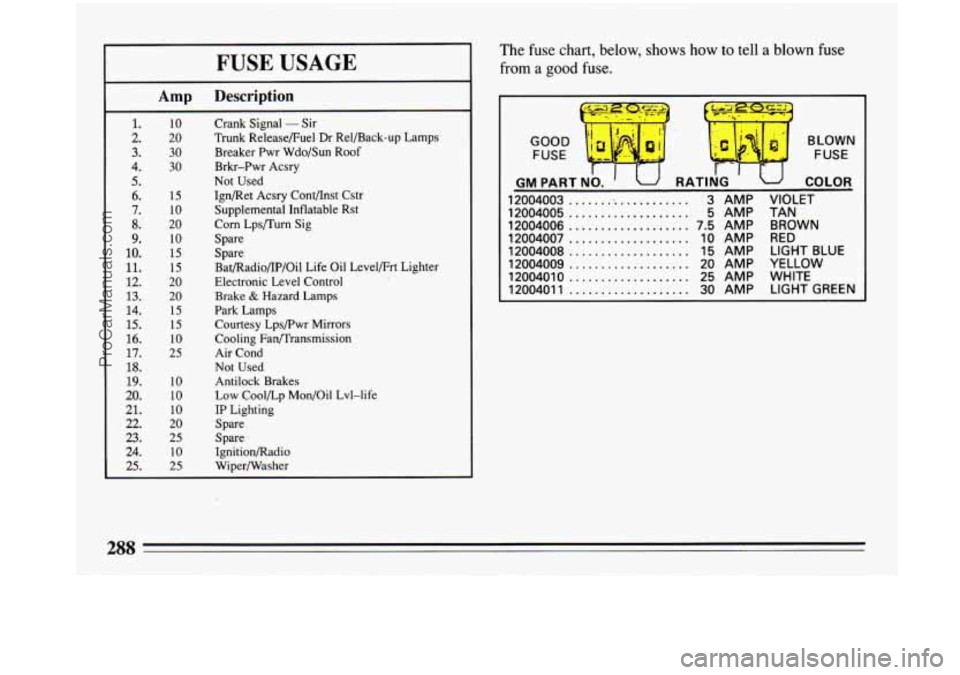
FUSE USAGE
Amp Description
1.
2.
3.
4.
5. 6.
7.
8.
9.
10.
11. 12.
13.
14.
15.
16. 17.
18.
19.
20.
21.
22.
23.
24.
25.
10
20
30
30
15
10
20
10
15
15
20
20
15
15
10
25
10
10
10
20
25
10
25
Crank Signal - Sir
Trunk Release/Fuel.Dr Rel/Back-up Lamps
Breaker Pwr Wdo/Sun Roof
Brkr-Pwr Acsry
Not Used
Ign/Ret Acsry ContDnst Cstr
Supplemental Inflatable Rst
Corn Lps/Turn Sig
Spare
Spare
Bat/Radio/IP/Oil Life Oil Level/Frt Lighter
Electronic Level Control
Brake
& Hazard Lamps
Park Lamps
Courtesy Lps/Pwr Mirrors
Cooling Fan/Transmission
Air Cond
Not Used
Antilock Brakes
Low Cool/Lp Mon/Oil Lvl-life
IP Lighting
Spare
Spare
IgnitionBadio
Wiperwasher
The fuse chart, below, shows how to tell a blown fuse
from a
good fuse.
GOOD
FUSE 1 BLOWN .r, ' \' gJ
'TI r
FUSE
GM PART NO. ' RATING ' COLOF
12004003 .................... 3 AMP VIOLET
12004005
................... 5 AMP TAN
12004006
................... 7.5 AMP BROWN
12004007
................... 10 AMP RED
12004008
................... 15 AMP LIGHT
BLUE
12004009
................... 20 AMP YELLOW
12004010
................... 25 AMP WHITE
1200401
1 ................... 30 AMP LIGHT
GREEN
ProCarManuals.com
Page 291 of 340
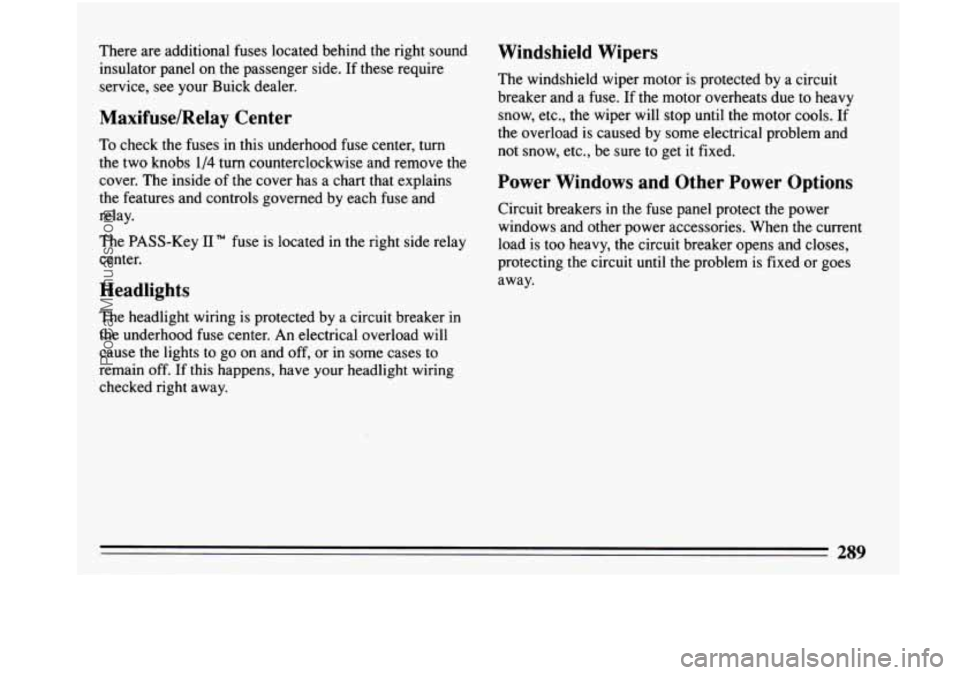
There are additional fuses located behind the right sound
insulator panel on the passenger side. If these require
service, see your Buick dealer.
Maxifuse/Relay Center
To check the fuses in this underhood fuse center, turn
the two knobs
1/4 turn counterclockwise and remove the
cover. The inside of
the cover has a chart that explains
the features and controls governed by each fuse and
relay.
The PASS-Key 'I1
TM fuse is located in the right side relay
center.
Headlights
The headlight wiring is protected by a circuit breaker in
the underhood fuse center. An electrical overload will
cause
the lights to go on and off, or in some cases to
remain
off. If this happens, have your headlight wiring
checked right away.
*
Windshield Wipers
The windshield wiper motor is protected by a circuit
breaker and a fuse. If the motor overheats due to heavy
snow, etc., the wiper will stop until the motor cools. If
the overload is caused by some electrical problem and
not snow, etc., be sure to get it fixed.
Power Windows and Other Power Options
Circuit breakers in the fuse panel protect the power
windows and other power accessories. When
the current
load is too heavy, the circuit breaker opens and closes,
protecting the circuit until the problem is fixed or goes
away.
ProCarManuals.com
Page 293 of 340
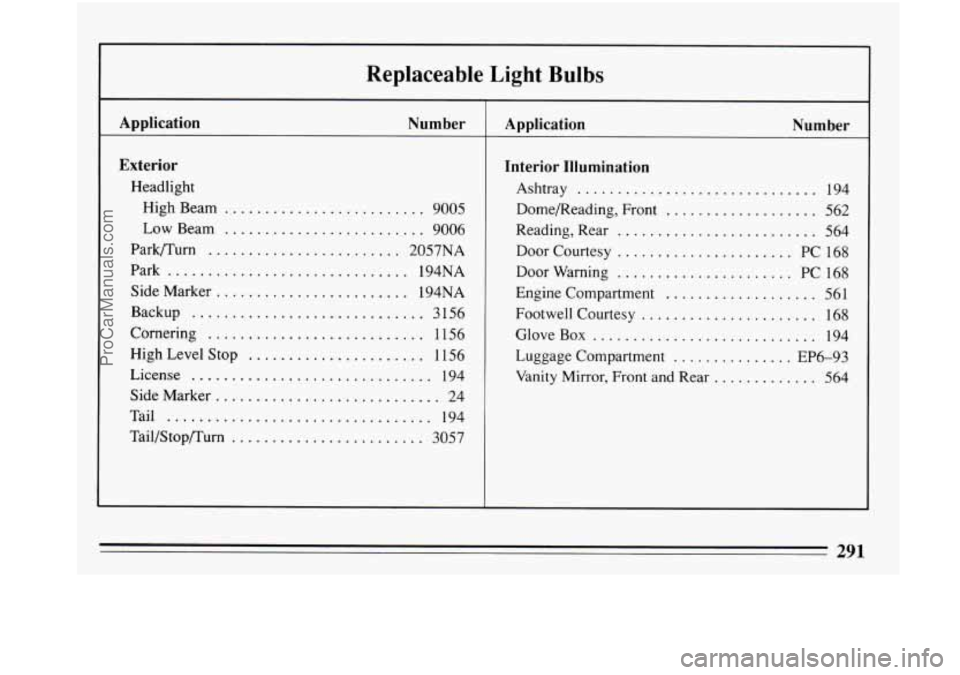
Replaceable Light Bulbs
Application Number
Exterior
Headlight High Beam
......................... 9005
Low Beam
......................... 9006
Park/Turn
........................ 2057NA
Park
.............................. 194NA
Side Marker
........................ 194NA
Backup
............................. 3156
Cornering
........................... 1156
High Level Stop
...................... 1156
License
.............................. 194
Side Marker
............................ 24
Tail
................................. 194
Tail/Stop/Turn
........................ 3057
Application Number
Interior Illumination
Ashtray .............................. 194
Dome/Reading. Front
................... 562
Reading. Rear
......................... 564
Door Courtesy
...................... PC 168
Door Warning
...................... PC 168
Engine Compartment
................... 561
Footwell Courtesy
...................... 168
GloveBox
............................ 194
Luggage Compartment
............... EP6-93
Vanity Mirror. Front and Rear
............. 564
ProCarManuals.com