air condition BUICK PARK AVENUE 1993 Owners Manual
[x] Cancel search | Manufacturer: BUICK, Model Year: 1993, Model line: PARK AVENUE, Model: BUICK PARK AVENUE 1993Pages: 340, PDF Size: 18.17 MB
Page 131 of 340
@ Part 3 Comfort Controls & Audio Systems
. I
In this part you’ll find out how to operate the comfort control systems and audio systems offered with your Buick .
Be sure to read about the particular system supplied with your vehicle .
Part 3 includes:
Comfort Control System
............................................................ 130
Heater and Defroster
................................................ 132.136. 138
Airconditioner
........................................................... 132. 137
RearWindowDefogger
........................................................ 136
Ventilation
............................................................... 132. 138
Audiosystems
.................................................................... 139
Setting the Clock
.................................................. 142.145.148. 151
Radio Controls
.................................................. 141.144.147. 150
TapePlayerControls
................................................ 143. 145. 148
CDPlayerControls
............................................................ 151
Understanding Radio Reception
................................................... 139
Care of Cassette Tape Player & Tapes ............................................. 155
CareofCompactDiscs
......................................................... 155
Antennacare
................................................................ 156
ProCarManuals.com
Page 139 of 340
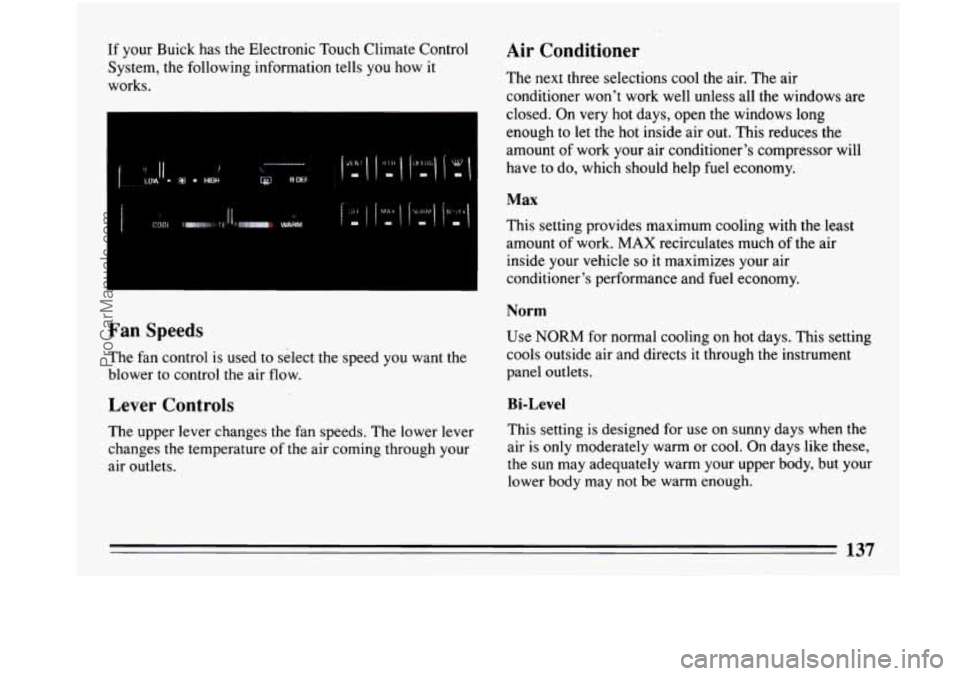
If your Buick has the Electronic Touch Climate Control
System, the following information
tells you how it
works.
Air Conditioner
The next three selections cool the air. The air
conditioner won't work well unless all the windows are
1 closed. On very hot days, open the windows long ~
~ ~ enough to let the hot inside air out. This reduces the
i amount of work your air conditioner's compressor will
have to do, which should help fuel economy.
Max
This setting provides maximum cooling with the least
amount of work.
MAX recirculates much of the air
inside your vehicle
so it maximizes your air
conditioner's performance and fuel economy.
Fan Speeds
The fan control is used to select the speed you want the
blower to control
the air flow.
Lever Controls
The upper lever changes the fan speeds. The lower lever
changes the temperature of the air coming through your
air outlets.
Norm
Use NORM for normal cooling on hot days. This setting
cools outside air and directs
it through the instrument
panel outlets.
Bi-Level
This setting is designed for use on sunny days when the
air
is only moderately warm or cool. On days like these,
the sun may adequately warm your upper body, but your
lower body may not be warm enough.
ProCarManuals.com
Page 140 of 340
The Bi-level setting directs outside air into your vehicle
in two ways. Cool air is directed toward your upper
body through instrument panel outlets, while slightly
warmed air is directed through the heater outlet at your
feet.
The air conditioner compress& operates in all Air
Conditioning positions and the Defrost position when
the outside temperature is above
48 OF (9 “C).
When you don’t need to cool the outside air, use the
VENT, HEAT and
DEFROST settings. Adjust the
temperature control for comfort. You’ll get better fuel
economy (gas mileage) if you’re not cooling the outside
air. When you cool the air, your engine runs a
refrigeration compressor, and it has to work harder.
Vent
For mild outside temperature, when little heating or
cooling is needed, use the
VENT setting. Air will flow
thought the instrument panel outlets. Use the air outlets
to turn on, adjust and turn
off the air flow. Adjust the
temperature lever
to the desired temperature.
Heater
When outside temperatures are cold, pressing the HTR
setting and adjusting the temperature lever will send
warm air through the floor outlets and some through the
defroster vents.
Defrost
The DEFROST setting directs most of the air flow
toward the windshield. Use defrost when you want to
remove
fog or ice from the windshield. When it’s 48OF
(9 * C) or warmer, you’ll get cooled air.
Defog
Air entering the vehicle will be evenly split between the
floor outlets and the outlets near the windshield. You
can control the temperature of the air and the fan speed
to clear the foggy windows.
138
ProCarManuals.com
Page 177 of 340
and go or be heard all the time your vehicle is moving
(except when you are pushing on the brake pedal
firmly).
I
A CAUTION:
The brake wear warning sound means that I
sooner or later your brakes won’t work well. That
could lead to an accident. When you hear the
brake wear warning sound, have your vehicle
serviced.
I
could result in costly brake repair. I
Some driving conditions or climates may cause a brake
squeal when the brakes are first applied or lightly
applied.
This does not mean something is wrong with
your brakes.
Rear Drum Brakes
Your rear drum brakes don’t have wear indicators, but if
you ever hear a rear brake rubbing noise, have the rear
brake linings inspected. Also, the rear brake drums
should be removed and inspected each time the tires are
removed for rotation or changing. When
you have the
front brakes replaced, have the rear brakes inspected,
too.
Brake linings should always be replaced as complete
axle sets.
Brake Pedal Travel
See your dealer if the brake pedal does not return to
normal height, or if there is a rapid increase in pedal
travel. This could be a sign of brake trouble.
Brake Adjustment
Every time you make a moderate brake stop, your
brakes adjust for wear.
If you rarely make a moderate or heavier stop, then your
brakes might not adjust correctly. If you drive in that
way, then
-- very carefully -- make a few moderate
brake stops about every
1000 miles (1 600 km), so your
brakes will adjust properly.
175
ProCarManuals.com
Page 224 of 340
If you get the overheat warning with no sign of steam,
try this for a minute or
so:
1. Turn off your air conditioner.
2. Turn on your heater to full hot at the highest fan
speed and open the window as necessary.
3. If you’re in a traffic jam, shift to “N” (Neutral).
If
you no longer have the overheat warning, you can
drive. Just
to be safe, drive slower for about ten minutes.
If the warning doesn’t come back on,
you can drive
normally.
If the warning continues, pull over, stop, and park your
vehicle right away.
If there’s still no sign of steam, you can idle the engine
for two or three minutes while you’re parked, to see if
the warning stops. But then, if
you still have the
warning, TURN
OFF THE ENGINE AND GET
EVERYONE OUT
OF THE VEHICLE until it cools
down. You
may decide not to lift the hood but to get service
help right away.
e
w . ._
,
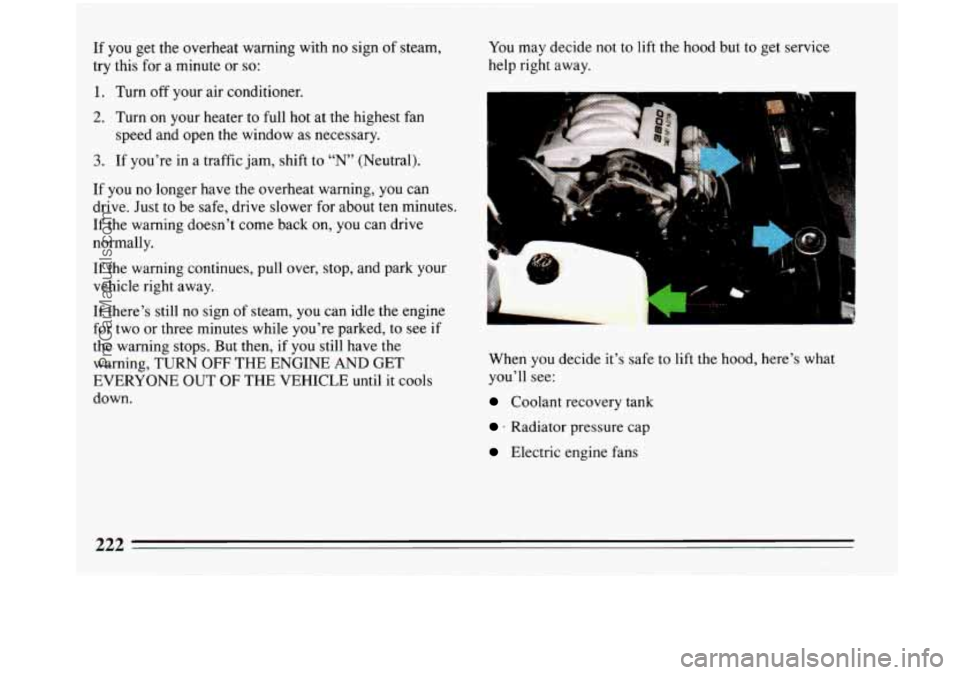
When you decide it’s safe to lift the hood, here’s what
you’ll see:
Coolant recovery tank
* Radiator pressure cap
Electric engine fans
ProCarManuals.com
Page 252 of 340
A CAUTION:
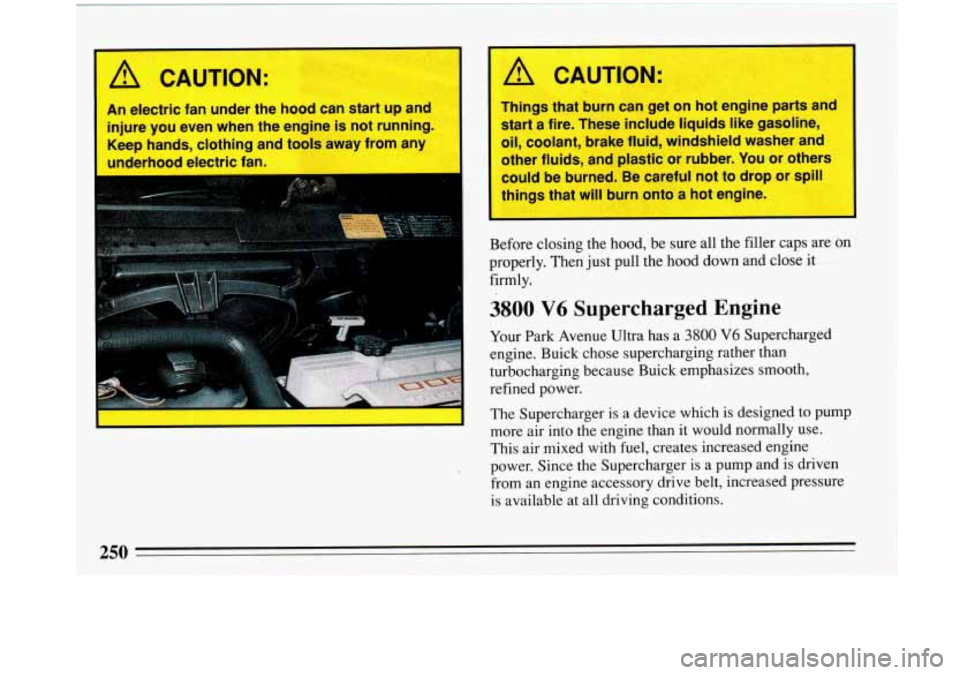
An electric fan under the hood can start up and
injure you even when the engine is not running.
Keep hands, clothing and tools away from any
I underhood electric fan. I
A CAUTION:
1
Things that burn can get on hot engine parts and
start a fire. These include liquids like gasoline,
oil, coolant, brake fluid, windshield washer and
other fluids, and plastic or rubber.
You or others
could be burned. Be careful not to drop or spill
things that will burn onto
a hot engine.
-- I
Before closing the hood, be sure all the filler caps are on
properly. Then just pull the hood down and close it
firmly.
3800 V6 Supercharged Engine
Your Park Avenue Ultra has a 3800 V6 Supercharged
engine. Buick chose supercharging rather than
turbocharging because Buick emphasizes smooth,
refined power.
The Supercharger is a device which is designed
to pump
more air into the engine than it would normally use.
This air mixed with fuel, creates increased engine
power. Since the Supercharger is a pump and
is driven
from an engine accessory drive belt, increased pressure
is available at all driving conditions.
250
ProCarManuals.com
Page 253 of 340
The powertrain control module (PCM), works with a
vacuum control to regulate the increased pressure
required during specific driving conditions. When this
increased pressure or boost, is not desired such as during
idling and light throttle cruising, the excess air that the
Supercharger is pumping is routed through a bypass. All
of these controls, working together provide high
performance character and fuel efficiency in the
3800
V6 Supercharged Buick engine.
The power steering pump uses a remote reservoir
mounted on the throttle and cruise control cable bracket.
See “Maintenance Schedule’’ in the Index for when you
should check the fluid.
The supercharged
3800 engine uses two accessory drive
belts. One belt drives the generator and the power
steering pump. The second belt drives the supercharger,
coolant pump and air conditioning compressor. Each
belt has
its own tensioner and idler pulley. See
“Maintenance Schedule’’ in the Index for when you
should check the accessory drive belts and supercharger
oil level. Have your dealer check the oil level in the
supercharger.
Engine Oil
It’s a good idea to check your engine oil every time you
get fuel. In order to get an accurate reading, the oil must
be warm and the vehicle must be on level ground.
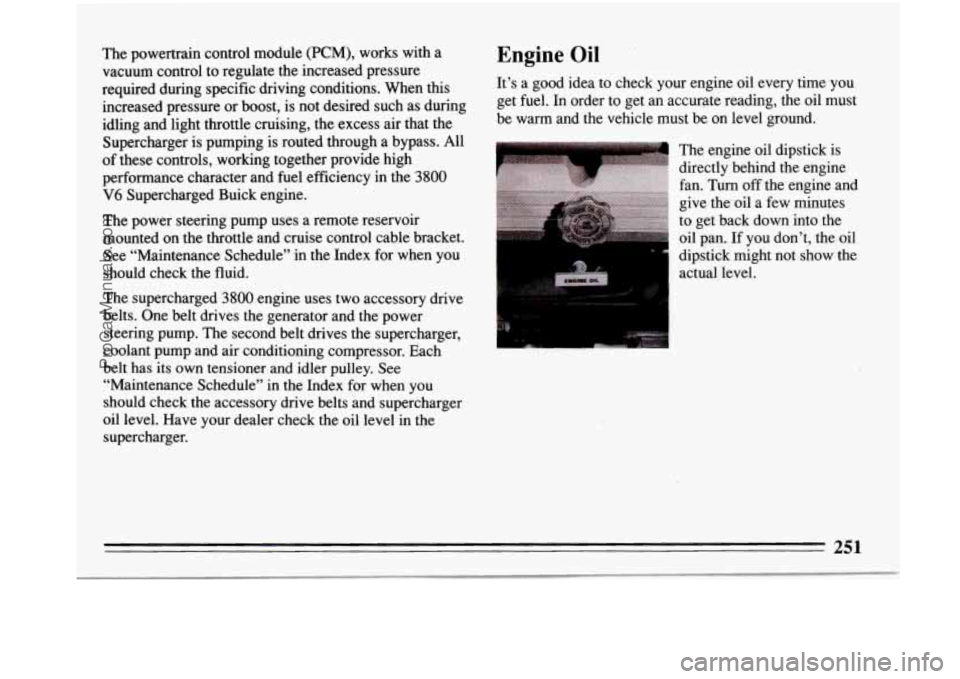
The engine oil dipstick is
directly behind the engine
fan. Turn
off the engine and
give the oil a few minutes
to get back down into the
oil pan. If you don’t, the oil
dipstick might not &ow the
actual level.
ProCarManuals.com
Page 276 of 340
The tire has a puncture, cut, or other damage that
can’t be repaired well because
of the size or location
of the damage.
Buying New Tires
To find out what kind and size of tires you need, look at
the Tire-Loading Information label.
The tires installed
on your vehicle when it was new had
a Tire Performance Criteria Specification (TPC Spec)
number on each tire’s sidewall. When you get
new tires,
get ones with that same TPC Spec number. That way,
your vehicle will continue to have tires that are designed
to give proper endurance, handling, speed rating,
traction, ride and other things during normal service on
your vehicle.
If your tires have an all-season tread
design, the TPC number will be followed by a
“MS”
(for mud and snow).
If you ever replace your tires with those not having a
TPC Spec number, make sure
they are the same size,
load range, speed rating and construction type (bias,
bias-belted or radial) as your original tires.
. CAUTION:
Xing tires could cause you to lose control
hile driving. If you mix tires ob different sizes or
types (radial and bias-betted tires;), the vehicle
may not handle properly, and you coutd have a
crash.
Be sure to use the same size and type
tires on all wheels.
It’s all right to drive
with your compact spare,
bbugh. It was developed for limited use on your
Uniform Tire Quality Grading
The following information relates to the system
developed by the United States National Highway
Traffic Safety Administration which grades tires by
treadwear, traction and temperature performance. (This
applies only to vehicles sold
in the United States.)
Treadwear
The treadwear grade is a comparative rating based on
the wear rate of the tire when tested under controlled
conditions on a specified government test course. For
example, a tire graded
150 would wear one and a half (1
ProCarManuals.com
Page 278 of 340
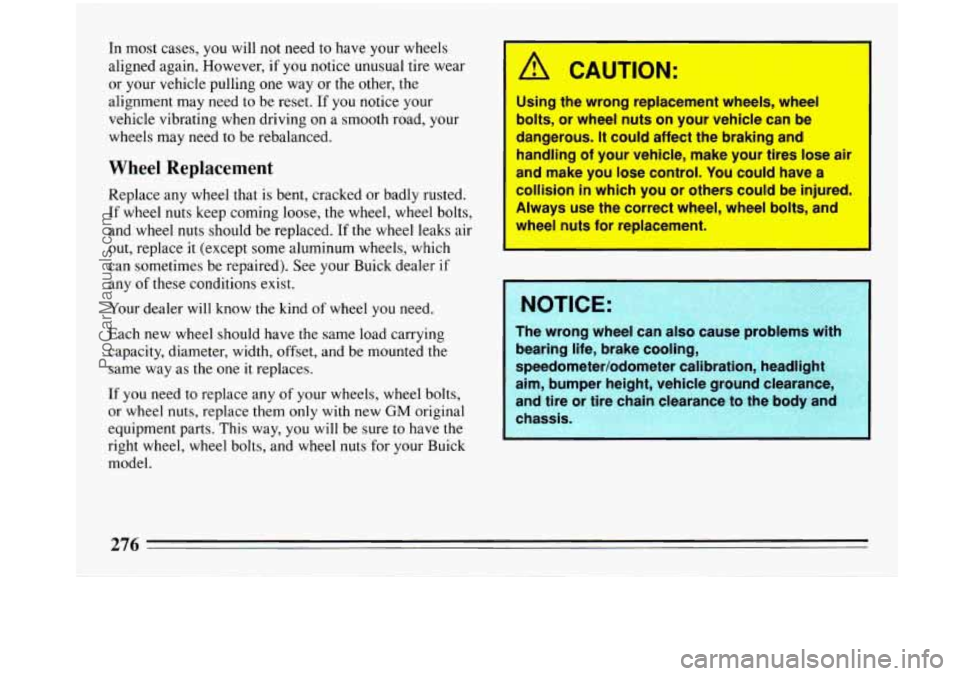
In most cases, you will not need to have your wheels
aligned again. However, if
you notice unusual tire wear
or your vehicle pulling one way or the other, the
alignment may need to be reset.
If you notice your
vehicle vibrating when driving on a smooth road, your
wheels may need to be rebalanced.
Wheel Replacement
Replace any wheel that is bent, cracked or badly rusted.
If wheel nuts keep coming loose, the wheel, wheel bolts,
and wheel nuts should be replaced.
If the wheel leaks air
out, replace it (except some aluminum wheels, which
can sometimes be repaired). See your Buick dealer if
any
of these conditions exist.
Your dealer will know the kind
of wheel you need.
Each new wheel should have the same load carrying
capacity, diameter, width, offset, and be mounted
the
same way as the one it replaces.
If
you need to replace any of your wheels, wheel bolts,
or wheel nuts, replace them
only with new GM original
equipment parts. This way, you will be sure
to have the
right wheel, wheel bolts, and wheel nuts for your Buick
model.
A CAUTION:
Using the wrong replacement wheels, wheel
bolts, or wheel nuts on your vehicle can be
rngerous. It could affect the braking and
.. ~ndling of your vehicle, make your tires lose air
and make you lose control. You could have a
collision
in which you or others could be injured.
- ..ways use the correct wheel, wheel bolts, ~ d
I wheel nuts
for replacement.
I
1: NOTICE:
The wrong wheel can atso cause Droblems with
bearing life, brake cooling,
speedometer/odometer calibration, headllgb,,
aim, bumper height, vehicle ground clearance
and tire or tire chain clearance to the body an(
chassis.
ProCarManuals.com
Page 286 of 340
Underbody Maintenance
Chemicals used for ice and snow removal and dust
control can collect on
the underbody. If these are not
removed, accelerated corrosion (rust) can occur on the
underbody parts such as fuel lines, frame, floor pan, and
exhaust system even though they have corrosion
protection.
At least every spring, flush these materials from the
underbody with plain water. Clean any areas where mud
and other debris can collect. Dirt packed in closed areas
of the frame should be loosened before being flushed.
Your dealer or
an underbody vehicle washing system
can do this for you.
Chemical Paint Spotting
Some weather and atmospheric conditions can create a
chemical fallout. Airborne pollutants can fall upon and
attack painted surfaces on your vehicle. This damage
can take two forms: blotchy, ringlet-shaped
discolorations, and small irregular dark spots etchgd into
the paint surface.
Although no defect
in the paint job causes this, Buick
will repair, at no charge to the owner, the surfaces
of
new vehicles damaged by this fallout condition within
12 months or 12,000 miles (20
000 km) of purchase,
whichever comes first.
ProCarManuals.com