rear view mirror BUICK PARK AVENUE 1993 Owners Manual
[x] Cancel search | Manufacturer: BUICK, Model Year: 1993, Model line: PARK AVENUE, Model: BUICK PARK AVENUE 1993Pages: 340, PDF Size: 18.17 MB
Page 110 of 340
Outside Mirrors
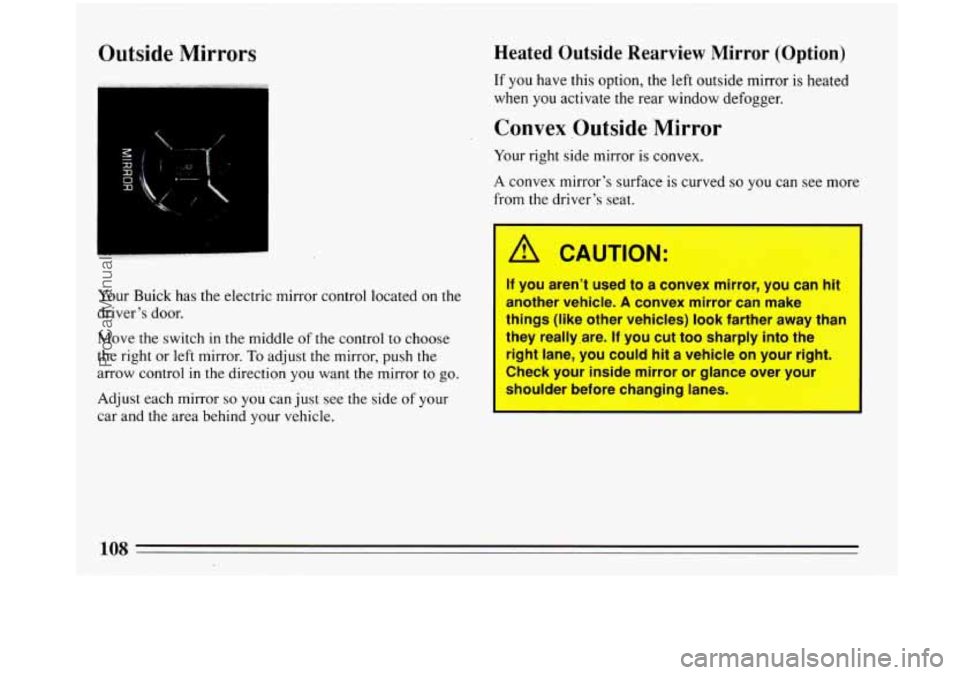
Your Buick has the electric mirror control located on the
driver’s door.
Move the switch in the middle
of the control to choose
the right or left mirror.
To adjust the mirror, push the
arrow control
in the direction you want the mirror to go.
Adjust each mirror
so you can just see the side of your
car and the area behind your vehicle.
Heated Outside Rearview Mirror (Option)
If you have this option, the left outside mirror is heated
when you activate the rear window defogger.
Convex .Outside Mirror
Your right side mirror is convex.
A convex mirror’s surface is curved
so you can see more
from the driver’s seat.
1 A CAUTION:
I
~ If you aren’t used to a convex mirror, you can hit
another vehicle.
A convex mirror can make
things (like other vehicles) look farther away than
they really.are. If you cut
too sharply into the
right lane, you could hit a vehicle on your right.
Check your inside mirror or glance over your
shoulder before changing lanes.
108
ProCarManuals.com
Page 138 of 340
Defrost Rear Window Defogger
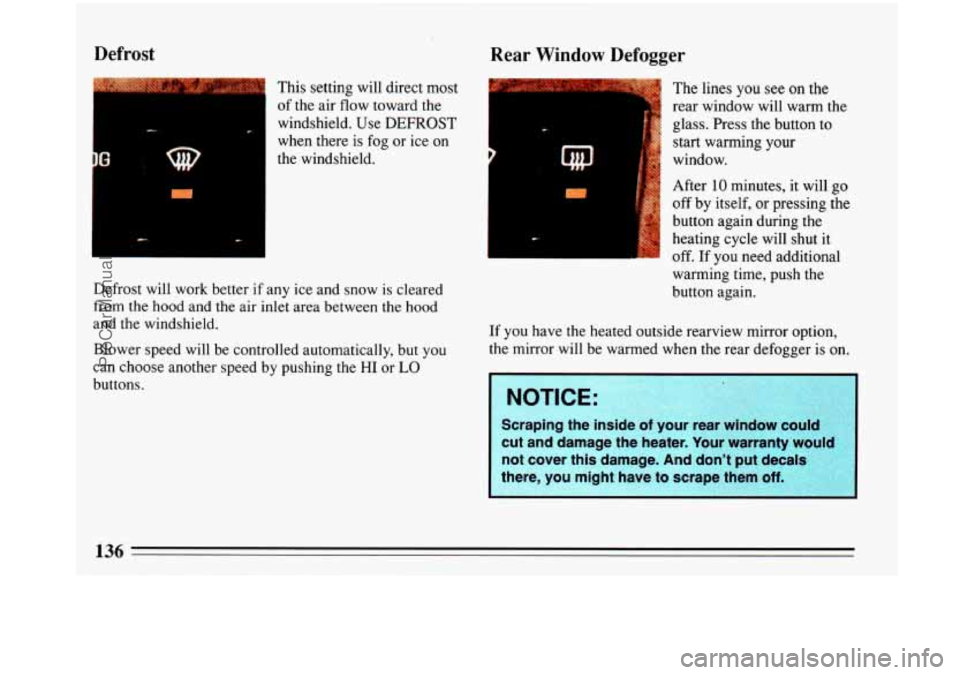
This setting will direct most
of the air flow toward the
windshield. Use
DEFROST
when there is fog or ice on
the-windshield.
Defrost will work better if any ice and snow is cleared
from the hood and the air inlet area between the hood
and the windshield.
Blower speed will be controlled automatically, but
you
can choose another speed by pushing the HI or LO
buttons. The
lines
you see on the
rear window will warm the
glass. Press the button to
start warming your
window.
After
10 minutes, it will go
off by itself, or pressing the
button again during the
heating cycle will shut it
off. If you need additional
warming time, push the
button again.
c. i
If you have the heated outside rearview mirror option,
the mirror will be warmed when the rear defogger is on.
1.
i NOTICE: , .' '2 , .. , ,.. ~. , ..~
I: Scraping the inside of your rear window could
cut and damage the heater. Your warranty would
ProCarManuals.com
Page 183 of 340
vehicle is skidding. Learn to recognize warning clues --
such as enough water, ice or packed snow on the road to
make a “mirrored surface”
-- and slow down when you
have any doubt.
Remember: Any anti-lock braking system (ABS) helps
avoid only the braking skid. Steer the way
you want to
go-
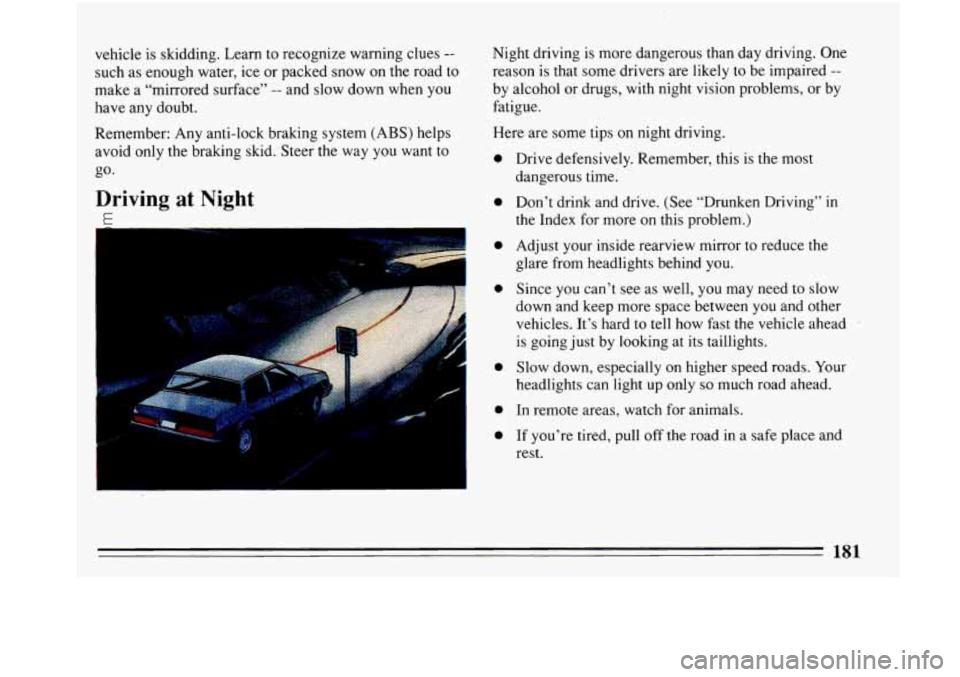
Driving at Night
...,.
.. -
Night driving is more dangerous than day driving. One
reason
is that some drivers are likely to be impaired --
by alcohol or drugs, with night vision problems, or by
fatigue.
Here are some tips on night driving.
0
0
0
c
0
0
0
Drive defensively. Remember, this is the most
dangerous time.
Don’t drink and drive. (See “Drunken Driving” in
the Index for more on this problem.)
Adjust your inside rearview mirror to reduce the
glare from headlights behind you.
Since you can’t see as well, you may need to slow
down and keep more space between you and other
vehicles. It’s hard
to tell how fast the vehicle ahead .
is going just by looking at its taillights.
Slow down, especially on higher speed roads. Your
headlights can light up only
so much road ahead.
In remote areas, watch for animals.
If you’re tired, pull off the road in a safe place and
rest.
ProCarManuals.com
Page 191 of 340
too-slow driving breaks a smooth traffic flow. Treat the
left lane on a freeway as a passing lane.
Entering the Freeway
At the entrance there is usually a ramp mat leads to the
freeway.
If you have a clear view of the freeway as you
drive along the entrance ramp, you should begin to
check traffic. Try to. determine where you expect to
blend with the flow.
If traffic is light, you may have no
problem. But if it is heavy, find a gap as you move along
the entering lane and time your approach. Try to merge
into the gap at,close to the prevailing speed. Switch on
your
turn signal, check your rearview mirrors as you
move along, and glance over your shoulder as often as
necessary. Try to blend smoothly with the traffi.c flow.
Driving on the Freeway
Once you are on the freeway, adjust your speed to the
posted limit or to the prevailing rate if it’s slower. Stay
in the right lane unless you want to ‘pass. If you are on a
two-lane freeway, treat the right Lane as the slow lane
and the left lane as the passing lane.
If you are on a three-lane freeway, treat the right lane as
the slower-speed through lane, the middle lane as the
higher-speed through lane, and
the left lane as the
passing lane. Before changing lanes, check
your rearview mirrors.
Then use your turn signal.
Just before
you leave the lane, glance quickly over your
shoulder to make sure there isn’t another vehicle in your
“blind” spot.
If you are moving from an outside.to a center lane on a
freeway having more than two lanes, make sure another
vehicle isn’t about to move into the same spot. Look at
the vehicles two lanes over and watch for telltale signs:
turn signals flashing,
an increase in speed, or moving
toward the edge of the lane. Be prepared to delay your
move.
.
Once you are moving on the freeway, make certain you
allow a reasonable following distance. Expect to move
slightly slower at night.
Leaving the Freeway
When you want to leave the freeway, move to the proper
lane well in advance. Dashing across lanes at the last
minute is dangerous.
If you miss your exit do not, under
any circumstances, stop and back up. Drive on to the
next exit.
At each.exit point is a’deceleration lane. Ideally it
should be long enough for you to enter it at freeway
speed (after signaling, of course) and then do your
ProCarManuals.com
Page 194 of 340
Then here are some tips:
e
e
e
e Make sure your vehicle is well ventilated, with a
comfortably cool interior.
Keep your eyes moving. Scan the road ahead and to
the sides. Check your rearview mirrors frequently
and your instruments from time
to time. This can
help you avoid
a fixed stare.
Wear
good sunglasses in bright light. Glare can
cause drowsiness. But don't wear sunglasses at
night. They will drastically reduce your overall
vision at the very time you need all the seeing power
you have.
If you get sleepy, pull off the road into a rest, service,
or parking area and take a nap, get some exercise, or
both. For safety, treat drowsiness
on the highway as
an emergency.
As in any driving situation, keep pace with traffic and
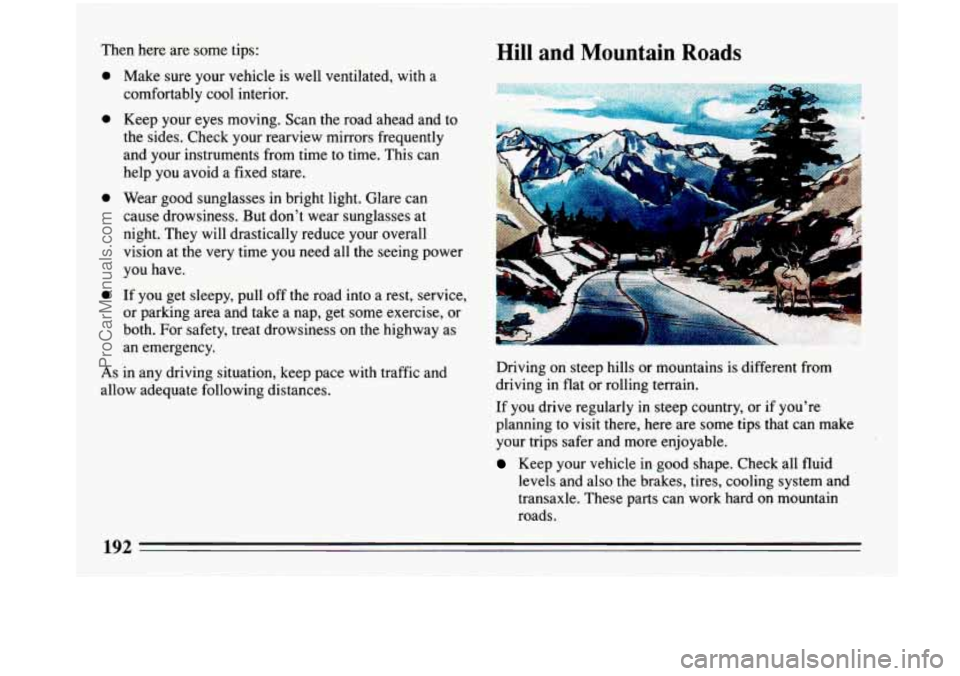
allow adequate following distances. Driving on
steep hills or mountains is different from
driving in flat or rolling terrain.
If you drive regularly
in steep country, or if you're
,planning to visit there, here are some tips that can make
your trips safer and more enjoyable.
Keep your vehicle in good shape. Check all fluid
levels and also the brakes, tires, cooling system and
transaxle. These parts can work hard
on mountain
roads.
192
ProCarManuals.com
Page 329 of 340
Gages and Warning Indicators ................... 117
Panel
....................................... 101
Time Out Feature
............................. 113
Traffic
...................................... 165
“On” Warning
................................ 101
Operation
.................................... 92
Loading Your Vehicle
............................ 268
Locks. Door
..................................... 62
Locks. Rear Door Security
.......................... 69
Long Distance Driving
............................ 190
Loss of Control
................................. 180
Low Oil Pressure. Warning Light
................... 124
LowFuelLight
................................. 119
Maintenance
Inspections
.................................. 308
Record
...................................... 311
Schedule
.................................... 293
Underbody
.................................. 284
Malfunction Indicator Light
........................ 126
Manualseat
..................................... 14
Markings, Pavement
............................. 166
Master Cylinder, Brake
........................... 263
Memory Seat and Mirrors
.......................... 15
Methanol in Gasoline ............................. 243
Mirrors Automatic
................................... 106
Convex Outside
.............................. 108 Heated
Outside Rearview
....................... 108
Inside
...................................... 106
Outside
..................................... 108
Mist, Driving in
................................. 186
Mobile Telephone, Adding a
....................... 140
Monitors, Lamp
................................. 105
Mountain Driving
................................ 192
MTBE In Gasoline
............................... 243
N (Neutral) Gear Position ......................... 81
Netconvenience
................................ 109
New Vehicle “Break-In”
........................... 74
NightDriving
................................... 181
Nightvision
.................................... 182
Notices About Damage
............................ 11
Octane Required for Your Car
..................... 243
Odometer
...................................... 117
Odometer. Trip
.................................. 117
Off (Ignition Key Position)
......................... 76
Off Road Recovery .............................. 178
Oil. Change Your Engine
...................... 25 1. 293
Oil. Engine
..................................... 251
Oil Pressure Warning Light
........................ 123
Operation in Foreign Countries
..................... 245
Overdrive. Automatic ............................. 82
Overheated Engine
............................... 221
327
ProCarManuals.com