coolant BUICK PARK AVENUE 1994 User Guide
[x] Cancel search | Manufacturer: BUICK, Model Year: 1994, Model line: PARK AVENUE, Model: BUICK PARK AVENUE 1994Pages: 324, PDF Size: 17.01 MB
Page 211 of 324
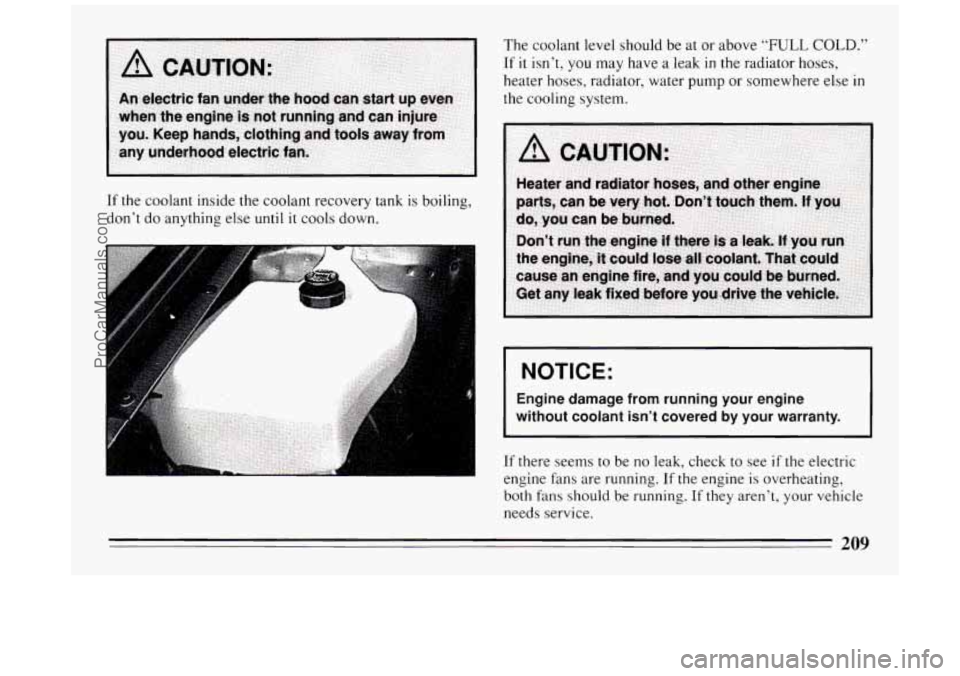
If the coolant inside the coolant recovery tank is boiling,
don’t do anything else
until it cools down.
P
The coolant level should be at or above “FULL COLD.”
If it isn’t, you may have a leak in the radiator hoses,
heater hoses, radiator, water pump or somewhere else in
the cooling system.
I NOTICE:
I
Engine damage from running your engine
without coolant isn’t covered
by your warranty.
If there seems to be no leak, check to see if the electric
engine fans are running.
If the engine is overheating,
both
fans should be running. If they aren’t, your vehicle
needs service.
209
ProCarManuals.com
Page 212 of 324
How to Add Coolant to the Coolant
Recovery Tank
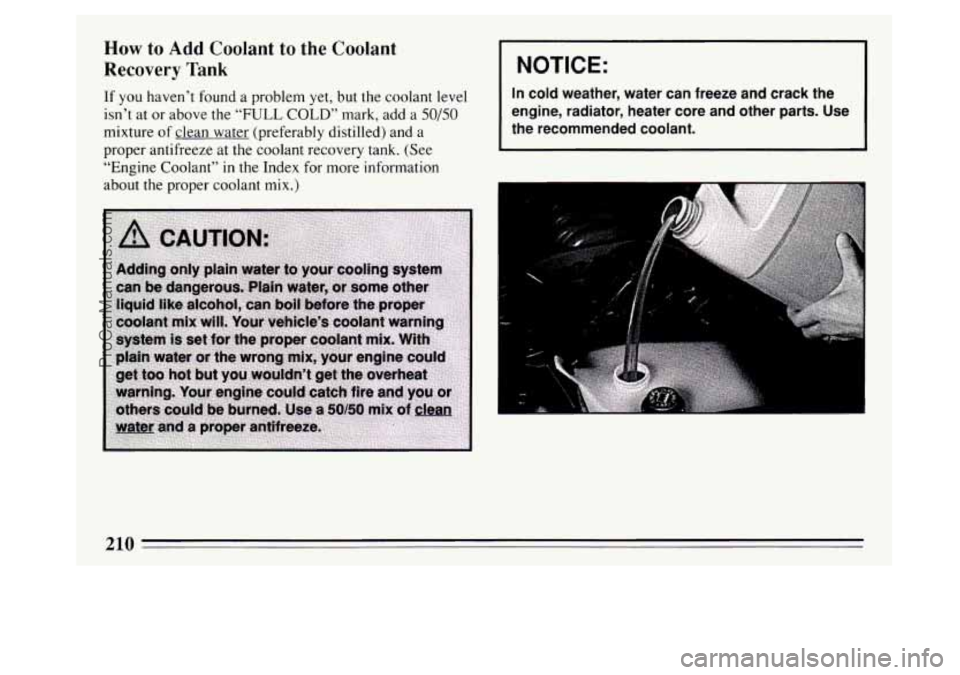
If you haven’t found a problem yet, but the coolant level
isn’t at or above the
“FULL COLD” mark, add a 50/50
mixture of clean water (preferably distilled) and a
proper antifreeze at the coolant recovery tank. (See
“Engine Coolant’’
in the Index for more information
about the proper coolant mix.)
NOTICE:
In cold weather, water can freeze and crack the
engine, radiator, heater core and other parts. Use
the recommended coolant.
210
ProCarManuals.com
Page 213 of 324

When the coolant in the coolant recovery tank is at or
above the
“FULL COLD” mark, start your vehicle.
If the overheat warning continues, there’s one more
thing you can try.
You can add the proper coolant mix
directly to the radiator but be sure the cooling system
is
cool before you do it.
ProCarManuals.com
Page 214 of 324
How to Add Coolant to the Radiator
1
"I
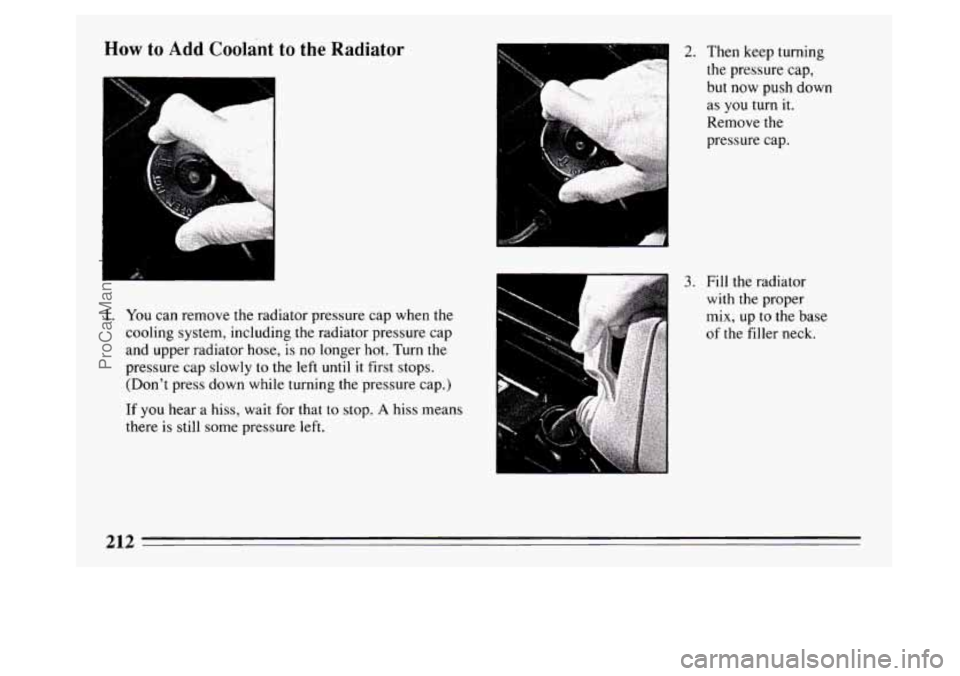
1. You can remove the radiator pressure cap when the
cooling system, including
the radiator pressure cap
and upper radiator hose,
is no longer hot. Turn the
pressure cap slowly to the left
until it first stops.
(Don't press down while turning the pressure cap.)
If you hear a hiss, wait for that to stop. A hiss means
there
is still some pressure left.
I 3. Fill the radiator
with the proper
mix, up
to the base
of the filler neck.
212
ProCarManuals.com
Page 215 of 324

4. Then fill the coolant recovery tank to “FULL COLD.”
5. Put the cap back on the coolant recovery tank, but
leave the radiator pressure cap off.
6. Start the engine and
let it run
until you
can feel the upper
radiator hose
getting hot. Watch
out for the engine
fans.
7. By this time the coolant level inside the radiator
filler neck may be lower. If the level
is lower, add
more of the proper mix through the filler neck until
the level reaches the base of the filler neck.
ProCarManuals.com
Page 216 of 324

8. Then replace the
pressure cap. At
any time during this
procedure
if coolant
begins to
flow out
of the filler neck,
reinstall the
pressure cap. Be
sure the arrows on
pressure cap line up
like this.
If a Tire Goes Flat
It’s unusual for a tire to “blow out” while you’re driving,
especially
if you maintain your tires properly. If air goes
out of
a tire, it’s much more likely to leak out slowly.
But
if you should ever have a “blowout,” here are a few
tips about what to expect and what to do:
If a front tire fails, the flat tire will create
a drag that
pulls the vehicle toward that side. Take your foot
off the
accelerator pedal and grip the steering wheel firmly.
Steer to maintain lane position, then gently brake to a
stop well out of the traffic lane.
A rear blowout, particularly on a curve, acts much like a
skid and may require the same correction you’d use in a
skid. In any rear blowout, remove your foot from the
accelerator pedal. Get the vehicle under control by
steering the way you want the vehicle to
go. It may be
very bumpy and noisy, but you can still steer. Gently
brake to a stop, well
off the road if possible.
If a tire goes flat, the next section shows how to use
your jacking equipment to change
a flat tire safely.
214
ProCarManuals.com
Page 229 of 324

Part 6 Service and Appearance Care
Here you will find information about the care of your Buick . This part begins with service and fuel information. and
then
it shows how to check important fluid and lubricant levels . There is also technical information about your
vehicle. and a section devoted to its appearance care
.
Part 6 includes:
Service ........................................................................\
.. 228
Fuel
........................................................................\
..... 229
HoodRelease
..................................................................... 234
Engineoil
....................................................................... \
238
Aircleaner
....................................................................... \
243
Automatic Transaxle Fluid
........................................................... 244
Enginecoolant
.................................................................... 247
PowerSteeringFluid ............................................................... 250
Windshield Washer Fluid
............................................................ 251
Brakes
........................................................................\
... 252
Battery
........................................................................\
.. 255
BulbReplacement
................................................................. 256
Loading Your Vehicle
............................................................... 258
Tires
........................................................................\
.... 260
Appearancecare
.................................................................. 268
Vehicle Identification Number (VIN) .................................................. 276
FusesandCircuitBreakers
........................................................... 277
Capacities and Specifications
......................................................... 282
227
ProCarManuals.com
Page 238 of 324
Before closing the hood, be sure all the filler caps are on
properly. Then pull the hood down and close it firmly.
Engine Accessory Belt
A
D
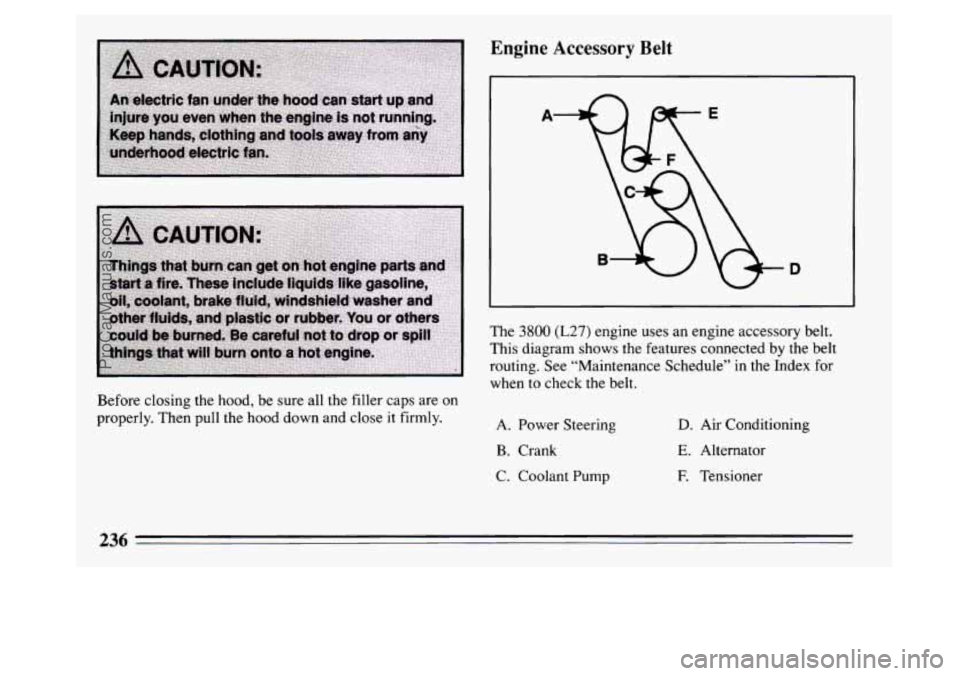
The 3800 (L27) engine uses an engine accessory belt.
This diagram shows the features connected by the belt
routing. See “Maintenance Schedule” in the Index for
when to check
the belt.
A. Power Steering
B. Crank
C. Coolant Pump
D. Air Conditioning
E. Alternator
E Tensioner
236
ProCarManuals.com
Page 239 of 324
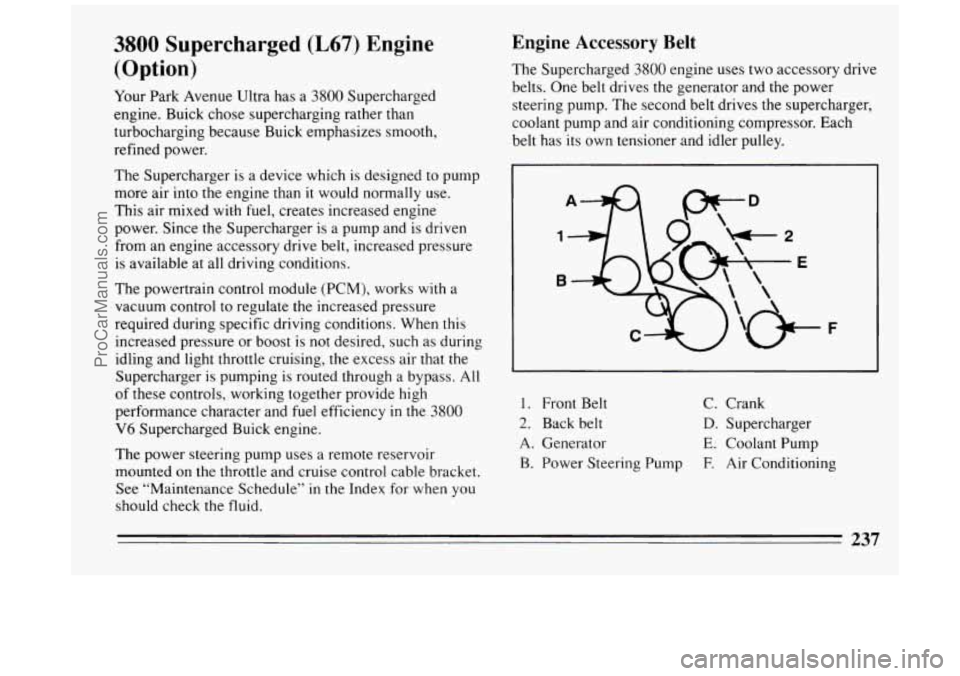
3800 Supercharged (L67) Engine
(Option)
Your Park Avenue Ultra has a 3800 Supercharged
engine. Buick chose supercharging rather than
turbocharging because Buick emphasizes smooth,
refined power.
The Supercharger is a device which is designed to pump
more air into the engine than it would normally use.
This air mixed with fuel, creates increased engine
power. Since
the Supercharger is a pump and is driven
from an engine accessory drive belt, increased pressure
is available at all driving conditions.
The powertrain control module (PCM), works with a
vacuum control to regulate the increased pressure
required during specific driving conditions. When this
increased pressure or boost is not desired, such as during
idling and light throttle cruising, the excess air that the
Supercharger is pumping
is routed through a bypass. All
of these controls, working together provide high
performance character and
fuel efficiency in the 3800
V6 Supercharged Buick engine.
The power steering pump uses a remote reservoir
mounted on the throttle and cruise control cable bracket.
See “Maintenance Schedule’’ in
the Index for when you
should check the fluid.
Engine Accessory Belt
The Supercharged 3800 engine uses two accessory drive
belts. One belt drives the generator and the power
steering pump. The second belt drives the supercharger,
coolant pump and air conditioning compressor. Each
belt has its own tensioner and idler pulley.
1. Front Belt
C. Crank
2. Back belt D. Supercharger
A. Generator
E. Coolant Pump
B. Power Steering Pump E Air Conditioning
237
ProCarManuals.com
Page 244 of 324

Engine Oil Additives
Don’t add anything to your oil. Your Buick dealer is
ready to advise if you think something should be added.
When to Change Engine Oil
See if any one of these is true for you:
Most trips are less than 4 miles (6 km).
It’s below freezing outside and most trips are less
than
10 miles (16 km).
The engine is at low speed most of the time (as in
door-to-door delivery, or in stop-and-go traffic).
0 You tow a trailer often.
Most trips are through dusty places.
If any one of these is true for your vehicle, then you
need to change your oil and filter every
3,000 miles
(5 000 km) or 3 months -- whichever comes first. (See
“Change Oil Soon” in the Index.) If
none of
them is true, change the oil every 7,500 miles
(12 500 km) or 12 months -- whichever comes first.
Change the filter at the first oil change and at every
other oil change after that.
If the optional “Change Oil Soon” light comes on you
will need to change your oil sooner than either mileage
specified. Depending upon driving habits, the “Change
Oil Soon’’ light may come on
as early as 2,000 miles or
less from the last time the oil life monitor was reset (See
“Oil Life Monitor” in the Index.)
Always reset the oil
life monitor after every oil change.
Engine Coolant Heater (Engine Block
Heater)
An engine coolant heater can be a big help if you have
to park outside in very cold weather,
0°F (- 18 “C) or
colder. If your vehicle has this option, see “Engine
Coolant Heater” in the Index.
242
ProCarManuals.com