warning BUICK PARK AVENUE 1994 User Guide
[x] Cancel search | Manufacturer: BUICK, Model Year: 1994, Model line: PARK AVENUE, Model: BUICK PARK AVENUE 1994Pages: 324, PDF Size: 17.01 MB
Page 125 of 324
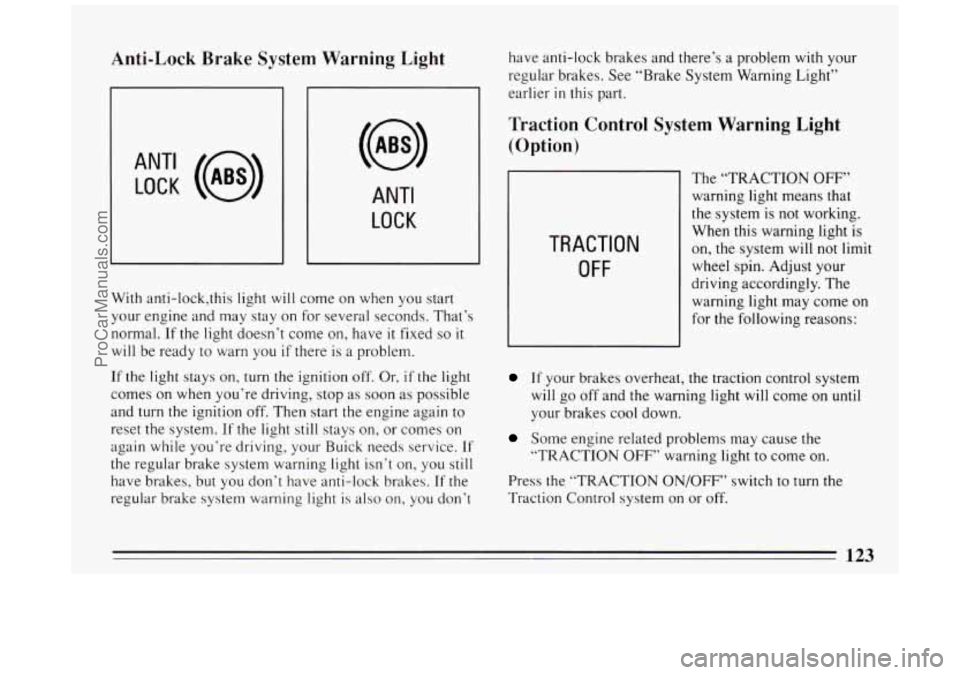
Anti-Lock Brake System Warning Light
ANT‘ LOCK (a)
ANTI
LOCK
J
With anti-lock,this light will come on when you start
your engine and may stay on for several seconds. That’s
normal.
If the light doesn’t come on, have it fixed so it
will be ready to warn you if there is a problem.
If the light stays on, turn the ignition
off, Or, if the light
comes on when you’re driving, stop as soon as possible
and
turn the ignition off. Then start the engine again to
reset the system.
If the light still stays on, or comes on
again while you’re driving, your Buick needs service.
If
the regular brake system warning light isn’t on, you still
have brakes, but you don’t have anti-lock brakes. If the
regular brake system warning light is also on, you don’t have
anti-lock brakes and there’s a problem
with your
regular brakes. See “Brake System Warning Light”
earlier
in this part.
Traction Control System Warning Light
(Option)
TRACTION
OFF
The “TRACTION OFF”
warning light means that
the system is not working.
When this warning light is
on, the system will not limit
wheel spin. Adjust your
driving accordingly. The
warning light may come on
for the following reasons:
If your brakes overheat, the traction control system
will go off and the warning light will come on
until
your brakes cool down.
Some engine related problems may cause the
“TRACTION
OFF’’ warning light to come on.
Press the “TRACTION ON/OFF” switch to turn the
Traction Control system on or off.
123
ProCarManuals.com
Page 126 of 324
Engine Coolant Temperature Gage If the “TRACTION OFF” warning light comes on and
stays on for an extended period of time, your vehicle
needs service.
Engine Coolant Temperature Warning
Light
TEMP
This light tells you that your engine coolant has
overheated or your radiator cooling fans are not working.
If you have been operating your vehicle under normal
driving conditions, you should pull
off the road, stop your
vehicle and turn the engine
off as soon as possible.
The chapter “Problems on the Road,” in this manual
explains what to do. See “Engine Overheating” in the
Index.
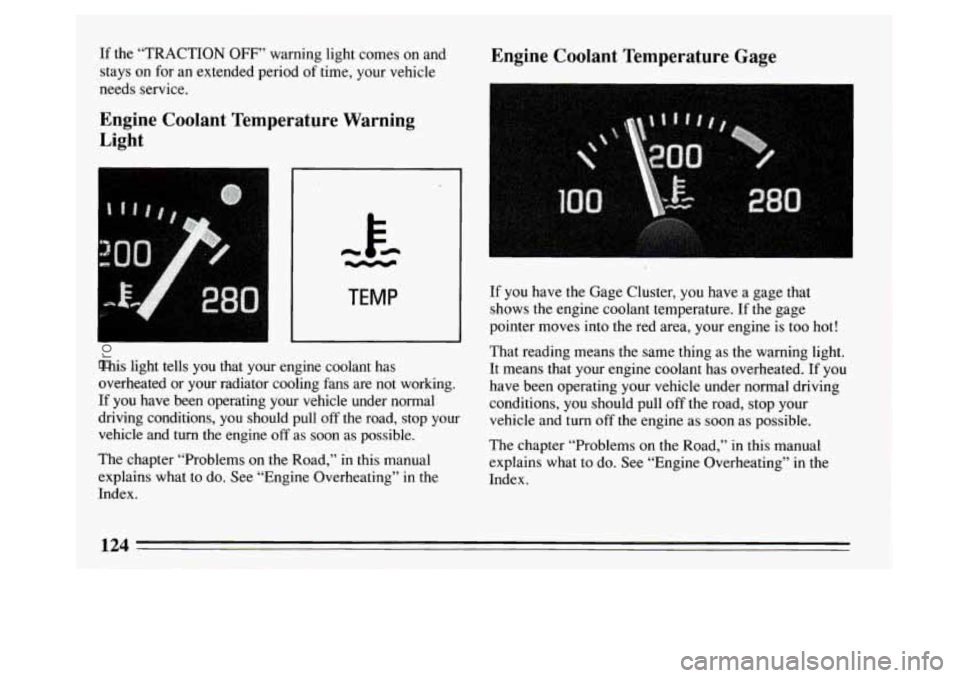
If you have the Gage Cluster, you have a gage that
shows the engine coolant temperature.
If the gage
pointer moves into the red area, your engine is too hot!
That reading means the same thing as the warning light.
It means that your engine coolant has overheated. If you
have been operating your vehicle under normal driving
conditions, you should pull
off the road, stop your
vehicle and
turn off the engine as soon as possible.
The chapter “Problems on the Road,” in this manual
explains what to do. See “Engine Overheating” in the
Index.
124
ProCarManuals.com
Page 127 of 324
Low Coolant Warning Light Engine
Oil Pressure Light and Gage
COOLANT
LOW
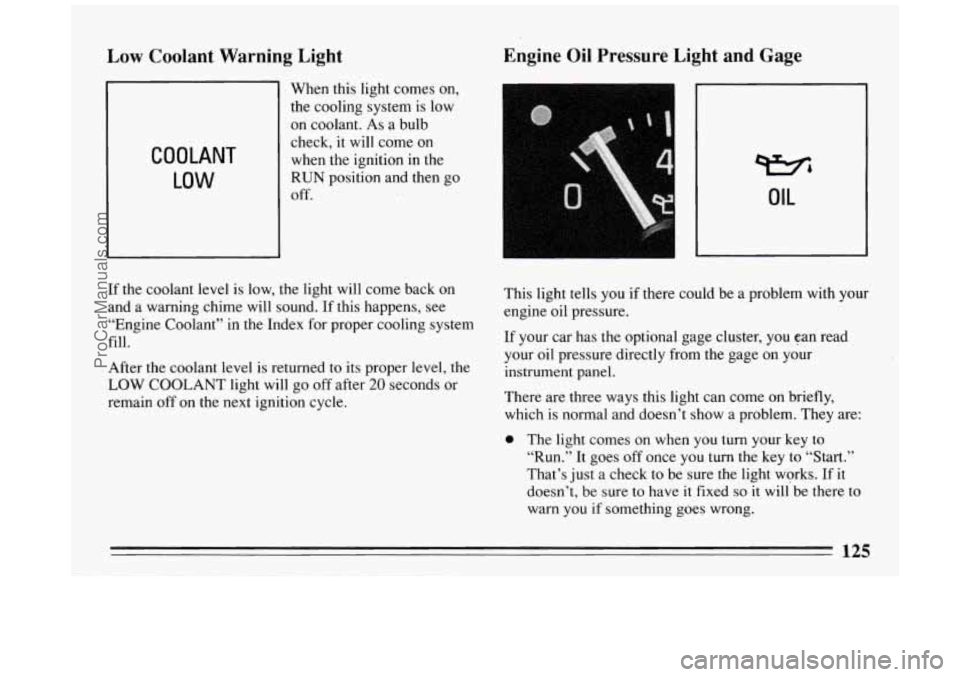
When this light comes on,
the cooling system is low
on coolant. As a bulb
check, it will come on
when the ignition in the
RUN position and then go
Off.
Wb
OIL
If the coolant level is low, the light will come back on
and
a warning chime will sound. If this happens, see
“Engine Coolant’’ in the Index for proper cooling system
fill.
After the coolant level is returned to its proper level, the
LOW COOLANT light will go off after 20 seconds or
remain off
on the next ignition cycle. This
light
tells you if there could be a problem with your
engine oil pressure.
If your car has the optional gage cluster, you can read
your oil pressure directly from the gage on your
instrument panel.
There are three ways this light can come on briefly,
which
is normal and doesn’t show a problem. They are:
0 The light comes on when you turn your key to
“Run.”
It goes off once you turn the key to “Start.”
That’s just a check
to be sure the light works. If it
doesn’t, be sure
to have it fixed so it willbe there to
warn you if something goes wrong.
125
ProCarManuals.com
Page 169 of 324
Anti-Lock Brakes (ABS)
Your Buick has an advanced electronic braking system
that will help prevent skidding.
ANT‘ LOCK (@)
ANTI
LOCK
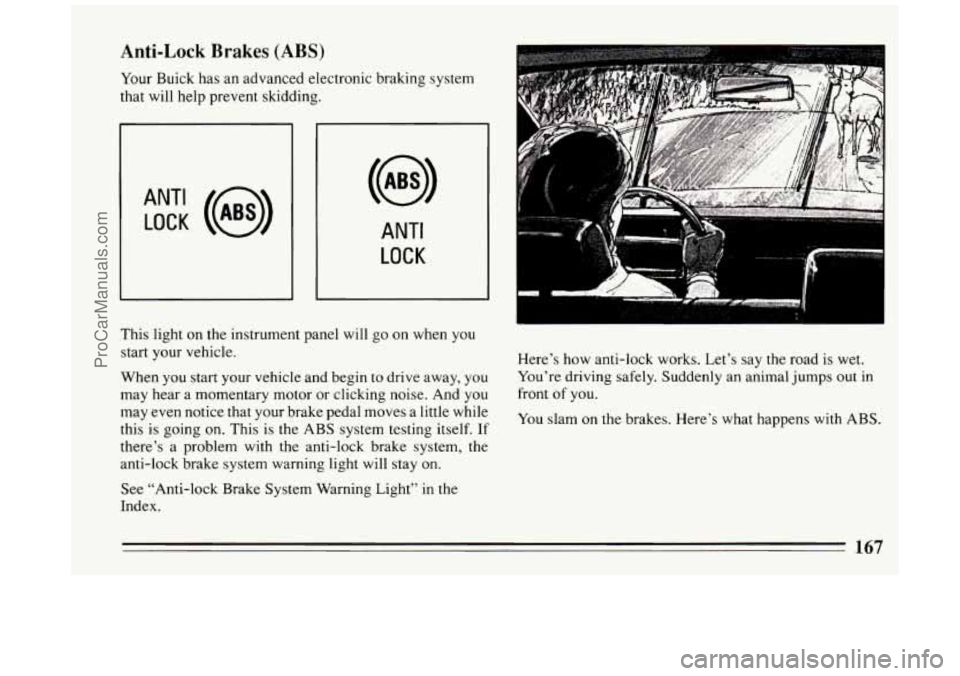
This light on the instrument panel will go on when you
start your vehicle.
When you start your vehicle and begin to drive away, you
may hear a momentary motor or clicking noise. And you
may even notice that your brake pedal moves a little while
this is going
on. This is the ABS system testing itself. If
there’s a problem with the anti-lock brake system, the
anti-lock brake system warning light will stay on.
See “Anti-lock Brake System Warning Light”
in the
Index. Here’s how
anti-lock works. Let’s say the road is wet.
You’re driving safely. Suddenly an animal jumps out in
front of you.
You slam
on the brakes. Here’s what happens with ABS.
167
ProCarManuals.com
Page 171 of 324
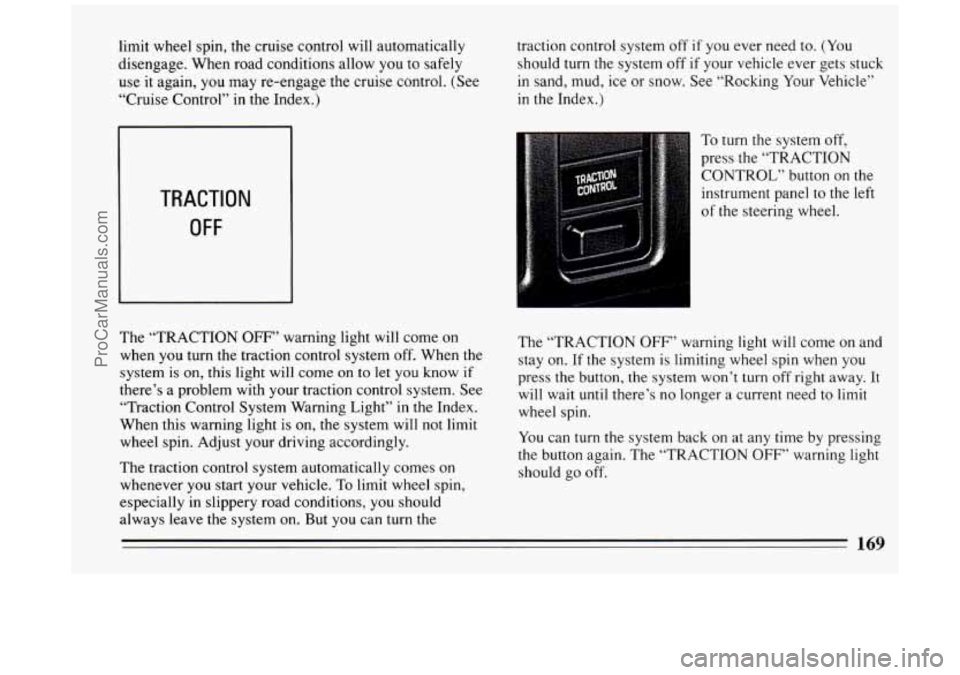
limit wheel spin, the cruise control will automatically
disengage. When road conditions allow you to safely
use it again, you may re-engage the cruise control. (See
“Cruise Control” in the Index.) traction control system
off if you ever need to. (You
should turn the system off if your vehicle ever gets stuck
in sand, mud, ice or snow. See “Rocking Your Vehicle’’
in the Index.)
TRACTION
OFF
The “TRACTION OFF” warning light will come on
when you turn the traction control system off. When the
system
is on, this light will come on to let you know if
there’s a problem with your traction control system. See
“Traction Control System Warning Light” in
the Index.
When this warning light is
on, the system will not limit
wheel spin. Adjust your driving accordingly.
The traction control system automatically comes on
whenever you start your vehicle.
To limit wheel spin,
especially in slippery road conditions,
you should
always leave the system on. But you can turn the To
turn the system off,
press the “TRACTION
CONTROL” button
on the
instrument panel to the left
of the steering wheel.
The “TRACTION
OFF” warning light will come on and
stay on.
If the system is limiting wheel spin when you
press the button, the system won’t
turn off right away. It
will wait until there’s no longer
a current need to limit
wheel spin.
You can
turn the system back on at any time by pressing
the button again. The “TRACTION
OFF” warning light
should go off.
ProCarManuals.com
Page 176 of 324
Skidding
In a skid, a driver can lose control of the vehicle.
Defensive drivers avoid most skids by taking reasonable
care suited to existing conditions, and by not
“overdriving” those conditions. But skids are always
possible.
The three types
of skids correspond to your Buick’s
three control systems. In the braking skid your wheels
aren’t rolling. In the steering or cornering skid, too
much speed or steering in a curve causes tires
to slip and
lose cornering force. And in the acceleration skid too
much throttle causes the driving wheels to spin.
A cornering skid is best handled by easing your foot off”
the accelerator pedal.
If you have the traction control system, remember: It
helps avoid only the acceleration skid.
If you do not have traction control, or if the system is
off, then an acceleration skid is also best handled by
easing your foot off the accelerator pedal.
If your vehicle starts
to slide, ease your foot off the
accelerator pedal and quickly steer the way you want the
vehicle
to go. If you start steering quickly enough, your
vehicle may straighten out. Always be ready for a
second skid if it occurs. Of
course, traction is reduced when water, snow, ice,
gravel, or other material is on the road. For safety, you’ll
want to slow down and adjust your driving
to these
conditions. It is important to slow down on slippery
surfaces because stopping distance will be longer and
vehicle control more limited.
While driving
on a surface with reduced traction, try
your best to avoid sudden steering, acceleration, or
braking (including engine braking by shifting to a lower
gear). Any sudden changes could c’ause the tires to slide.
You may not realize the surface is slippery until
your
vehicle is skidding. Learn to recognize warning clues --
such as enough water, ice or packed snow on the road to
make a “mirrored surface”
-- and slow down when you
have any doubt.
Remember: Any anti-lock braking system
(ABS) helps
avoid only the braking skid.
174
ProCarManuals.com
Page 181 of 324
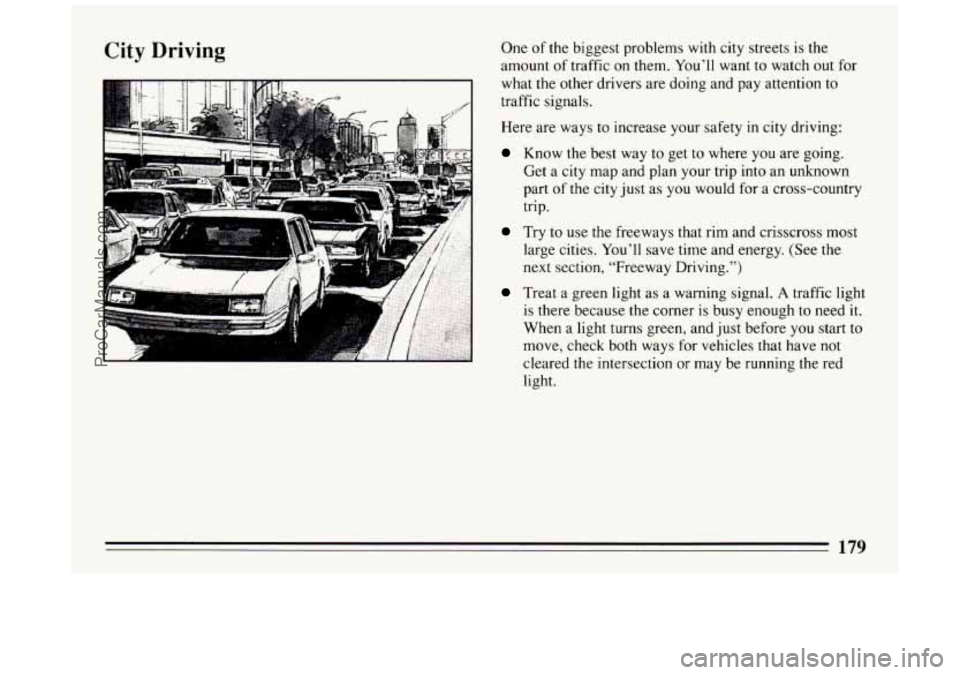
City Driving One of the biggest problems with city streets is the
amount of traffic on them. You’ll want to watch out
for
what the other drivers are doing and pay attention to
traffic signals.
Here are ways to increase your safety
in city driving:
Know the best way to get to where you are going.
Get a city map and plan your trip into an unknown
part
of the city just as you would for a cross-country
trip.
Try to use the freeways that rim and crisscross most
large cities. You’ll save time and energy. (See the
next section, “Freeway Driving.”)
Treat a green light as a warning signal. A traffic light
is there because the corner is busy enough to need it.
When a light turns green, and just before you start to
move, check both ways for vehicles that have not
cleared the intersection or may be running the red
light.
179
ProCarManuals.com
Page 186 of 324
Here are some tips for winter driving:
Have your Buick in good shape for winter. Be sure
your engine coolant mix is correct.
You may want to put winter emergency supplies in
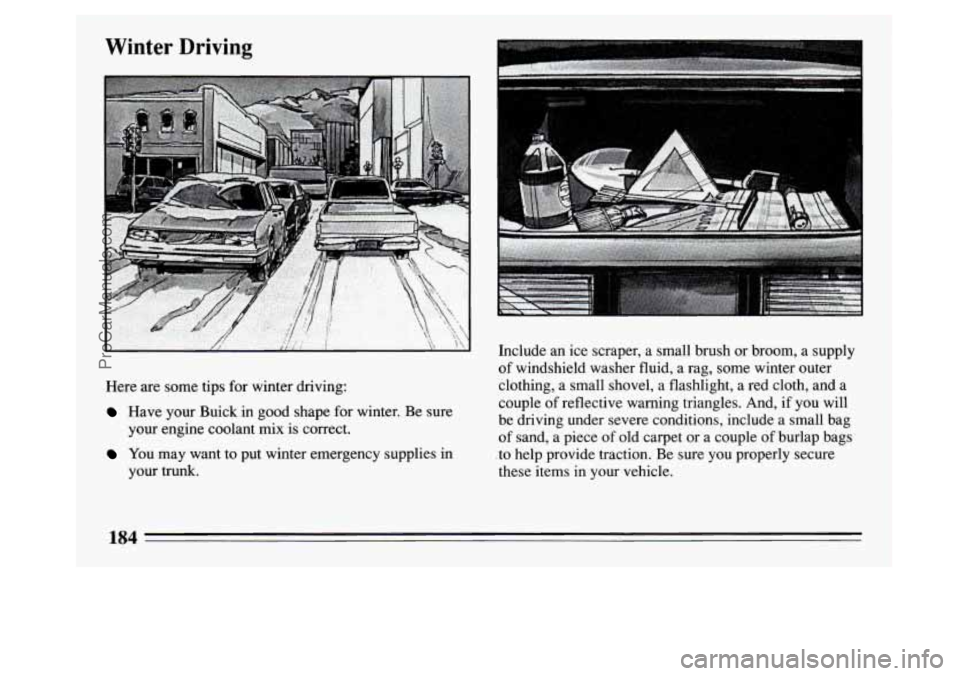
your trunk. Include
an ice scraper, a small brush or broom, a supply
of windshield washer fluid, a rag, some winter outer
clothing, a small shovel, a flashlight, a red cloth, and a
couple
of reflective warning triangles. And, if you will
be driving under severe conditions, include a small bag
of sand, a piece of old carpet or a couple of burlap bags
.to help provide traction.
Be sure you properly secure
these items in your vehicle.
184
ProCarManuals.com
Page 195 of 324
Turn Signals When Towing a Trailer
When you tow a trailer, your vehicle has to have a
different turn signal flasher and extra wiring. The green
arrows on your instrument panel
will flash whenever
you signal a turn or lane change. Properly hooked up,
the trailer lights
will also flash, telling other drivers
you’re about to turn, change lanes or stop.
When towing a trailer, the green arrows on your
instrument panel will flash for turns even
if the bulbs on
the trailer are burned out. Thus, you may
think drivers
behind you are seeing your signal when they are not. It’s
important to check occasionally to be sure the trailer
bulbs are still working.
Your vehicle has bulb warning lights. When you plug
trailer lights into your vehicle’s lighting system, its bulb
warning lights may not
let you know if one of your
lights goes out.
So, when you have trailer lights plugged
in, be sure to check your vehicle and trailer lights from
time to time to be sure they’re all working. Once you
disconnect the trailer lights, the bulb warning lights
again can tell you
if one of your vehicle lights is out.
Driving On Grades
Reduce speed and shift to a lower gear before you start
down a long or steep downgrade. If you don’t shift down,
you might have to use your brakes
so much that
they would get hot and no longer work well.
On a long uphill grade, shift down to “D or 3” (Drive)
and reduce your speed to around
45 mph (70 km/h) to
reduce the possibility of engine and transaxle
overheating.
Parking on Hills
You really should not park your vehicle, with a trailer
attached,
on a hill. If something goes wrong, your rig
could start to move. People can be injured, and both
your vehicle and the trailer can be damaged.
But
if you ever have to park your rig on a hill, here’s
how
to do it:
1. Apply your regular brakes, but don’t shift into “P”
(Park) yet.
2. Have someone place chocks under the trailer wheels.
3. When the wheel chocks are in place, release the
regular brakes until the chocks absorb the load.
4. Reapply the regular brakes. Then apply your parking
brake, and the shift to
“P” (Park).
5. Release the regular brakes.
193
ProCarManuals.com
Page 197 of 324
Part 5 Problems on the Road
Here you’ll find what to do about some problems that can occur on the road .
Part 5 includes:
Hazard Warning Flashers .................................................. ....
Other Wa-ning Devices ........................................ ...............
“Jump”Starting ...................................................................
TowingYourBuick ................................................................
Engineoverheating ................................................................
IfaTireGoesFlat .................................................................
ChangingaFlatTire ................................................................
Compact Spare Tire .................................................................
If You’re Stuck in Sand, Mud, Ice or Snow ..............................................
196
197
198
203
207
214
215
224
225
195
ProCarManuals.com