brake fluid BUICK PARK AVENUE 1994 Owners Manual
[x] Cancel search | Manufacturer: BUICK, Model Year: 1994, Model line: PARK AVENUE, Model: BUICK PARK AVENUE 1994Pages: 324, PDF Size: 17.01 MB
Page 100 of 324
NOTICE:
When using concentrated washer fluid,
follow the manufacturer’s instructions for
adding water.
0 Don’t mix water with ready-to use washer
fluid. Water can cause the solution to
freeze and damage your washer fluid tank
and other parts
of the washer system. Also,
water doesn’t clean as well as washer fluid.
0 Fill your washer fluid tank only 3/4 full
when it’s very cold. This allows for
expansion, which could damage the tank
if
it is completely full.
windshield washer. It can damage your
paint.
Don’t use radiator antifreeze in your
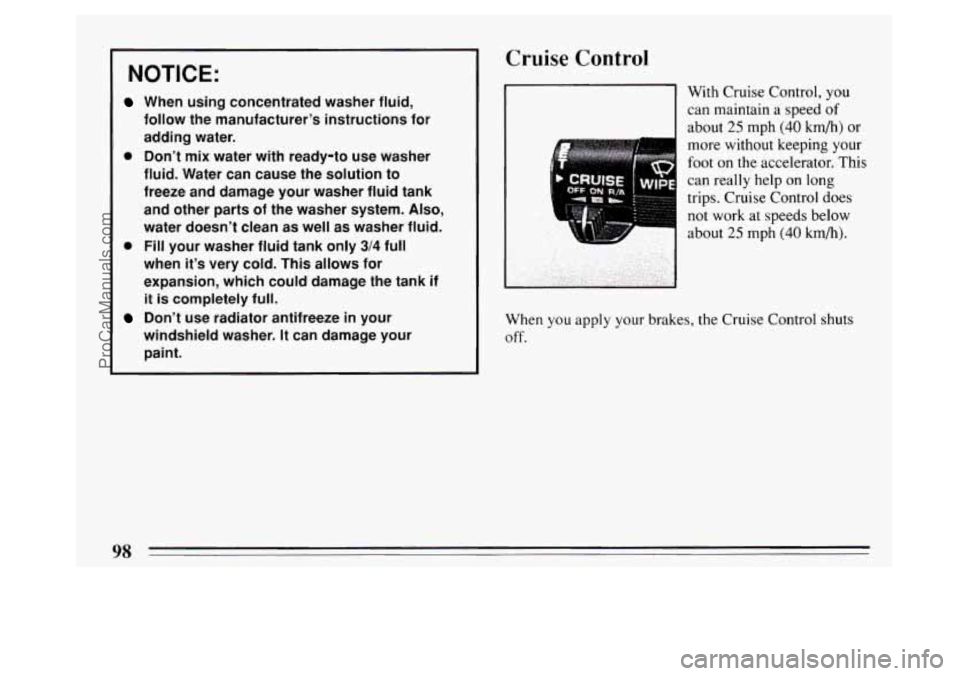
Cruise Control
1
With Cruise Control, you
can maintain a speed
of
about 25 mph (40 km/h) or
more without keeping your
foot on the accelerator. This
can really help on long
trips. Cruise Control does
not work at speeds below
about
25 mph (40 km/h).
When you apply your brakes, the Cruise Control shuts
off.
98
ProCarManuals.com
Page 185 of 324
0 Keep your vehicle in good shape. Check all fluid
levels and also the brakes, tires, cooling system and
transaxle. These parts can work hard on mountain
roads.
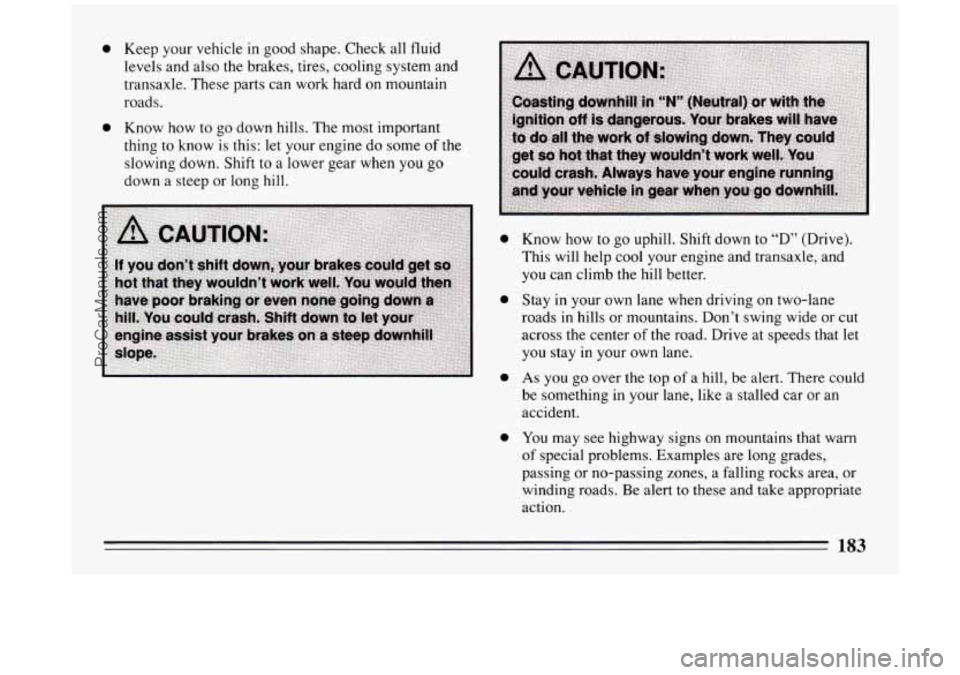
0 Know how to go down hills. The most important
thing
to know is this: let your engine do some of the
slowing down. Shift to
a lower gear when you go
down a steep or long hill.
0
0
0
0
Know how to go uphill. Shift down to “D” (Drive).
This will help cool your engine and transaxle, and
you can climb the hill better.
Stay
in your own lane when driving on two-lane
roads
in hills or mountains. Don’t swing wide or cut
across the center
of the road. Drive at speeds that let
you stay in your own lane.
As you go over the top of a hill, be alert. There could
be something in your lane, like a stalled car or an
accident.
You may see highway signs on mountains that warn
of special problems. Examples are long grades,
passing or no-passing zones, a falling rocks area, or
winding roads. Be alert
to these and take appropriate
action.
183
ProCarManuals.com
Page 196 of 324
When You Are Ready to Leave After
Parking on a Hill
1. Apply your regular brakes and hold the pedal down
while you:
Start your engine;
0 Shift into a gear; and
0 Release the parking brake.
2. Let up on the brake pedal.
3. Drive slowly until the trailer is clear of the chocks.
4. Stop and have someone pick up and store the chocks.
Maintenance When Trailer Towing
Your vehicle will need service more often when you’re
pulling a trailer. See the Maintenance Schedule for more
on this. Things that are especially important in trailer
operation are automatic transaxle fluid (don’t overfill),
engine oil, belts, cooling system, and brake adjustment.
Each of these is covered in this manual, and the Index
will help you find them quickly. If you’re trailering, it’s
a good idea to review these sections before you start
your trip.
Check periodically to see that all hitch nuts and bolts are
tight.
194
ProCarManuals.com
Page 229 of 324

Part 6 Service and Appearance Care
Here you will find information about the care of your Buick . This part begins with service and fuel information. and
then
it shows how to check important fluid and lubricant levels . There is also technical information about your
vehicle. and a section devoted to its appearance care
.
Part 6 includes:
Service ........................................................................\
.. 228
Fuel
........................................................................\
..... 229
HoodRelease
..................................................................... 234
Engineoil
....................................................................... \
238
Aircleaner
....................................................................... \
243
Automatic Transaxle Fluid
........................................................... 244
Enginecoolant
.................................................................... 247
PowerSteeringFluid ............................................................... 250
Windshield Washer Fluid
............................................................ 251
Brakes
........................................................................\
... 252
Battery
........................................................................\
.. 255
BulbReplacement
................................................................. 256
Loading Your Vehicle
............................................................... 258
Tires
........................................................................\
.... 260
Appearancecare
.................................................................. 268
Vehicle Identification Number (VIN) .................................................. 276
FusesandCircuitBreakers
........................................................... 277
Capacities and Specifications
......................................................... 282
227
ProCarManuals.com
Page 247 of 324
Wait at least 30 minutes before checking the transaxle
fluid level
if you have been driving:
0 When outside temperatures are above 90°F (32°C).
0 At high speed for quite a while.
0 In heavy traffic -- especially in hot weather.
0 While pulling a trailer.
To get the right reading, the fluid should be at normal
operating temperature, which is 180°F to 200°F (82°C
to 93°C).
Get the vehicle warmed up by driving about 15 miles
(24 km) when outside temperatures are above 50°F
(10°C). If it's colder than 50°F (lO"C), you may have
to drive longer.
To check the fluid level
Park your vehicle on a level place. Keep the engine
running.
0 With the parking brake applied, place the shift lever
in "P" (Park).
With your foot on the brake pedal, move the shift
lever through each gear range, pausing for about
three seconds
in each range. Then, position the shift
lever in "P" (Park).
0 Let the engine run at idle for three to five minutes.
Then, without shutting
off the engine. follow these
steps:
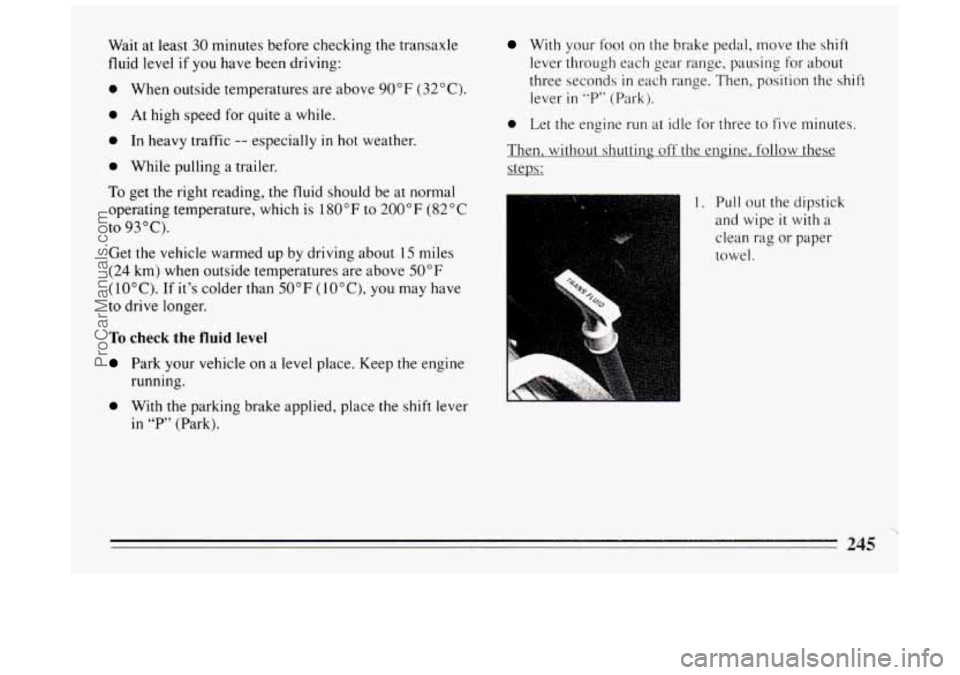
I. Pull out the dipstick
and wipe
it with a
clean rag or paper
towel.
ProCarManuals.com
Page 254 of 324
Brakes
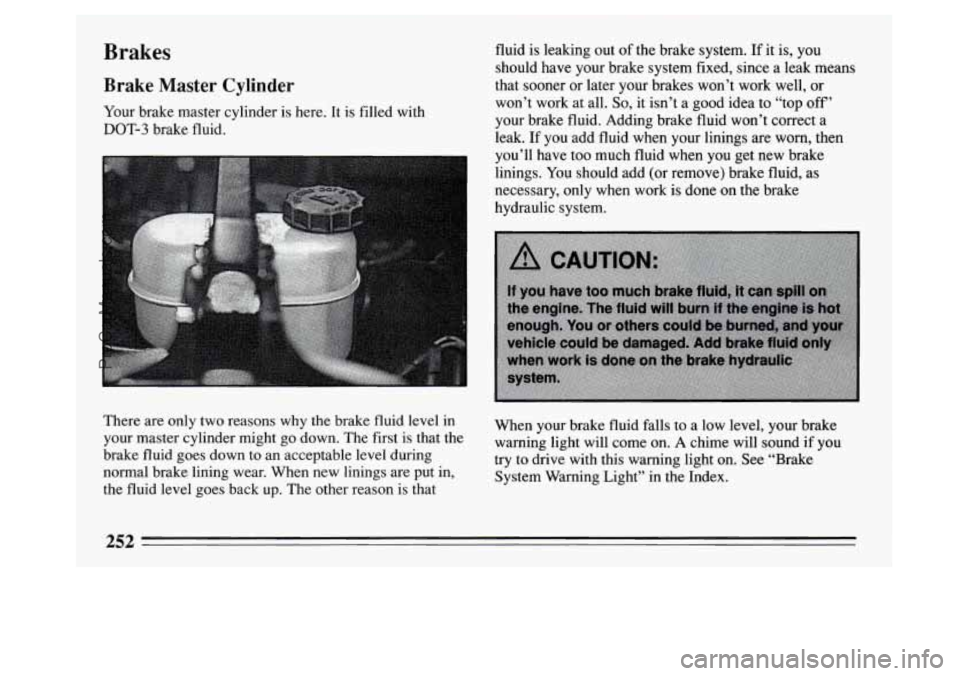
Brake Master Cylinder
Your brake master cylinder is here. It is filled with
DOT-3 brake fluid. fluid is leaking
out of the brake system. If it is, you
should have your brake system fixed, since a leak means
that sooner or later your brakes won’t work well, or
won’t work at all.
So, it isn’t a good idea to “top off’
your brake fluid. Adding brake fluid won’t correct a
leak. If you add fluid when your linings are worn, then
you’ll have too much fluid when you get new brake
linings.
You should add (or remove) brake fluid, as
necessary, only when work is done on the brake
hydraulic system.
There are only two reasons why the brake fluid level
in
your master cylinder might go down. The first is that the
brake fluid goes down to an acceptable level during
normal brake lining wear. When new linings are put in,
the fluid level goes back up. The other reason is that When
your brake fluid falls to a low level, your brake
warning light will come on. A chime will sound if you
try to drive with this warning light on. See “Brake
System Warning Light” in the Index.
252
ProCarManuals.com
Page 255 of 324
What to Add
When you do need brake fluid, use only DOT-3 brake
fluid
-- such as Delco Supreme 11 @ (GM Part
No. 1052535). Use new brake fluid from a sealed
container only, and always clean
the brake fluid
reservoir cap before removing
it.
Brake Wear
Your Buick has front disc brakes and rear drum brakes.
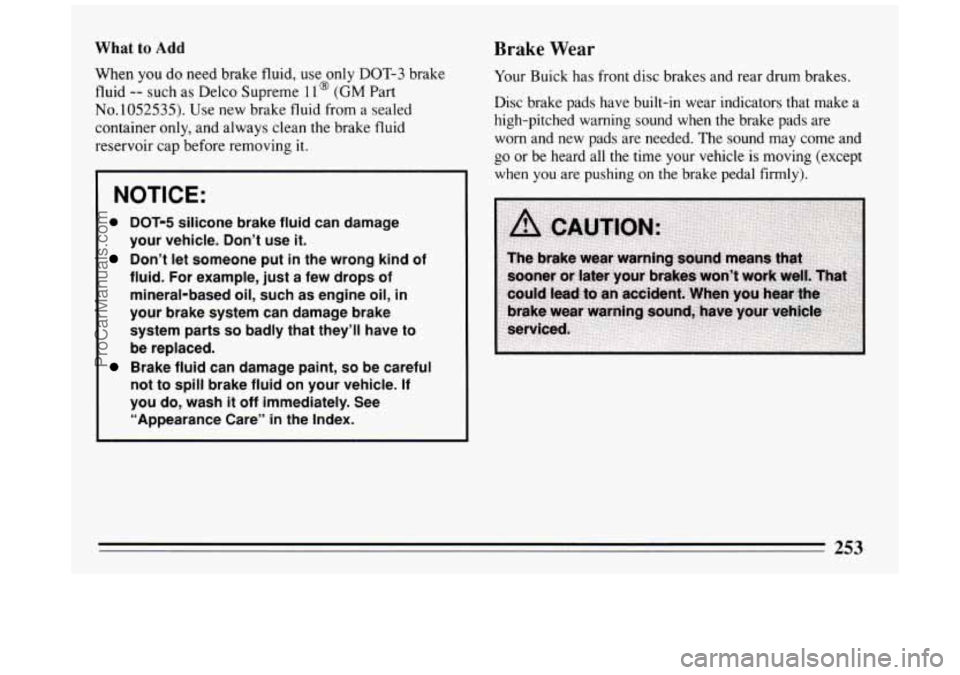
NOTICE:
0 DOT-5 silicone brake fluid can damage
your vehicle. Don’t use
it.
Don’t let someone put in the wrong kind of
fluid. For example, just
a few drops of
mineral-based oil, such as engine oil, in
your brake system can damage brake
system parts
so badly that they’ll have to
be replaced.
Brake fluid can damage paint, so be careful
not
to spill brake fluid on your vehicle. If
you do, wash
it off immediately. See
“Appearance Care”
in the Index.
Disc brake pads have built-in wear indicators that make a
high-pitched warning sound when the brake pads are
worn and new pads are needed. The sound may come and
go or be heard all the time your vehicle
is moving (except
when
you are pushing on the brake pedal firmly).
253
ProCarManuals.com
Page 294 of 324
Explanation of Scheduled Maintenance
Services
Following are explanations of the services listed in
Schedule I and Schedule 11.
The proper fluids and lubricants to use are listed
in
Section D. Make sure whoever services your vehicle
uses these. All parts should be replaced and all
necessary repairs done before you or anyone else drives
the vehicle.
NOTE: To determine your engine’s displacement and
code, see “Engine Identification”
in the Index.
1. Engine Oil and Filter Change* -- Always use SH
or SG Energy Conserving I1 oils of proper viscosity.
The
“SH” or “SG” designation may be shown alone
or
in combination with others, such as “SH/CD” or
“SH,
SG, CD,” “SG/CD,” etc. To determine the
preferred viscosity for your vehicle’s engine (e.g., SAE
5W-30 or SAE low-30), see “Engine Oil” in
the Index.
If your vehicle has an Engine Oil Life Monitor, the
monitor will show you when to change the oil. See
“Engine Oil Life Monitor”
in the Index. 2.
Chassis Lubrication -- Lubricate
the transaxle shift
linkage, parking brake cable guides, underbody
contact points and linkage. If your vehicle is
equipped
with grease fittings, lubricate the
suspension and steering linkage.
3. Tire and Wheel Rotation and Inspection -- For
proper wear and maximum tire life, rotate your tires
following the instructions
in this manual. See “Tires,
Inspection
& Rotation” in the Index. Check the tires
for uneven wear or damage. If you see irregular or
premature wear, check the wheel alignment. Check
for damaged wheels also.
4. Engine Accessory Drive Belt(s) Inspection --
Inspect the belt(s) for cracks, fraying, wear and
proper tension. Replace as needed.
5. Cooling System Service* -- Drain, flush and refill
the system
with new or approved recycled coolant
conforming to GM Specification 1825M. Keep
coolant at the proper mixture as specified. See
“Coolant”
in the Index. This provides proper freeze
protection, corrosion inhibitor level and engine
operating temperature.
292
ProCarManuals.com
Page 301 of 324
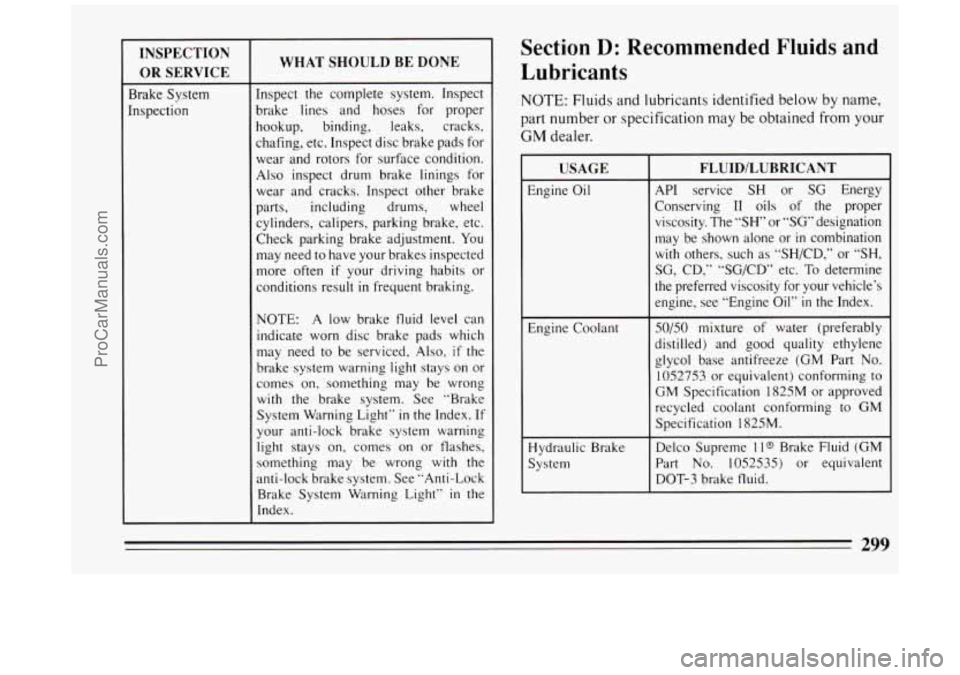
INSPECTION
OR SERVICE
Brake System
[nspection
WHAT SHOULD BE DONE
Inspect the complete system. Inspect
brake
lines and hoses for proper
hookup, binding, leaks, cracks,
chafing, etc. Inspect disc brake pads for
wear and rotors for surface condition.
Also inspect drum brake linings for
wear and cracks. Inspect other brake
parts, including drums, wheel
cylinders, calipers, parking brake, etc.
Check parking brake adjustment. You
may need
to have your brakes inspected
more often if your driving habits or
conditions result
in frequent braking.
NOTE:
A low brake fluid level can
indicate worn disc brake pads which
may need to be serviced, Also,
if the
brake system warning light stays on or
comes
on, something may be wrong
with the brake system. See ”Brake
System Warning Light”
in the Index. If
your anti-lock brake system warning
light stays on, comes on or flashes,
something may
be wrong with the
anti-lock brake system. See “Anti-Lock
Brake System Warning Light”
in the
Index.
Section D: Recommended Fluids and
Lubricants
NOTE: Fluids and lubricants identified below by name,
part number or specification may be obtained from your
GM dealer
I USAGE FLUID/LUBRICANT
API service
SH or SG Energy
Conserving I1 oils
of the proper
viscosity. The
“SH” or “SG” designation
may be shown alone or
in combination
with others, such as “SH/CD,” or
“SH,
SG, CD,” “SG/CD” etc. To determine
the preferred viscosity for your vehicle’s
engine, see “Engine Oil”
in the Index.
S0/50 mixture of water (preferably
distilled) and good quality ethylene
glycol base antifreeze
(GM Part No.
1052753 or equivalent) conforming to
GM Specification 182SM or approved
recycled coolant conforming to
GM
Specification 182SM.
Delco Supreme
1 I@ Brake Fluid (GM
Part
No. 1052535) or equivalent
DOT-3 brake fluid.
~ 299
ProCarManuals.com
Page 302 of 324
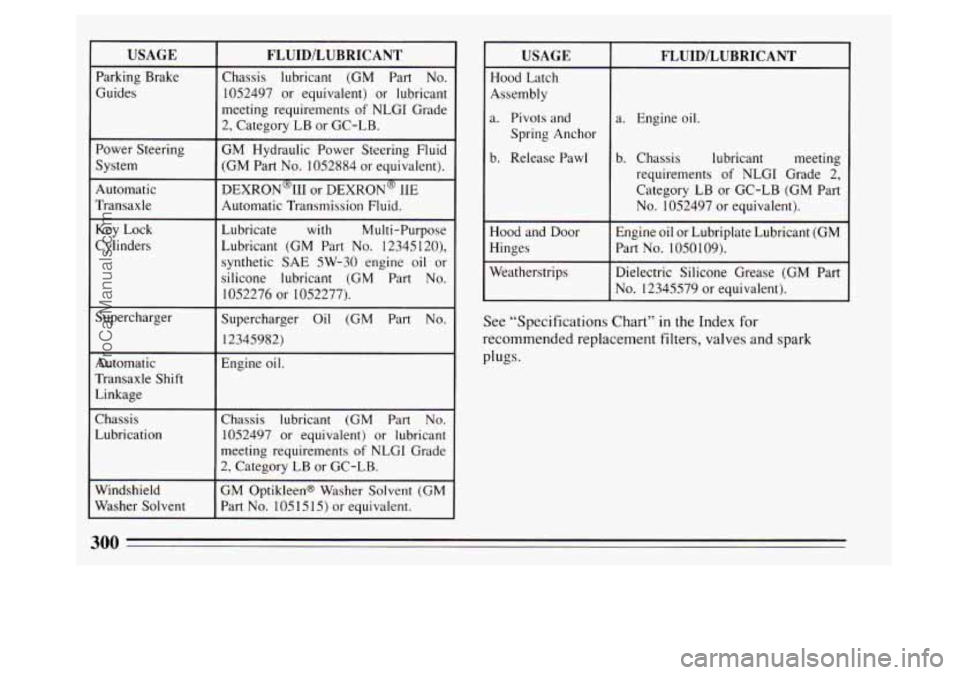
USAGE
Parking Brake
Guides
Power Steering
System
Automatic
Transaxle
Key Lock
Cylinders
Supercharger
Automatic
Transaxle Shift
Linkage
Chassis
Lubrication
Windshield
Washer Solvent
FLUID/LUBRICANT
Chassis lubricant (GM Part No.
1052497 or equivalent) or lubricant
meeting requirements of NLGI Grade
2, Category LB or GC-LB.
GM Hydraulic Power Steering Fluid
(GM Part
No. 1052884 or equivalent).
DEXRON~II or DEXRON~ IIE
Automatic Transmission Fluid.
Lubricate with Multi-Purpose
Lubricant (GM Part
No. 12345120),
synthetic SAE 5W-30 engine
oil or
silicone lubricant (GM Part
No.
1052276 or 1052277).
Supercharger Oil (GM Part
No.
12345982)
Engine oil.
Chassis lubricant (GM Part
No.
1052497 or equivalent) or lubricant
meeting requirements
of NLGI Grade
2, Category LB
or GC-LB.
GM OptikleenB Washer Solvent (GM
Part
No. 105 15 15) or equivalent.
USAGE
Hood Latch
Assembly
a. Pivots and
Spring Anchor
b. Release Pawl
Hood and Door
Hinges
Weatherstrips
FLUID/LUBRICANT
a. Engine oil.
b. Chassis lubricant meeting
requirements of NLGI Grade
2,
Category LB or GC-LB (GM Part
No. 1052497 or equivalent).
Engine oil or Lubriplate Lubricant (GM
Part
No. 1050109).
Dielectric Silicone Grease (GM Part
No. 12345579 or equivalent).
See “Specifications Chart” in the Index for
recommended replacement filters, valves and spark
plugs.
300
ProCarManuals.com