heating BUICK PARK AVENUE 1994 Owners Manual
[x] Cancel search | Manufacturer: BUICK, Model Year: 1994, Model line: PARK AVENUE, Model: BUICK PARK AVENUE 1994Pages: 324, PDF Size: 17.01 MB
Page 11 of 324
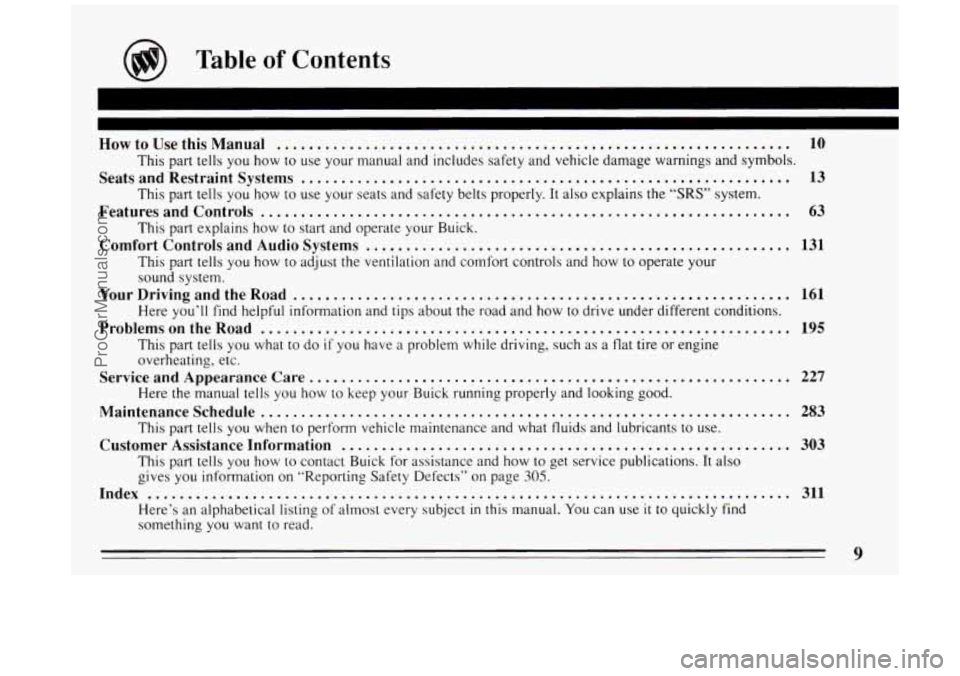
Table of Contents
How to Use this Manual ................................................................ 10
This part tells you how to use your manual and includes safety and vehicle damage \
warnings and symbols.
Seats and Restraint Systems ............................................................. 13
This part tells you how to use your seats and safety belts properl\
y. It also explains the “SRS” system.
FeaturesandControls .................................................................. 63
This part explains how to start and operate your Buick.
Comfort Controls and Audio Systems ..................................................... 131
This part tells you how to adjust the ventilation and comfort controls and how to operate your
sound system.
Here you’ll find helpful information and tips about
the road and how to drive under different conditions.
ProblemsontheRoad .................................................................. 195
This part tells you what to do if you have a problem while driving, such as a flat tire or engine
overheating, etc.
Here
the manual tells you how to keep your Buick running properly and \
looking good.
This part tells you when to perform vehicle maintenance and what fluids and lubricants to use.
This part tells you how
to contact Buick for assistance and how to get service publications. It also
gives you information on “Reporting Safety Defects” on pag\
e
305.
Here’s an alphabetical listing of almost every subject in this manual. You can use it to quickly find
something you want to read.
YourDrivingandtheRoad .............................................................. 161
Serviceand Appearancecare
............................................................ 227
Maintenanceschedule .................................................................. 283
Customer Assistance Information
........................................................ 303
Index
........................................................................\
........ 311
9
ProCarManuals.com
Page 120 of 324
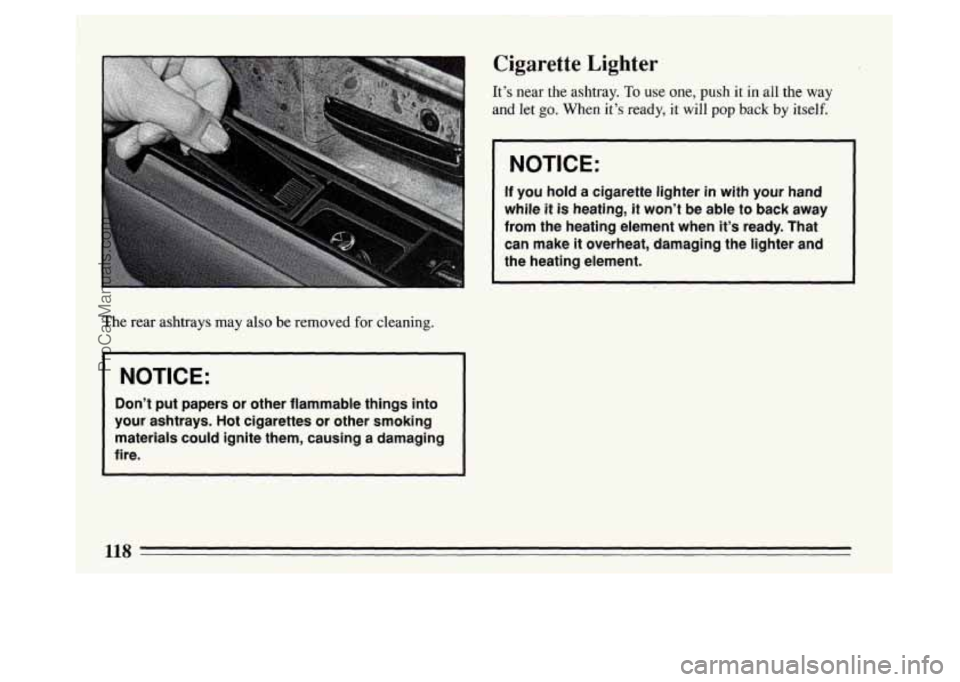
The rear ashtrays may also be removed for cleaning.
I NOTICE:
Don’t put papers or other flammable things into
your ashtrays. Hot cigarettes or other smoking
materials could ignite them, causing a damaging
fire.
Cigarette Lighter
It’s near the ashtray. To use one, push it in all the way
and
let go. When it’s ready, it will pop back by itself.
I NOTICE:
If you hold a cigarette lighter in with your hand
while
it is heating, it won’t be able to back away
from the heating element when it’s ready. That
can make
it overheat, damaging the lighter and
the heating element.
118
ProCarManuals.com
Page 126 of 324
Engine Coolant Temperature Gage If the “TRACTION OFF” warning light comes on and
stays on for an extended period of time, your vehicle
needs service.
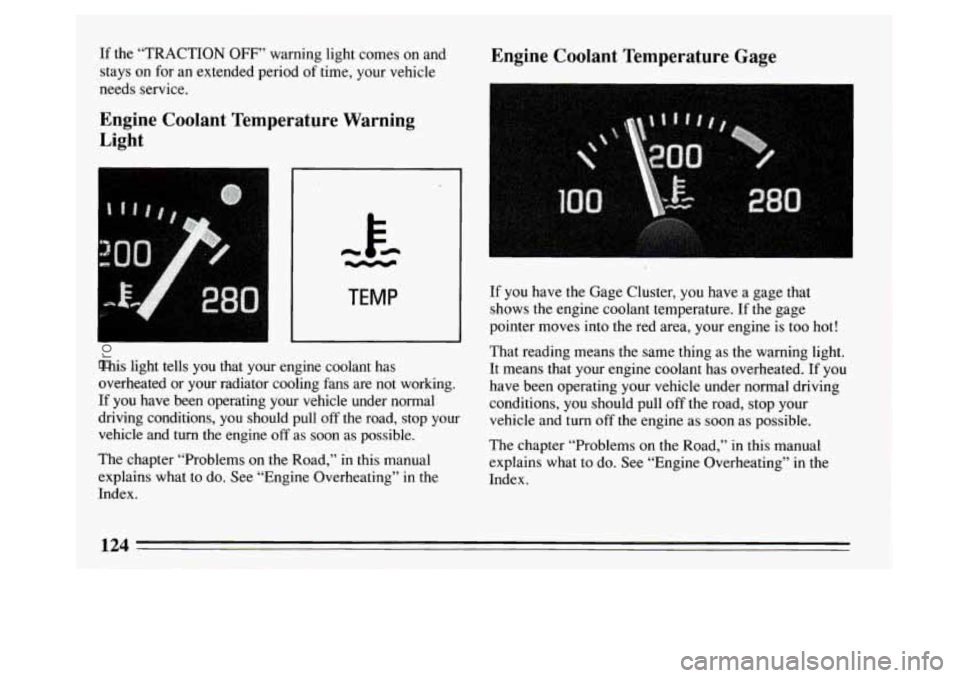
Engine Coolant Temperature Warning
Light
TEMP
This light tells you that your engine coolant has
overheated or your radiator cooling fans are not working.
If you have been operating your vehicle under normal
driving conditions, you should pull
off the road, stop your
vehicle and turn the engine
off as soon as possible.
The chapter “Problems on the Road,” in this manual
explains what to do. See “Engine Overheating” in the
Index.
If you have the Gage Cluster, you have a gage that
shows the engine coolant temperature.
If the gage
pointer moves into the red area, your engine is too hot!
That reading means the same thing as the warning light.
It means that your engine coolant has overheated. If you
have been operating your vehicle under normal driving
conditions, you should pull
off the road, stop your
vehicle and
turn off the engine as soon as possible.
The chapter “Problems on the Road,” in this manual
explains what to do. See “Engine Overheating” in the
Index.
124
ProCarManuals.com
Page 136 of 324
CoollWarm Off
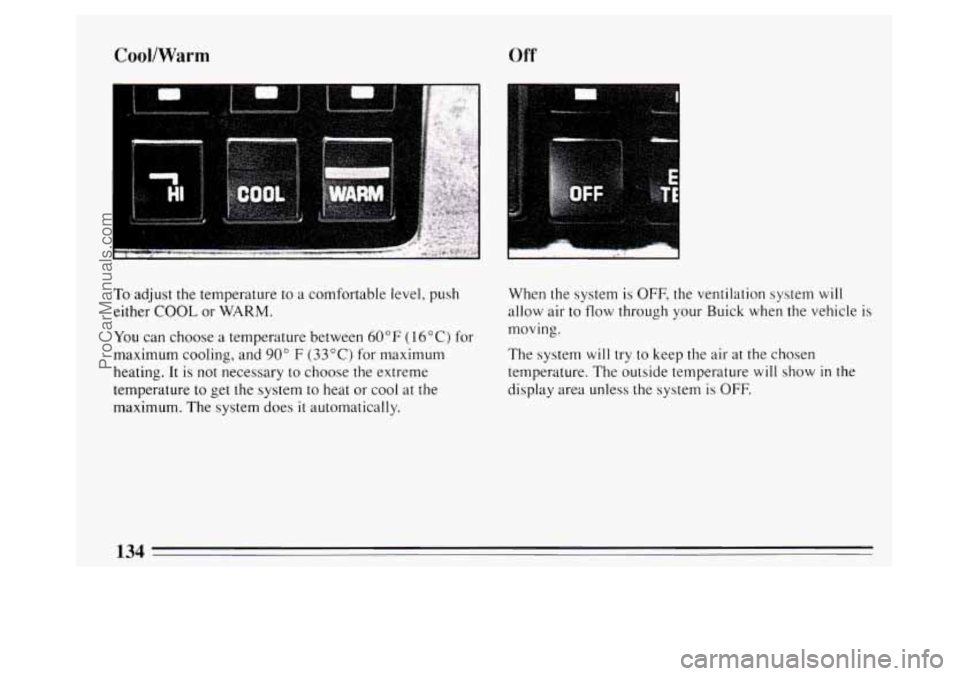
To adjust the temperature to a comfortable level, push
either
COOL or WARM.
You can choose a temperature between 60 OF ( 16 O C) for
maximum cooling, and
90" F (33°C) for maximum
heating. It is not necessary to choose the extreme
temperature
to get the system to heat or cool at the
maximum. The system does
it automatically. When the
system
is OFF, the ventilation system will
allow air to flow through your Buick when the vehicle is
moving.
The system
will try to keep the air at the chosen
temperature. The outside temperature will show
in the
display area unless the system is
OFF.
134
ProCarManuals.com
Page 141 of 324
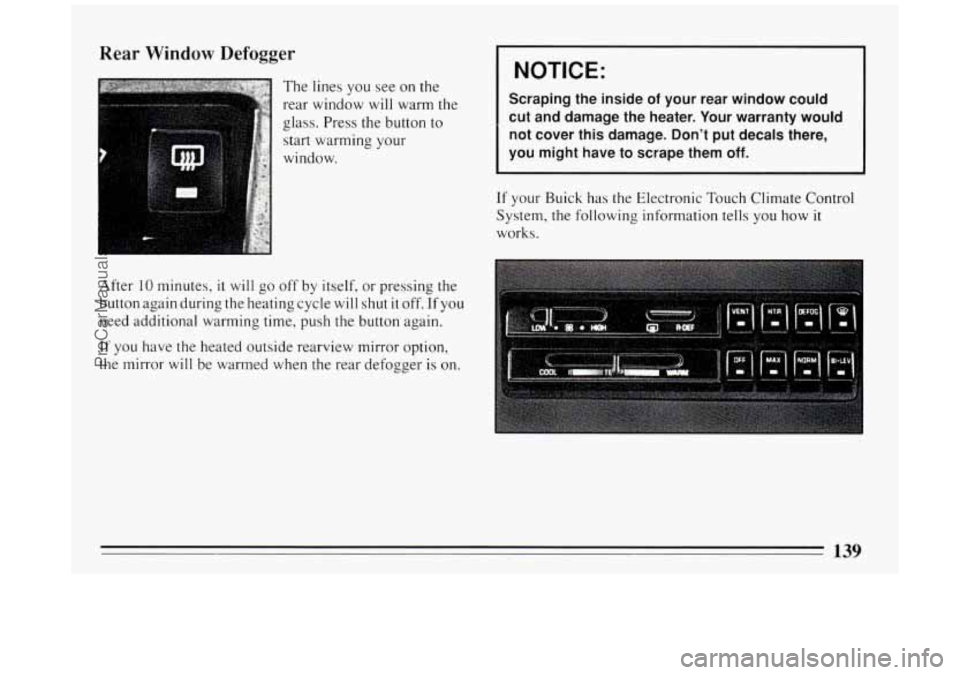
Rear Window Defogger
The lines you see on the
rear window will warm the
glass. Press the button to
start warming your
window.
NOTICE:
Scraping the inside of your rear window could
cut and damage the heater. Your warranty would
not cover this damage. Don’t put decals there,
you might have to scrape them
off.
If your Buick has the Electronic Touch Climate Control
System, the following information tells you how
it
works.
After
10 minutes, it will go off by itself, or pressing the
button again during the heating cycle will shut
it off. If you
need additional warming time, push the button again.
If you have the heated outside rearview mirror option,
the mirror
will be warmed when the rear defogger is on.
139
ProCarManuals.com
Page 143 of 324
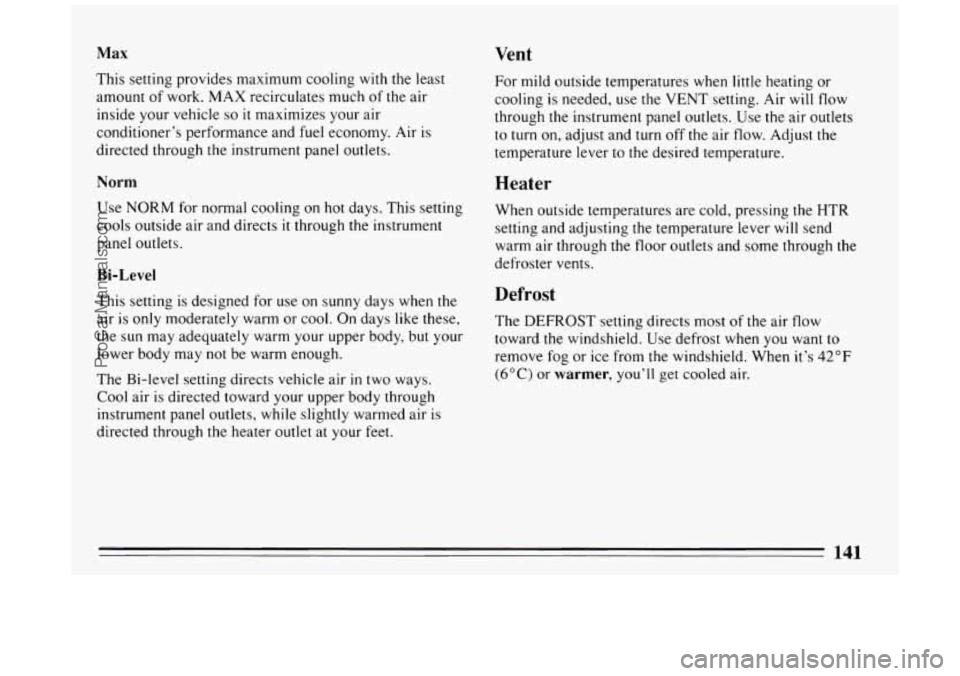
Max Vent
This setting provides maximum cooling with the least
amount
of work. MAX recirculates much of the air
inside
your vehicle so it maximizes your air
conditioner’s performance and fuel economy. Air is
directed through
the instrument panel outlets.
Norm
Use NORM for normal cooling on hot days. This setting
cools outside air and directs
it through the instrument
panel outlets.
Bi-Level
This setting is designed for use on sunny days when the
air is only moderately warm or cool. On days like these,
the sun may adequately warm your upper body, but your
lower body may not be warm enough.
The Bi-level setting directs vehicle air
in two ways.
Cool air
is directed toward your upper body through
instrument panel outlets, while slightly warmed air is
directed through the heater outlet at your feet. For
mild outside temperatures when little heating or
cooling is needed, use the VENT setting. Air
will flow
through the instrument panel outlets. ,Use the air outlets
to turn
on, adjust and turn off the air flow. Adjust the
temperature lever to the desired temperature.
Heater
When outside temperatures are cold, pressing the HTR
setting and adjusting the temperature lever
will send
warm air through
the floor outlets and some through the
defroster vents.
Defrost
The DEFROST setting directs most of the air flow
toward the windshield. Use defrost when you want
to
remove fog or ice from the windshield. When it’s 42°F
(6°C) or warmer, you’ll get cooled air.
ProCarManuals.com
Page 144 of 324
Defog
When the outside temperature is mild, use Defog to
keep the
fog off the windshield.
Air entering the vehicle will be evenly split between the
floor outlets and the outlets near
the windshield. You
can control the temperature of the air and the fan speed
to clear the foggy windows.
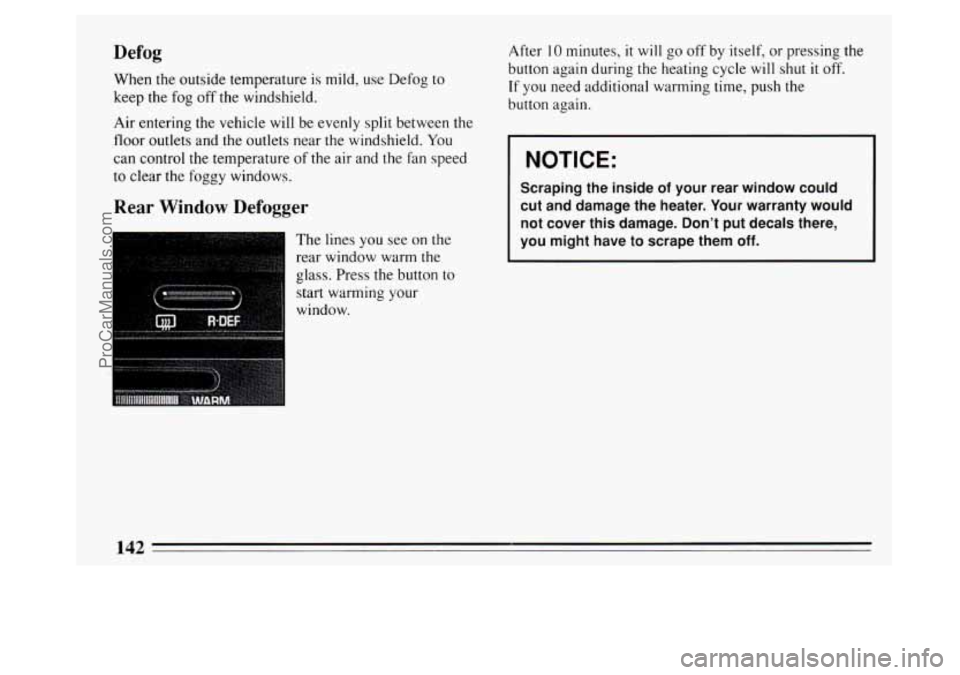
Rear Window Defogger
The lines you see on the
rear window warm the
glass. Press the button to start warming your
window. After
10 minutes, it will go off by
itself, or pressing the
button again during the heating cycle
will shut it off.
If you need additional warming time, push the
button again.
I NOTICE:
Scraping the inside of your rear window could
cut and damage the heater.
Your warranty would
not cover this damage. Don’t put decals there,
you might have to scrape them
off.
142
ProCarManuals.com
Page 195 of 324
Turn Signals When Towing a Trailer
When you tow a trailer, your vehicle has to have a
different turn signal flasher and extra wiring. The green
arrows on your instrument panel
will flash whenever
you signal a turn or lane change. Properly hooked up,
the trailer lights
will also flash, telling other drivers
you’re about to turn, change lanes or stop.
When towing a trailer, the green arrows on your
instrument panel will flash for turns even
if the bulbs on
the trailer are burned out. Thus, you may
think drivers
behind you are seeing your signal when they are not. It’s
important to check occasionally to be sure the trailer
bulbs are still working.
Your vehicle has bulb warning lights. When you plug
trailer lights into your vehicle’s lighting system, its bulb
warning lights may not
let you know if one of your
lights goes out.
So, when you have trailer lights plugged
in, be sure to check your vehicle and trailer lights from
time to time to be sure they’re all working. Once you
disconnect the trailer lights, the bulb warning lights
again can tell you
if one of your vehicle lights is out.
Driving On Grades
Reduce speed and shift to a lower gear before you start
down a long or steep downgrade. If you don’t shift down,
you might have to use your brakes
so much that
they would get hot and no longer work well.
On a long uphill grade, shift down to “D or 3” (Drive)
and reduce your speed to around
45 mph (70 km/h) to
reduce the possibility of engine and transaxle
overheating.
Parking on Hills
You really should not park your vehicle, with a trailer
attached,
on a hill. If something goes wrong, your rig
could start to move. People can be injured, and both
your vehicle and the trailer can be damaged.
But
if you ever have to park your rig on a hill, here’s
how
to do it:
1. Apply your regular brakes, but don’t shift into “P”
(Park) yet.
2. Have someone place chocks under the trailer wheels.
3. When the wheel chocks are in place, release the
regular brakes until the chocks absorb the load.
4. Reapply the regular brakes. Then apply your parking
brake, and the shift to
“P” (Park).
5. Release the regular brakes.
193
ProCarManuals.com
Page 197 of 324
Part 5 Problems on the Road
Here you’ll find what to do about some problems that can occur on the road .
Part 5 includes:
Hazard Warning Flashers .................................................. ....
Other Wa-ning Devices ........................................ ...............
“Jump”Starting ...................................................................
TowingYourBuick ................................................................
Engineoverheating ................................................................
IfaTireGoesFlat .................................................................
ChangingaFlatTire ................................................................
Compact Spare Tire .................................................................
If You’re Stuck in Sand, Mud, Ice or Snow ..............................................
196
197
198
203
207
214
215
224
225
195
ProCarManuals.com
Page 209 of 324
Engine Overheating
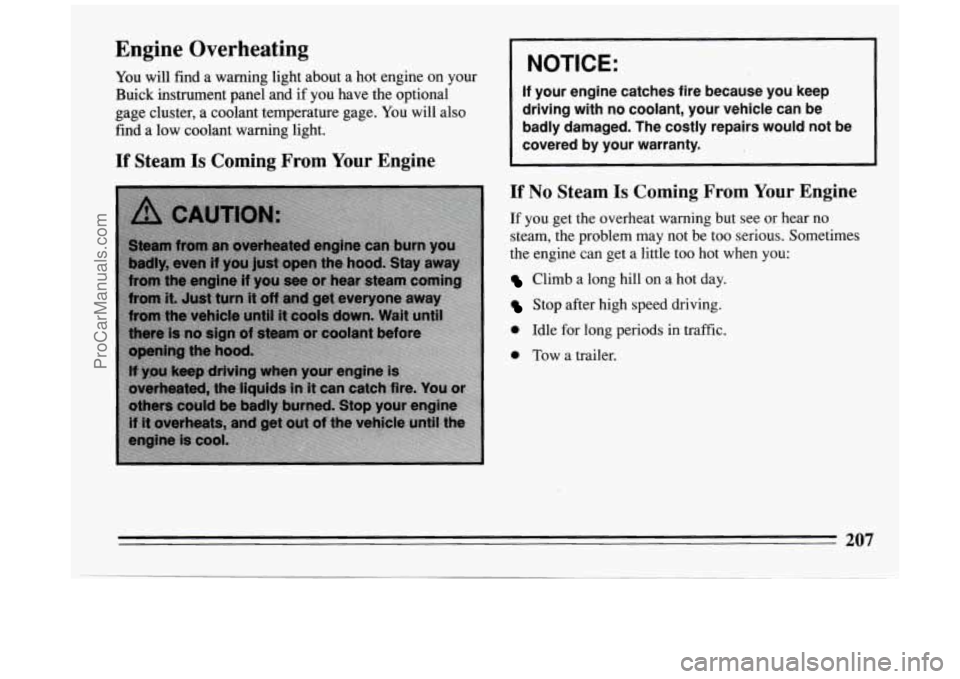
You will find a warning light about a hot engine on your
Buick instrument panel and if you have the optional
gage cluster, a coolant temperature gage. You will also
find a low coolant warning light.
If Steam Is Coming From Your Engine
NOTICE:
If your engine catches fire because you keep
driving with no coolant, your vehicle can be
badly damaged. The costly repairs would not be
covered by your warranty.
If NO Steam Is Coming From Your Engine
If you get the overheat warning but see or hear no
steam, the problem may not be too serious. Sometimes
the engine can get a little too hot when you:
Climb a long hill on a hot day.
Stop after high speed driving.
0 Idle for long periods in traffic.
0 Tow a trailer.
207
ProCarManuals.com