headlamp BUICK PARK AVENUE 1996 User Guide
[x] Cancel search | Manufacturer: BUICK, Model Year: 1996, Model line: PARK AVENUE, Model: BUICK PARK AVENUE 1996Pages: 388, PDF Size: 20.04 MB
Page 108 of 388
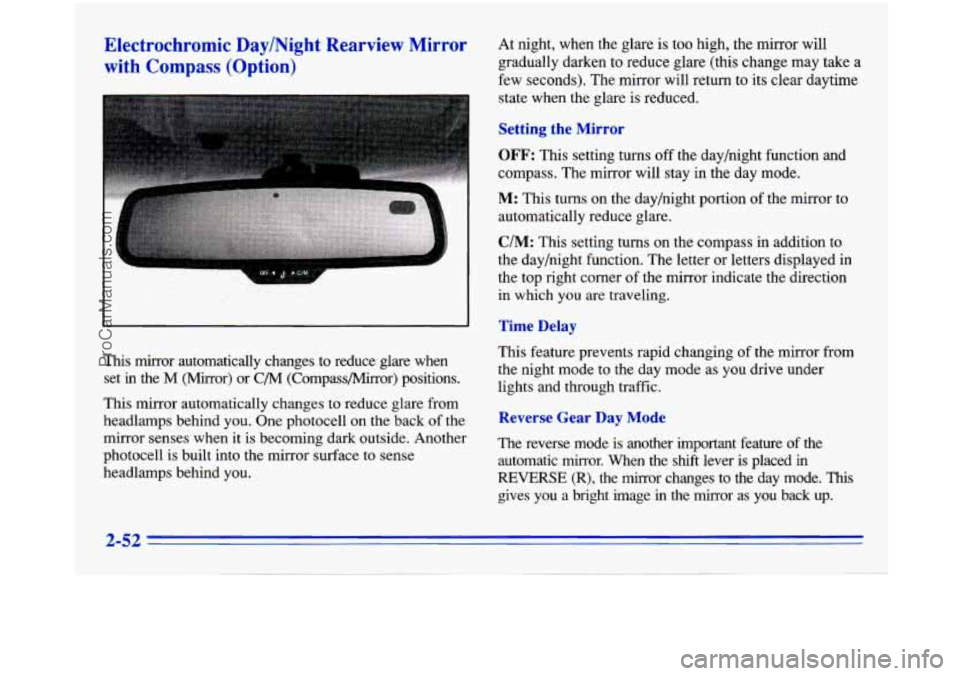
Electrochromic Day/Night Rearview Mirror with
Compass (Option)
At night, when the glare is too high, the mirror will
gradually darken to reduce glare (this change may take a
few seconds). The mirror will return to its clear daytime
state when the glare is reduced.
Setting the Mirror
OFF: This setting turns off the day/night function and
compass. The mirror will stay in the day mode.
M: This turns on the day/night portion of the mirror to
automatically reduce glare.
C/M: This setting turns on the compass in addition to
the day/night function. The letter or letters displayed in
the top right corner
of the mirror indicate the direction
in which you are traveling.
Time Delay
This mirror automatically changes to reduce glare when
set
in the M (Mirror) or C/M (Compass/Mirror) positions.
This mirror automatically changes to reduce glare from
headlamps behind you. One photocell on the back
of the
mirror senses when it
is becoming dark outside. Another
photocell
is built into the mirror surface to sense
headlamps behind you. This feature
prevents rapid changing
of the mirror from
the night mode to the day mode as you drive under
lights and through traffic.
Reverse Gear Day Mode
The reverse mode is another important feature of the
automatic mirror. When the shift lever is placed in
REVERSE (R), the mirror changes to the day mode. This
gives you a bright image in the mirror as you back up.
ProCarManuals.com
Page 111 of 388
Convex Outside Mirror
Your passenger’s side mirror is convex. A convex
mirror’s surface is curved
so you can see more from the
driver’s seat.
I, -
A convex mirror can make things (like other
vehicles) look farther away than they really are.
If you cut too sharply into the right lane, you
could hit a vehicle on your right. Check your
inside mirror or glance over your shoulder before
changing lanes.
Heated Outside Rearview Mirror (Option)
If you have this option, the lelt and right outside mirrors
are heated when you activate the rear window defogger.
Automatic Dimming Outside Rearview
Mirror (Option)
If you have this option, the driver’s side outside mirror
will adjust for the glare of headlamps behind you. This
feature is controlled by the on and off settings on the
automatic electrochromic day/night rearview mirror. See
“Automatic Electrochromic Daymight Rearview
Mirror” earlier
in this section.
Storage Compartments
Glove Box
The glove box is directly in front of the front passenger
seat. Use the
door key to lock and unlock the glove box.
To open, pull the latch to the right of the lock.
ProCarManuals.com
Page 121 of 388
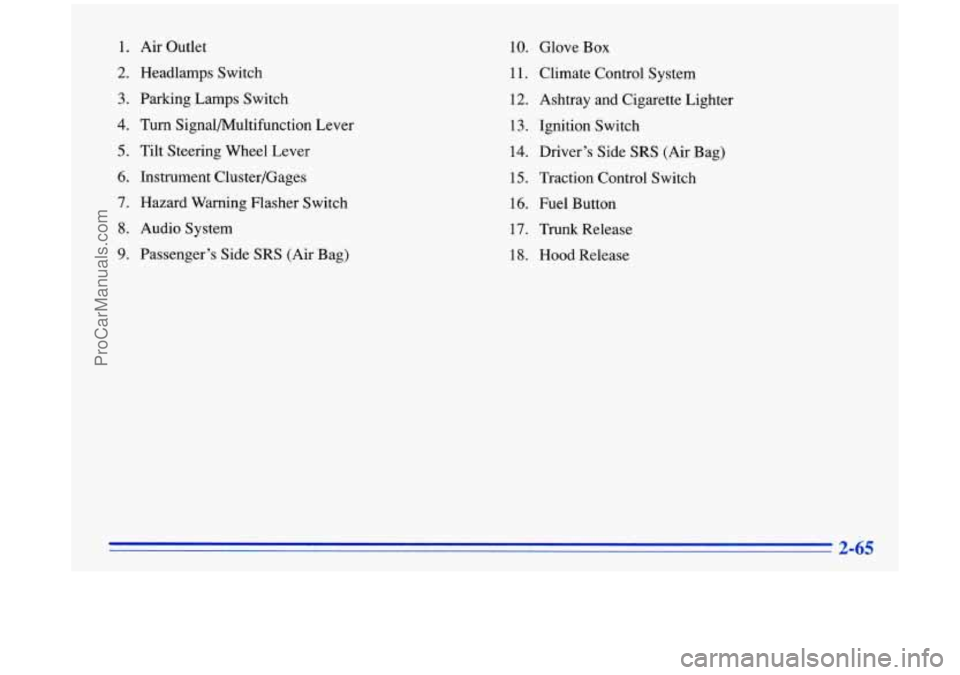
1. Air Outlet
2. Headlamps Switch
3. Parking Lamps Switch
4. Turn Signal/Multifunction Lever
5. Tilt Steering Wheel Lever
6. Instrument Cluster/Gages
7. Hazard Warning Flasher Switch
8. Audio System
9. Passenger’s Side SRS (Air Bag)
10. Glove Box
11. Climate Control System
12. Ashtray and Cigarette Lighter
13. Ignition Switch
14. Driver’s Side
SRS (Air Bag)
15. Traction Control Switch
16. Fuel Button
17.
Trunk Release
18. Hood Release
ProCarManuals.com
Page 189 of 388
Here are some tips on night driving.
0
0
0
0
0
0
0
Drive defensively.
Don’t drink and drive.
Adjust your inside rearview mlrror to reduce the
glare from headlamps behind you.
Since you can’t see as well, you may need to
slow down and keep more space between you and
other vehicles.
Slow down, especially on higher speed roads. Your
headlamps can light up only
so much road ahead.
In remote areas, watch for animals.
If you’re tired, pull off the road in a safe place
and rest.
Night Vision
No one can see as well at night as in the daytime. But as
we get older
these differences increase. A 50-year-old
driver may require at least twice as much light to see the
same thing at night as a 20-year-old.
What you do in the daytime can also affect your night
vision. For example, if you spend the day in bright
sunshine you are wise to wear sunglasses. Your eyes
will
have less trouble adjusting to night. But if you’re driving,
don’t wear sunglasses at night. They may cut
down on glare from headlamps, but they also make a lot
of things invisible.
You can be temporarily blinded by approaching
headlamps. It can take a second or two, or even several
seconds, for your eyes to readjust to the dark. When
you are faced with severe glare (as from a driver who
doesn’t lower the high beams, or a vehicle with
misaimed headlamps), slow down a little. Avoid staring
directly into the approaching headlamps.
Keep your windshield and all the glass on your vehicle
clean
-- inside and out. Glare at night is made much
worse by dirt on the glass. Even the inside of the glass
can build up a film caused by dust. Dirty glass makes
lights dazzle and flash more than clean glass would,.
making the pupils of your eyes contract repeatedly.
Remember that your headlamps light up far less of a
roadway when you are in a turn or curve. Keep your
eyes moving; that way, it’s easier to pick out dimly
lighted objects. Just as your headlamps should be
checked regularly for proper aim,
so should your eyes
be examined regularly. Some drivers suffer from night
blindness
-- the inability to see in dim light -- and
aren’t even aware of it.
1 4-15
ProCarManuals.com
Page 192 of 388
Hydroplaning
Hydroplaning is dangerous. So much water can build up
under your tires that they can actually ride on the water.
This can happen if the road is wet enough and you’re
going fast enough. When your vehicle is hydroplaning,
it has little or no contact with the road.
Hydroplaning doesn’t happen often. But
it can if your
tires haven’t much tread
or if the pressure in one or
more is low. It can happen if a lot
of water is standing on
the road. If you can see reflections from trees, telephone
poles or other vehicles, and raindrops “dimple” the
water’s surface, there could be hydroplaning.
Hydroplaning usually happens at higher speeds. There
just isn’t a hard and fast rule about hydroplaning. The
best advice is to slow down when it is raining.
0
0
Driving Through Deep Standing Water
NOTICE:
If you drive too quickly through deep puddles or
standing water, water can come in through your
engine’s air intake and badly damage your
engine. Never drive through water that
is slightly
lower than the underbody
of your vehicle. If you
can’t avoid deep puddles or standing water, drive
through them very slowly.
Some Other Rainy Weather Tips
Turn on your low-beam headlamps -- not just
your parking lamps
-- to help make you more visible
to others.
Besides slowing down, allow some extra following
distance. And be especially careful when
you pass
another vehicle. Allow yourself more clear room
ahead, and be prepared to have your view restricted
by road spray.
Have good tires with proper tread depth. (See
“Tires”
in the Index.)
0
ProCarManuals.com
Page 202 of 388
Run your engine only as long as you must. This saves
fuel. When you run the engine, make it go a little faster
than just idle. That is, push the accelerator slightly. This
uses less fuel for the heat that you get and it keeps the
battery charged. You will need a well-charged battery to
restart the vehicle, and possibly for signaling later on
with your headlamps. Let the heater run for awhile.
Then, shut the engine off and close the window almost
all the way to preserve the heat. Start the engine again
and repeat this only when you feel really uncomfortable
from the cold. But do it as little as possible. Preserve the
fuel as long as you can. To help keep warm, you can get
out of the vehicle and do some fairly vigorous exercises
every half hour or
so until help comes.
Loading Your Vehicle
ym OCCUPANTS
VEHICLE CAP. WT.
TIRE-LOADING INFORMATION
7
FRT. CTR. RR. TOTAL LBS. KG
MAX. LOADING & GVWR
SAME AS VEHICLE
CAPACITY WEIGHT XXX COLD TIRE
TIRE
SIZE SPEED PRESSURE
RTG PSI/KPa
FRT.
RR.
SPA.
IF TIRES ARE HOT, ADD 4PSIi28KPa
SEE OWNER'S MANUAL FOR ADDITIONAL
INFORMATION
- ~ ~ __
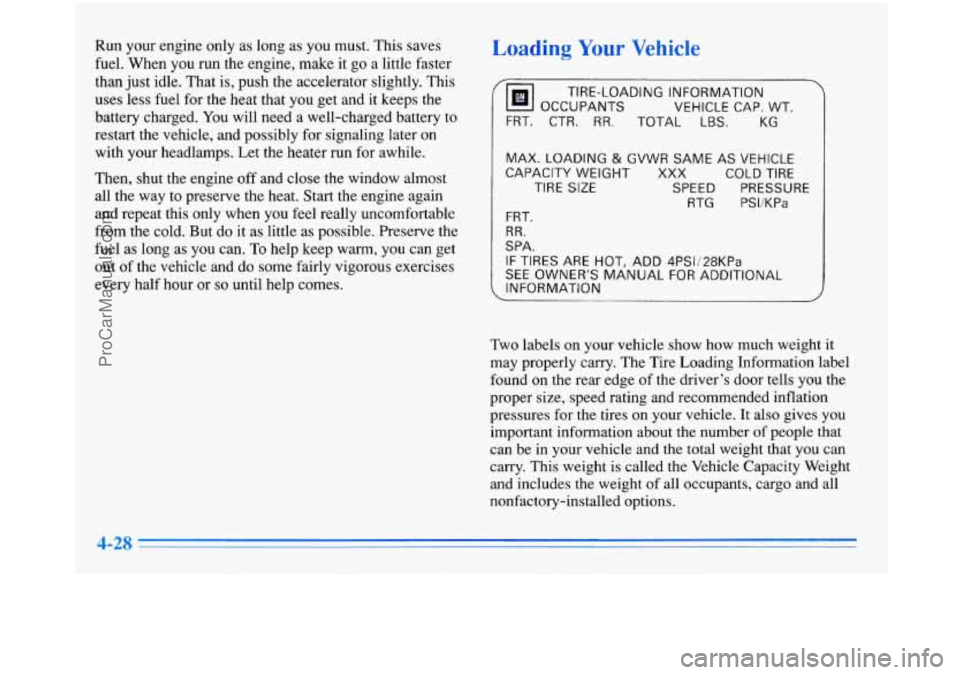
Two labels on your vehicle show how much weight it
may properly carry. The Tire Loading Information label
found on the rear edge
of the driver's door tells you the
proper size, speed rating and recommended inflation
pressures for the tires on your vehicle. It also gives you
important information about the number
of people that
can be in your vehicle and the total weight that you can
carry. This weight is called the Vehicle Capacity Weight
and includes the weight of all occupants, cargo and all
nonfactory-installed options.
4-28
ProCarManuals.com
Page 282 of 388
Bulb Replacement
The following procedure tells you how to replace your
headlamp bulbs.
Halogen Bulbs
Halogen bulbs have pressurized gas inside and
can burst if
you drop or scratch the bulb. You or
others
could be injured. Be sure to read and
follow the instructions on the bulb package.
Headlamps
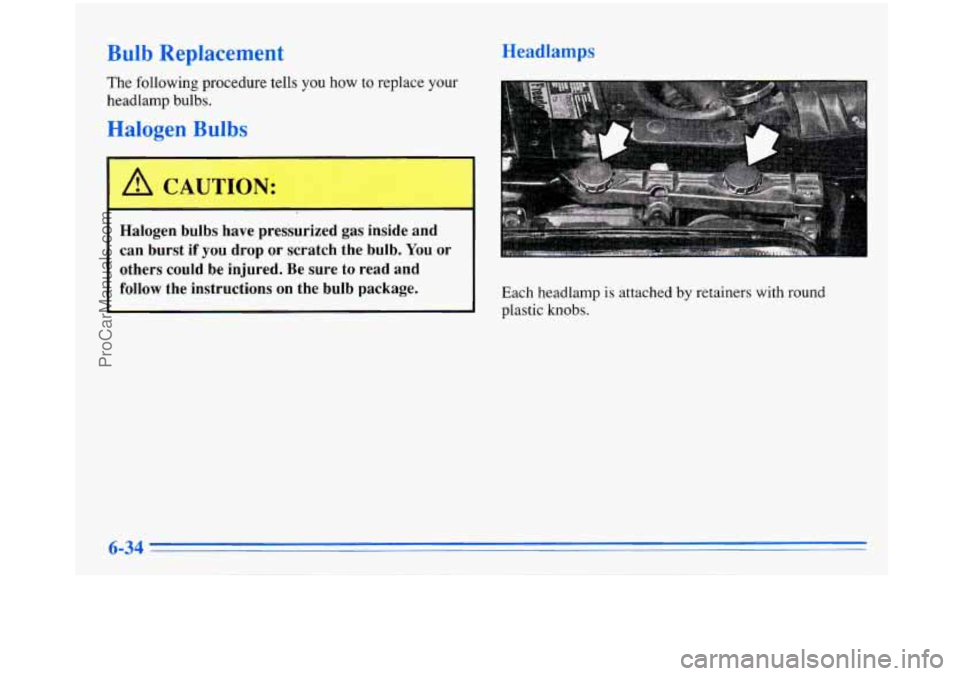
Each headlamp is attached by retainers with round
plastic knobs.
ProCarManuals.com
Page 283 of 388
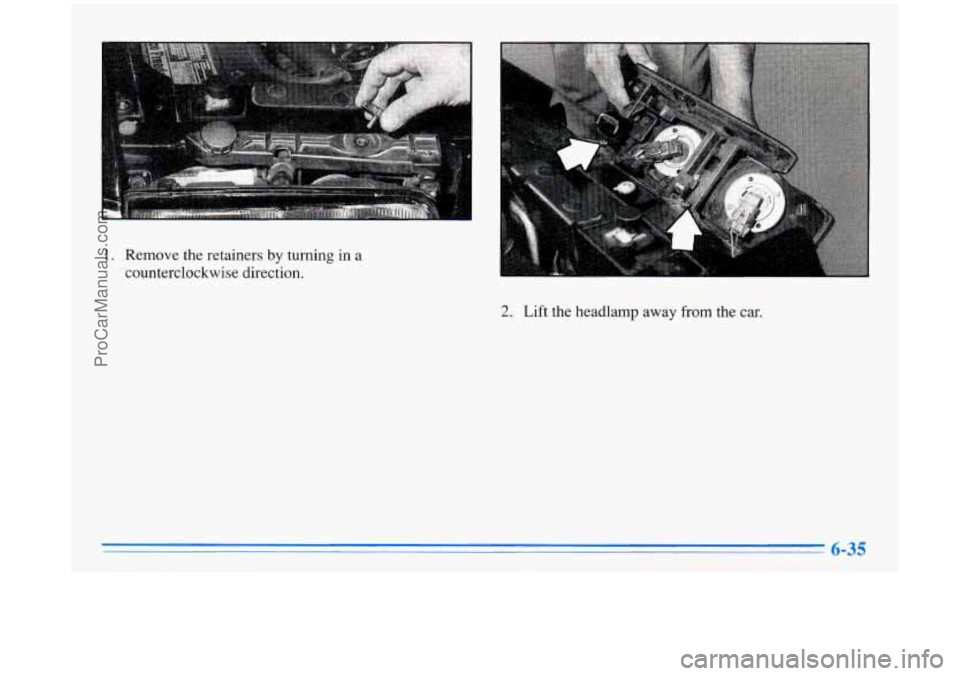
1. Remove the retainers by turning in a
counterclockwise direction.
2. Lift the headlamp away from the car.
6-35
-
ProCarManuals.com
Page 284 of 388
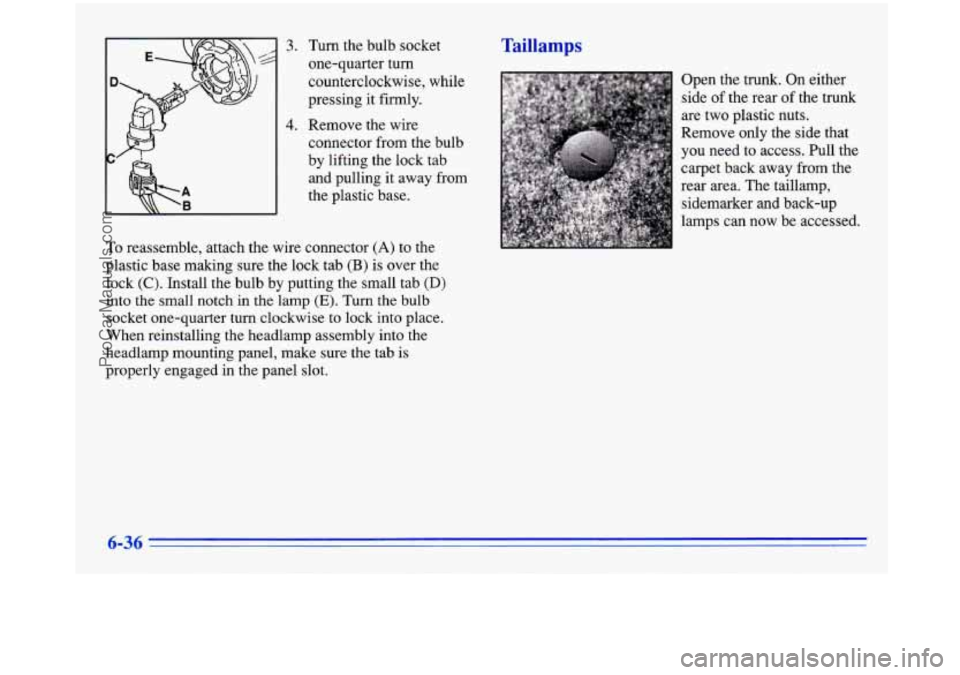
3. Turn the bulb socket
one-quarter turn
counterclockwise, while
pressing it firmly.
4. Remove the wire
connector from the bulb
by lifting the lock tab
and pulling it away from
the plastic base.
To reassemble, attach the wire connector (A) to the
plastic base making sure the lock tab
(B) is over the
lock
(C). Install the bulb by putting the small tab (D)
into the small notch in the lamp (E). Turn the bulb
socket one-quarter turn clockwise to lock into place.
When reinstalling the headlamp assembly into the
headlamp mounting panel, make sure the tab
is
properly engaged in the panel slot.
Taillamps
Open the trunk. On either
side
of the rear of the trunk
are two plastic nuts.
Remove only the side that
you need to access. Pull the
carpet back away from the
rear area. The taillamp,
sidemarker and back-up
lamps can now be accessed.
ProCarManuals.com
Page 293 of 388
Wheel Replacement
Replace any wheel that is bent, cracked, or badly rusted
or corroded.
If wheel nuts keep coming loose, the wheel,
wheel bolts and wheel nuts should be replaced. If the
wheel leaks air, replace it (except some aluminum
wheels, which can sometimes be repaired). See
your
Buick dealer if any of these conditions exist.
Your dealer will know the kind
of wheel you need.
Each new wheel should have the same load-carrying
capacity, diameter, width, offset and be mounted the
same way as the one
it replaces.
If you need to replace any of your wheels, wheel bolts
or wheel nuts, replace them only with new
GM original
equipment parts. This way, you will be sure
to have
the right wheel, wheel bolts and wheel nuts for your
Buick model. Using
the wrong replacement wheels, wheel bolts
or wheel nuts on your vehicle can be dangerous.
It could affect the braking and handling of your
vehicle, make your tires lose air and make
you
lose control. You could have a collision in which
you or others could be injured. Always use
the correct wheel, wheel bolts and wheel nuts
for replacement.
NOTICE:
The WtMg wheel can also cause problems with
bearing life, brake cooling, speedometer or
odometer calibration, headlamp aim, bumper
height, vehicle ground clearance and tire or tire
chain‘clearance to the body and chassis.
See “Changing a Flat Tire” in the Index for
more information.
6-45
ProCarManuals.com