power steering BUICK PARK AVENUE 1996 Owners Manual
[x] Cancel search | Manufacturer: BUICK, Model Year: 1996, Model line: PARK AVENUE, Model: BUICK PARK AVENUE 1996Pages: 388, PDF Size: 20.04 MB
Page 76 of 388
I.
I
Ignition Positions
With the ignition key in the ignition switch, you can turn
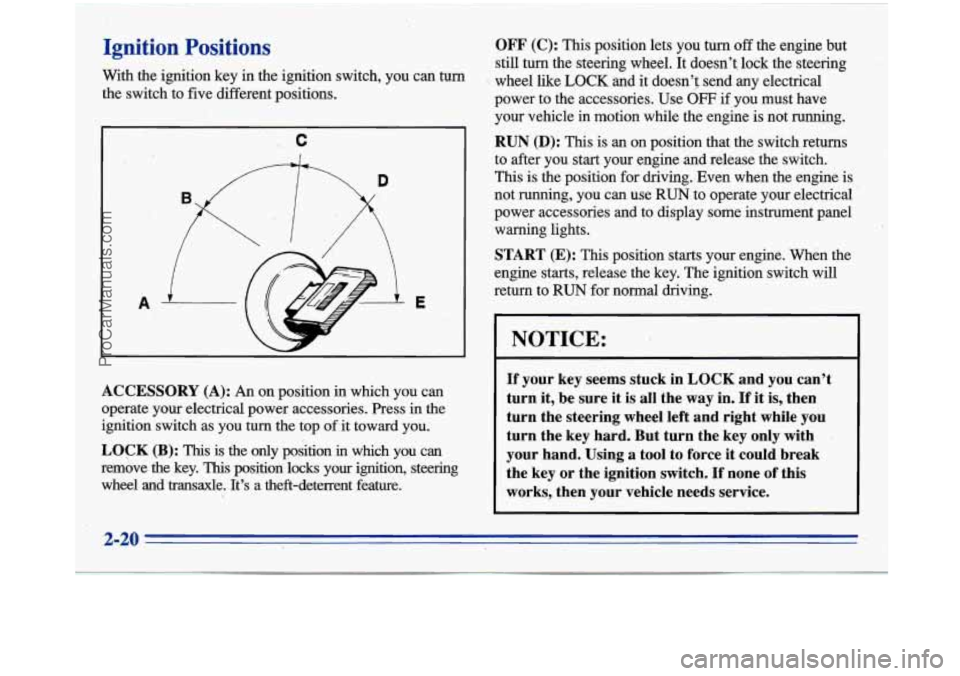
the switch to five different positions.
.. c
I
A E
ACCESSORY (A): An on position in which you can
operate your electrical power accessories. Press in the
ignition switch as you
hun the top of it toward you.
LOCK
(B): This is the only position in which yqu can
remove
the key. This position locks your ignition, steering
wheel and transaxle. It’s a theft-deterrent feature.
.. ,
OFF (C): This position lets you turn off the engine but
still turn the steering wheel. It doesn’t lock the steering
-.
wheel like LOCK and it doesn’f send any electrical
power to the accessories. Use
OFF if you must have
your vehicle
in motion while the engine is not running.
RUN (D): This is- an on position that the switch returns
to after you start your engine and release the switch.
This is the position for driving.-Even when the engine is
not running, you can use RUN to operate your electrical ’
power accessories and to display some instrument panel
warning lights.
START (E): This position starts your engine. When the
engine starts, release the key. The ignition switch
will
return to RUN for normal driving.
NOTICE:
If your key seems stuck in LOCK and you can’t
turn it, be sure it is all the
way in. If it is, then
turn the steering wheel left and right while you
turn the key hard. But turn the key only with
your hand. Using
a tool to force it could break
the key or the ignition switch.
If none of this
works, then your vehicle needs service.
ProCarManuals.com
Page 89 of 388
Windows
Power Windows
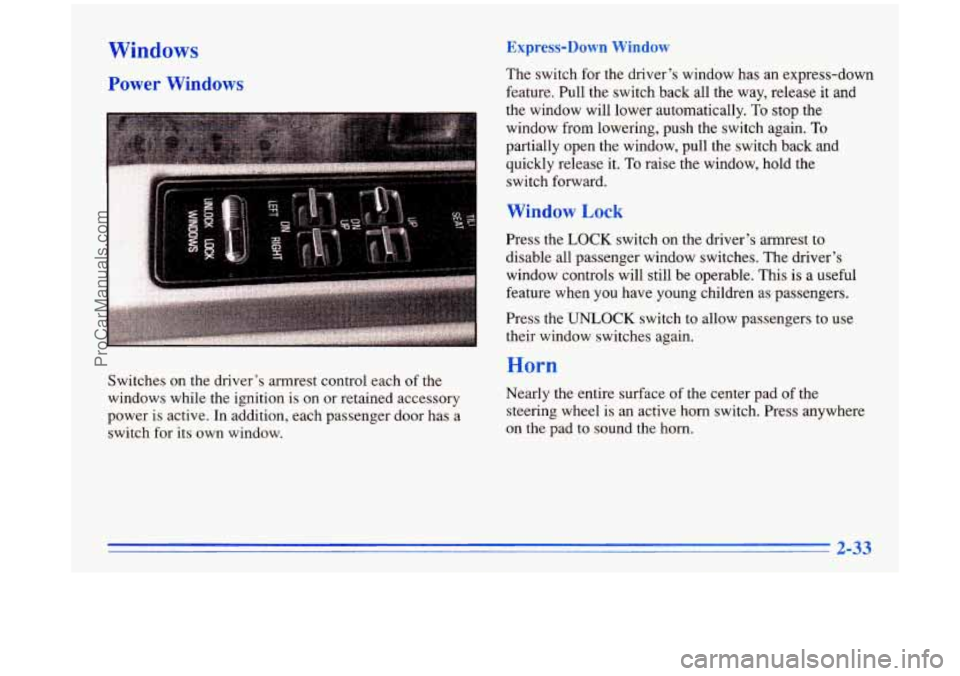
Switches on the driver’s armrest control each of the
windows while the ignition is
on or retained accessory
power is active. In addition, each passenger door has a
switch for its own window.
Express-Down Window
The switch for the driver’s window has an express-down
feature. Pull the switch back all the way, release it and
the window will lower automatically.
To stop the
window from lowering, push the switch again.
To
partially open the window, pull the switch back and
quickly release it. To raise the window, hold the
switch forward.
Window Lock
Press the LOCK switch on the driver’s armrest to
disable all passenger window switches. The driver’s
window controls will still be operable. This is
a useful
feature when you have young children
as passengers.
Press the
UNLOCK switch to allow passengers to use
their window switches again.
Horn
Nearly the entire surface of the center pad of the
steering wheel is an active horn switch. Press anywhere
on the pad to sound the horn.
ProCarManuals.com
Page 183 of 388
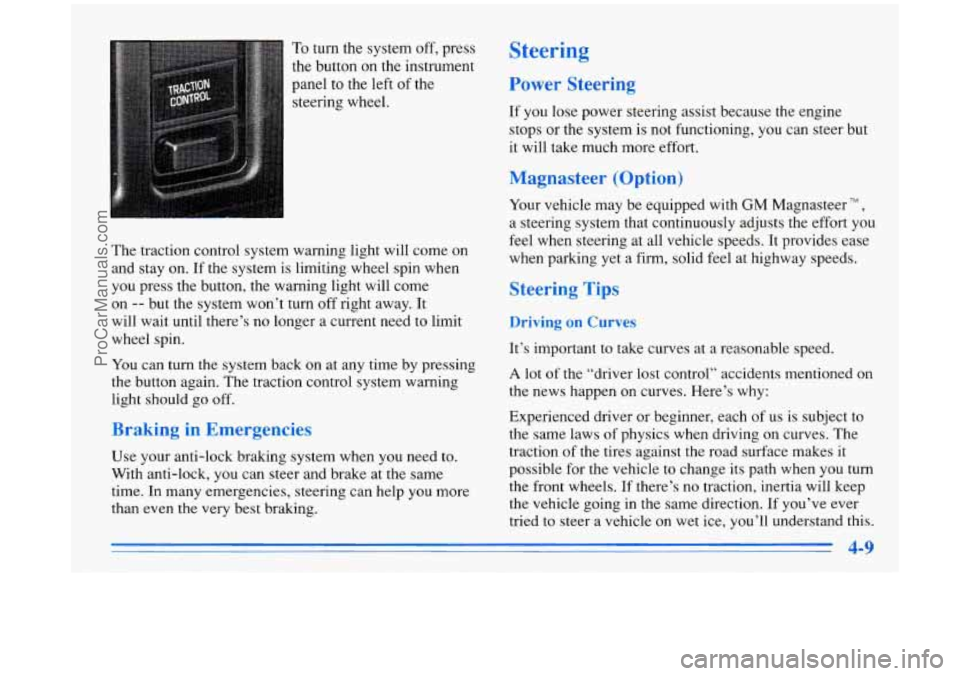
To turn the system off, press
the button on the instrument
panel to the left of the
steering wheel.
The traction control system warning light will come
on
and stay on. If the system is limiting wheel spin when
you press the button, the warning light will come
on
-- but the system won’t turn off right away. It
will wait until there’s no longer a current need to limit
wheel spin.
You can turn the system back on at any time by pressing
the button again. The traction control system warning
light should go off.
Braking in Emergencies
Use your anti-lock braking system when you need to.
With anti-lock,
you can steer and brake at the same
time. In many emergencies, steering can help you more
than even
the very best braking.
Steering
Power Steering
If you lose power steering assist because the engine
stops or the system is not functioning, you can steer but
it will take much more effort.
Magnasteer (Option)
Your vehicle may be equipped with GM Magnasteer TM ,
a steering system that continuously adjusts the effort you
feel when steering at all vehicle speeds. It provides ease
when parking yet a firm, solid feel at highway speeds.
Steering Tips
Driving on Curves
It’s important to take curves at a reasonable speed.
A lot of the “driver lost control” accidents mentioned on
the news happen on curves. Here’s why:
Experienced driver or beginner, each of
us is subject to
the same laws of physics when driving on curves. The
traction of the tires against the road surface makes it
possible for the vehicle to change its path when
you turn
the front wheels.
If there’s no traction, inertia will keep
the vehicle going in the same direction. If you’ve ever
tried to steer a vehicle on wet ice, you’ll understand
this.
4-9
-
ProCarManuals.com
Page 260 of 388
Your Park Avenue Ultra has a 3800 Supercharged
engine. Buick chose supercharging rather than
turbocharging because Buick emphasizes smooth,
refined power.
The supercharger
is a device which is designed to pump
more air into the engine than it would normally use.
This air mixed with fuel creates increased engine power.
Since the supercharger is a pump and is driven from an
engine accessory drive belt, increased pressure is available at all driving conditions.
The Powertrain Control Module (PCM) works with a
vacuum control to regulate the increased pressure
required during specific driving conditions. When this increased pressure or boost is not desired, such as during
idling and light throttle cruising, the excess air that the
supercharger is pumping is routed through a bypass. All
of these controls working together provide high
performance character and fuel efficiency in the
3800 V6 Supercharged Buick engine.
The power steering pump and reservoir are mounted
on the rear (driver’s side)
of the engine block. See
“Maintenance Schedule” in the Index for when you
should check the fluid.
Engine Oil
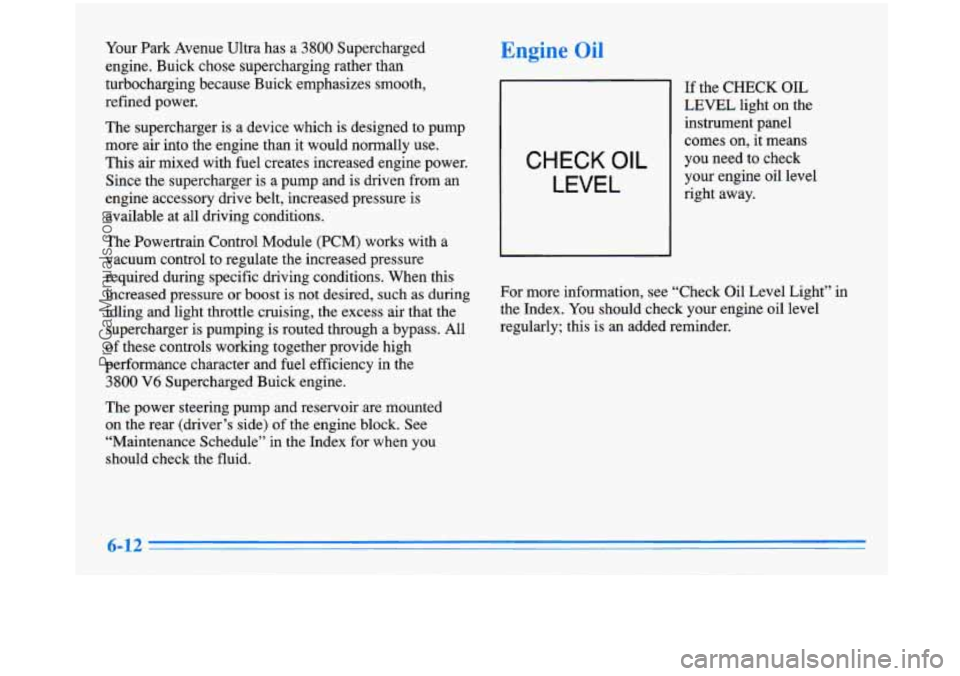
If the CHECK OIL
LEVEL light on the
instrument panel
comes on, it means
CHECK OIL you need to check
LEVEL your engine oil level
right away.
For more information, see “Check Oil Level Light” in
the Index. You should check your engine oil level
regularly; this is an added reminder.
ProCarManuals.com
Page 276 of 388
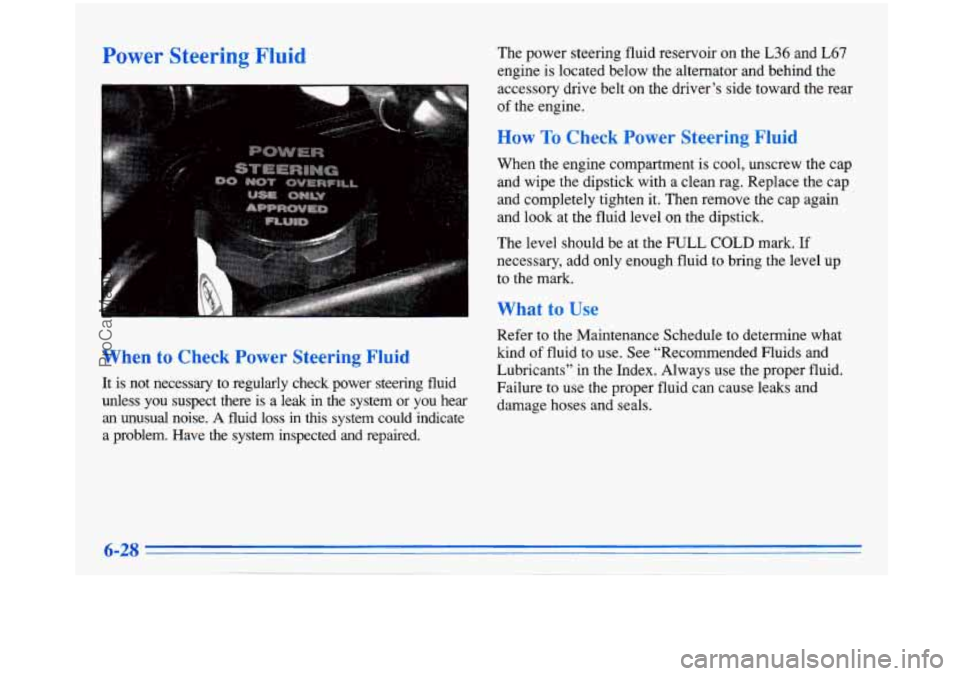
Power Steering Fluid
When to Check Power Steering Fluid
It is not necessary to regularly check power steering fluid
unless you suspect there
is a leak in the system or you hear
an unusual noise. A fluid loss in this system could indicate
a problem. Have the system inspected and repaired. The
power steering fluid reservoir on the L36 and L67
engine is located below the alternator and behind the
accessory drive belt on the driver’s side toward the rear
of the engine.
How To Check Power Steering Fluid
When the engine compartment is cool, unscrew the cap
and wipe the dipstick with a clean rag. Replace the cap
and completely tighten
it. Then remove the cap again
and look at the fluid level on the dipstick.
The level should be at the FULL COLD mark.
If
necessary, add only enough fluid to bring the level up
to the mark.
What to Use
Refer to the Maintenance Schedule to determine what
kind of fluid
to use. See “Recommended Fluids and
Lubricants” in the Index. Always use the proper fluid.
Failure to use the proper fluid can cause leaks and
damage hoses and seals.
ProCarManuals.com
Page 312 of 388
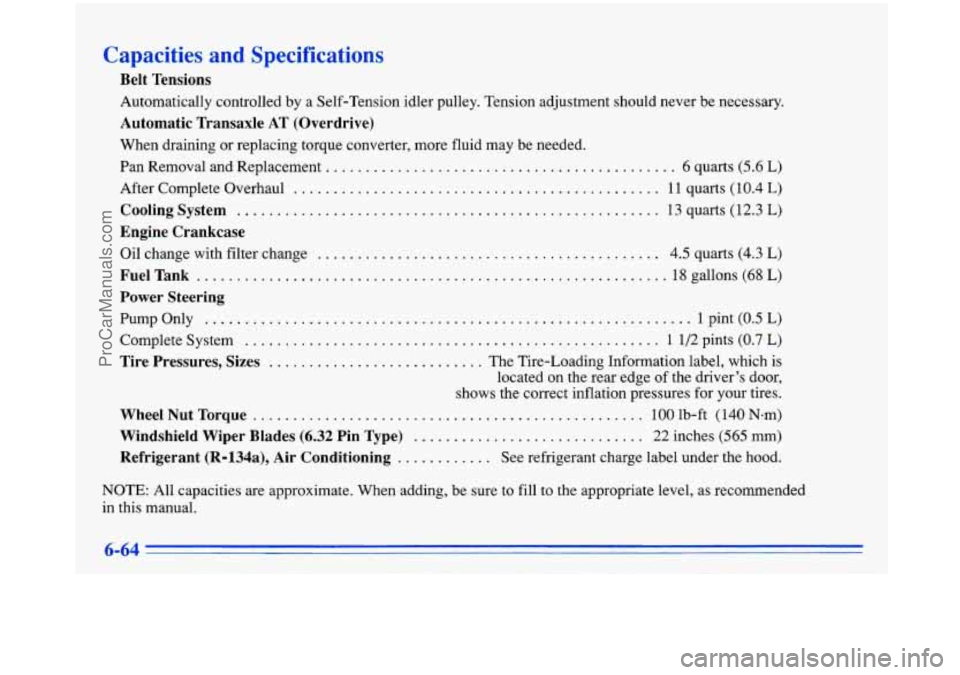
Capacities and Specifications
Belt Tensions
Automatically controlled by a Self-Tension idler pulley. Tension adjustment should never be necessary.
Automatic Transaxle AT (Overdrive)
When draining or replacing torque converter, more fluid may be needed.
Pan Removal and Replacement
............................................ 6 quarts (5.6 L)
After Complete Overhaul .............................................. 11 quarts (1 0.4 L)
Cooling System ..................................................... 13 quarts (12.3 L)
Oil change with filter change ........................................... 4.5 quarts (4.3 L)
Engine Crankcase
FuelTank
........................................................... 18gallons(68L)
Power Steering
Pump Only ............................................................. 1 pint (0.5 L)
Complete System .................................................... 1 1/2 pints (0.7 L)
Tire Pressures, Sizes ........................... The Tire-Loading Information label, which is
located on the rear edge of the driver’s door,
shows the correct inflation pressures for your tires.
Wheel Nut Torque ................................................. 100 lb-ft (140 N-rn)
Windshield Wiper Blades (6.32 Pin Type) ............................. 22 inches (565 mm)
Refrigerant (R=134a), Air Conditioning ............ See refrigerant charge label under the hood.
NOTE: All capacities are approximate. When adding, be sure to fill to the appropriate level, as recommended
in this manual.
6-64
ProCarManuals.com
Page 315 of 388
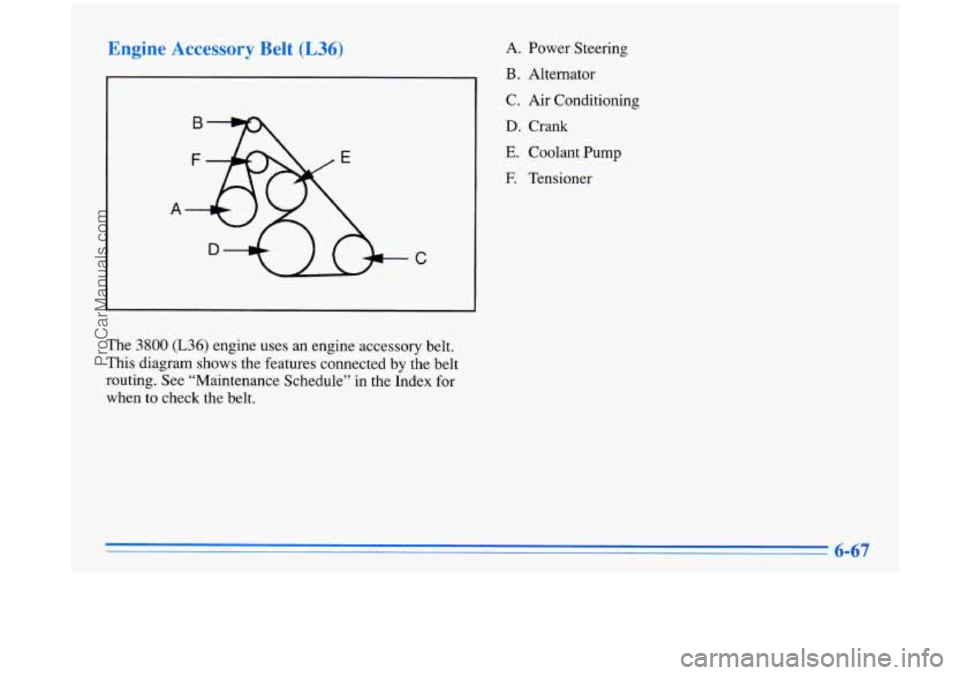
Engine Accessory Belt (L36)
C
I
A. Power Steering
B. Alternator
C. Air Conditioning
D. Crank
E. Coolant Pump
E Tensioner
The
3800 (L36) engine uses an engine accessory belt.
This diagram shows the features connected by the belt
routing. See “Maintenance Schedule” in the Index for
when
to check the belt.
ProCarManuals.com
Page 316 of 388
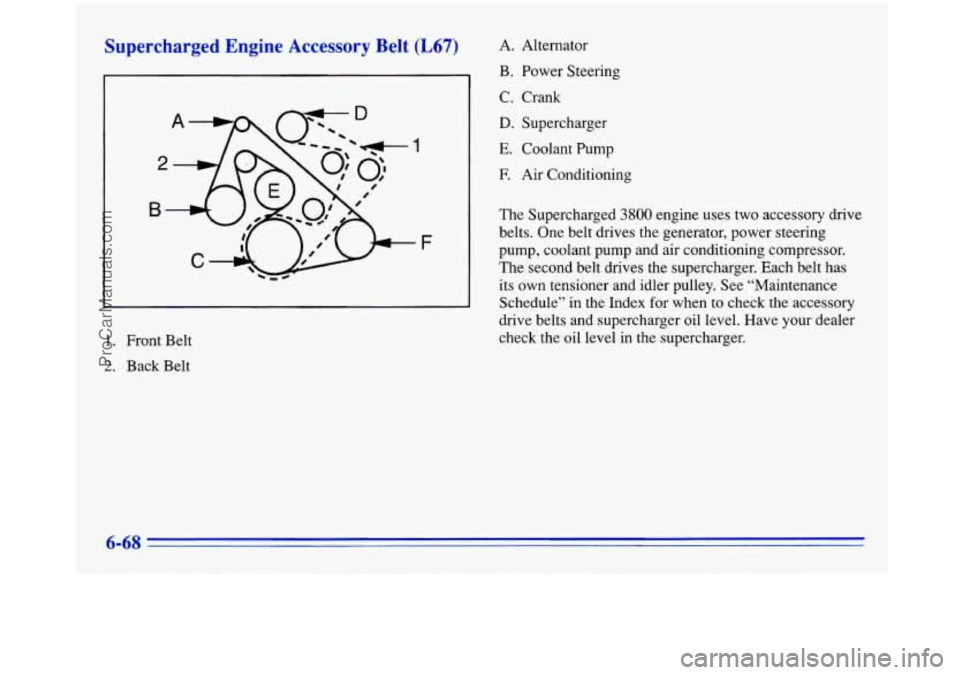
mharged Engine Accessory Belt (L67)
F
1. Front Belt
2. Back Belt A.
B.
C.
D.
E.
E
Alternator
Power Steering
Crank
Supercharger
Coolant Pump
Air Conditioning
The Supercharged
3800 engine uses two accessory drive
belts. One belt drives the generator, power steering
pump, coolant pump and air conditioning compressor.
The second belt drives the supercharger. Each belt has
its own tensioner and idler pulley. See “Maintenance
Schedule” in the Index for when
to check the accessory
drive belts and supercharger oil level. Have your dealer
check the
oil level in the supercharger.
6-68
ProCarManuals.com
Page 360 of 388
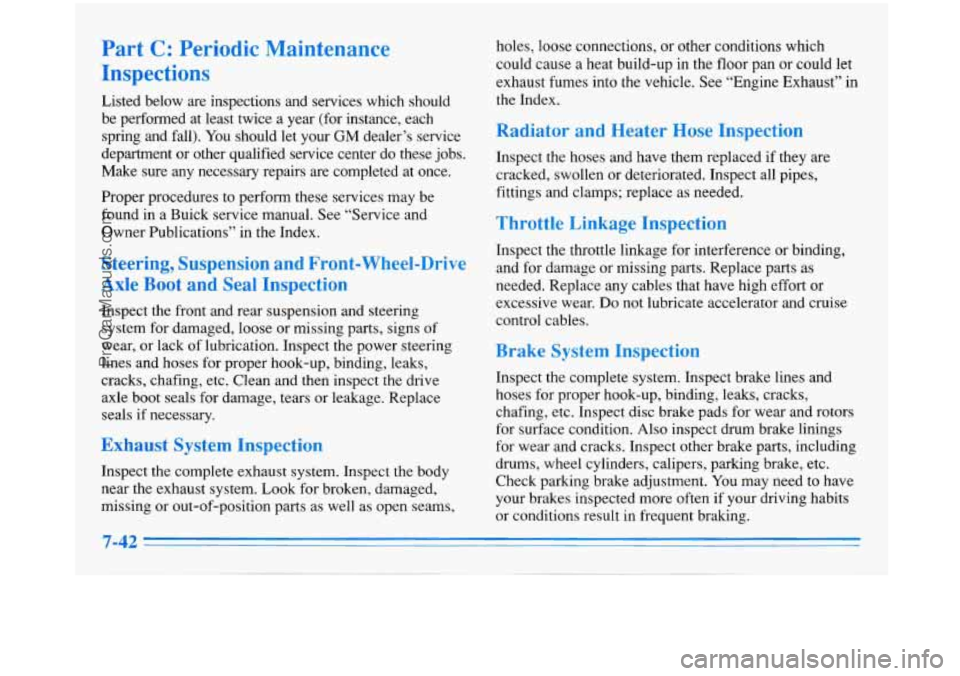
Part C: Periodic Maintenance
Inspections
Listed below are inspections and services which should
be performed at least twice a year (for instance, each
spring and fall). You should let your
GM dealer’s service
department or other qualified service center do these jobs.
Make sure any necessary repairs are completed at once.
Proper procedures to perform these services may be
found in a Buick service manual. See “Service and
Owner Publications” in the Index.
Steering, Suspension and Front-Wheel-Drive
Axle Boot and Seal Inspection
Inspect the front and rear suspension and steering
system for damaged, loose or missing parts, signs of
wear, or lack of lubrication. Inspect the power steering
lines and hoses for proper hook-up, binding, leaks,
cracks, chafing, etc. Clean and then inspect the drive
axle boot seals for damage, tears or leakage. Replace
seals if necessary.
Exhaust System Inspection
Inspect the complete exhaust system, Inspect the body
near the exhaust system. Look for broken, damaged,
missing or out-of-position parts as well as open seams, holes,
loose connections, or other conditions which
could cause a heat build-up in the floor pan or could let
exhaust fumes into
the vehicle. See “Engine Exhaust” in
the Index.
Radiator and Heater Hose Inspection
Inspect the hoses and have them replaced if they are
cracked, swollen or deteriorated. Inspect all pipes,
fittings and clamps; replace as needed.
Throttle Linkage Inspection
Inspect the throttle linkage for interference or binding,
and for damage or missing parts. Replace parts as
needed. Replace any cables that have high effort
or
excessive wear. Do not lubricate accelerator and cruise
control cables.
Brake System Inspection
Inspect the complete system. Inspect brake lines and
hoses for proper hook-up, binding, leaks, cracks,
chafing, etc. Inspect disc brake pads for wear and rotors
for surface condition. Also inspect drum brake linings
for wear and cracks. Inspect other brake parts, including
drums, wheel cylinders, calipers, parking brake, etc.
Check parking brake adjustment. You may need to have
your brakes inspected more often if your driving habits
or conditions result in frequent braking.
7-42
ProCarManuals.com
Page 361 of 388
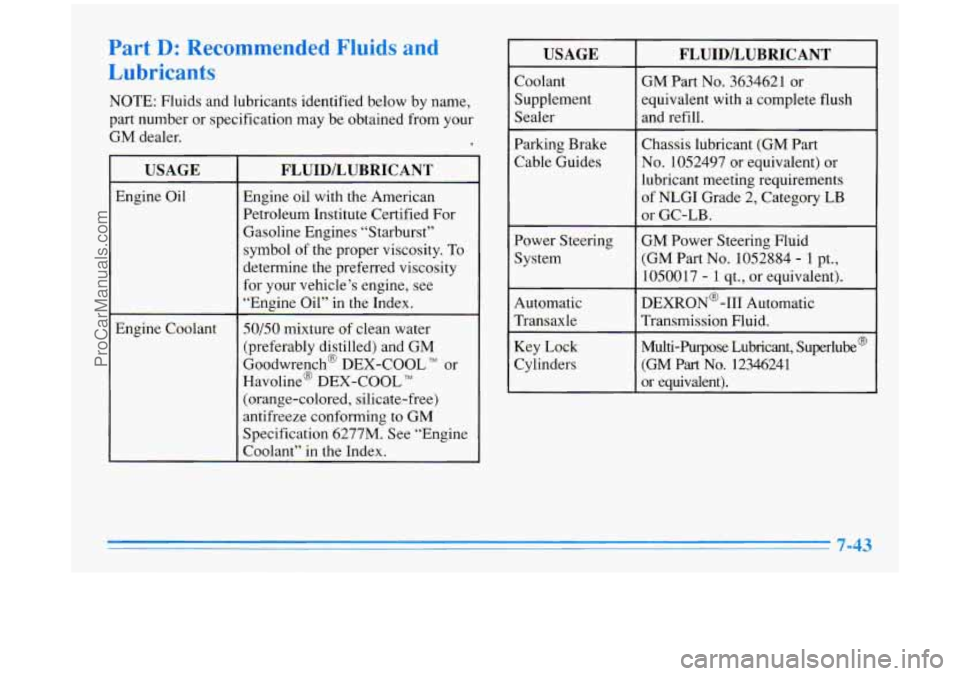
and
wicants
NOTE: Fluids and lubricants identified below by name,
part number or spe
GM dealer.
USAGE
Engine Oil
Engine Coolant ification may be
obtained from your
1
FLUID/LUBRICANT
Engine oil with the American
Petroleum Institute Certified For
Gasoline Engines
“S tarburst”
symbol
of the proper viscosity. To
determine the preferred viscosity
for your vehicle’s engine, see
“Engine Oil” in the Index.
50/50 mixture of clean water
(preferably distilled) and GM
Goodwrench’ DEX-COOL
TM or
Havoline@ DEX-COOL
TM
(orange-colored, silicate-free)
antifreeze conforming to GM
Specification 6277M. See “Engine
Coolant’’ in the Index.
USAGE
Coolant
Supplement
Sealer
Parking Brake Cable Guides
Power Steering System
Automatic
Transaxle
Key Lock
Cylinders
FLUID/LUBRICANT
GM Part No. 3634621 or
equivalent with a complete flush
and refill.
Chassis lubricant (GM Part
No. 1052497 or equivalent) or
lubricant meeting requirements
of NLGI Grade 2, Category LB
or GC-LB.
GM Power Steering Fluid
(GM Part No. 1052884
- 1 pt.,
10500 17
- 1 qt., or equivalent).
DEXRON@-111 Automatic
Transmission Fluid.
Multi-Purpose Lubricant, Superlube@ (GM
Part No. 12346241
or equivalent).
ProCarManuals.com