radiator cap BUICK PARK AVENUE 1996 Owners Manual
[x] Cancel search | Manufacturer: BUICK, Model Year: 1996, Model line: PARK AVENUE, Model: BUICK PARK AVENUE 1996Pages: 388, PDF Size: 20.04 MB
Page 226 of 388
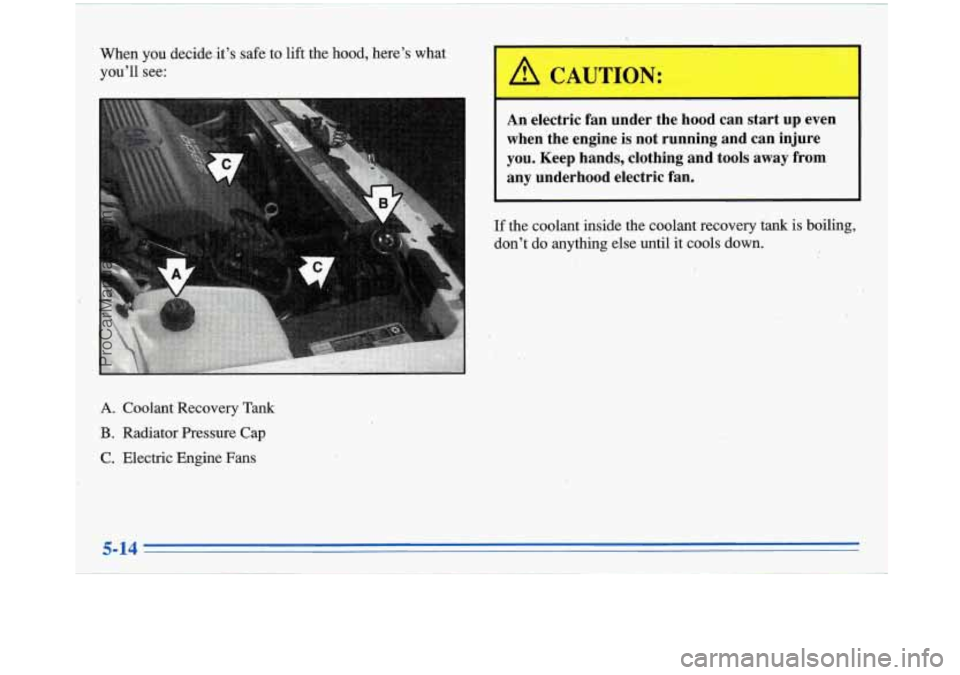
When you decideit’s safe to lift the hood, here’s what
you’ll see:
An electric fan under the hood can start up even
when the engine is not running and can injure
you. Keep hands, clothing and tools aw~ay from
any underhood electric fan.
If the coolant inside the coolant recovery tank is boiling,
don’t
do anything else until it cools down.
A. Coolant Recovery Tank
B. Radiator Pressure Cap
C. Electric Engine Fans
5-14
.I .
ProCarManuals.com
Page 230 of 388
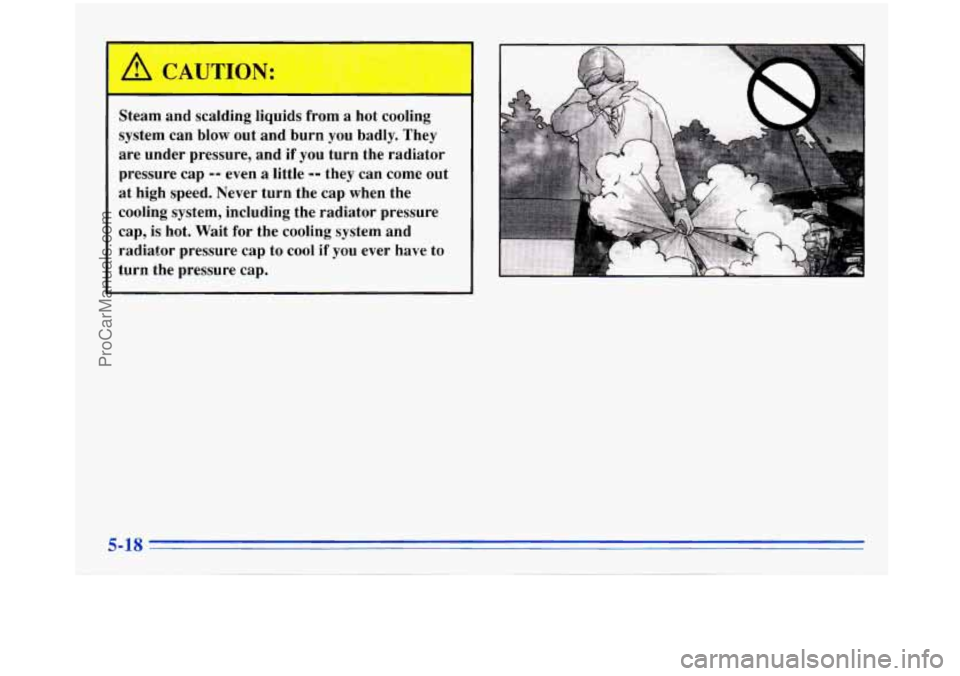
Steam and scalding liquids from a hot cooling
system can blow out and burn you badly. They
are under pressure, and
if you turn the radiator
pressure cap
-- even a little -- they can come out
at high speed. Never turn the cap when the
cooling system, including the radiator pressure
cap, is
hot. Wait for the cooling system and
radiator pressure cap to cool if you ever have to
turn the pressure cap.
5-18
.~
ProCarManuals.com
Page 231 of 388
Horn )., Add CL=-~=- to the Radiator
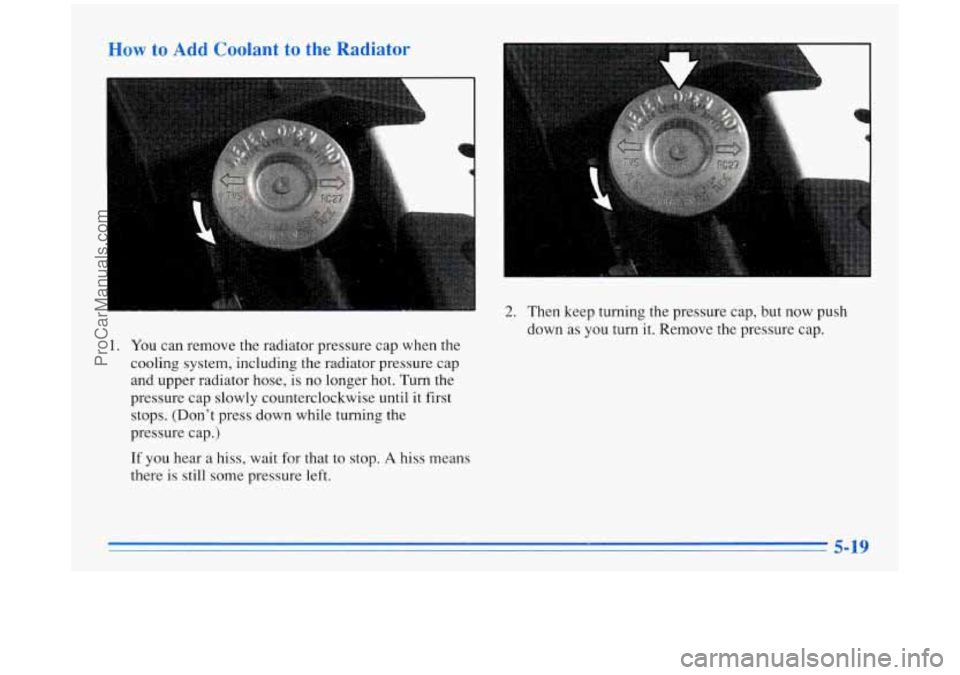
1. You can remove the radiator pressure cap when the
cooling system, including the radiator pressure cap
and upper radiator hose, is no longer hot. Turn the
pressure cap slowly counterclockwise until it first
stops. (Don’t press down while turning the
pressure cap.)
If you hear a hiss, wait for that to stop. A hiss means
there
is still some pressure left.
2. Then keep turning the pressure cap, but now push
down as
you turn it. Remove the pressure cap.
5-19
ProCarManuals.com
Page 232 of 388
I
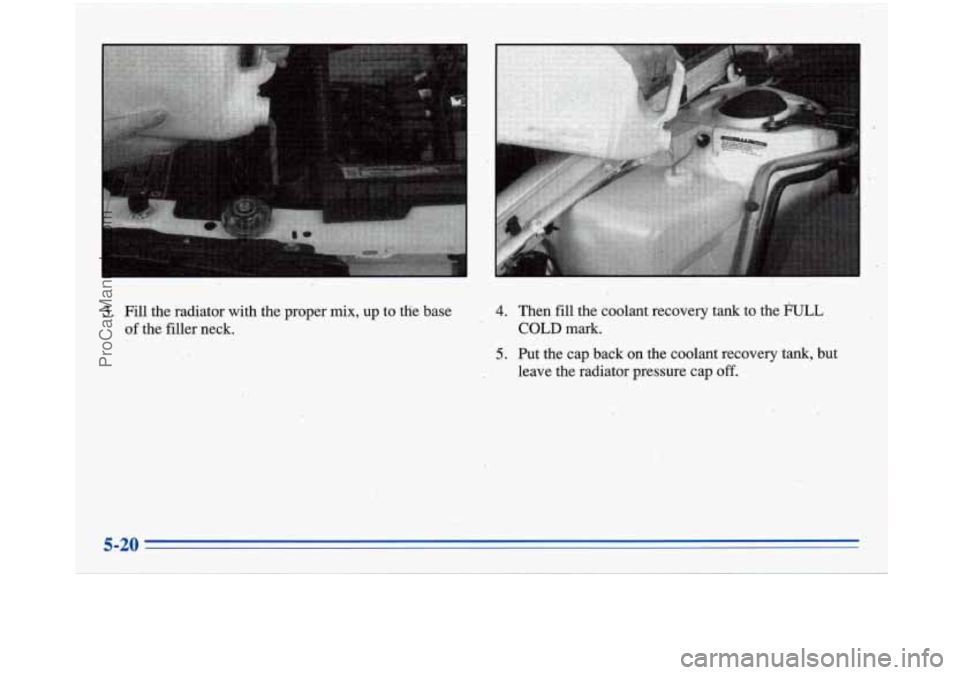
3. Fill the radiator with the proper mix, up to tffe base
of the filler neck. 4. Then fill the coolant recovery tank to the FULL
5. Put the cap back on the coolant recovery tank, but
COLD mark.
leave the radiator pressure cap
off.
5-20
ProCarManuals.com
Page 233 of 388
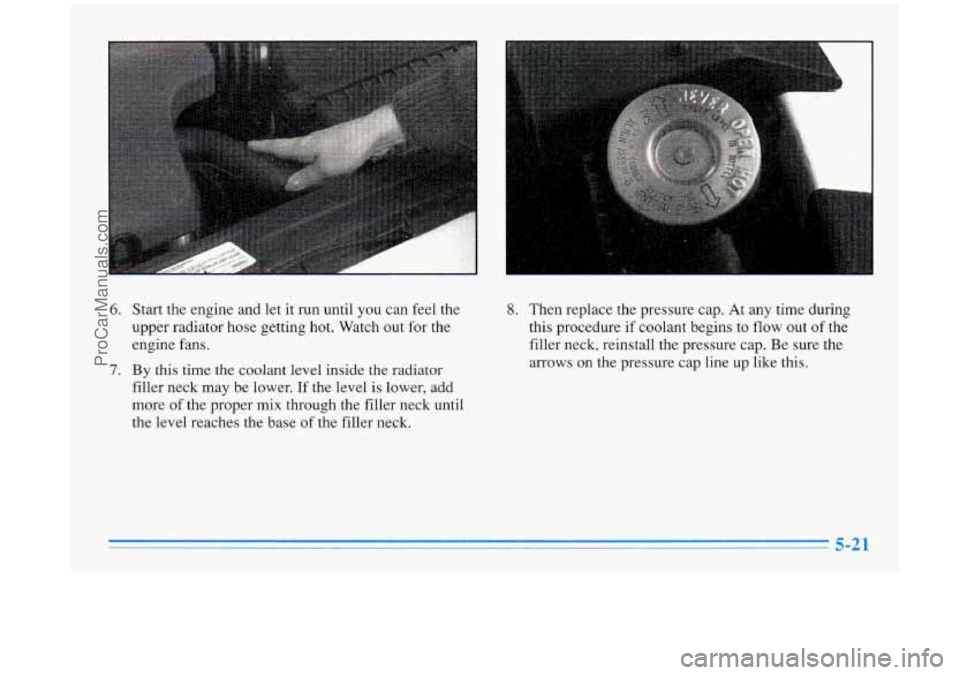
6. Start the engine and let it run until you can feel the
upper radiator hose getting hot. Watch out for the
engine fans.
7. By this time the coolant level inside the radiator
filler neck may be lower.
If the level is lower, add
more of the proper mix through the filler neck until
the level reaches the base
of the filler neck.
8. Then replace the pressure cap. At any time during
this procedure if coolant begins to
flow out of the
filler neck, reinstall the pressure cap. Be sure the
arrows
on the pressure cap line up like this.
ProCarManuals.com
Page 258 of 388
wv DCIIC~ II [~uut: n) u~gmc (L36)
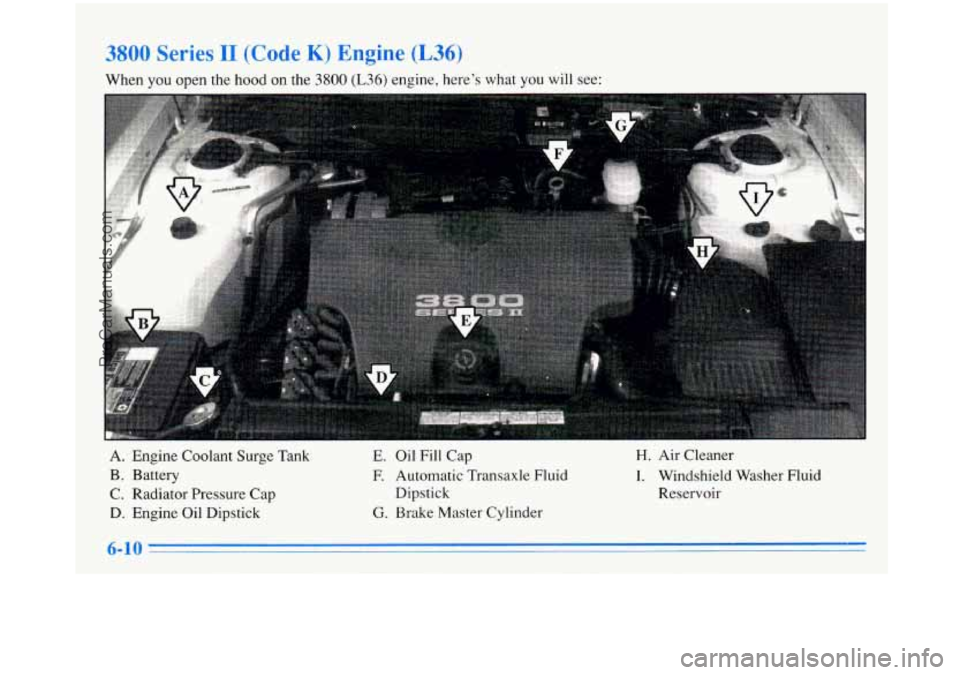
When you open the hood on the 3800 (L36) engine, here’s what you will see:
A. Engine Coolant Surge Tank
B. Battery
C. Radiator Pressure Cap
D. Engine Oil Dipstick E.
Oil
Fill Cap
E Automatic Transaxle Fluid
Dipstick
G. Brake Master Cylinder
.. ,.
H. Air Cleaner
I. Windshield Washer Fluid
Reservoir
ProCarManuals.com
Page 259 of 388
3800 Supercharged (L67) Engine (Option)
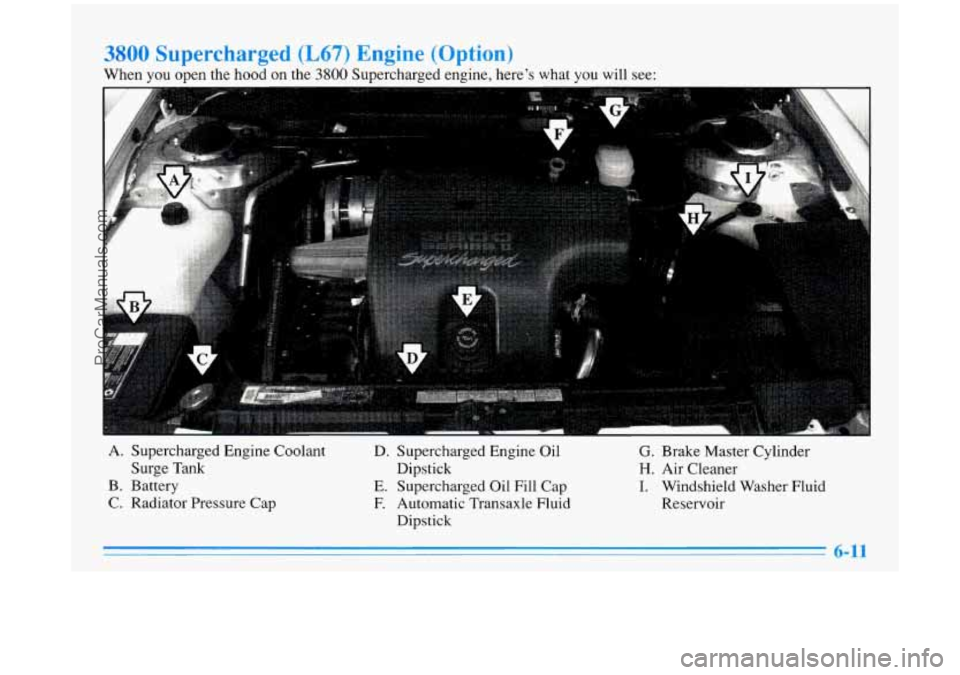
When you open the hood on the 3800 Supercharged engine, here's what you will see:
... . .
A. Supercharged Engine Coolant
B. Battery
C. Radiator Pressure Cap
Surge
Tank D. Supercharged
Engine Oil
E. Supercharged Oil Fill Cap
F. Automatic Transaxle Fluid
Dipstick
Dipstick
-.
G. Brake
Master Cylinder
H. Air Cleaner
I. Windshield Washer Fluid
Reservoir
6-11
ProCarManuals.com
Page 275 of 388
nrning the radiator pressure cap when the engine
and radiator are hot can allow steam and scalding
liquids to blow out and burn
you badly. With the
coolant recovery tank, you
will almost never have
to add coolant at the radiator. Never turn the
radiator pressure cap
-- even a little -- when the
engine
and radiator are hot.
Add coolant mix at the recovery tank, but be careful not
to spill it.
You can be burned if you spill coolant on hot
engine parts. Coolant contains ethylene glycol,
and it will burn if the engine parts are hot
enough. Don’t spill coolant on
a hot engine.
Radiator Pressure Cap
NOTICE:
Your radiator pressure cap is a 15 psi (105 kPa)
pressure-type cap and must be tightly installed to
prevent coolant loss and possible engine damage
from overheating. Be sure the arrows
on the cap
line up with the overflow tube on the radiator
filler neck.
When you replace your radiator pressure cap, an
AC@
cap is recommended.
Thermostat
Engine coolant temperature is controlled by a thermostat
in the engine coolant system.
The thermostat stops the
flow of coolant through the radiator until the coolant
reaches a preset temperature.
When you replace your thermostat, an
AC@ thermostat
is recommended.
ProCarManuals.com
Page 277 of 388
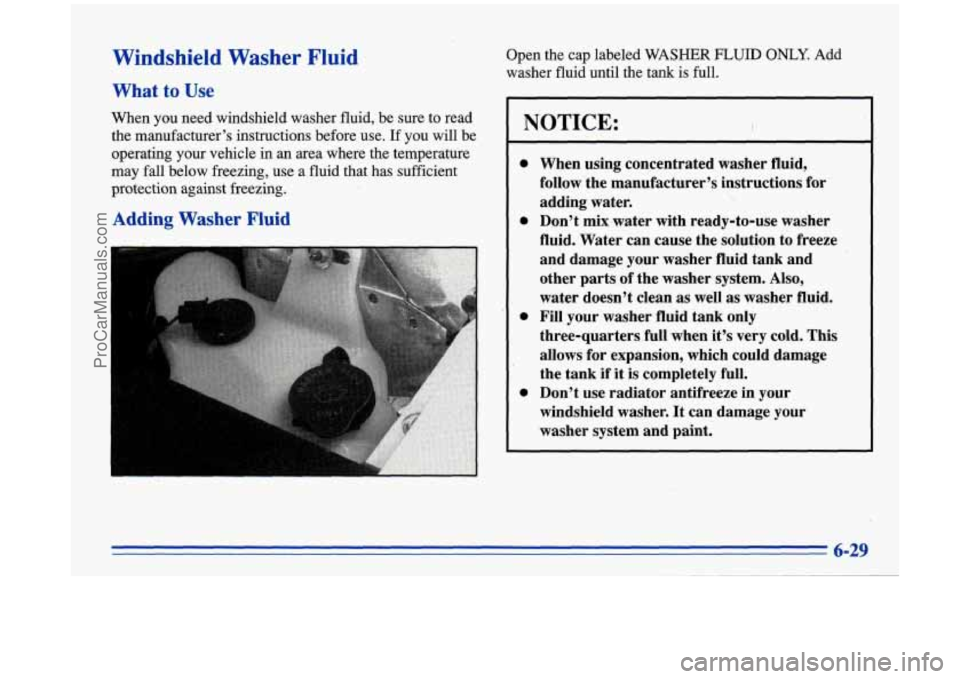
Windshield Washer Fluid
What to Use
When you need windshield washer fluid, be sure to read
the manufacturer’s instructions before use.
If you will be
operating your vehicle in an area where the temperature
may
fall below freezing, use a fluid that has sufficient
protection against freezing.
Adding Washer Fluid
Open the cap labeled WASHER FLUID ONLY. Add
washer fluid until the tank is
full.
NOTICE: I
0
0
0
0
When using concentrated washer fluid,
follow the manufacturer’s instructions for
adding water.
Don’t mix,water with ready-to-use washer
fluid. Water can cause the solution to freeze
and damage your washer fluid tank and
other
parts of the washer system. Also,
water doesn’t clean
as well as washer fluid.
Fill your washer fluid tank only
three-quarters full when
it’s very cold. This
allows for expansion, which could damage
the tank
if it is completely full.
Don’t use radiator antifreeze in your
windshield washer. It can damage your
washer system and paint.
6-29
ProCarManuals.com
Page 343 of 388
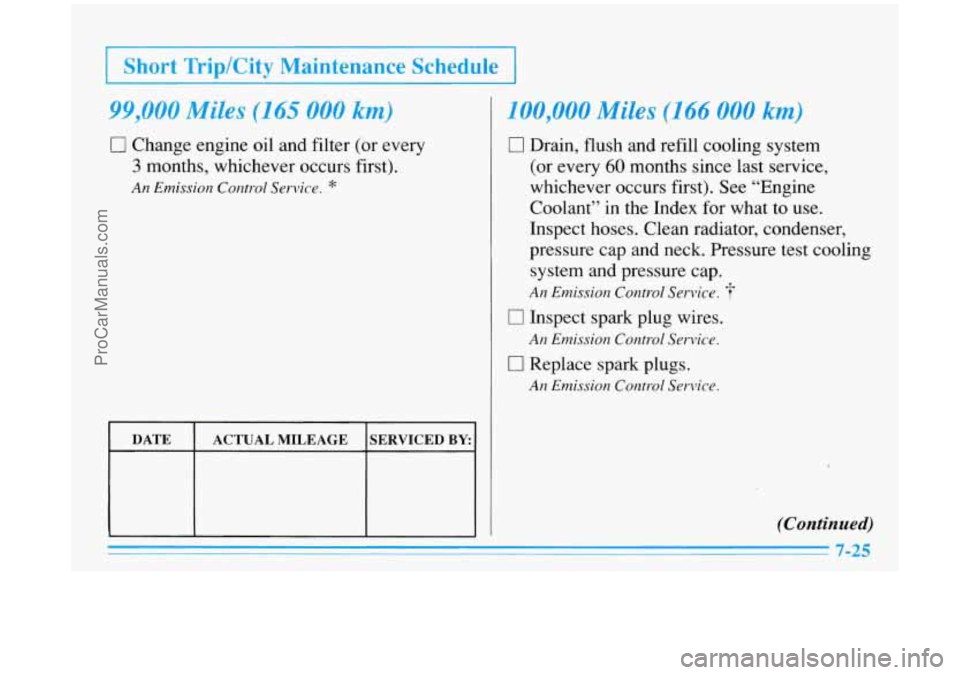
Short Trip/City Maintenance Schedule I
99,000 Miles (165 000 km)
0 Change engine oil and filter (or every
3 months, whichever occurs first).
An Emission Control Service. *
I I I 1
DATE
SERVICED BY: ACTUAL MILEAGE
100,000 Miles (166 000 km)
El Drain, flush and refill cooling system
(or every
60 months since last service,
whichever occurs first). See “Engine
Coolant” in the Index for what to use.
Inspect hoses. Clean radiator, condenser,
pressure cap and neck. Pressure test cooling
system and pressure cap.
An Emission Control Service.
0 Inspect spark plug wires.
An Emission Control Service.
0 Replace spark plugs.
An Emission Control Service.
(Continued)
ProCarManuals.com