brake light BUICK PARK AVENUE 1997 Owners Manual
[x] Cancel search | Manufacturer: BUICK, Model Year: 1997, Model line: PARK AVENUE, Model: BUICK PARK AVENUE 1997Pages: 420, PDF Size: 21.93 MB
Page 12 of 420
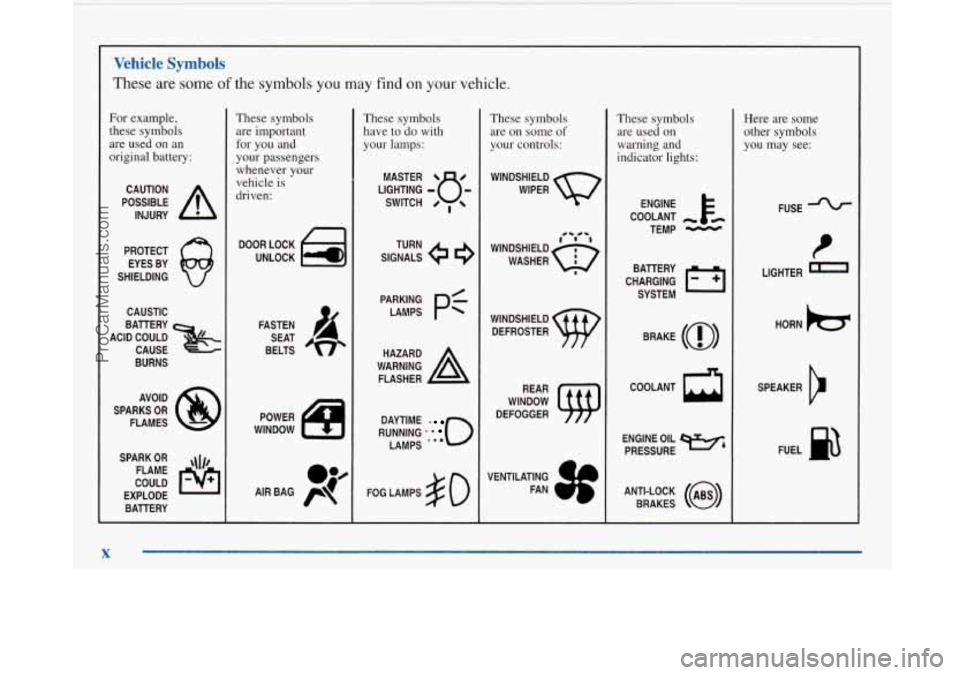
Vehicle Symbols
These are some of the symbols you may find on your vehicle.
For example,
these symbols
are used on an
original battery:
POSSIBLE A
CAUTION
INJURY
PROTECT EYES BY
SHIELDING
CAUSTIC
ACID COULD
&
BAllERY
CAUSE
BURNS
AVOID
SPARKS
OR
FLAMES
SPARK
OR ,\I/,
COULD FLAME
EXPLODE BAllERY
X
These symbols are important
for you and
your passengers
whenever your
vehicle is
driven:
DOOR LOCK
UNLOCK
FASTEN SEAT
BELTS
POWER
WINDOW
These symbols have to do with
your lamps:
SIGNALS 6
TURN
RUNNING
* ' 0
DAYTIME -
LAMPS .'*
FOG LAMPS $0
These symbols
are
on some of
your controls:
WINDSHIELD
WIPER
WINDSHIELD DEFROSTER
WINDOW
DEFOGGER
These symbols are used
on
warning and
indicator lights:
COOLANT -
TEMP -
CHARGING I-1
BAlTERY
SYSTEM
BRAKE
(a)
COOLANT a
ENGINE OIL e,
PRESSURE
ANTI-LOCK
(@)
BRAKES
Here are some
other symbols
you may see:
FUSE
LIGHTER
a
HORN )tr
SPEAKER
IJ
FUEL p3
1 I
ProCarManuals.com
Page 61 of 420
Section 2 Features and Controls
Here you can learn about the many standard and optional features on your Buick, and information on starting, shifting
and braking. Also explained are the instrument panel and the warning systems that tell you if everything is working
properly
-- and what to do if you have a problem.
2-2
2-4
2-8
2- 14
2-15 2-16
2- 17
2-
19
2-20
2-2 1
2-22
2-23
2-27
2-28
2-30
2-3
1
Keys
Door Locks
Remote Keyless Entry System
TrUnk
Theft
Content Theft Deterrent
PASS-Key@
III
New Vehicle “Break-In”
Ignition Positions
Starting Your Engine
Engine Coolant Heater
Automatic Transaxle Operation
Parking Brake Shifting Into PARK
(P)
Shifting Out of PARK (P)
Parking Over Things That
Burn
2-3 1
2-32
2-33
2-34
2-34
2-44
2-46
2-50
2-55
2-64
2-64
2-68
2-73
2-82
2-84 Engine Exhaust
Running
Your Engine While You’re Parked
Windows
Tilt Wheel
Turn Signal/Multifunction Lever
Exterior Lamps
Interior Lamps
Mirrors
Storage Compartments
Astroroof
Universal Transmitter
Instrument Panel
Warning Lights, Gages and Indicators
Head-Up Display (HUD)
Driver Information Center (DIC)
2-1
ProCarManuals.com
Page 79 of 420
To program the new key:
1, Insert the current driver’s key (black in color) in the
ignition and start the engine. If the engine will not
start, see your dealer for service.
2. After the engine has started, turn the key to OFF and
remove the key.
3. Insert the key to be programmed and turn it to RUN
within ten seconds of removing the previous key.
4. The SECURITY telltale light will turn off once the
key has been programmed. It may not be apparent
that the SECURITY light went on due to how
quickly the key is programmed.
5. Repeat Steps 1 through 4 if additional keys are to
be programmed.
If you are ever driving and the SECURITY light comes
on and stays on, you will be able to restart your engine if
you turn it
off. Your PASS-Key I11 system, however, is
not working properly and must be serviced by your
Buick dealer. Your vehicle is not protected by the
PASS-Key
I11 system at this time.
A .- . , . ---- cle “Break-In”
NOTICE:
Your modern Buick doesn’t need an elaborate
“break-in.” But it will perform better
in the long
run if you follow these guidelines:
Don’t drive at any one speed -- fast or
slow
-- for the first 500 miles (805 km).
Don’t make full-throttle starts.
200 miles (322 km) or so. During this time
your new brake linings aren’t yet broken
in. Hard stops with new linings can mean
premature wear and earlier replacement.
Follow this breaking-in guideline every
time you get new brake linings.
See “Towing a Trailer” in the Index for
more information.
0 Avoid making hard stops for the first
0 Don’t tow a trailer during break-in.
ProCarManuals.com
Page 80 of 420
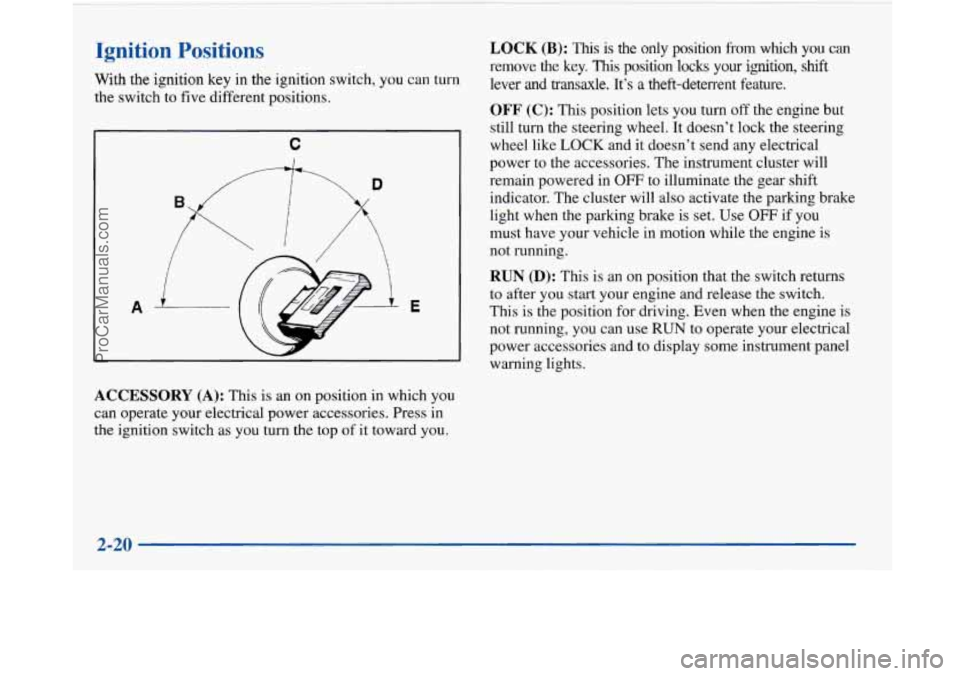
Ignition Positions
With the ignition key in the ignition switch, you can turn
the switch to five different positions.
C
I
D
-E 1
ACCESSORY (A): This is an on position in which you
can operate your electrical power accessories. Press in
the ignition switch as you turn the top of it toward you.
LOCK (B): This is the only position Erom which you can
remove the key.
This position locks your ignition, shift
lever and transaxle. It’s a theft-detewent feature.
OFF (C): This position lets you turn off the engine but
still turn the steering wheel. It doesn’t lock the steering
wheel like
LOCK and it doesn’t send any electrical
power to the accessories. The instrument cluster will
remain powered in
OFF to illuminate the gear shift
indicator. The cluster will also activate the parking brake
light when the parking brake is set. Use
OFF if you
must have your vehicle in motion while the engine is
not running.
RUN (D): This is an on position that the switch returns
to after you start your engine and release the switch.
This is the position for driving. Even when the engine is
not running, you can use
RUN to operate your electrical
power accessories and to display some instrument panel
warning lights.
2-20
I
ProCarManuals.com
Page 87 of 420
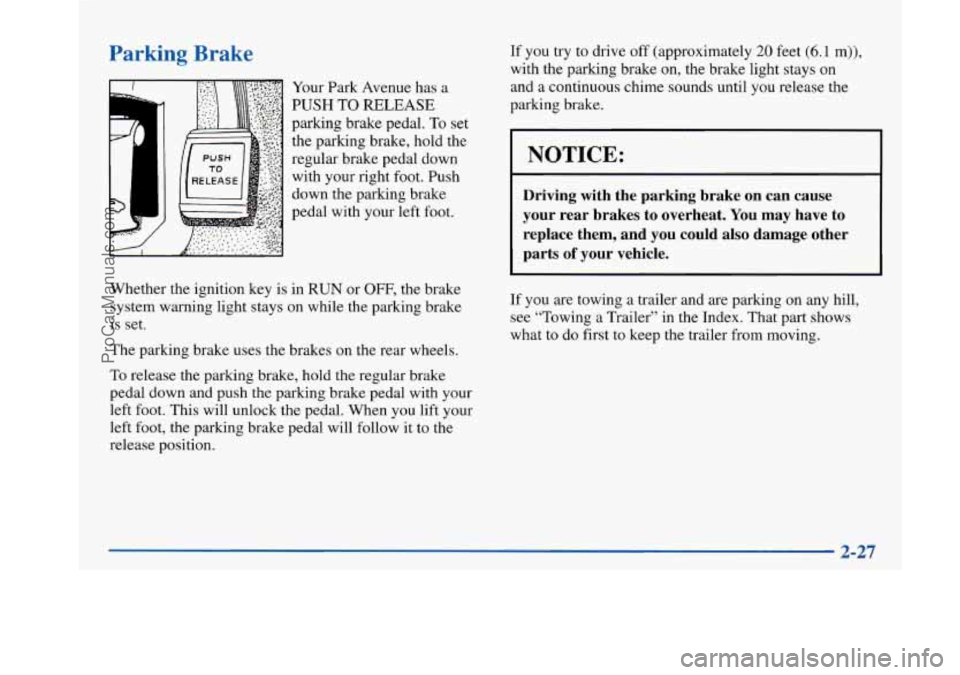
Parking Brake
Your Park Avenue has a
PUSH TO RELEASE
parking brake pedal. To set
the parking brake, hold the
regular brake pedal down
with your right foot. Push
down the parking brake
pedal with your left foot.
~___
Whether the ignition key is
in RUN or OFF, the brake
system warning light stays on while the parking brake
is set.
The parking brake uses the brakes on the rear wheels.
To release the parking brake, hold the regular brake
pedal down and push the parking brake pedal with your
left foot. This will unlock the pedal. When you lift your
left foot, the parking brake pedal will follow it to the
release position. If you
try to drive
off (approximately 20 feet (6.1 m)),
with the parking brake on, the brake light stays on and a continuous chime sounds until you release the
parking brake.
I NOTICE:
Driving with the parking brake on can cause
your rear brakes to overheat.
You may have to
replace them, and you could also damage other
parts
of your vehicle.
If you are towing a trailer and are parking on any hill,
see “Towing a Trailer” in the Index. That part shows
what to do first to keep the trailer from moving.
2-27
ProCarManuals.com
Page 101 of 420
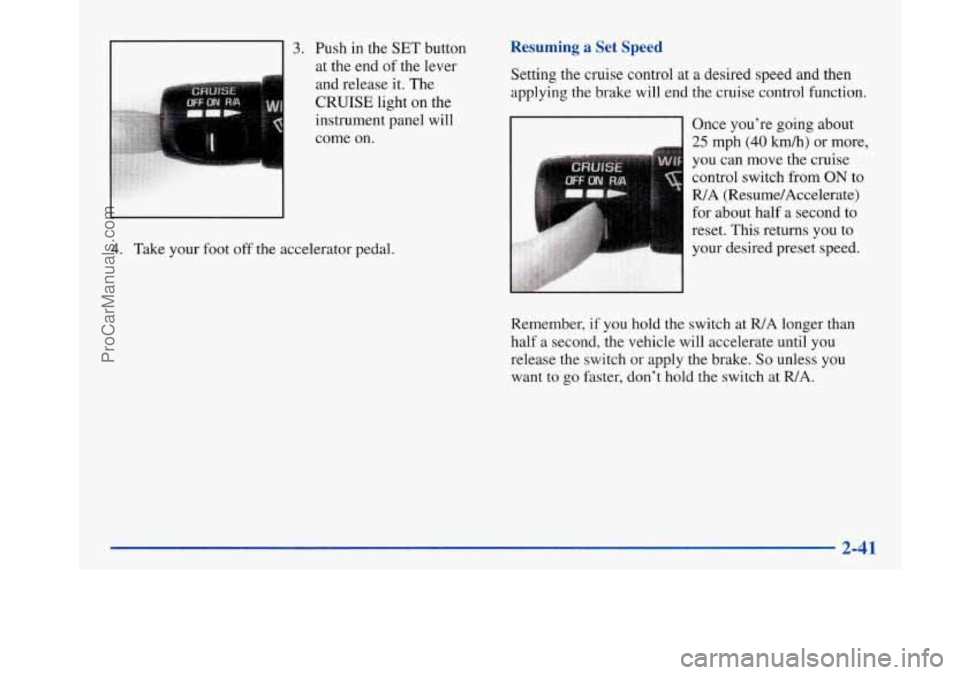
3. Push in the SET button
at the end of the lever
and release it. The
CRUISE light
on the
instrument panel will
come on.
4. Take your foot off the accelerator pedal.
Resuming a Set Speed
Setting the cruise control at a desired speed and then
applying the brake will end the cruise control function.
Once you’re going about
25 mph (40 km/h) or more,
you can move the cruise
control switch from ON to
WA (Resume/Accelerate)
for about half a second to
reset. This returns you to
your desired preset speed.
Remember, if you hold the switch at
WA longer than
half a second, the vehicle will accelerate until you
release the switch or apply the brake.
So unless you
want
to go faster, don’t hold the switch at WA.
2-41
ProCarManuals.com
Page 103 of 420
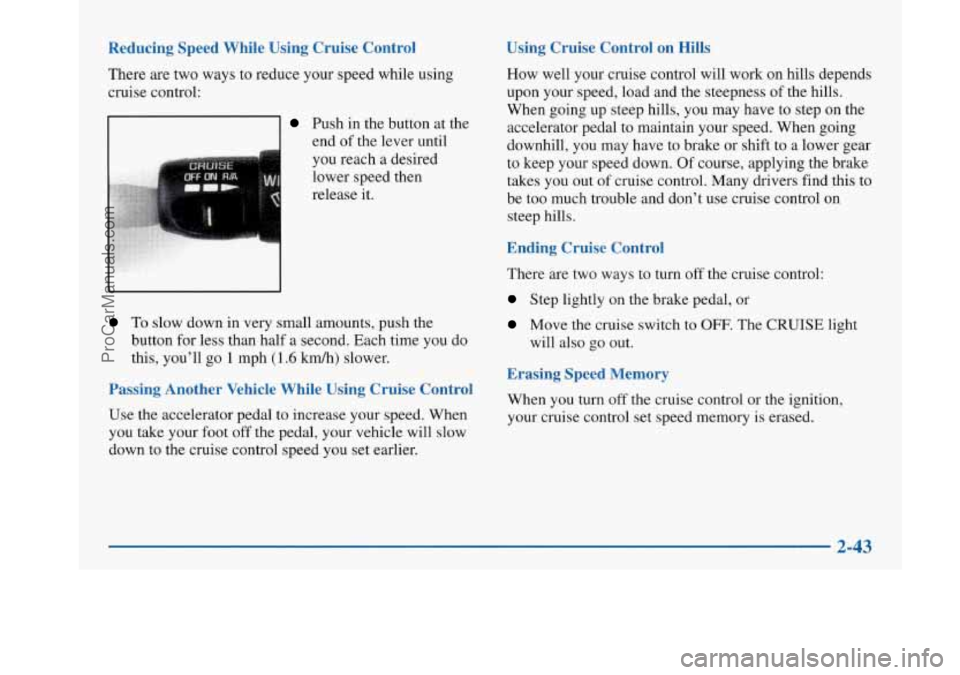
Reducing Speed While Using Cruise Control
There are two ways to reduce your speed while using
cruise control:
Push in the button at the end of the lever until
you reach a desired
lower speed then
release it.
To slow down in very small amounts, push the
button for less than half a second. Each time you do
this, you’ll
go 1 mph (1.6 km/h) slower.
Passing Another Vehicle While Using Cruise Control
Use the accelerator pedal to increase your speed. When
you take your foot off the pedal, your vehicle will slow
down to the cruise control speed you set earlier.
Using Cruise Control on Hills
How well your cruise control will work on hills depends
upon your speed, load and the steepness of the hills.
When going up steep hills, you may have to step on the
accelerator pedal to maintain your speed. When going
downhill, you may have to brake or shift to a lower gear
to keep your speed down.
Of course, applying the brake
takes you out of cruise control. Many drivers find this to
be too much trouble and don’t use cruise control
on
steep hills.
Ending Cruise Control
There are two ways to turn off the cruise control:
Step lightly on the brake pedal, or
Move the cruise switch to OFF. The CRUISE light
will also go out.
Erasing Speed Memory
When you turn off the cruise control or the ignition,
your cruise control set speed memory is erased.
2-43
ProCarManuals.com
Page 135 of 420
Brake System Warning Light
Your Buick’s hydraulic brake system is divided into two
parts. If one part isn’t working, the other part can still
work and stop you. For good braking, though, you need
both parts working well.
If the warning light comes on, there could be a brake
problem. Have your brake system inspected right away.
BRAKE
This light should come on
when you turn the key to
RUN. If it doesn’t come on
then, have
it fixed so it will
be ready to warn you if
there’s a problem.
I I
Your brake system may not be working properly
if the brake system warning light is on. Driving with the brake system warning light on can lead
to an accident. If the light is still on after you’ve pulled off the road and stopped carefully, have
the vehicle towed for service.
When the ignition is on, the brake system warning light will also come on when you set your parking
brake. The light will stay on if your parking brake
doesn’t release fully. If you try to drive off with the
parking brake set, a chime will also come on until you
release the parking brake.
If the light and chime stay on
after your parking brake
is fully released, it means you
have a brake problem.
If the light and chime come on while you are driving,
pull
off the road and stop carefully. You may notice that
the pedal is harder to push. Or, the pedal may go closer
to the floor. It may take longer to stop. If the light is still
on, have the vehicle towed for service. (See “Towing
Your Vehicle” in the Index.)
2-75
ProCarManuals.com
Page 136 of 420
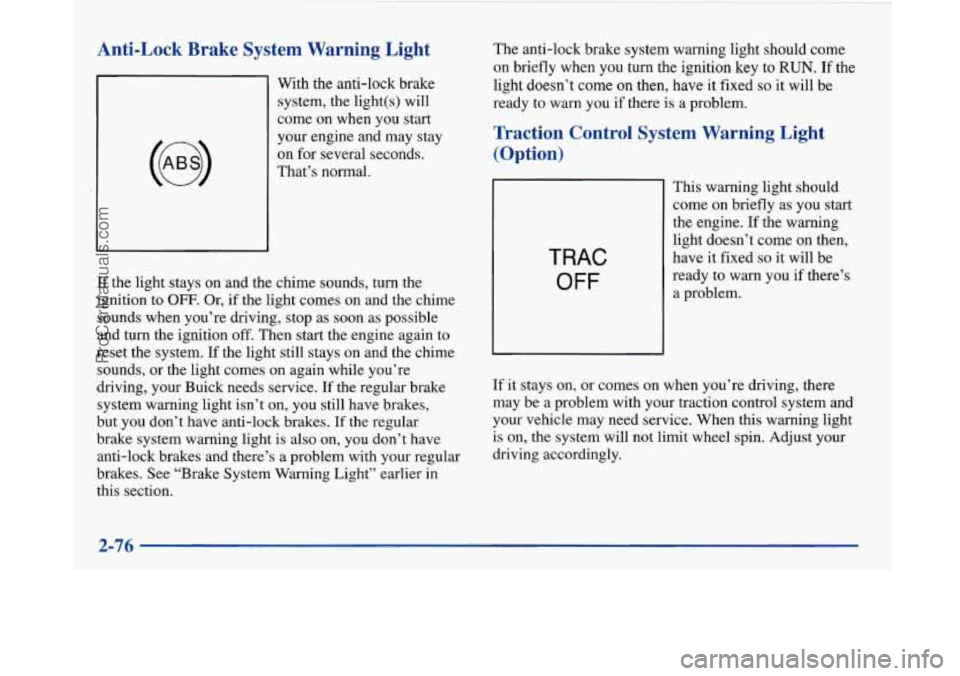
Anti-Lock Brake System Warning Light
With the anti-lock brake
system, the light(s) will
come on when you start
your engine and may stay
on for several seconds.
That’s normal.
If the light stays on and the chime sounds, turn the
ignition to
OFF. Or, if the light comes on and the chime
sounds when you’re driving, stop as soon as possible
and turn the ignition
off. Then start the engine again to
reset the system. If the light still stays on and the chime
sounds, or the light comes on again while you’re
driving, your Buick needs service.
If the regular brake
system warning light isn’t on, you still have brakes,
but you don’t have anti-lock brakes. If the regular
brake system warning light is also on, you don’t have
anti-lock brakes and there’s a problem with your regular
brakes. See “Brake System Warning Light” earlier in
this section. The
anti-lock brake system warning light should come
on briefly when you turn the ignition
key to RUN. If the
light doesn’t
come on then, have it fixed so it will be
ready
to warn you if there is a problem.
Traction Control System Warning Light
(Option)
TRAC
OFF
This warning light should
come
on briefly as you start
the engine. If the warning
light doesn’t come
on then,
have it fixed
so it will be
ready to warn you if there’s
a problem.
If it stays on, or comes on when you’re driving, there
may be a problem with your traction control system and
your vehicle may need service. When this warning light
is on, the system will not limit wheel spin. Adjust your
driving accordingly.
2-76
~
ProCarManuals.com
Page 137 of 420
The traction control system warning light may come on
for the following reasons:
e
0
e
If you turn the system off by pressing the button
located on the end of the shift lever, the warning
light will come on and stay on. To turn the system
back on, press the button again. The warning light
should go
off. (See “Traction Control System” in
the Index for more information.)
If there’s a brake system problem that
is specifically
related
to traction control, the traction control system
will turn
off, the warning light will come on and the
chime will sound.
If the traction control system is affected by an
engine related problem, the system will turn off,
the warning light will come on and the chime
will sound.
If the traction control system warning light comes on
and stays on for an extended period
of time when the
system
is turned on, your vehicle needs service.
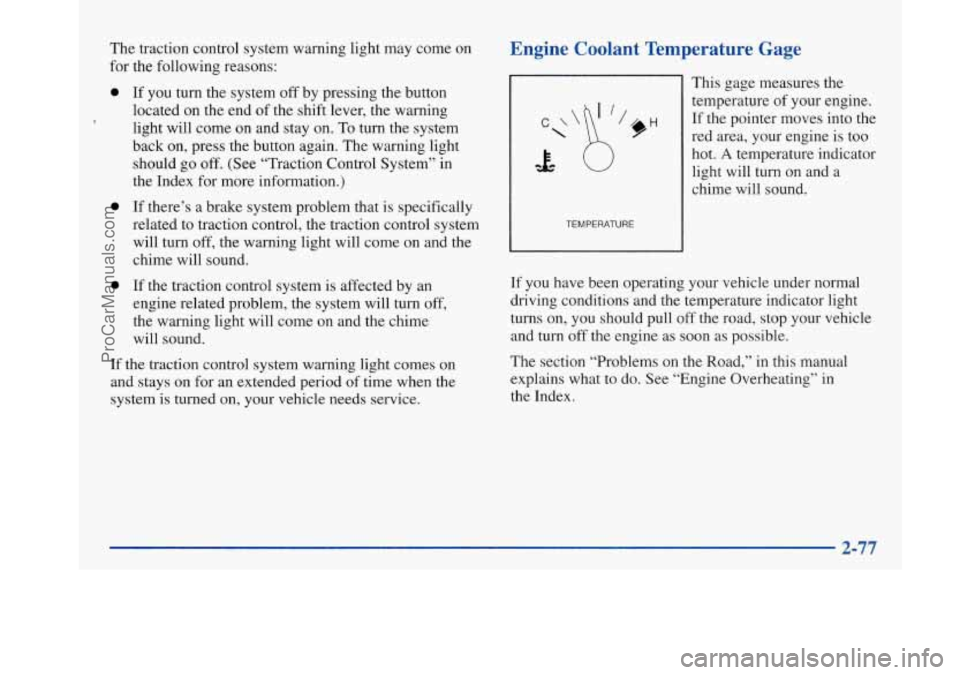
Engine Coolant Temperature Gage
TEMPERATURE
This gage measures the
temperature of your engine.
If the pointer moves into the
red area, your engine is too
hot.
A temperature indicator
light will turn on and a
chime will sound.
If you have been operating your vehicle under normal
driving conditions and the temperature indicator light
turns on, you should pull off the road, stop your vehicle
and turn off the engine as soon as possible.
The section “Problems on the Road,” in this manual
explains what to do. See “Engine Overheating” in
the Index.
ProCarManuals.com