fuel cap BUICK PARK AVENUE 1997 Owners Manual
[x] Cancel search | Manufacturer: BUICK, Model Year: 1997, Model line: PARK AVENUE, Model: BUICK PARK AVENUE 1997Pages: 420, PDF Size: 21.93 MB
Page 141 of 420
Service Vehicle Soon Light
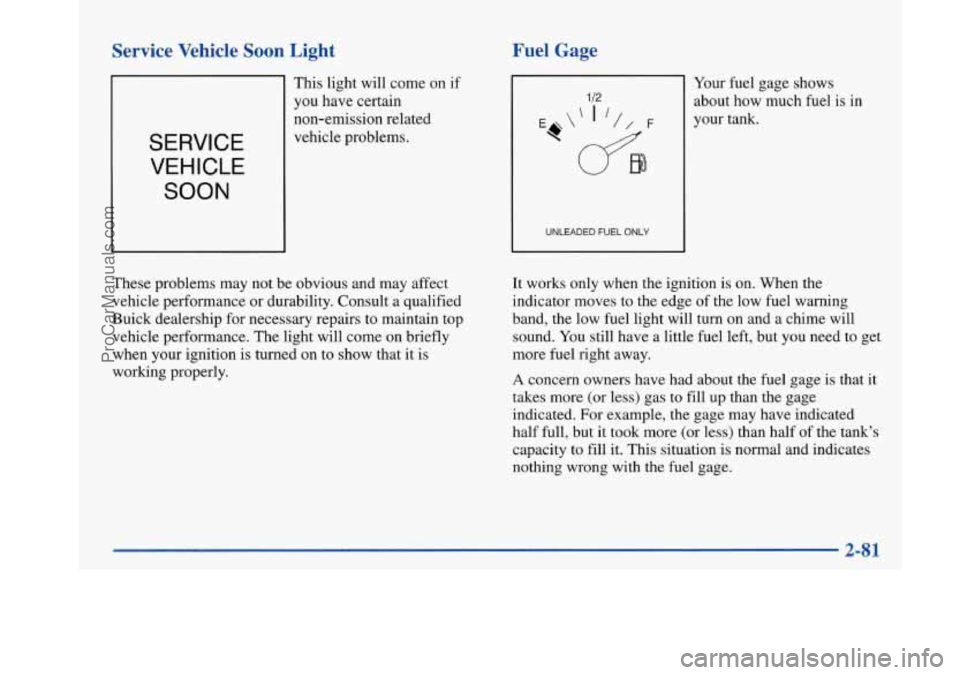
SERVICE
VEHICLE SOON
This light will come on if
you have certain
non-emission related
vehicle problems.
I
These problems may not be obvious and may affect
vehicle performance or durability. Consult a qualified
Buick dealership for necessary repairs to maintain top
vehicle performance. The light will come on briefly
when your ignition is turned on to show that it is
working properly.
Fuel Gage
UNLEADED FUEL ONLY
Your fuel gage shows
about how much fuel is in
your tank.
It works only when the ignition is on. When the
indicator moves to the edge of the low fuel warning
band, the low fuel light will turn on and a chime will
sound. You still have a little fuel left, but you need to get
more fuel right away.
A concern owners have had about the fuel gage is that it
takes more (or less) gas to fill up than the gage indicated.
For example, the gage may have indicated
half full, but it took more
(or less) than half of the tank's
capacity to fill it. This situation is normal and indicates
nothing wrong with the fuel gage.
2-81
ProCarManuals.com
Page 218 of 420
Run your engine only as long as you must. This saves
fuel. When you run the engine, make it go a little faster
than just idle. That
is, push the accelerator slightly. This
uses less fuel for the heat that you get and
it keeps the
battery charged. You will need a well-charged battery to
restart the vehicle, and possibly for signaling later on
with your headlamps. Let the heater run for awhile.
Then, shut the engine off and close the window almost
all the way to preserve the heat. Start the engine again
and repeat this only when you feel really uncomfortable
from the cold. But
do it as little as possible. Preserve the
fuel as long as you can. To help keep warm, you can get
out of the vehicle and do some fairly vigorous exercises
every half hour or
so until help comes.
Loading Your Vehicle
‘ OCCUPANTS
VEHICLE CAP. WT.
TIRE-LOADING
INFORMATION
FRT. CTR. RR.
TOTAL LBS. KG
MAX. LOADING & GVWR SAME AS VEHICLE
CAPACITY WEIGHT XXX COLD TIRE
TIRE SIZE SPEED PRESSURE RTG
PSI/KPa
FRT.
RR.
SPA.
IF TIRES ARE HOT, ADD 4PSli28KPa
SEE OWNER’S MANUAL FOR ADDITIONAL
INFORMATION
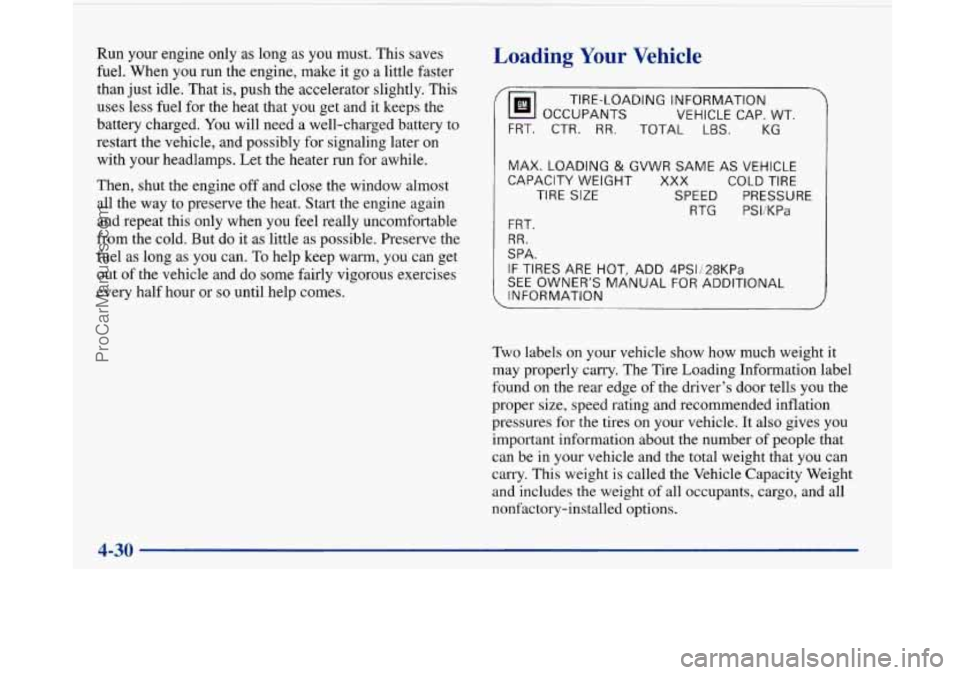
Two labels on your vehicle show how much weight it
may properly carry. The Tire Loading Information label
found on the rear edge of the driver’s door tells you the
proper size, speed rating and recommended inflation
pressures for the tires on your vehicle.
It also gives you
important information about the number of people that
can be in your vehicle and the total weight that you can
carry. This weight is called the Vehicle Capacity Weight
and includes the weight of all occupants, cargo, and all
nonfactory-installed options.
ProCarManuals.com
Page 219 of 420
THIS VEHICLE CONFORMS TO ALL APPLI-
CABLE
U.S. FEDERAL MOTOR VEHICLE
SAFETY, BUMPER, AND THEFT PREVENTION
STANDARDS IN EFFECT
ON THE DATE OF
MANUFACTURE SHOWN ABOVE.
MFD
BY GENERAL MOTORS CORP
DATE GVWR GAWR FRT GAWR RR
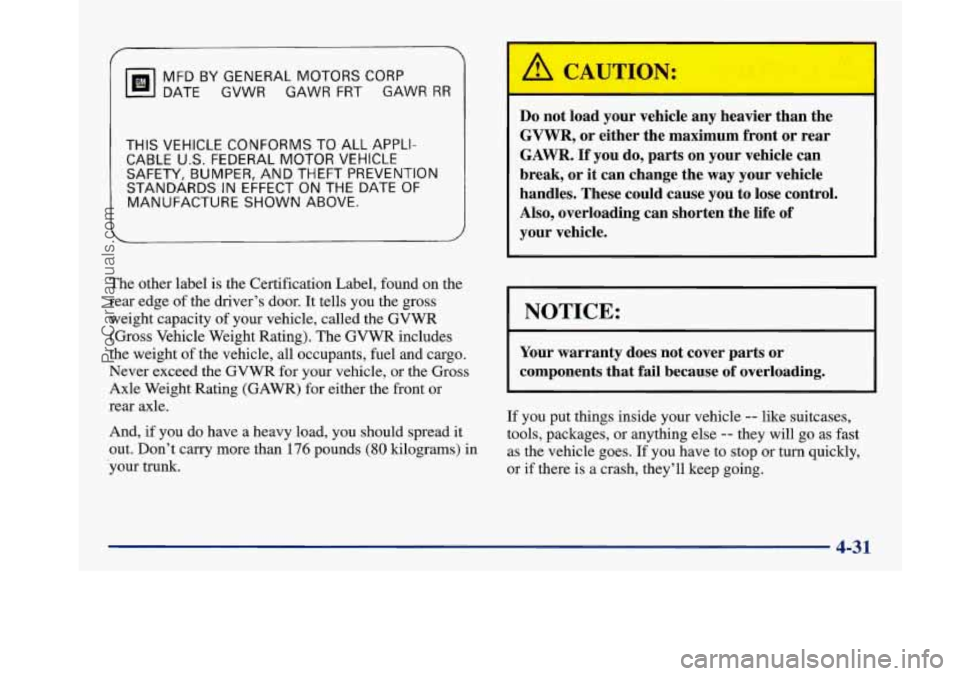
The other
label is the Certification Label, found on the
rear edge of the driver’s door.
It tells you the gross
weight capacity of your vehicle, called the
GVWR
(Gross Vehicle Weight Rating). The GVWR includes
the weight of the vehicle, all occupants, fuel and cargo.
Never exceed the GVWR for your vehicle, or the Gross
Axle Weight Rating (GAWR) for either the front or
rear axle.
And,
if you do have a heavy load, you should spread it
out. Don’t carry more than
176 pounds (80 kilograms) in
-your trunk.
Do not load your vehicle any heavier than the
GVWR, or either the maximum front or rear
GAWR.
If you do, parts on your vehicle can
break, or it can change the
way your vehicle
handles. These could cause you to lose control.
Also, overloading can shorten the life of
your vehicle.
NOTICE:
r
~~~ ~ ~
Your warranty does not cover parts or
components that fail because of overloading.
If you put things inside your vehicle -- like suitcases,
tools, packages, or anything else
-- they will go as fast
as the vehicle goes. If you have to stop or turn quickly,
or if there is a crash, they’ll keep going.
~- 4-31
ProCarManuals.com
Page 221 of 420
NOTICE:
Pulling a trailer improperly can damage your
vehicle and result in costly repairs not covered by
your warranty.
To pull a trailer correctly, follow
the advice in this part, and see your Buick dealer for important information about towing a trailer
with your vehicle.
Your vehicle can tow a trailer if it is equipped with the
proper trailer towing equipment. To identify what the
vehicle trailering capacity is for your vehicle, you
should read the information in “Weight of the Trailer”
that appears later in this section. But trailering is
different than just driving your vehicle by itself.
Trailering means changes in handling, durability and
fuel economy. Successful, safe trailering takes correct
equipment, and it has to be used properly.
That’s the reason for
this part. In it are many time-tested,
important trailering tips and safety rules. Many of these are
important for your safety and that of your passengers.
So
please read this section carefully before you pull a trailer.
Load-pulling components such as the engine, transaxle,
wheel assemblies and tires are forced to work harder
against the drag of the added weight. The engine is required to operate at relatively higher speeds and under
greater loads, generating extra heat. What’s more, the
trailer adds considerably to wind resistance, increasing
the pulling requirements.
If You Do Decide To Pull A Trailer
If you do, here are some important points:
0
0
0
0
0
There are many different laws, including speed limit
restrictions, having to do with trailering. Make sure
your rig will be legal, not only where you live but
also where you’ll be driving.
A good source for this
infomation can be state or provincial police.
Consider using a sway control. You can ask a hitch
dealer about sway controls.
Don’t tow a trailer at all during the first
1,000 miles
(1 600 km) your new vehicle is driven. Your engine,
axle or other parts could be damaged.
Then, during the first
500 miles (800 km) that you tow
a trailer, don’t drive over
50 mph (80 km/h) and don’t
make starts at full throttle. This helps your engine and
other parts of your vehicle wear
in at the heavier loads.
Obey speed limit restrictions when towing a trailer.
Don’t drive faster than the maximum posted speed
for trailers (or no more than
55 mph (90 km/h)) to
save wear on your vehicle’s parts.
1 mm 4-55
ProCarManuals.com
Page 265 of 420
Section 6 Service and Appearance Care
Here you will find information about the care of your Buick. This section begins with service and fuel information,
and then it shows how to check important fluid and lubricant levels. There is also technical information about your
vehicle, and a part devoted to its appearance care.
6-2
6-3
6-9
6-12
6- 17
6-20
6-2
1
6-24
6-28
6-29
6-30
6-34
6-34
6-46
6-47 Service
Fuel Checking Things Under the
Hood
Engine Oil
Air Cleaner Supercharger Oil
Automatic Transaxle Fluid
Engine Coolant Radiator Pressure Cap
Windshield Washer Fluid
Brakes
Battery
Bulb Replacement
Windshield Wiper Blade Replacement
Tires 6-56
6-57
6-6
1
6-64
6-64
6-65
6-66
6-67
6-73
6-75 6-76
6-77
6-77
6-78
6-78 Appearance
Care
Cleaning the Inside
of Your Buick
Cleaning the Outside of Your Buick
Underbody Maintenance
Chemical Paint Spotting
Appearance Care Materials Chart
Vehicle Identification Number (VIN)
Electrical System
Removing the Rear Seat Cushion
Replacement Bulbs Capacities and Specifications
Air Conditioning Refrigerants
Engine Specifications Vehicle Dimensions
Normal Maintenance Replacement Parts
ProCarManuals.com
Page 270 of 420
Filling Your Tank
I
Gasoline vapor is highly flammable. It burns
violently, and that can cause very bad injuries.
Don’t smoke
if you’re near gasoline or refueling
your vehicle. Keep sparks, flames and
smoking
materials away from gasoline.
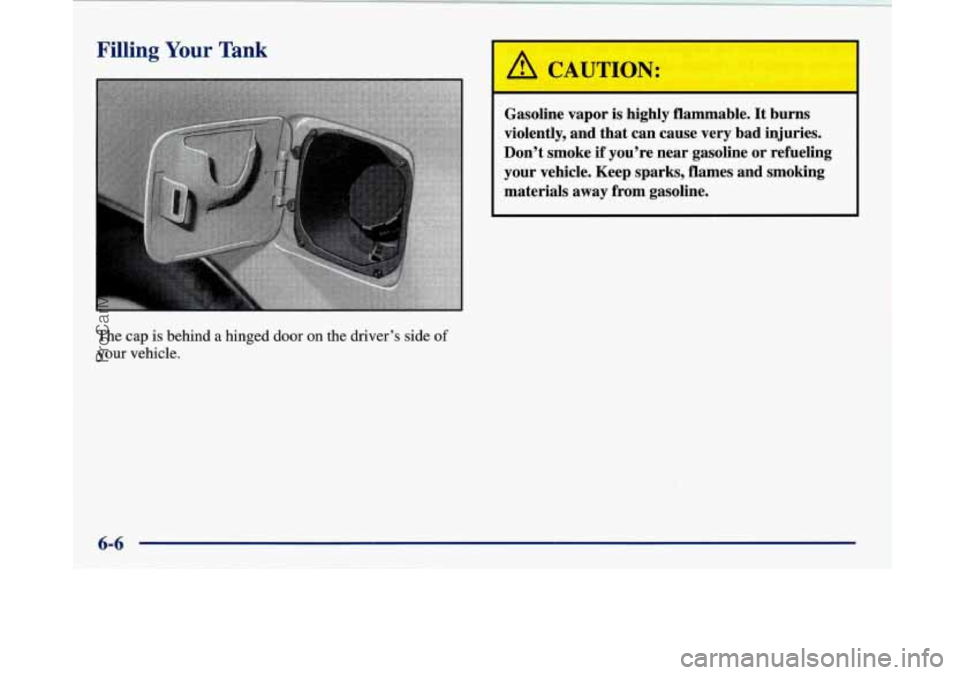
The cap is behind a hinged door on the driver’s side of
your vehicle.
6-6
ProCarManuals.com
Page 271 of 420
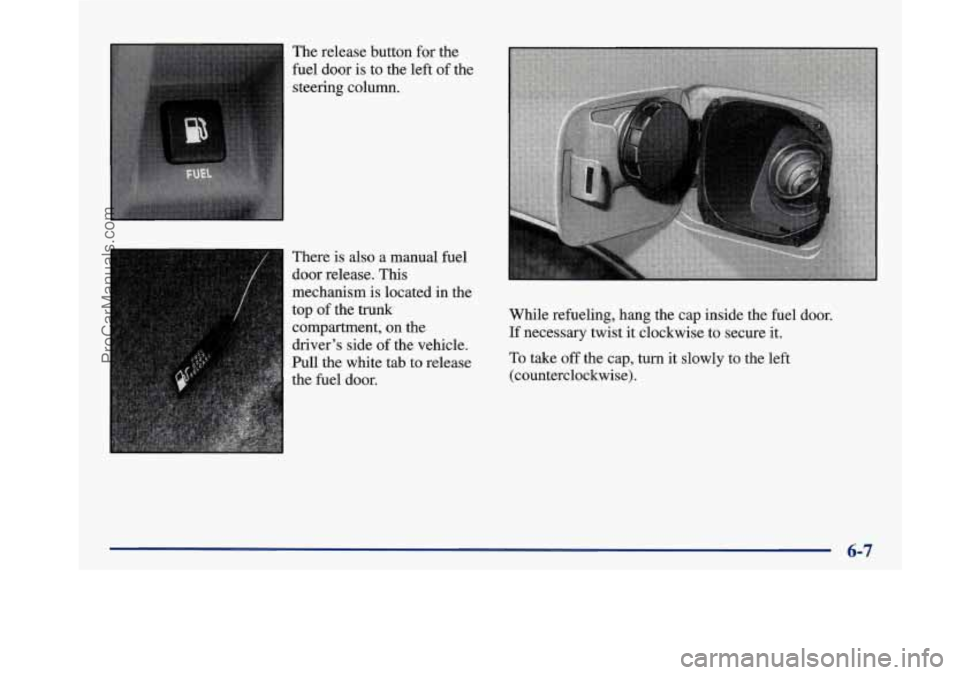
The release button for the
fuel door is to the left of the
steering column.
There is also a manual fuel
door release. This
mechanism
is located in the
top of the
tnxnk
compartment, on the
driver’s side of the vehicle.
Pull the white tab to release
the fuel door. While
refueling, hang the cap inside the fuel door. If necessary twist it clockwise to secure it.
To take off the cap, turn it slowly to the left
(counterclockwise).
6-7
ProCarManuals.com
Page 272 of 420
If you get gasoline on yourself and then
something ignites it, you could be badly burned.
Gasoline can spray out on you
if you open the
fuel filler cap too quickly. This spray can happen
if your tank is nearly full, and is more likely in
hot weather. Open the fuel filler cap slowly and
wait for any “hiss” noise to stop. Then unscrew
the cap all the way.
Be careful not to spill gasoline. Clean gasoline from
painted surfaces as soon as possible. See “Cleaning the
Outside
of Your Buick” in the Index. When
you put the cap back on, turn it to the right
(clockwise) until you hear a clicking sound. Make sure
you fully install the cap.
NOTICE:
If you need a new cap, be sure to get the right
type. Your dealer can get one for you.
If you get
the wrong type,
it may not fit or have proper
venting, and your fuel tank and emissions system
might be damaged.
6-8
ProCarManuals.com
Page 312 of 420
Inflation -- Tire Pressure
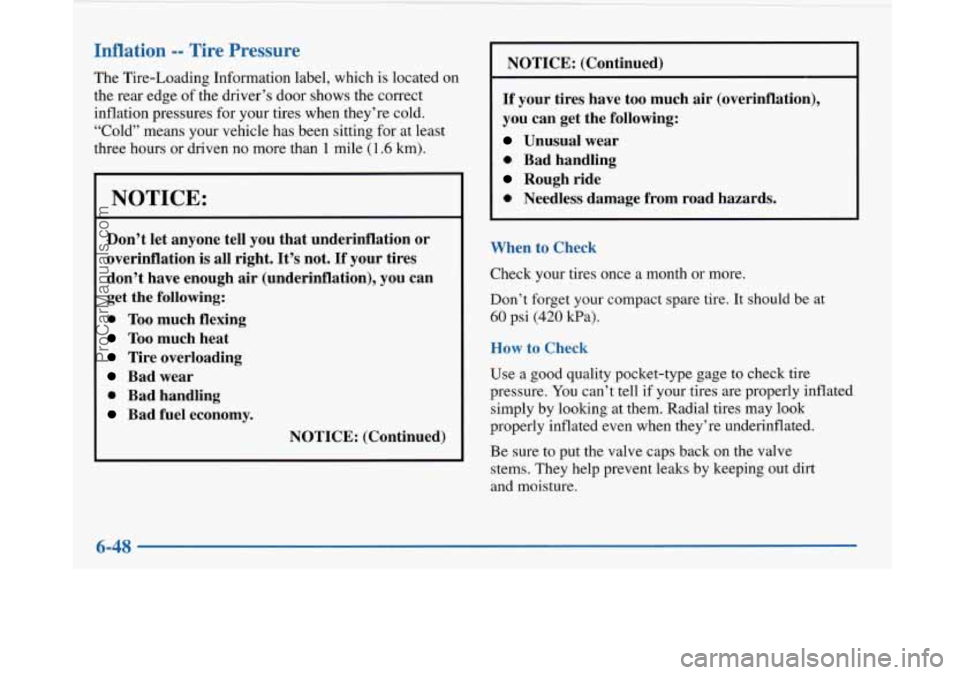
The Tire-Loading Information label, which is located on
the rear edge of the driver’s door shows the correct
inflation pressures for your tires when they’re cold.
“Cold” means your vehicle has been sitting for at least
three hours or driven no more than 1 mile (1.6 km).
NOTICE:
Don’t let anyone tell you that underinflation or
overinflation is all right. It’s not.
If your tires
don’t have enough
air (underinflation), you can
get the following:
0 Too much flexing
Too much heat
Tire overloading
Bad wear
0 Bad handling
Bad fuel economy.
NOTICE: (Continued) NOTICE: (Continued)
If your tires have too much air (overinflation),
you can get the following:
Unusual wear
0 Bad handling
Rough ride
0 Needless damage from road hazards.
When to Check
Check your tires once a month or more.
Don’t forget
your compact spare tire. It should be at
60 psi
(420 kPa).
How to Check
Use a good quality pocket-type gage to check tire
pressure. You can’t tell if your tires are properly inflated
simply by looking at them. Radial tires may look
properly inflated even when they’re underinflated.
Be sure to put the valve caps back on the valve
stems. They help prevent leaks by keeping out dirt
and moisture.
6-48
ProCarManuals.com
Page 340 of 420
Capacities and Specifications
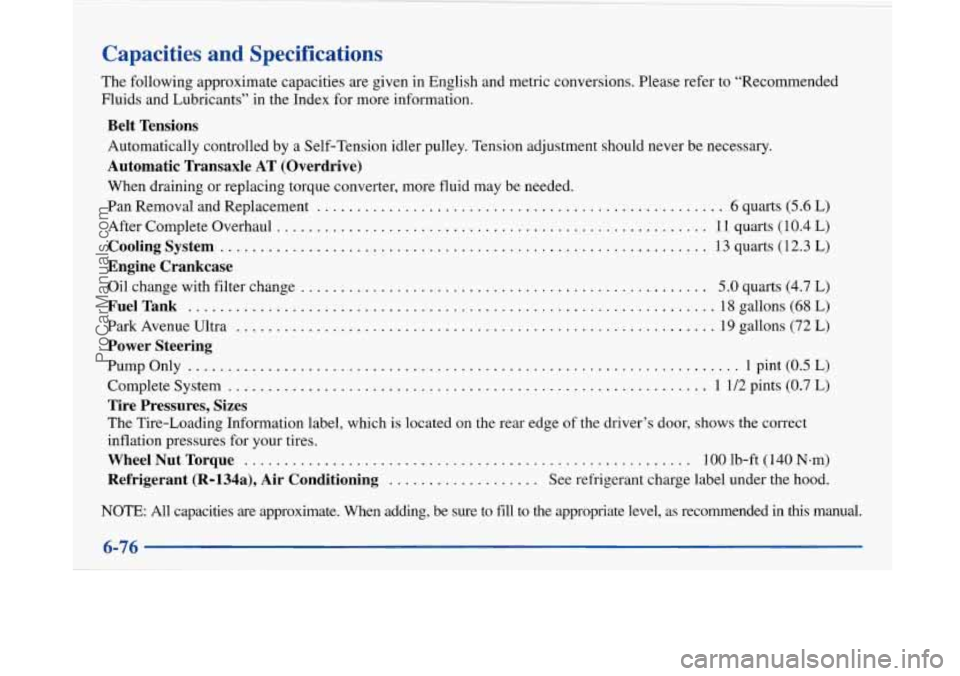
The following approximate capacities are given in English and metric conversions. Please refer to “Recommended
Fluids and Lubricants” in the Index for more information.
Belt Tensions
Automatically controlled by a Self-Tension idler pulley. Tension adjustment should never be necessary.
Automatic Transaxle AT (Overdrive)
When draining or replacing torque converter, more fluid may be needed.
Pan Removal and Replacement
................................................... 6 quarts (5.6 L)
After Complete Overhaul
...................................................... 11 quarts (10.4 L)
Cooling System ............................................................. 13 quarts (12.3 L)
Oil change with filter change ................................................... 5.0 quarts (4.7 L)
Park Avenue Ultra
............................................................ 19 gallons (72 L)
Engine Crankcase
FuelTank
......................,...........................................18gall\
ons (68L)
Power Steering
PumpOnly .....................................................................lpi\
nt (0.5L)
Tire Pressures, Sizes
The Tire-Loading Information label, which is located on the rear edge of the driver’s door, shows the correct
inflation pressures for your tires.
WheelNutTorque ........................................................ lOOlb-ft(140N~m)
Complete System
............................................................ 1
1/2 pints (0.7 L)
Refrigerant (R-l34a), Air Conditioning ................... See refrigerant charge label under the hood.
NOTE: All capacities are approximate. When adding, be sure to \
fill to the appropriate level, as recommended
in this manual.
ProCarManuals.com