ESP BUICK PARK AVENUE 1998 User Guide
[x] Cancel search | Manufacturer: BUICK, Model Year: 1998, Model line: PARK AVENUE, Model: BUICK PARK AVENUE 1998Pages: 426, PDF Size: 23.59 MB
Page 261 of 426
0:. .. . .
If 8 Goes FE&
It’s unusual for a tire to “blow out” while you’re driving,
especially
if you maintain your tires properly. If air goes
i...
...
out of a &e, it’s much moie likely to leak out slowly.
But if you should ever have a “blowout,” here are
a few
tips about what to expect
and what to do: 1 ‘i
< 1 If a front tire fails, the flat tire will create a drag that
’, !! pulls the vehicle toward that side. Take YOLK foot off the g accelerator pedal and grip the steering wheel firmly.
P Steer to maintain lane position, and then gently brake to
-4 ,i a stop well out of the traffic lane.
.2? .
skid and may require the same correction you’d use in a
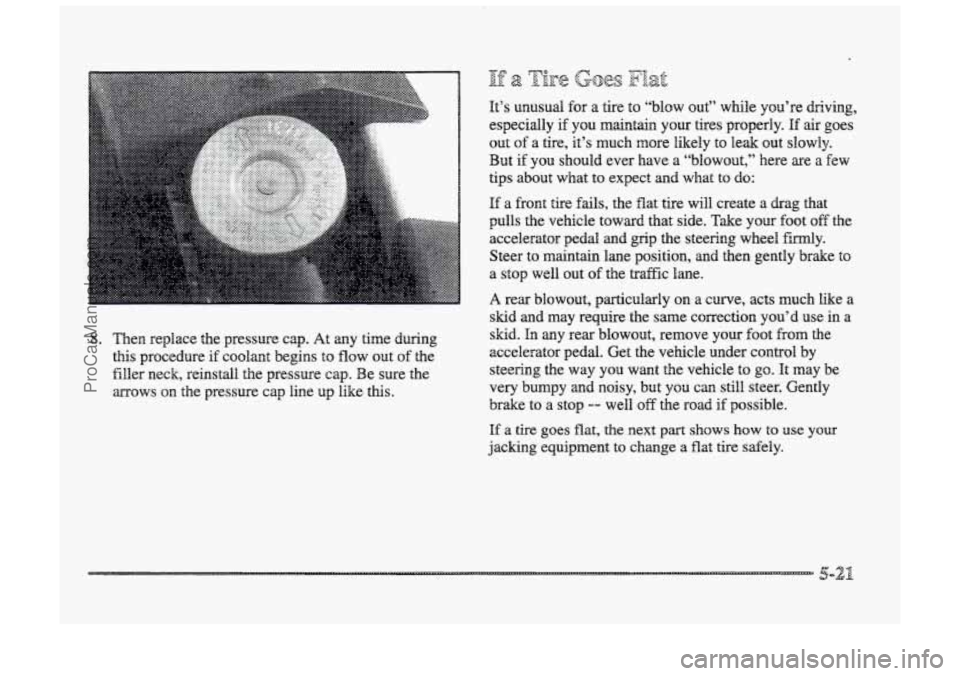
8. Then replace the pressure cap. At any time during
this procedure if
CQQ~EUI~ begins to flow out of the
filler neck, reinstall the pressure cap. Be sure the
mows
on the pressure cap line up like this.
s~. h any kearblowout, remove your foot kom the
accelerator pedal. Get the vehicle under control by
steering the
way you want the vehicle to go. It may be
very bumpy and noisy, but you can still steer. Gently
brake to
a stop -- well off the road if possible.
If a tire goes flat, the next part shows how to use your
jacking equipment to change a flat
tire safely.
ProCarManuals.com
Page 295 of 426
Because this operation can be a little difficult, you may
choose to have this done set your 3uick dealerslug
Service Department.
If you do it yourself, be sue to follow all the instructions
here,
OT you could get a false reading on the dipstick.
Wait at Beast 30 minutes before checking the transaxle
fhid lwei if you have been driving:
8 When outsiOe temperatures are above 90°F (3~ e>. m0-
@ At high speed for quite a while.
e In heavy traffic -- especiaily in hot weather.
8 While gulling a trailer.
ProCarManuals.com
Page 325 of 426
Q e
U~ffJrpx Qna&y K&-&&qg
m~
The following infomation relates to the system
developed by the United States
National Highway
Traffic Safety'Administration, which grades tires by
treadwear, traction and temperature pedommce.
(This applies only to vehicles sold in the 'United
States.) The grades are
molded on the sidewalls of most
passenger car tires. The Uniform Tire Quality Grading
system does not apply to deep tread, winter-type S~QW
tires, space-saver or temporary use spare tires, tires with
nominal rim diameters of 10 to 12 inches (25 to 30 cm),
or to some limited-production tires.
IVhile the tires available on Generd Motors passenger
cars and light trucks may vary with respect to these
grades, they
must also confom to Federal safety
requirements
and additional General Motors Tire
Performance Criteria
(PC) standards.
ProCarManuals.com
Page 326 of 426
''I+he brcadwear grade is a comparative rating based Q~Z
t tze wcx rate of the tire when tested under controlled
conditions
on a specified government test course.
For example, a tire graded 150 would wear one md a
Mf (I U2) times as well on the government course
:H tire graded 100. The relative performance of tires
depends
upon the actual conditions of their use,
however, and may depart significantly from the norm
tErrc to variations in driving habits, service practices
and differences in road characteristics and climate.
'The traction grades, from highest
to !owest, are A, 3,
and C, and they represent the tire's ability to stop ora
wet pavement as measured mder controlled conditions
on specified government test surfaces of asphalt
2nd concrete. A tire marked &: may have poor
traction performance.
Warning: The traction grade assigned
to this tire is based
on
braking (straight alead) traction tests and does not
ifgcllude cornering (turning) traction. heat
and its ability to dissipate heat when tested under
controlled csndidsns on a specified indoor laboratory
test wheel. Sustained
high temperature can cause the
material of the tire to degenerate and reduce tire life, and
excessive ternperaFure can lead to sudden fire faifwe.
The grade C corresponds to a level of pedomance
which ail passenger cx tires must meet e~nder the
Federal
Motor Vehicle Safety Stmda-d No. i09. Grades
B asci A represent higher levels of perhmance an the
laboratory test wheel than the minimum required by law.
The wheels OR your vehicle were aligned and balanced
careEulIy at the factory to give you the longest tire life
acd best overall performance.
Scheduled wheel alignment
and wheel balancing are not
needed. However, if you notice unusual tire wear or
your vehicle pulling GR~ way OF the other, the akignment
may need
to be reset. If YOU notice your vehicle
vibrating
when driving on a smooth road, your wheels
may need
to be rebalaaaced.
ProCarManuals.com