check engine BUICK PARK AVENUE 1998 User Guide
[x] Cancel search | Manufacturer: BUICK, Model Year: 1998, Model line: PARK AVENUE, Model: BUICK PARK AVENUE 1998Pages: 426, PDF Size: 23.59 MB
Page 245 of 426
6. Check that the jumper cables don’t have loose or
missing insulation. If they do, you could get a shock
and the vehicles could be damaged.
Before
you connect the cables, here are SOW basic
things
you should know. Positive (9) will go to
positive (+) and negative (-) will go to a metal
engine
pa. Don’t connect positive (+) to negative
(-1 or you’ll get a short that would damage the
battery
and maybe other parts, too.
7. Connect the red positive (9) cable to the positive (+>
terminal of the vehicle with the dead battery. Use a
remote positive
(+) terminal if the vehicle has one.
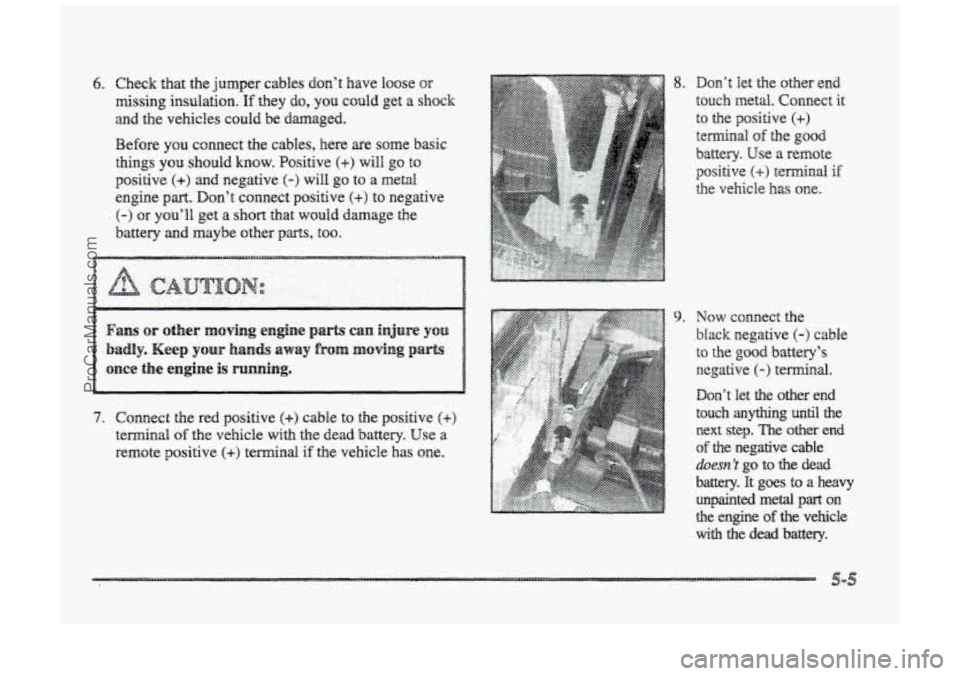
8. Don’t let the other end
t~~h metal. Connect it
to the positive (+)
terminal of the good
battery. Use a remote
positive
(9) terminal if
the vehicle has one.
NOW connect the
black negative (-) cable
to the good battery’s
negative (-) terminal.
Don’t let the other end
touch anytkzng
until the
next
step. The other end
of the negative cable
doem Z go to the dead
battery.
It goes to a heavy
unpainted metal
part on
the engine of the vebcle
with the dead battery.
ProCarManuals.com
Page 255 of 426
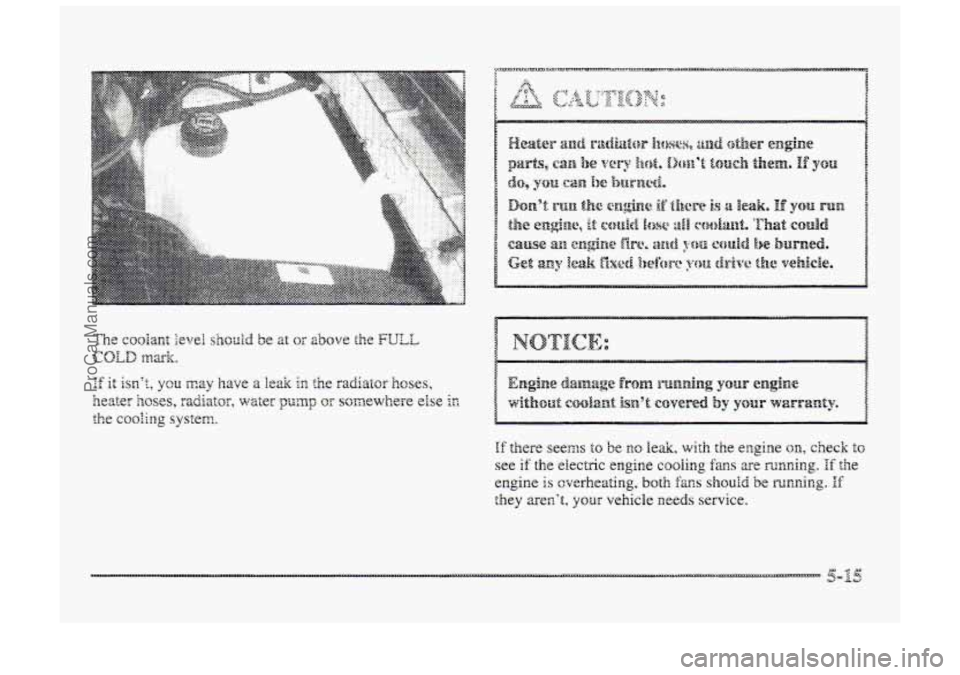
If there seem to be no leak, with the engine on, check io
see if the electric engiap,e cooling fans are mnning. If the
engine is cverkeating, both fm.s shouici be marning. If
they aren't, your vehicle needs service.
ProCarManuals.com
Page 275 of 426
6-2
6- 3
4-9
6-12
4-17
6- 19
4-20
6-23
5-27
6-28
6-29
4-32
6-33
6-45
6-46
Service
Fuel
Checking Things Under the Hood
Engine Oil
Air Cleaner
Supercharger
Oil
Automatic Transaxle Fluid
Engine Coolant
Radiator Bressure Cap
VVindskieTd Washes Fluid
Br&es
3 attery
Bulb Replacement
Windshield Wiper Blade Replacement
Tires Appearance
Care
Cleaning the Inside QE Y(.w VehicEe
Cleaning
the Outside of Your Vehicle
Underbody Maintenance
Chemical
Paint Spotting
Appearance Care Materials Chart
Vehicle icientifkation Number (VIN)
Electrical System
Removing the Rear Seat Cushion
Replacement Bulbs
Capacities and Specifications
Air Conditioning Re€rigerants
Engine Specifications
Vehicle Dimensions
Normal Maintenance Replacement 'Parts
ProCarManuals.com
Page 277 of 426
Things you might add to the outside of your vehicle can
affect
the airdaow around it. This may cause wind noise
and affect windshield washer performance. Check with
your dealer before adding equipment to the outside
of
your vehicle. The
8th digit sf your vehicle
identification number
(Vm) shows the code lettee for your engine. You will
find the VIN at the top left of your instmment panel.
(See “Vehicle Identifkation Number’’ in the Endex.)
If you have the 3800 engine (VIN Code use regula
unleaded gasoline rated
at 87 octane or higher. If you’re
using fuel rated
at the recommended octane or higher
and
you hear heavy knocking, your engine needs
service. But don’t
worry if YOU hear a little pinging
noise when you’re accelerating or driving
up a hill.
That’s normal, and YOU don’t have to buy a higher
octane fuel
to get rid of pinging. It’s the heavy, constant
knock
that means you have a problem.
If you have the 3800 Supercharged engine (VHN
Code I), use premium unleaded gasoline rated at
91 octane or higher. With the 3800 Supercharged
engine, in
an emergency, you may be able to use a
lower QC~XE -- as low as 87 -- if heavy knocking does
not occur. If you are using 91 cx higher octane unleaded
gasoline and
YOU hear heavy knocking, your engine
needs service.
6-3
ProCarManuals.com
Page 286 of 426
Your vehicle may have 2 3800 Sqercharged engine.
Supercharging, rather
than turbocharging, emphasizes
smooth, refined power.
The supercharger is a device which is designed to pump
more ais into the engine than it would normally use.
This air mixed with fuel creates increased engine power.
Since the supercharger
is a pump and is driven from an
engine
accessory drive belt, iwreased pressure is
available at all driving conditions.
The Powertrain Control Module (PCM) works with a
vacuum control to regulate the increased pressure
required during specific driving conditions. When this
increased pressure or boost is not desired, such as during
idling and light tfarsttIe cruising, the excess air that the
supercharger is pumping is routed through a bypass.
AB1 sf these controk working together provide high
performance character and fuel efficiency in the
3800 V6 Supercharged engine.
The power steering pump and reservoir are mounted on
the rear (driver’s side) sf the engine biock. See
“Maintenance Schedule”
in the Index for when you
should check the fluid.
c
ENGINE OIL LOW CHECK LEVEL HMBHBMrn
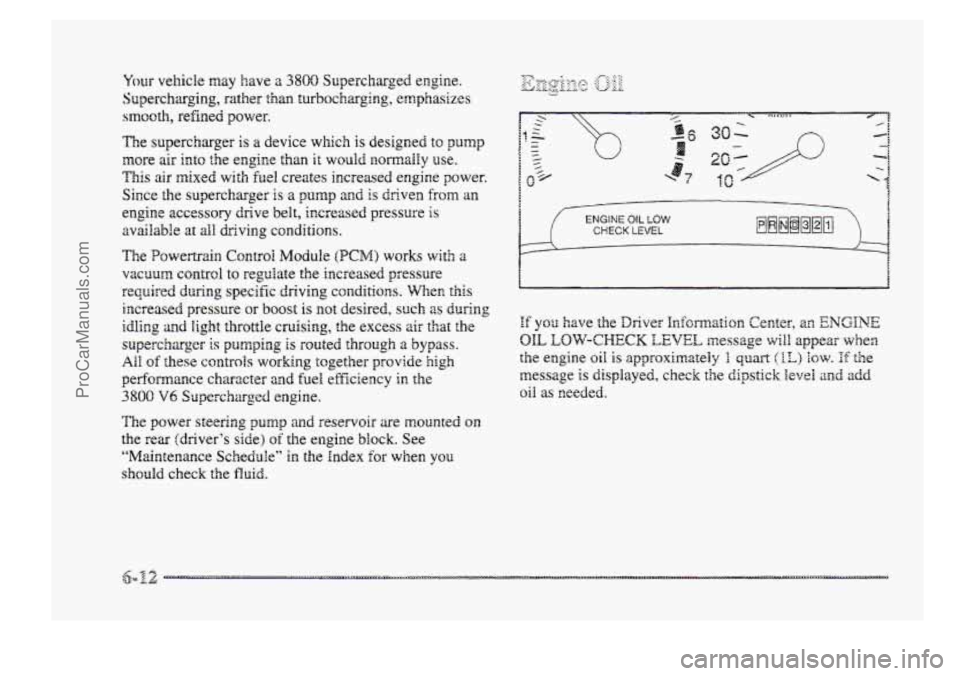
Ef you have the Driver Infcmation Center, an ENGINE
OIL LOW-CHECK LEVEL message will appear when
the engine oil is approximately I quart (fL) Isw. 11 the
message is displayed, check the dipstick level and add
oil as needed.
7r
ProCarManuals.com
Page 294 of 426
Check oil only when the engine is cold. Allow the
engine
to cool two to three hours after running.
I. Clean tke area around the oil fill plug before
removing it.
2. Remove the G~H fill plug wing a 3/26 inch
Allen
wrench.
3. The oil level is correct when it just reaches efre
bottom of the threads of the inspection hole.
4. Replace the oil plug with the O-ring in place.
Torque
to 88 bin ( IO N-m).
A good time to check your automatic transaxle fluid
level is wherr the engine oil is changed.
Change
both the fluid a.nd filter every 50,000 miles
(83 080 Ian) if the vehicle is mainly driven rander one
or more of these conditions:
8 In heavy city traffic where the outside temperature
regularly reaches
90°F (32°C) or higher.
0 Uses such as found in taxi, police QT delivery service.
If you do not use your vehicle under any sf these
conditions, the fluid and filter do not reqwie changing.
See “Scheduled Maintenance Services” in the Index.
ProCarManuals.com
Page 296 of 426
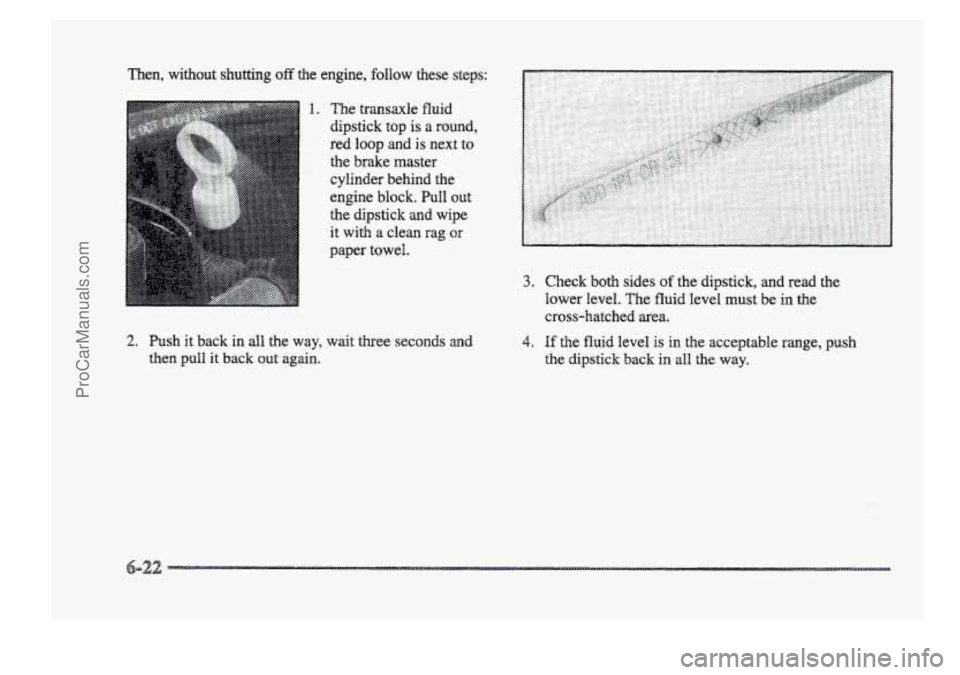
Then, without shutting off the engine, follow these steps:
1. The transaxle fluid
dipstick top is a round,
red
loop and is next to
............. ............. the brake master
cylinder behind
the
engine block. Pull out
the dipstick and wipe
it with a clean rag or
paper towel.
3. Check both sides of the dipstick, and read the
lower level. The fluid 'level
must be in the
cross-hatched area.
2. Push it back in all the way, wait thee seconds and 4. If the fluid level is in the acceptable range, push
then pull it back out again. the dipstick back in a11 the way.
ProCarManuals.com
Page 297 of 426
Refer to the Maintenance Schedule to determine what
kind
of transaxle fluid to use. See “Recommended
Fluids
md Eubricmts” in the Index.
If the fluid level is low, add only enough of the proper
fluid
to bring the level into the cross-hatched area on
the dipstick.
I. Pull out the dipstick.
2. Using a long-neck funnel, add enough fluid at the
dipstick hole
to bring it to the proper level.
It doesn’t
take much fluid, generally less than one
pint
(0.5 L). Don’t ove@Zl.
3. After adding fluid, recheck the fluid level ips
4. When the correct fluid level is obt.ained, push the
described
under “How to Check.”
dipstick back in
dl the way.
The cooling s stem in your vehicle is filled with
DEX-COOL engine coolant. This coolant is designed
to remain in your vehicle for 5 years or 150,000 miles
(240 MI0 h) whichever occurs first, if you add only
DEX-COOL“ extended life coolant,
The following explains
your coding system and
how to add coolant when it is low. If YOU have a
problem with engine overheating, see “Engine
Overheating”
in the Index.
A 50/50 mixture of water and DEX-COOL’
coolant will:
J
Give freezing protection down to -34°F (-37°C).
Give boiling protection up to 265 OF 129 ” C).
Protect against rust and corrosion.
Help keep the proper engine temperature.
Let the warning lights and gages work as
they should.
ProCarManuals.com
Page 300 of 426
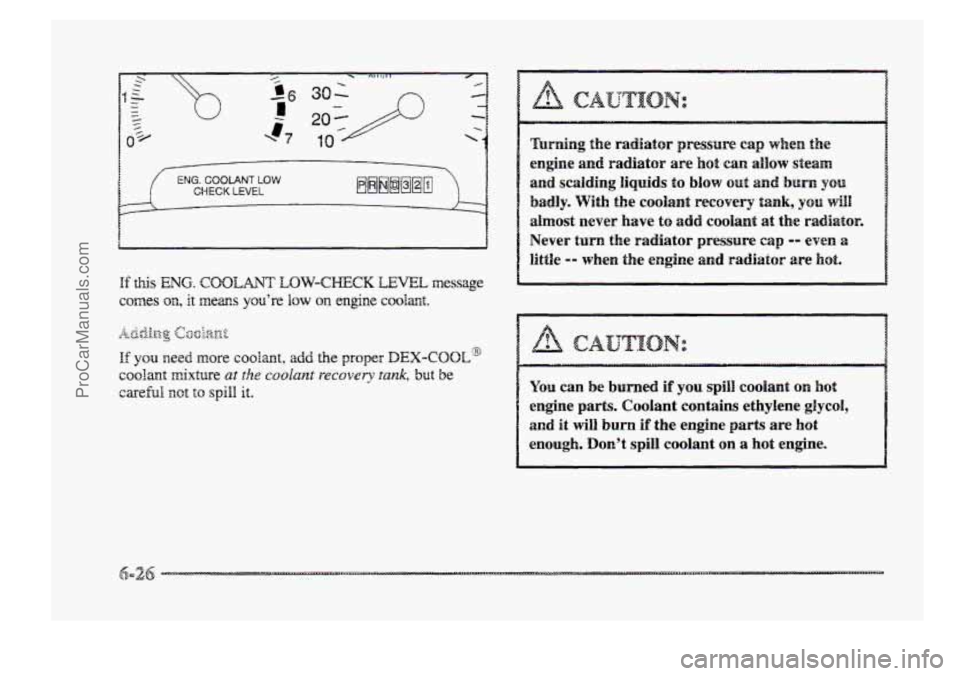
1 f ENG. COOLANT LOW CHECK LEVEL
Turning the radiator pressure cap when the
engine and radiator
are hot can allow steam
and scalding liquids to blow out and burn yon
badly. With the codant recovery tank, you will
almost never have fO add coolant at the radiator.
Never turn the radiator pressure cap -- even a
little -- when the engine sand radiator are hot.
You can be burned if you spill cooiant QPB hot
engine parts. Coolant contains ethylene glycol,
and it will burn if the engine parts are hot
enough. Don't spill coolant on a hot engine.
ProCarManuals.com
Page 348 of 426
Qverall
Length ................. 206.8 inches (525.3 cm)
Width ................... 74.7 inches ( B 89.7 cm)
Height ................... 58.8 inches (147.6 cm)
Wheelbase .............. B 13.8 inches (289.1 cm)
Front Tread ............... 62.7 inches (159.3 cm)
Rear Tread ............... 62.3 inches (158.2 cm)
".. - ?$ ~.p~~~$ 5 ~~4a~~.~ena~~~~ T:. '..
17. ~~~~ja-aee~~~~~~~ , ..-. yay&
Engine Oil Filter ................ AC Type PF-47
_L
Air Cleaner Element .......... AC Type A- 1096C
Fuel Filter .................... AC Type GF-627
Spark Plugs ................... AC Type 41-921
Gap: 0.060 inch (. 152 crn)
Windshield Wiper Blades
Type
............................ Hook Style
Length
..................... 22 inches (56 cm)
Filter
(HVAC air filter) ..... GM Part No. 52472175
Passenger
Compartment
Air
&g&ze &yggsGyy 15 jL2Q e. ,.', E c/ I'
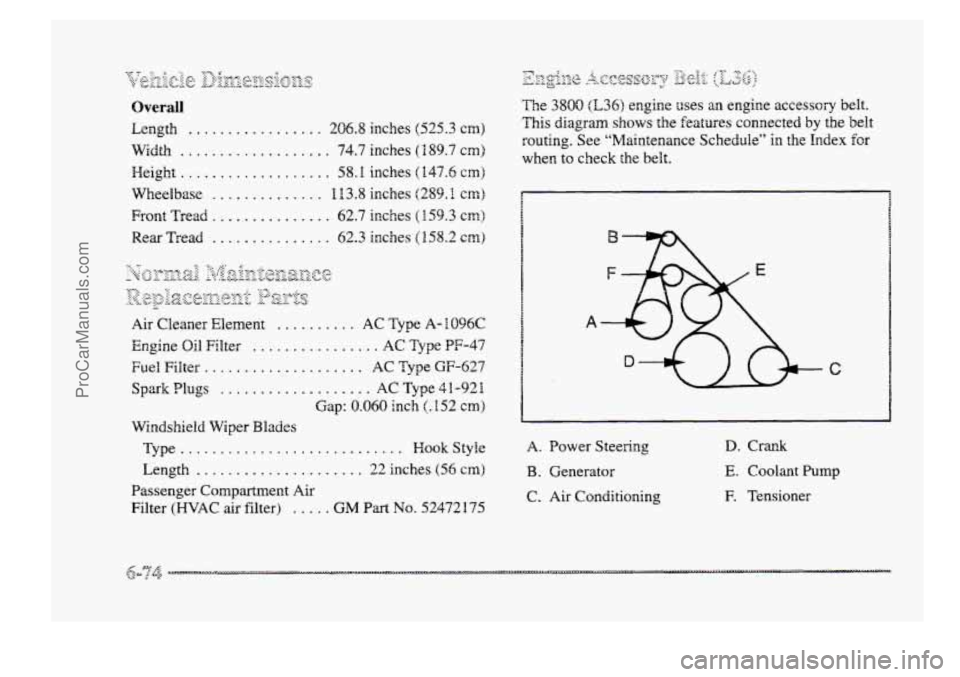
The 3800 (L36) engine uses an engine accessory belt.
This diagram shows the features connected by the belt
routing. See "Maintenance Schedule" in the Index for
when to check the belt.
A
C
A. Power Steering
B. Generator
C. Air Conditioning
D. Crank
E. Coolant Pump
E Tensioner
ProCarManuals.com