steering BUICK PARK AVENUE 1998 User Guide
[x] Cancel search | Manufacturer: BUICK, Model Year: 1998, Model line: PARK AVENUE, Model: BUICK PARK AVENUE 1998Pages: 426, PDF Size: 23.59 MB
Page 197 of 426
To unlock a secured radio see ‘6Udock.ing the
Thefi-Deterrent Feature After
a Bower LOSS” earlier in
this section.
Audio Steering W3eel c@ntr@ls
If your vehicle has this feature, can control certain
radio functions using the buttons on your steering wheel.
Some steering wheel controls may operate climate
CO~&Q~S. See “’Steering Wheel Controls for Climate
Contd” earlier in
this section.
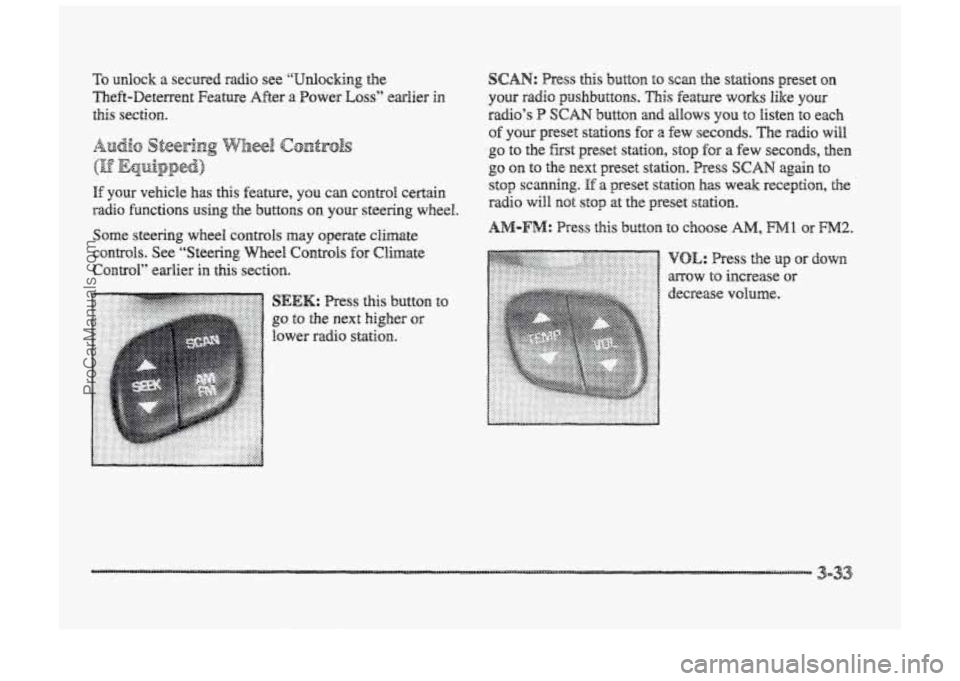
button
to SEEK: Press this
go to the next higher or
lower radio station.
SCAN: Press this button to scan the stations preset on
your radio psaslnbuttons. This feature works like your
radio’s P SCAN button and allows YOU to listen to each
of you preset stations for a few seconds. The radio will
go to the fist preset station, stop for a few seconds, then
go on to the next preset station. Press SCAN again to
stop scanning.
If a preset station has weak reception, the
radio will mot stop at the preset st&hn~.
ProCarManuals.com
Page 207 of 426
YO:; have three systems that make YQLX vehick go wircre
you want it to go. They are the brakes, the steering anti
the accelerator. AH three systems have to do their work
at the places where the tires meet the road.
ProCarManuals.com
Page 212 of 426
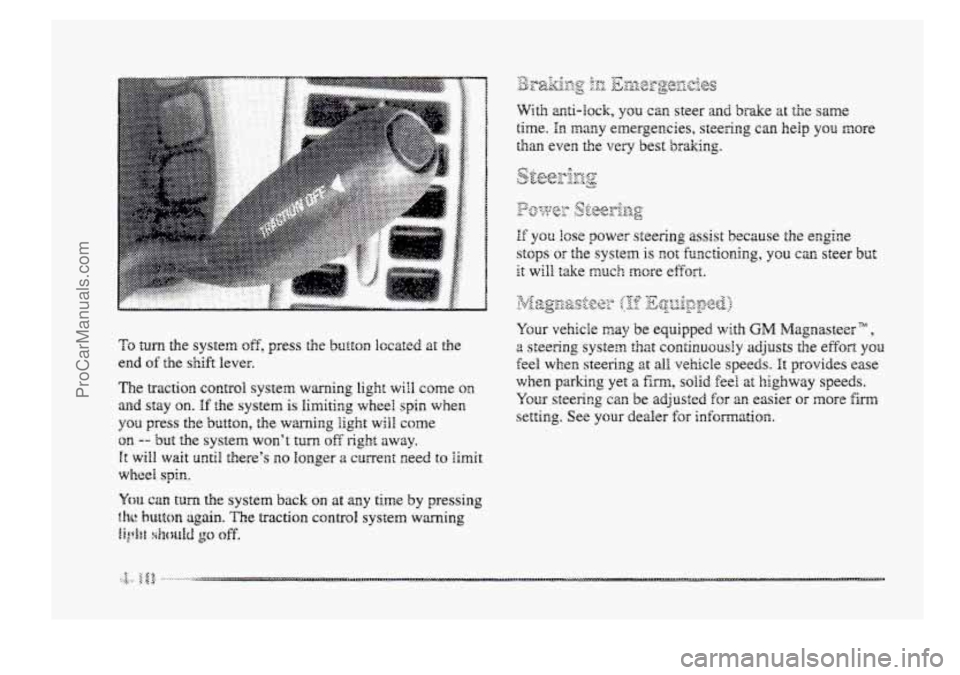
To turn the system off, press the button l~cated at the
end of the shift lever.
The traction control system warning light will come on
and stay on. If the system is limiting wheel spin when
you press the button, the warning light will come
on -- but the system won’t turn off right away.
It will wait until there’s no longer a current need to hit
wheel spin.
Ym can turn the system back on at any time by pressing
?.he button again. The traction control system warning
Bi& xkcPetM go off.
Your vehicle may be equipped with GM Magnasteer ” ,
a steering system that continuousIy adjusts the effort you
feel when steering at all vehicle speeds. It provides ease
when parking yet a firm, solid feel at highway speeds.
You- steering can be adjusted for an easier or more firm
setting. See your dealer for information
ProCarManuals.com
Page 213 of 426
It‘s important to take curves at ;r reasonable speed.
A lot of the “driver lost control” accidents mentioned on
the news happen on curves. Here’s why:
Experienced driver or beginner, each of us is subject to
the same laws of physics when driving on curves. The
traction of the tires agzjinst the roaC surface makes it
possible fcr the vehicle to change its path when you turn
the front wheels. If there’s no traction, inertia wiHl keep
the vehicle going in
the same direction. If you‘ve ever
tried
to steer a vehicle on wet ice, YQK‘IB understacd this.
The
trzctionr YOU can get in a curve depends on the
condition of your tires md the road surface, the angle at
which Gie curve
is banked, and your speed. Mile you’re
in ip curve, speed is the one fxtor you can control.
Suppose ycu’re steering through a sharp curve.
Then you suddenly accelerate. Both control
ProCarManuals.com
Page 214 of 426
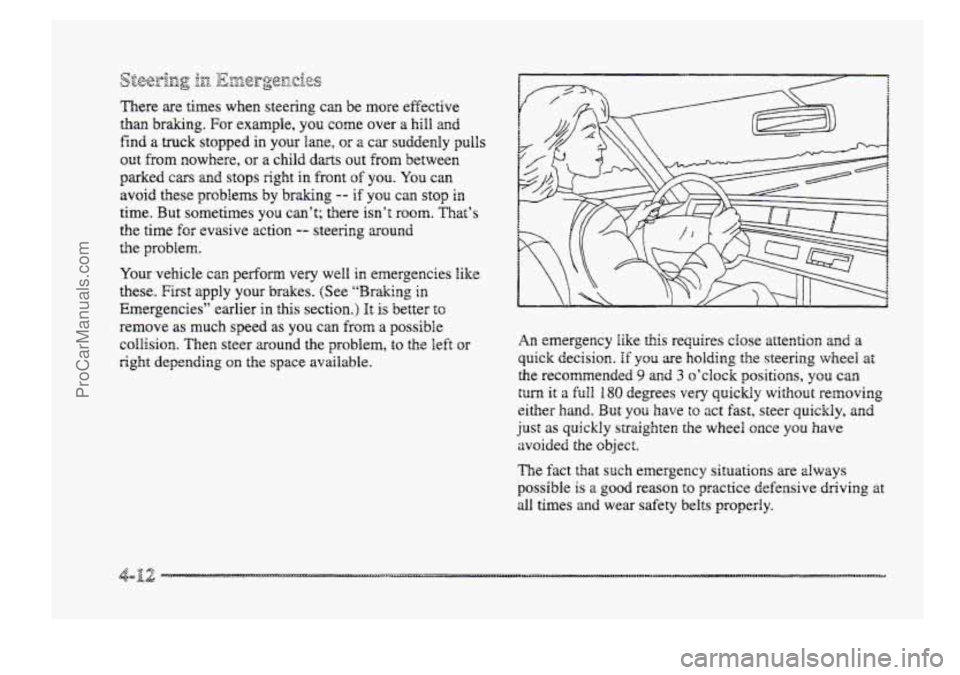
&3g;-izg 1x1 0 &i&rpe[z.iQs 7,ww e?
There are times when steering can be more effective
than brakmg. For example, you come over a hill and
find a truck stopped in your lane, or a car suddenly pulls
out from nowhere, OH a child darts out from between
parked
cars md stops right in front of YOU. You can
avoid these problems by
braking -- if you can stop in
time. But sometimes you can’t; trlere isn’t room. That’s
the time
for evasive action -- steering ~ound
the problem.
Your vehicle can perform very well in emergencies like
these. First apply your brakes. (See ‘‘Braking in
Emergencies” earlier in ”s section.) It is better tc
remove as much speed as you can from a possible
collision. Then steer around the problem, to the left or
right depending on the space available.
An emergency like this requires close attention and a
quick decision. If you are holding the steering wheel a’:
the recomended 9 and 3 o’clock positloas, you can
tuna it a full 180 degrees very quickly without removing
either hand. But you have to act fast, steer quickly, and
just as quickly straighten the wheel once you have
avoided the
object.
The fact that such emergency situations are always
possible is a good reason to practice defensive driving at
dl times and wear safety belts properly.
ProCarManuals.com
Page 230 of 426
Your anti-lock brakes irr;.lp~~e your vehicle’s stability
when
you make a hard stop on a slippery road. Even
though
you have the anti-lock braking system, p~’i8
want to begin stopping sooner than you would on dry
pavement. See “Anti-Lock)’ in the Index.
@ Allow greater following distance on a~y
@ Watch for slippery spots. The road might be he
until
you hit a spot that’s covered with ice. Ora an
otherwise clew road, ice patches may appear in
shaded areas where the sun can’t reach: around
clumps of trees, behind buildings or under bridges.
Sometimes the surface
of a curve or an overpass may
remain icy when the surrounding roads are cka. ff
you see a patch of ice ahead of you, br&e before you
are on it. Try not to br&e while you’re actually on
the ice, and avoid sudden steering maneuvers.
slippery
road.
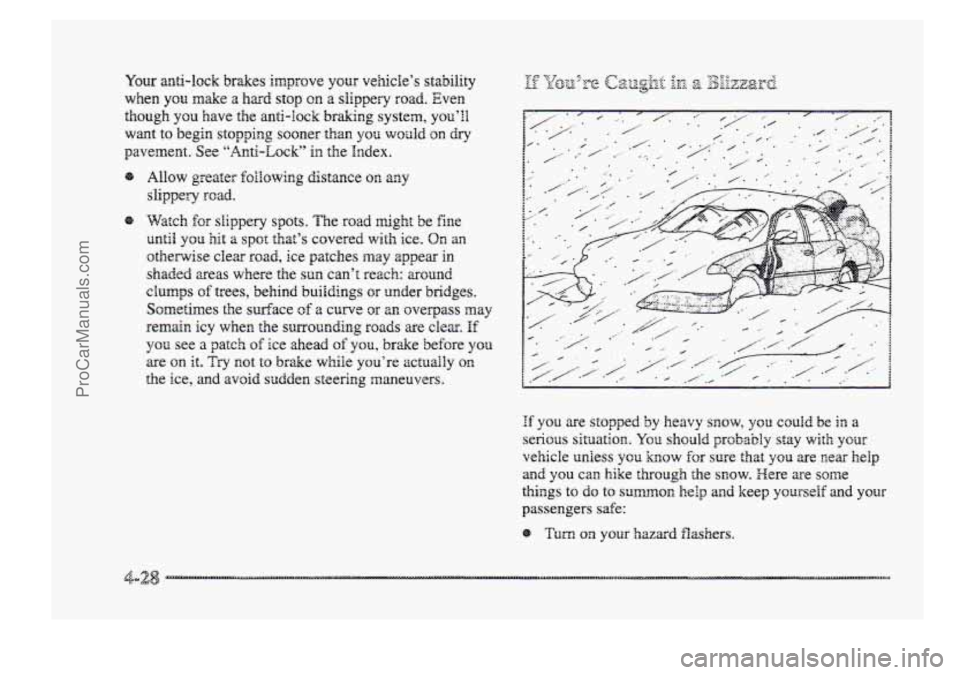
If you are stopped by
heavy snow, you couId be in a
serious situation. YOE skhoald prsbably stay witk your
vehicle unless
you know for sure that you are zear help
and you cas hike through the snow. Here are some
things to do to SUH~~QEZ kip and keep yourself and ~QUI-
passengers safe:
@ Turn on your hazard flashers.
ProCarManuals.com
Page 248 of 426
2
A vehicle can fall from a car carrier if it isn’t
adequately secured. This can cause a collision,
serious personal injury and vehicle damage. The
vehicle should be tightly secured with chains OF
steel cables before it is transported.
Don’t use substitutes (ropes, leather straps,
canvas webbing, etc.) that can be cut by sharp
edges underneath the towed vehicje. Always use
T-hooks inserted in the T-hook siob. Never use
J-hooks. They will damage drivetrain and
suspension components. When your vehicle
is being towed, have the ignition key
in OW. The steering wheel should be
clamped in a.
straight-ahead position, with a clamping device
designed for towing service. DQ not use the vehicle’s
steering
column iock for this. The transaxle should be in
NEUTRAL (N) and the parking brake released.
Don’t have your vehicle towed the front wheels,
unless you must. If the vehicle must be towed QII the
front wheels, be sure to fallow the speed and distance
restrictions later in this section or your transaxle will be
damaged. If these Limits must be exceeded, then the
front wheels have to be supported on a dolly.
ProCarManuals.com
Page 261 of 426
0:. .. . .
If 8 Goes FE&
It’s unusual for a tire to “blow out” while you’re driving,
especially
if you maintain your tires properly. If air goes
i...
...
out of a &e, it’s much moie likely to leak out slowly.
But if you should ever have a “blowout,” here are
a few
tips about what to expect
and what to do: 1 ‘i
< 1 If a front tire fails, the flat tire will create a drag that
’, !! pulls the vehicle toward that side. Take YOLK foot off the g accelerator pedal and grip the steering wheel firmly.
P Steer to maintain lane position, and then gently brake to
-4 ,i a stop well out of the traffic lane.
.2? .
skid and may require the same correction you’d use in a
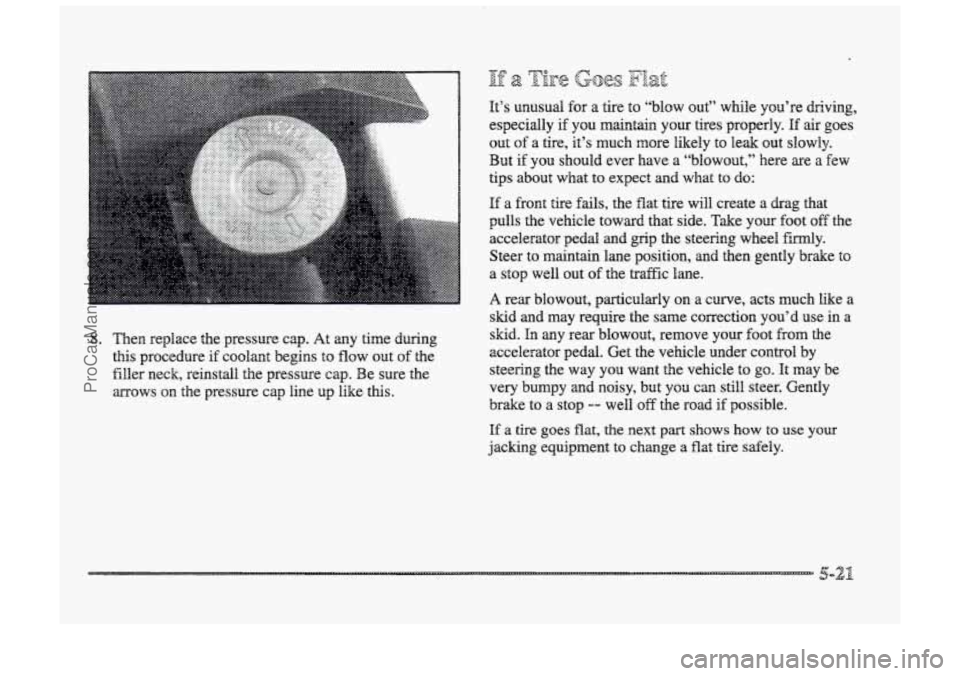
8. Then replace the pressure cap. At any time during
this procedure if
CQQ~EUI~ begins to flow out of the
filler neck, reinstall the pressure cap. Be sure the
mows
on the pressure cap line up like this.
s~. h any kearblowout, remove your foot kom the
accelerator pedal. Get the vehicle under control by
steering the
way you want the vehicle to go. It may be
very bumpy and noisy, but you can still steer. Gently
brake to
a stop -- well off the road if possible.
If a tire goes flat, the next part shows how to use your
jacking equipment to change a flat
tire safely.
ProCarManuals.com
Page 286 of 426
Your vehicle may have 2 3800 Sqercharged engine.
Supercharging, rather
than turbocharging, emphasizes
smooth, refined power.
The supercharger is a device which is designed to pump
more ais into the engine than it would normally use.
This air mixed with fuel creates increased engine power.
Since the supercharger
is a pump and is driven from an
engine
accessory drive belt, iwreased pressure is
available at all driving conditions.
The Powertrain Control Module (PCM) works with a
vacuum control to regulate the increased pressure
required during specific driving conditions. When this
increased pressure or boost is not desired, such as during
idling and light tfarsttIe cruising, the excess air that the
supercharger is pumping is routed through a bypass.
AB1 sf these controk working together provide high
performance character and fuel efficiency in the
3800 V6 Supercharged engine.
The power steering pump and reservoir are mounted on
the rear (driver’s side) sf the engine biock. See
“Maintenance Schedule”
in the Index for when you
should check the fluid.
c
ENGINE OIL LOW CHECK LEVEL HMBHBMrn
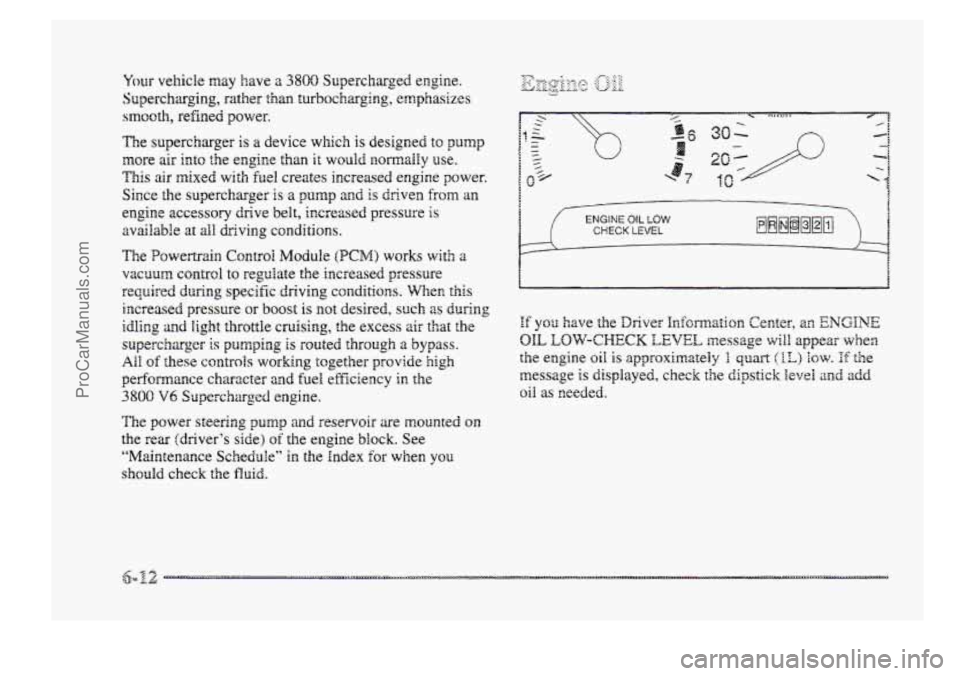
Ef you have the Driver Infcmation Center, an ENGINE
OIL LOW-CHECK LEVEL message will appear when
the engine oil is approximately I quart (fL) Isw. 11 the
message is displayed, check the dipstick level and add
oil as needed.
7r
ProCarManuals.com
Page 346 of 426
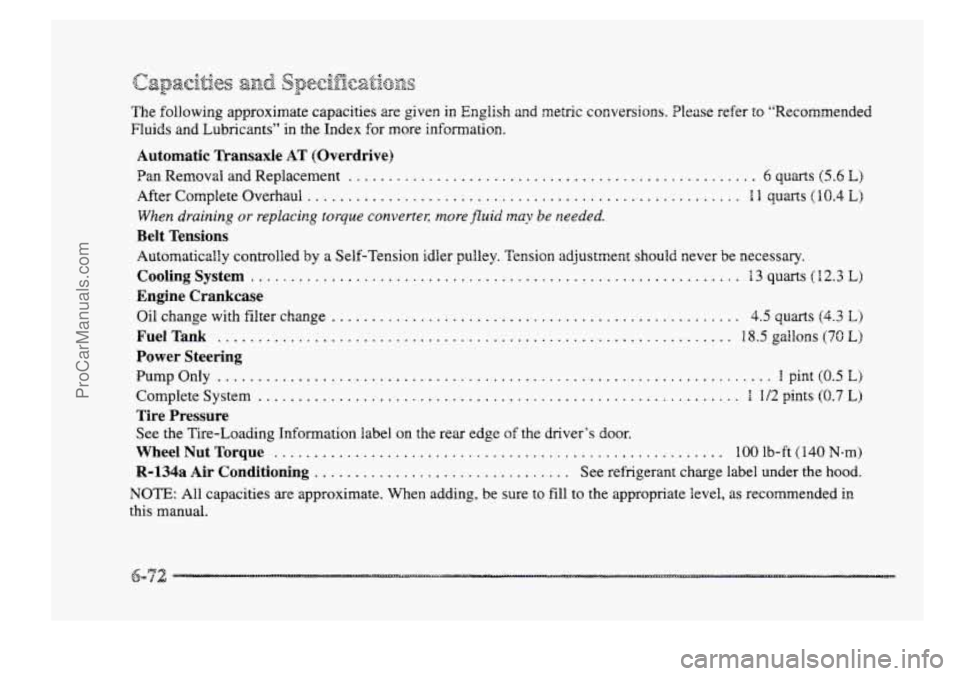
The following approximate capacities are given in English and metric conversions. Please refer to “Recommended
Fluids and Lubricants” in the Index for more information.
Automatic Transaxle AT (Overdrive)
Pan Removal and Replacement ................................................... 6 quarts (5.6 L)
After Complete Overhaul ...................................................... 1 I quarts (10.4 E)
When draining or replacing torque convertep; nzore fluid may be needed.
Belt Tensions
Automatically controlled by a Self-Tension idler pulley. Tension adjustment should never be necessary.
Cooling System ............................................................. 13 quarts (12.3 k)
Engine Crankcase
Oil change with filter change ................................................... 4.5 quarts (4.3 L)
Power Steering
Complete System ............................................................ 1 1/2 pints (0.7 L)
Tire Pressure
See the Tire-Loading Information label on the rear edge of the driver’s door.
WheelNutTorque ........................................................ 1001b-ft(140N-m)
R-134a Air Conditioning ................................ See refrigerant charge label under the hood.
FuelTank ................................................................ 18SgaIlons(70L)
PumpOnly ..................................................................... 1pint(OSE)
NOTE: All capacities are approximate. When adding, be sure to fill to the appropriate level, as recommended in
this manual.
ProCarManuals.com