brakes BUICK PARK AVENUE 1998 Owners Manual
[x] Cancel search | Manufacturer: BUICK, Model Year: 1998, Model line: PARK AVENUE, Model: BUICK PARK AVENUE 1998Pages: 426, PDF Size: 23.59 MB
Page 11 of 426
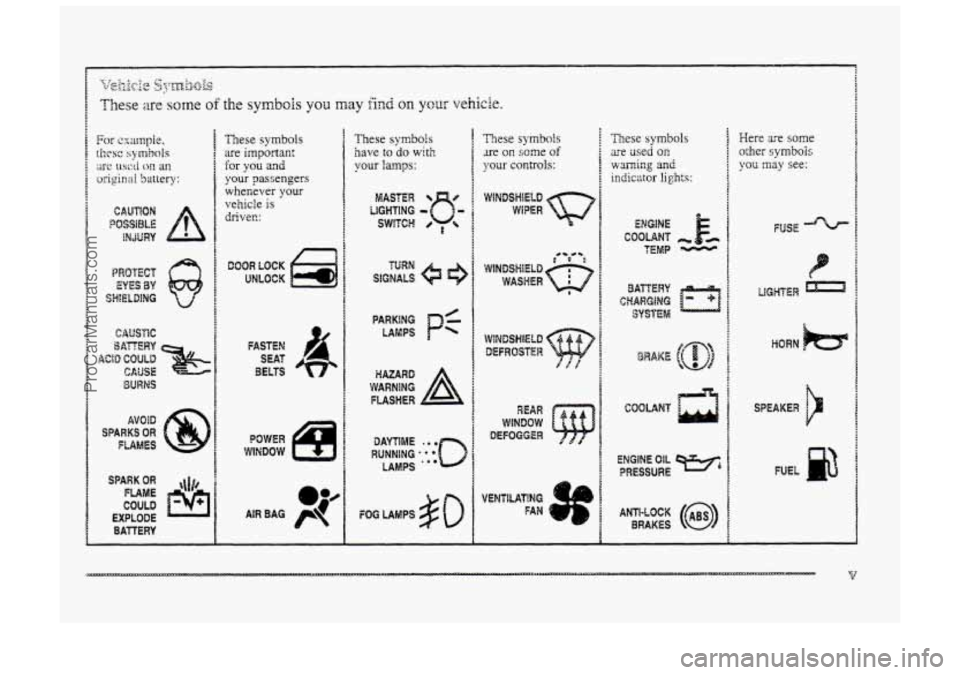
CAUSPlC
BURNS
SPARK OR ql!,
COULD
FUME
EXPLODE
BATTERY
I F
1 :
f
I
1
These symbols
are important
for you and
your passengers whenever your
vehicle
is
driver.:
DOOR LOCK
UNLOCK
POWER
WINDOW
These symbols
have to do with
your lamps:
I. These symbols i These symbols
are on some of ' are used OR
your controls: wming and
[ indicator lights: i
WEWTkATIMG
FAN
BRAKE
ANTI-LOCK (e)
BRAKES
Here xe some
other symbols
you may see:
SPEAKER
FUEL
ProCarManuals.com
Page 92 of 426
AUTOMATIC OVERDRIVE (@):This positionis for
normal driving. Pf you need more power for passing,
and you’re:
Going less than about 35 mph (55 kmh), push your
accelerator pedal about halfway down.
e Going about 35 mph (55 kmh) or more, push the
accelerator
all the way down.
You’U shift down to the next gear and have more power.
THIRD (3): This position is also used for normal
driving, however, it offers more power and Bower fuel
economy than AUTOMATIC OVERDRIVE (0).
Here are some times you might choose THIRD (3)
instead of AUTOMATIC OVERDRIVE (a):
Qb When towing a trailer, so there is less shifting
between gears,
or
SECQND (2): This position gives you nore power but
lower fuel economy. YQU can use SECOND (2) on hills.
It can help control your speed as you go down steep
mountain roads, but
then you would also want to use
your
brakes off and on.
NOTICE:
Don’t drive in SECOND (2) for more than
5 miles (8 km), or at speeds over 55 mph
(88 km/h), or you can damage your transaxle.
Use AUTOMATIC OVERDRIVE (0) or
THIRD (3) as much as possible.
Don’t shift into SECOND
(2) unless you are going
slower than
65 mph (105 km/h), or you can
damage your engine.
When going down a steep hill.
ProCarManuals.com
Page 93 of 426
FIRST (I): This position gives you even more power
(but lower fuel economy) than SECOND (2). You can
use it on very steep hills, or in deep snow or mud. If the
selector lever is put in FIRST ( I >, the transaxle won’t
shift into first gear until the vehicle is going
slowHy enough.
If your hplrt wheels can’t rotate, don’t try to
drive. This might happen if YOU were stuck in
very deep sand OF mud or were up against a solid
object. You could damage your transaxle.
Also, if you stop when going uphill, don’t hold
your vehicIe there with only the accelerator
pedal. This could overheat and damage the
transaxle. Use ysur brakes or shift into BARK (P)
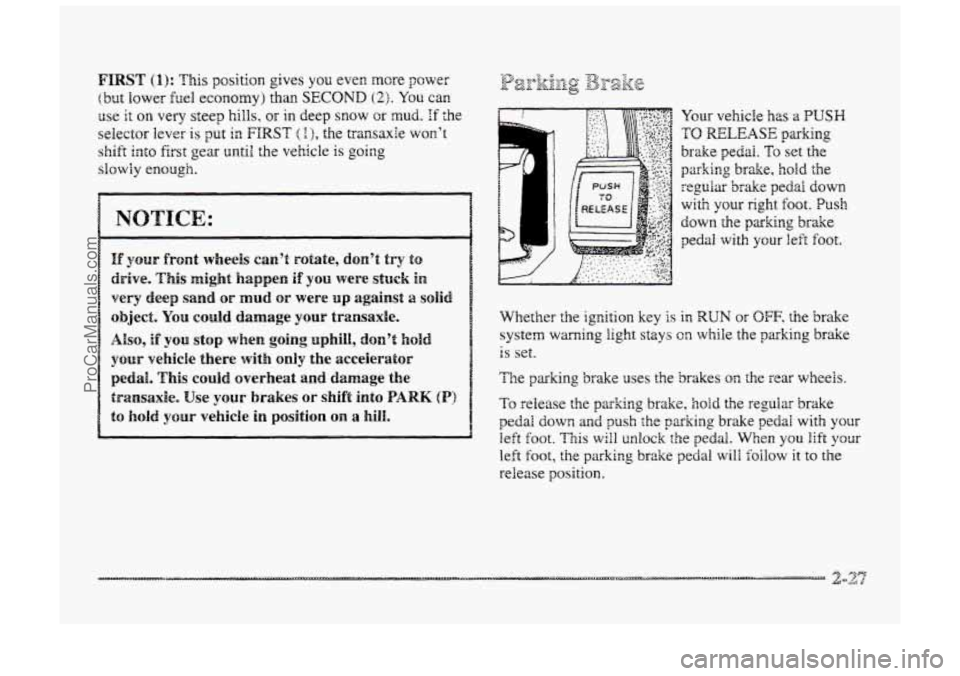
Your vehicle has a PUSH
TO RELEASE parking
brake pedai. To set the
parking brake, hold the
regular brake pedal down
with your right foot. Push
down the papking brake
pedal with your left foot.
~~ ~~
Whether the ignition key is in RUN or OFF. the brake
system
wming light stays on while the parking brake
1s set.
The parhng brake uses the brakes the rear wheels.
To release the parking brake, hoki the regular brake
pedal down and push the parking brake pedal with your
left foot. This will unlock the pedal. When you lift your
left foot, the parking brzke pedal will foilow it to the
release position.
ProCarManuals.com
Page 94 of 426
If you try to drive (approximately 20 feet (6.9 m)) with
the
parlkrng brake on, the brake light stays on and a
continuous chime sounds until you release the
parking
brake.
NOTICE:
Driving with the parking brake on can cause
your rear brakes to overheat. You may have to
replace them, and you could also damage other
parts
of your vehicle.
If you are towing a trailer and are parking on any hill,
see “Towing a Trailer” in the Index. That part shows
what
to do first to keep the trailer from moving.
It can be dangerous to get out of your vehicle if
the shift lever is not fully in PARK (P) with the
parking brake firmly set. Your vehicle can roll.
If
you have left the engine running, the vehicle can
move suddenly. You or others
could be injured.
To be sure your vehicle won’t move, even when
you’re on fairly level ground,
use the steps that
follow.
If you’re pulling a trailer, see “Towing a
Trailer” in the Index.
1. Hold the brake pedal down with your right foot and
set the parking brake.
ProCarManuals.com
Page 207 of 426
YO:; have three systems that make YQLX vehick go wircre
you want it to go. They are the brakes, the steering anti
the accelerator. AH three systems have to do their work
at the places where the tires meet the road.
ProCarManuals.com
Page 208 of 426
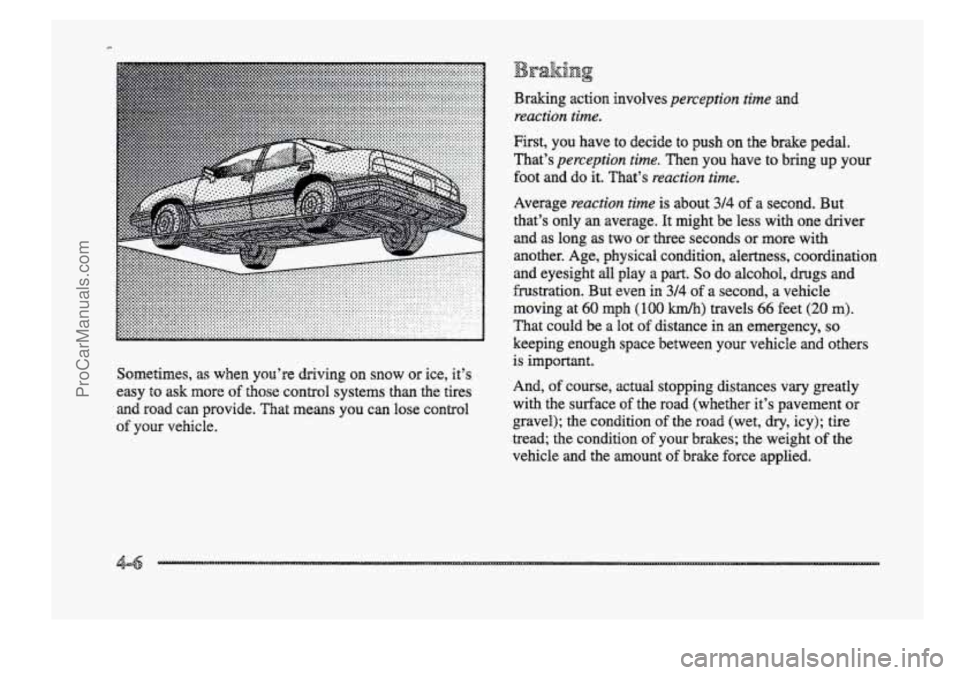
Sometimes, as when you’re driving on snow or ice, it’s
easy
to ask more of hose control systems than the tires
and road can provide.
That means you can lose control
of your vehicle. Braking
action involves perreption
time and
reaction time.
First, you have to decide to push on the brake pedal.
That’s
perception time. Then you have to bring up your
foot and do it. That’s reaction time.
Average reaction time is about 314 of a second. But
that’s
only an average. It might be less with one driver
and as long
as two OS three seconds or more with
another. Age, physical condition, alertness, coordination
and eyesight
dl play a part. So do alcohol, drugs and
frustration. But even
in 3/4 of a second, a vehicle
moving at
60 mpph (100 km/h) travels 66 feet (20 m).
That could be a lot of distance in an emergency, so
keeping enough space between your vehicle and others
is important.
And,
of course, actual stopping distances vary greatly
with the surface
of the road (whether it’s pavement or
gravel); the condition
of the road (wet, dry, icy); tire
tread; the condition
of your brakes; the weight of the
vehicle and the
amount of brake force applied.
ProCarManuals.com
Page 209 of 426
Avoid Reedless heavy braking. Some people drive in
spurts -- heavy acceleration followed by heavy
braking -- rather than keeping pace with traffic. This is a
mistake. Your brakes may not have time to COO^ between
hard stops. Your brakes will wear out much Easter if you
dc a lot of heavy braking. If YOU keep pace with the
traffic ‘ad allow realistic follewing distances, you will
eliminate a lot of unnecessary braking. That means
better
braking and longer brake life.
If your engine ever steps while you’re driving, brake
nomctHBy but don’t pump your brakes. HE you do, the
pedal may get harder to push down. If your engine
stops, you will still have some power brake assist. But
you will use it when you brake. Once the power assist is
used
up, it may take longer to stop and the brake pedal
will be hxder to push.
ProCarManuals.com
Page 211 of 426
Remember: Anti-lock doesn’t change the the you need
to get your foot up to the br&e pedal or always decrease
stopping distance. If you get too dose to the vehicle in
front of you, you won’t have time to apply your brakes
If that vehicle suddenly slows or stcps. Always leave
enough
room up ahead tu stop, even though yorr have
anti-lock brakes.
Don’t pump the brakes. Just hold the brake pedal down
5mly and let anti-lock work for you. You may feel a
slight brake pedal gulsation or notice some noise, but
this is normal.
?F? 5-~~l:”~p.Tp LC :~?$<:4:?~$ ,y...,iq:py; (TF &&@$B&) r ,y a% *.-blL& . ,%*i ...,‘. --’3 li Y z .i I A -2.
YQW vehicle may have a traction control system thzat
limits wheel spin. This is especially useful in slippery
road conditions. The system operates only if it senses
that one
or both of the front wheels are spinning or
beginning to lose traction. When this happens, the
system works the front brakes and reduces engine power
to limit wheel spin.
You may feel or hear the system working, but this
is nomal.
__ . ... a
See ‘‘T~-acti~m Contra1 System Warning Eight” ii: the
Irzdex. WEen this warning light is on, the system will mt
limit wheel spin. Adjust your driving zccsrdingly.
The traction COII~FO~ system arr;2smaticaily comes on
whenever you start your vehicle. To limit wheel spin,
especially in siippery road conditio~s, y3u shouEd
always leave the system on. But you can turn- the
traction control system off‘ if you ever need to. (YQQ
should turn the system off if pur vehicBe ever gets stuck
in sand, mud, ice or snow. See “Rockr~g Your Vehicle”
in the Index.)
ProCarManuals.com
Page 214 of 426
&3g;-izg 1x1 0 &i&rpe[z.iQs 7,ww e?
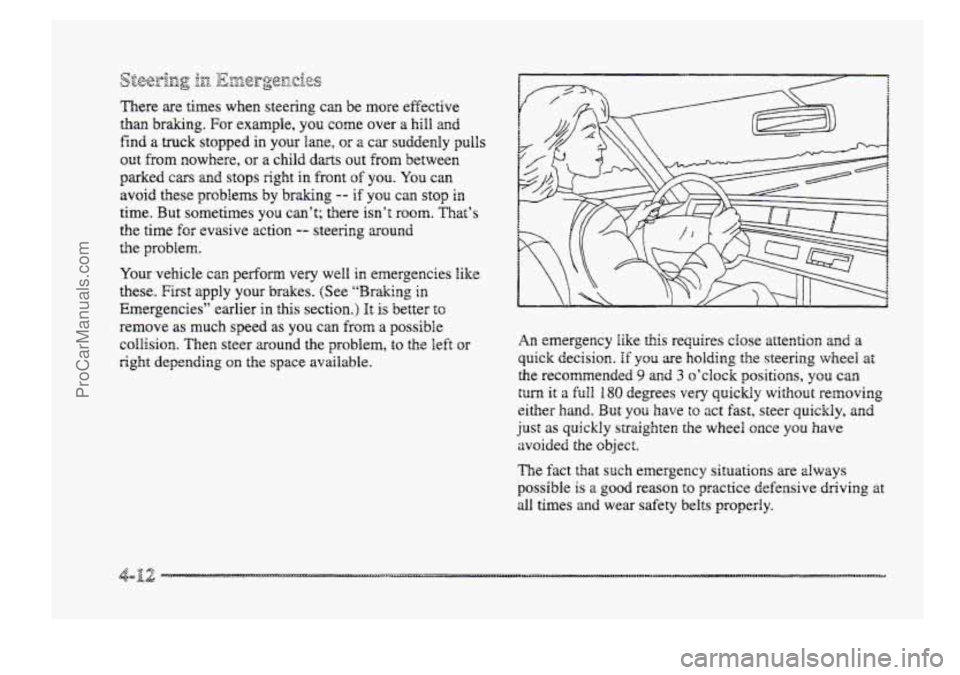
There are times when steering can be more effective
than brakmg. For example, you come over a hill and
find a truck stopped in your lane, or a car suddenly pulls
out from nowhere, OH a child darts out from between
parked
cars md stops right in front of YOU. You can
avoid these problems by
braking -- if you can stop in
time. But sometimes you can’t; trlere isn’t room. That’s
the time
for evasive action -- steering ~ound
the problem.
Your vehicle can perform very well in emergencies like
these. First apply your brakes. (See ‘‘Braking in
Emergencies” earlier in ”s section.) It is better tc
remove as much speed as you can from a possible
collision. Then steer around the problem, to the left or
right depending on the space available.
An emergency like this requires close attention and a
quick decision. If you are holding the steering wheel a’:
the recomended 9 and 3 o’clock positloas, you can
tuna it a full 180 degrees very quickly without removing
either hand. But you have to act fast, steer quickly, and
just as quickly straighten the wheel once you have
avoided the
object.
The fact that such emergency situations are always
possible is a good reason to practice defensive driving at
dl times and wear safety belts properly.
ProCarManuals.com
Page 221 of 426
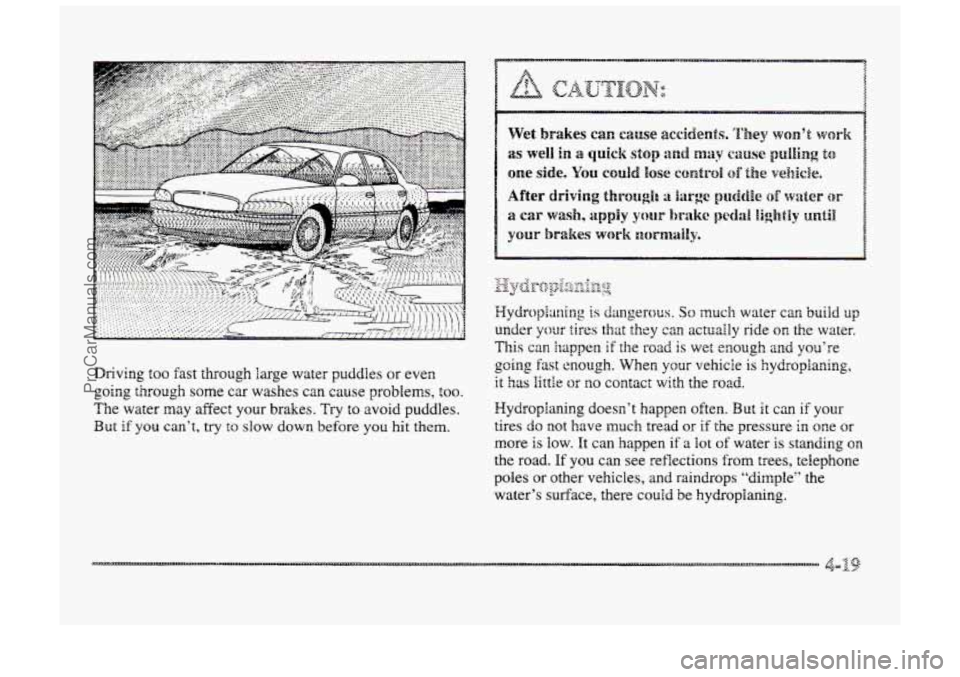
Driving too fast through large water puddles or even
going through some car washes can cause problems, too.
The water may affect your brakes. Try to avoid puddles.
But if you can’t, try to slow down before you hit them. Hydroplaning
is dangerous. S:, much water can build up
under
your tires that they cm actually ride on the water.
This can happerm If the road is wet enough and you’re
going fast enough. When your vehicle
is hydroplaning,
it has little or no contact with the road.
Hydroplaning doesn’t happen often. But it can if your
tires do not have much tread or if the pressure in one or
more is low. It can happen if a lot of water is standing on
the road. If you can see reflections from trees, telephone
poles or other vehicles, and raindrops “dimple” the
water’s surface, there could
be hydroplaning.
ProCarManuals.com