tire type BUICK PARK AVENUE 1998 Owners Manual
[x] Cancel search | Manufacturer: BUICK, Model Year: 1998, Model line: PARK AVENUE, Model: BUICK PARK AVENUE 1998Pages: 426, PDF Size: 23.59 MB
Page 321 of 426
Cheek
Use a good quality pocket-type gage t~ check tire
pressure. You can’t tell. if your tires ae properly inflated
simply by
looking at them. Radial tires may lo&
properly inflated even when they’re underinnflated.
Be sure to put the
valve caps back on the valve stems.
They help prevent leaks by
keeping OU~ dirt md moisture.
(?-&e& pgessnre sy$&ekB @f Eqa@p&)
The check tire pressure system can de& you to a
large change in the pressure of one tire. The system
won’t
alert you before you chive that a tire is low or
flat. You must begin driving before the system will
work properly.
The
TIRE PRESSURE LOW CHECK TIRES message
will appear on the Driver hf~~~~~ati~n Center (DK) if
pressure in one tire becomes at least 10 psi (69 Wa)
lower or higher than the other thee tires. The check tire
pressure system won’t alert you if more than one tire is
Bow or high, or if the system is not calibrated properly.
It also won’t tell YOU which tire is Bow or high.
E the anti-lock brake system waning light comes on,
the check tire pressure system may not be working
properly. See your deder for service. (Also,
see
“Anti-hck Brake System Wzming Light” in the Index.)
ProCarManuals.com
Page 324 of 426
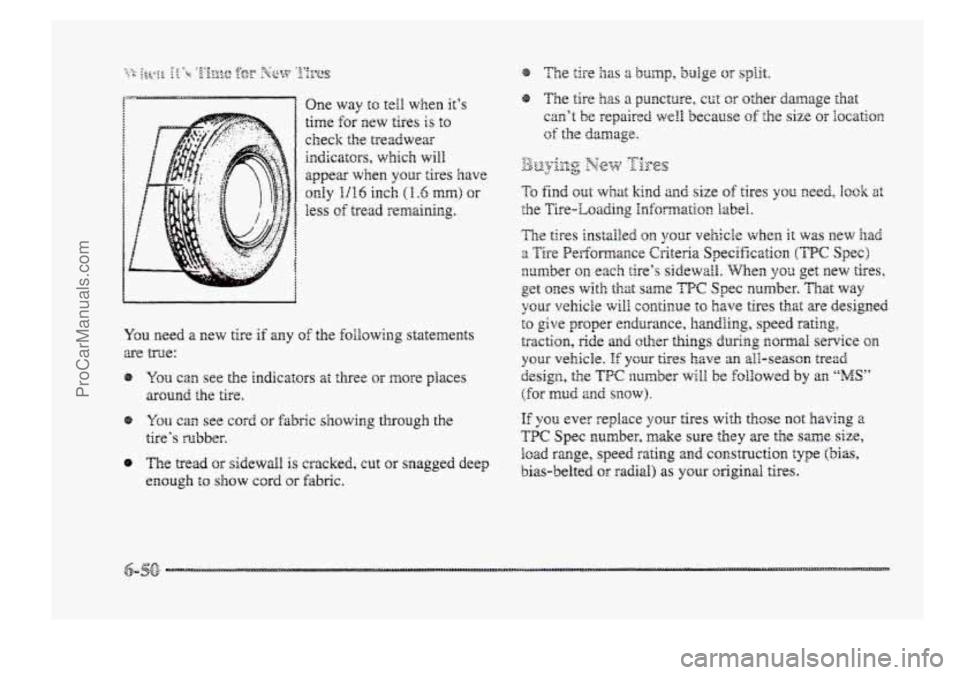
One way to tell when it’s
time for new tires is to
check the treadwear
inciicatdlrs,
which will
appear when yQx tires have
only 1/16 inch (H .e mm) car
less of tread remaining.
8 The tread or sidewall is cracked, cut or snagged deep
enough to show cord OF fabric.
If you ever replace YOUF tires with those not having a
TPC Spec number, make sure they are the sme size,
load rmge, speed rating and ~OI-LS~IUC~~Q~ type (bias,
bias-beited or radial) as your original tires.
ProCarManuals.com
Page 325 of 426
Q e
U~ffJrpx Qna&y K&-&&qg
m~
The following infomation relates to the system
developed by the United States
National Highway
Traffic Safety'Administration, which grades tires by
treadwear, traction and temperature pedommce.
(This applies only to vehicles sold in the 'United
States.) The grades are
molded on the sidewalls of most
passenger car tires. The Uniform Tire Quality Grading
system does not apply to deep tread, winter-type S~QW
tires, space-saver or temporary use spare tires, tires with
nominal rim diameters of 10 to 12 inches (25 to 30 cm),
or to some limited-production tires.
IVhile the tires available on Generd Motors passenger
cars and light trucks may vary with respect to these
grades, they
must also confom to Federal safety
requirements
and additional General Motors Tire
Performance Criteria
(PC) standards.
ProCarManuals.com
Page 328 of 426
-.- ,. sed 7-h $.-&&&c,:&,~ =- ‘0 . -.‘?3. r ?;%;?e& .- .%
how far it’s been driven. It could fail suddenly
and cause an accident. If you have to replace a
wheel, use a new GM original equipment wheel.
:-.-% 0 iCI?&?,S -
NOTICE:
Use tire chains only where Begal and only when
YOU must. Use only SAE Class “S” type chains
that are the proper size
for your tires. Install
them
on the front tires and tighten them as
tightly as possible with the ends securely
fastened. Drive slowly and follow the chain
manufacturer’s instructions.
If you can hear the
chains contacting your vehicle, stop and retighten
them.
If the contact continues, slow down until it
stops. Driving too fast or spinning the wheels
with chains on will damage your vehicle.
ProCarManuals.com