spare tire BUICK PARK AVENUE 1999 Owners Manual
[x] Cancel search | Manufacturer: BUICK, Model Year: 1999, Model line: PARK AVENUE, Model: BUICK PARK AVENUE 1999Pages: 400, PDF Size: 3.25 MB
Page 229 of 400

5-
yellowblue
5-1
Section 5 Problems on the Road
Here you'll find what to do about some problems that can occur on the road.
5
-2 Hazard Warning Flashers
5
-2 Other Warning Devices
5
-3 Jump Starting
5
-7 Towing Your Vehicle
5
-8 Engine Overheating5
-10 Cooling System
5
-17 If a Tire Goes Flat
5
-18 Changing a Flat Tire
5
-27 Compact Spare Tire
5
-28 If You're Stuck: In Sand, Mud, Ice or Snow
ProCarManuals.com
Page 247 of 400
yellowblue
5-19 Removing the Spare Tire and Tools
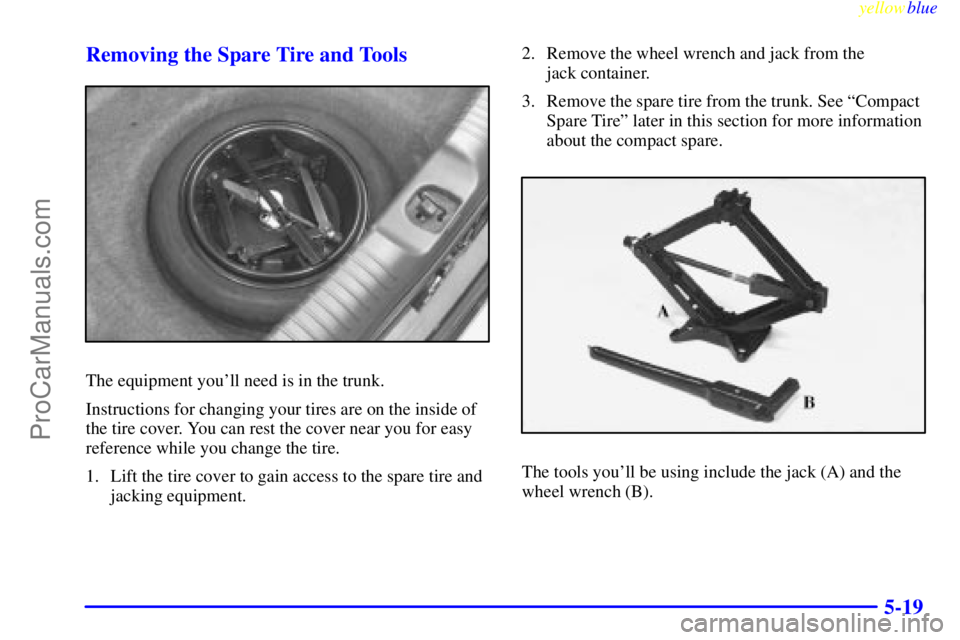
The equipment you'll need is in the trunk.
Instructions for changing your tires are on the inside of
the tire cover. You can rest the cover near you for easy
reference while you change the tire.
1. Lift the tire cover to gain access to the spare tire and
jacking equipment.2. Remove the wheel wrench and jack from the
jack container.
3. Remove the spare tire from the trunk. See ªCompact
Spare Tireº later in this section for more information
about the compact spare.
The tools you'll be using include the jack (A) and the
wheel wrench (B).
ProCarManuals.com
Page 249 of 400
yellowblue
5-21 Removing the Flat Tire and Installing the
Spare Tire
1. Use the wheel wrench to loosen the wheel nuts, but
don't remove them yet.
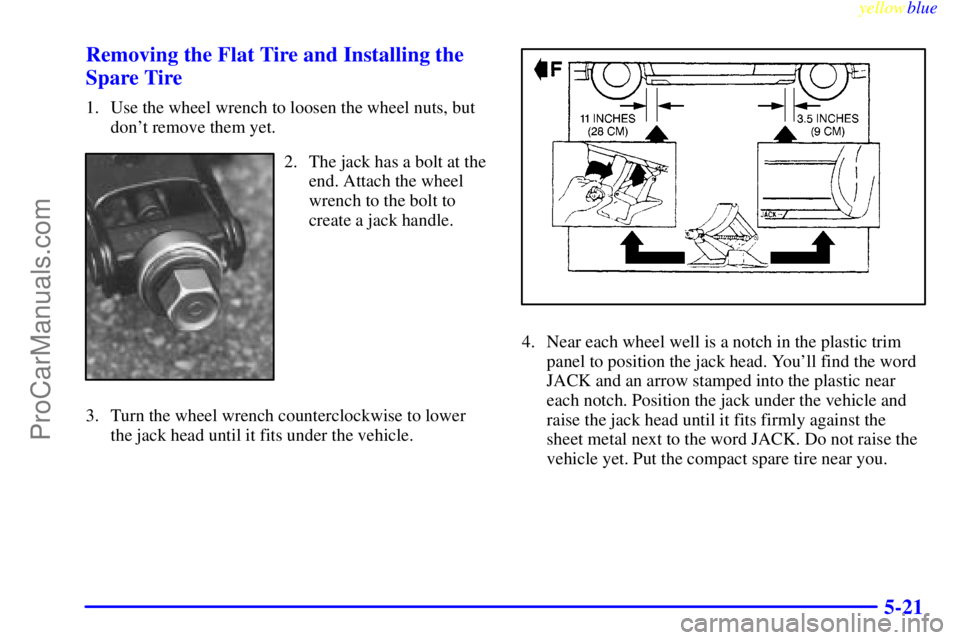
2. The jack has a bolt at the
end. Attach the wheel
wrench to the bolt to
create a jack handle.
3. Turn the wheel wrench counterclockwise to lower
the jack head until it fits under the vehicle.
4. Near each wheel well is a notch in the plastic trim
panel to position the jack head. You'll find the word
JACK and an arrow stamped into the plastic near
each notch. Position the jack under the vehicle and
raise the jack head until it fits firmly against the
sheet metal next to the word JACK. Do not raise the
vehicle yet. Put the compact spare tire near you.
ProCarManuals.com
Page 250 of 400
yellowblue
5-22
CAUTION:
Getting under a vehicle when it is jacked up is
dangerous. If the vehicle slips off the jack, you
could be badly injured or killed. Never get under
a vehicle when it is supported only by a jack.
CAUTION:
Raising your vehicle with the jack improperly
positioned can damage the vehicle and even
make the vehicle fall. To help avoid personal
injury and vehicle damage, be sure to fit the jack
lift head into the proper location before raising
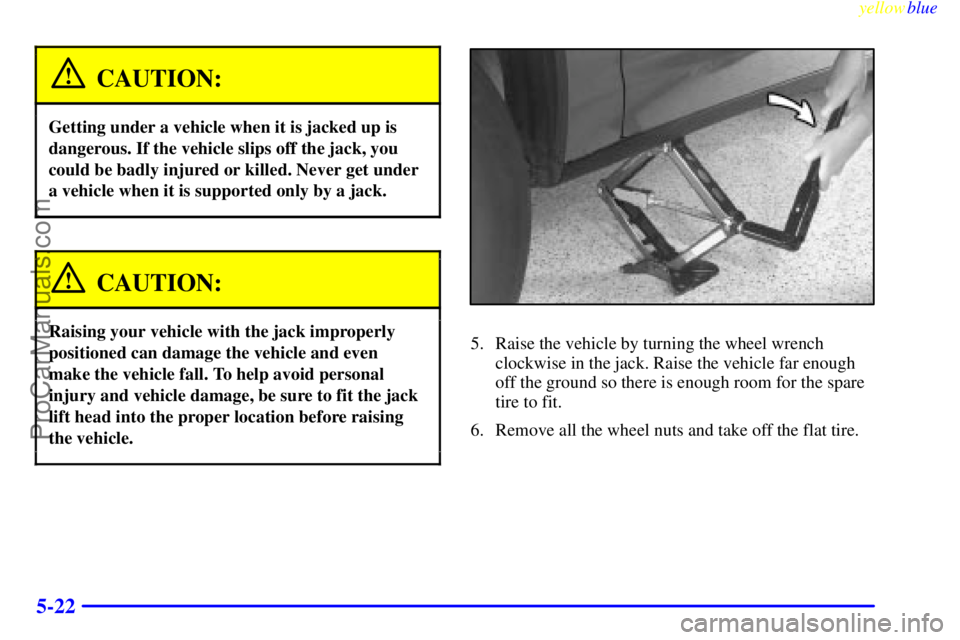
the vehicle.5. Raise the vehicle by turning the wheel wrench
clockwise in the jack. Raise the vehicle far enough
off the ground so there is enough room for the spare
tire to fit.
6. Remove all the wheel nuts and take off the flat tire.
ProCarManuals.com
Page 251 of 400
yellowblue
5-23
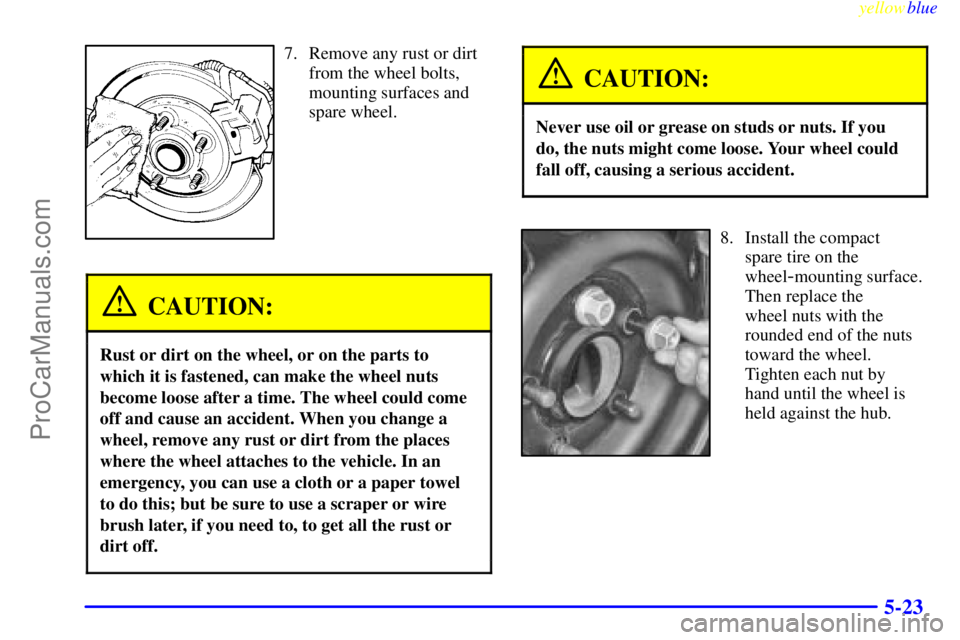
7. Remove any rust or dirt
from the wheel bolts,
mounting surfaces and
spare wheel.
CAUTION:
Rust or dirt on the wheel, or on the parts to
which it is fastened, can make the wheel nuts
become loose after a time. The wheel could come
off and cause an accident. When you change a
wheel, remove any rust or dirt from the places
where the wheel attaches to the vehicle. In an
emergency, you can use a cloth or a paper towel
to do this; but be sure to use a scraper or wire
brush later, if you need to, to get all the rust or
dirt off.
CAUTION:
Never use oil or grease on studs or nuts. If you
do, the nuts might come loose. Your wheel could
fall off, causing a serious accident.
8. Install the compact
spare tire on the
wheel
-mounting surface.
Then replace the
wheel nuts with the
rounded end of the nuts
toward the wheel.
Tighten each nut by
hand until the wheel is
held against the hub.
ProCarManuals.com
Page 253 of 400
yellowblue
5-25
NOTICE:
Improperly tightened wheel nuts can lead to
brake pulsation and rotor damage. To avoid
expensive brake repairs, evenly tighten the wheel
nuts in the proper sequence and to the proper
torque specification.
Store the wheel cover in the trunk until you have the
flat tire repaired or replaced.
NOTICE:
Wheel covers won't fit on your compact spare. If
you try to put a wheel cover on your compact
spare, you could damage the cover or the spare.
Storing the Flat Tire and Tools
CAUTION:
Storing a jack, a tire or other equipment in the
passenger compartment of the vehicle could
cause injury. In a sudden stop or collision, loose
equipment could strike someone. Store all these
in the proper place.
After you've put the compact spare tire on your vehicle,
you'll need to store the flat tire in your trunk. Use the
following procedure to secure the flat tire in the trunk.
Store the flat tire as far forward in the trunk as possible.
Store the jack and wheel wrench in their compartment in
the trunk.
ProCarManuals.com
Page 254 of 400
yellowblue
5-26
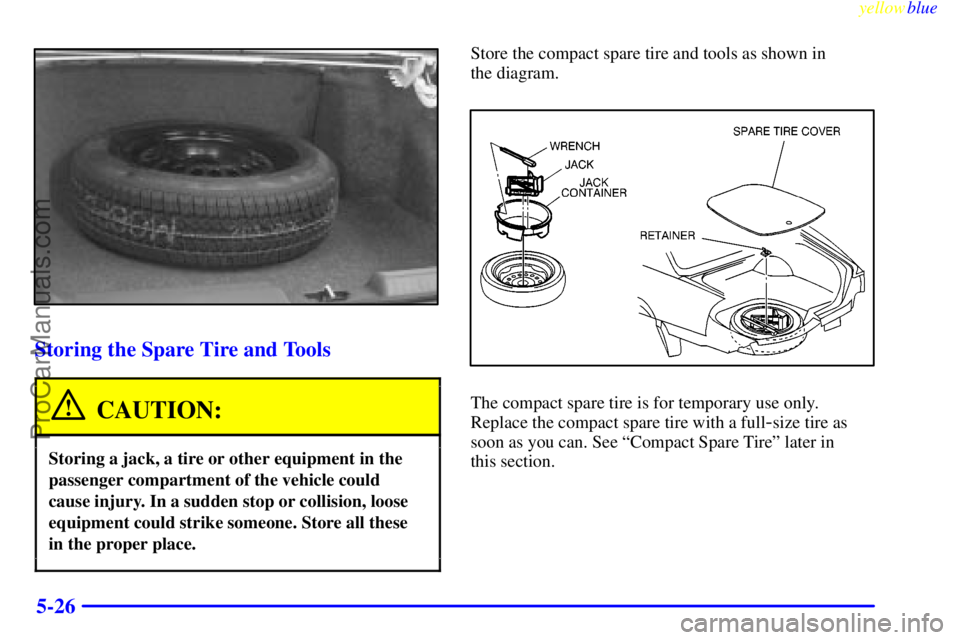
Storing the Spare Tire and Tools
CAUTION:
Storing a jack, a tire or other equipment in the
passenger compartment of the vehicle could
cause injury. In a sudden stop or collision, loose
equipment could strike someone. Store all these
in the proper place.
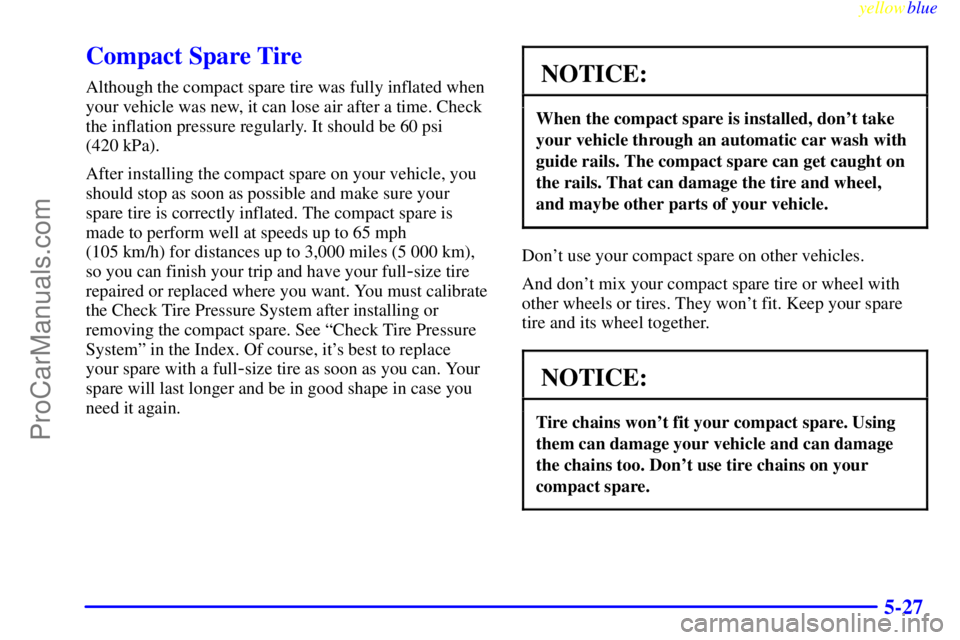
Store the compact spare tire and tools as shown in
the diagram.
The compact spare tire is for temporary use only.
Replace the compact spare tire with a full
-size tire as
soon as you can. See ªCompact Spare Tireº later in
this section.
ProCarManuals.com
Page 255 of 400
yellowblue
5-27
Compact Spare Tire
Although the compact spare tire was fully inflated when
your vehicle was new, it can lose air after a time. Check
the inflation pressure regularly. It should be 60 psi
(420 kPa).
After installing the compact spare on your vehicle, you
should stop as soon as possible and make sure your
spare tire is correctly inflated. The compact spare is
made to perform well at speeds up to 65 mph
(105 km/h) for distances up to 3,000 miles (5 000 km),
so you can finish your trip and have your full
-size tire
repaired or replaced where you want. You must calibrate
the Check Tire Pressure System after installing or
removing the compact spare. See ªCheck Tire Pressure
Systemº in the Index. Of course, it's best to replace
your spare with a full
-size tire as soon as you can. Your
spare will last longer and be in good shape in case you
need it again.
NOTICE:
When the compact spare is installed, don't take
your vehicle through an automatic car wash with
guide rails. The compact spare can get caught on
the rails. That can damage the tire and wheel,
and maybe other parts of your vehicle.
Don't use your compact spare on other vehicles.
And don't mix your compact spare tire or wheel with
other wheels or tires. They won't fit. Keep your spare
tire and its wheel together.
NOTICE:
Tire chains won't fit your compact spare. Using
them can damage your vehicle and can damage
the chains too. Don't use tire chains on your
compact spare.
ProCarManuals.com
Page 306 of 400

yellowblue
6-48
When to Check
Check your tires once a month or more.
Don't forget your compact spare tire. It should be at
60 psi (420 kPa).
How to Check
Use a good quality pocket
-type gage to check tire
pressure. You can't tell if your tires are properly inflated
simply by looking at them. Radial tires may look
properly inflated even when they're underinflated.
Be sure to put the valve caps back on the valve
stems. They help prevent leaks by keeping out dirt
and moisture.
Check Tire Pressure System (If Equipped)
The check tire pressure system can alert you to a large
change in the pressure of one tire. The system won't alert
you before you drive that a tire is low or flat. You must
begin driving before the system will work properly.
The TIRE PRESSURE LOW: CHECK TIRES message
will appear on the Driver Information Center (DIC) if
pressure in one tire becomes at least 10 psi (69 kPa)
lower or higher than the other three tires. The check tire
pressure system won't alert you if more than one tire is
low or high, or if the system is not calibrated properly. It
also won't tell you which tire is low or high.
If the anti
-lock brake system warning light comes on,
the check tire pressure system may not be working
properly. See your dealer for service. (Also, see
ªAnti
-Lock Brake System Warning Lightº in the Index.)
The check tire pressure system detects differences in tire
rotation speeds that are caused by changes in tire pressure.
The system can alert you about a low tire
-- but it doesn't
replace normal tire maintenance. See ªTiresº in the Index.
ProCarManuals.com
Page 307 of 400

yellowblue
6-49
When the TIRE PRESSURE LOW: CHECK TIRES
message appears on the Driver Information Center, you
should stop as soon as you can and check all your tires for
damage. (If a tire is flat, see ªIf a Tire Goes Flatº in the
Index.) Also check the tire pressure in all four tires as soon
as you can. See ªInflation
-Tire Pressureº in the Index.
Any time you adjust a tire's pressure or have one or
more tires repaired or replaced, you'll need to reset
(calibrate) the check tire pressure system. You'll also
need to reset the system whenever you rotate the tires,
buy new tires, install or remove the compact spare, and
whenever the vehicle's battery has been disconnected.
Don't reset the check tire pressure system without first
correcting the cause of the problem and checking and
adjusting the pressure in all four tires. If you reset the
system when the tire pressures are incorrect, the check
tire pressure system will not work properly and may not
alert you when a tire is low or high.To reset (calibrate) the system:
1. Turn the ignition switch to RUN.
2. Press the GAGE INFO button on the DIC until
TIRE PRESSURE appears on the display.
3. Press and hold the DIC RESET button for about five
seconds. After five seconds, the display will show
TIRE PRESSURE RESET. If TIRE PRESSURE
RESET does not appear on the display after about
five seconds, see your dealer for service. After you
release the DIC RESET button, TIRE PRESSURE
NORMAL will appear on the display.
The system completes the calibration process during
driving. During the first 10 to 25 miles (15 to 40 km) of
driving, the system will not alert you if a tire is high or
low. After 25 to 100 miles (40 to 160 km), the
system will only alert you about pressure differences of
12 psi (85 kPa) or more. After about 100 miles (160 km)
of driving, the system will alert you if one tire is
10 psi (69 kPa) different from the other three tires.
ProCarManuals.com