belt BUICK PARK AVENUE 2003 Owner's Guide
[x] Cancel search | Manufacturer: BUICK, Model Year: 2003, Model line: PARK AVENUE, Model: BUICK PARK AVENUE 2003Pages: 372, PDF Size: 2.8 MB
Page 31 of 372
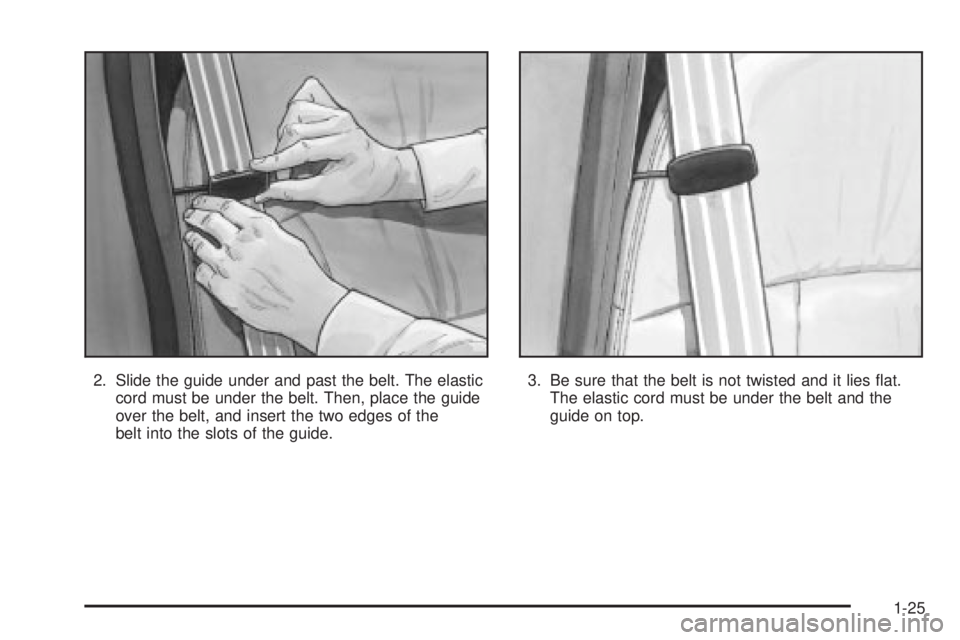
2. Slide the guide under and past the belt. The elastic
cord must be under the belt. Then, place the guide
over the belt, and insert the two edges of the
belt into the slots of the guide.3. Be sure that the belt is not twisted and it lies ¯at.
The elastic cord must be under the belt and the
guide on top.
1-25
Page 32 of 372
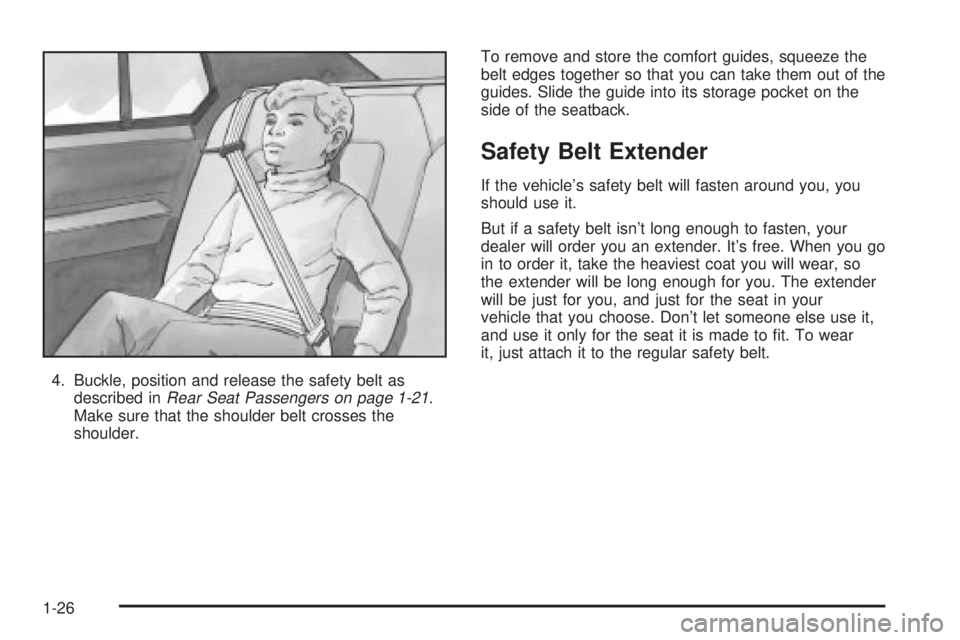
4. Buckle, position and release the safety belt as
described inRear Seat Passengers on page 1-21.
Make sure that the shoulder belt crosses the
shoulder.To remove and store the comfort guides, squeeze the
belt edges together so that you can take them out of the
guides. Slide the guide into its storage pocket on the
side of the seatback.
Safety Belt Extender
If the vehicle's safety belt will fasten around you, you
should use it.
But if a safety belt isn't long enough to fasten, your
dealer will order you an extender. It's free. When you go
in to order it, take the heaviest coat you will wear, so
the extender will be long enough for you. The extender
will be just for you, and just for the seat in your
vehicle that you choose. Don't let someone else use it,
and use it only for the seat it is made to ®t. To wear
it, just attach it to the regular safety belt.
1-26
Page 33 of 372
Child Restraints
Older Children
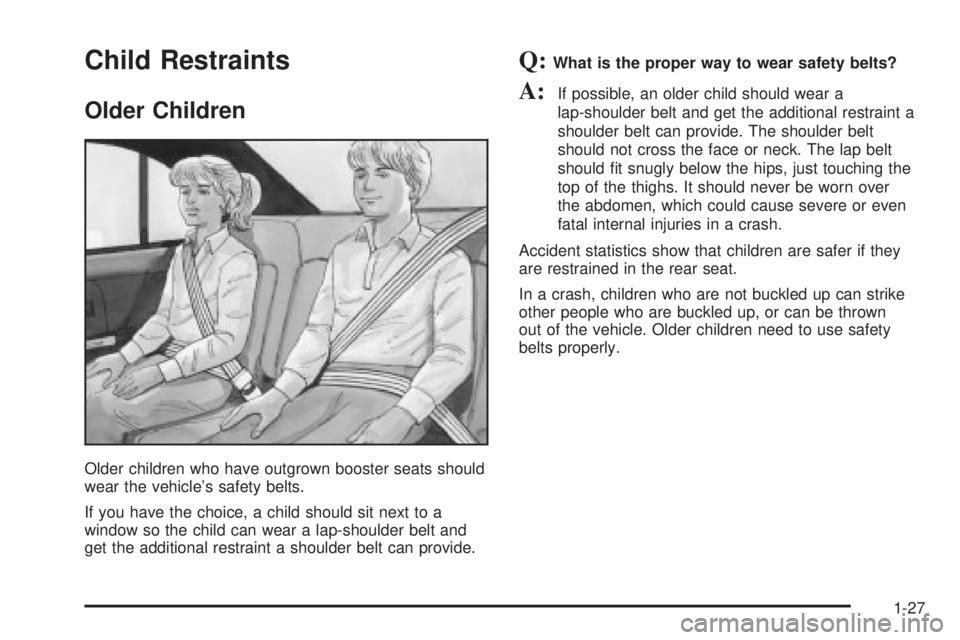
Older children who have outgrown booster seats should
wear the vehicle's safety belts.
If you have the choice, a child should sit next to a
window so the child can wear a lap-shoulder belt and
get the additional restraint a shoulder belt can provide.
Q:What is the proper way to wear safety belts?
A:If possible, an older child should wear a
lap-shoulder belt and get the additional restraint a
shoulder belt can provide. The shoulder belt
should not cross the face or neck. The lap belt
should ®t snugly below the hips, just touching the
top of the thighs. It should never be worn over
the abdomen, which could cause severe or even
fatal internal injuries in a crash.
Accident statistics show that children are safer if they
are restrained in the rear seat.
In a crash, children who are not buckled up can strike
other people who are buckled up, or can be thrown
out of the vehicle. Older children need to use safety
belts properly.
1-27
Page 34 of 372
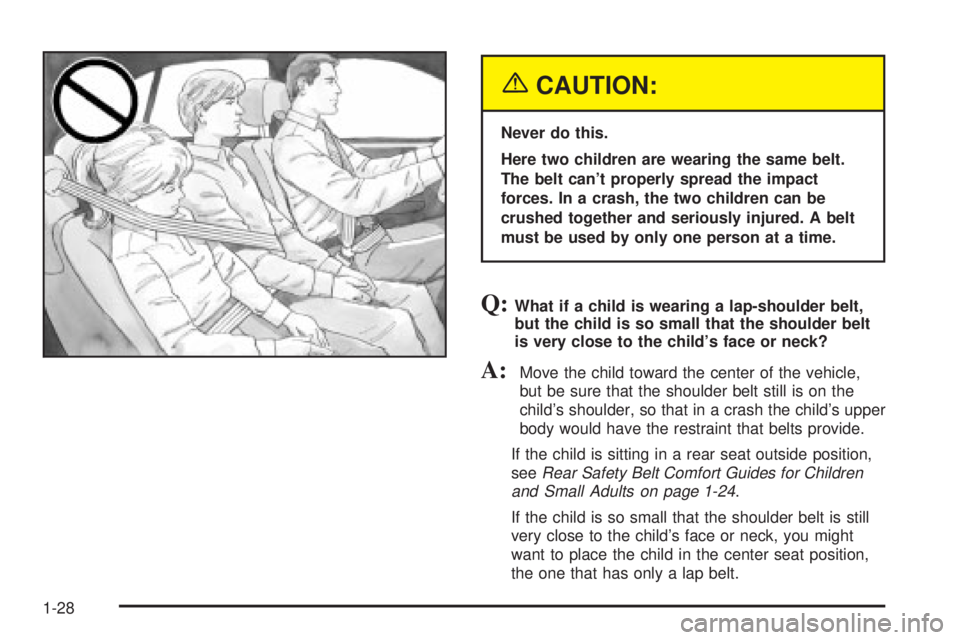
{CAUTION:
Never do this.
Here two children are wearing the same belt.
The belt can't properly spread the impact
forces. In a crash, the two children can be
crushed together and seriously injured. A belt
must be used by only one person at a time.
Q:What if a child is wearing a lap-shoulder belt,
but the child is so small that the shoulder belt
is very close to the child's face or neck?
A:Move the child toward the center of the vehicle,
but be sure that the shoulder belt still is on the
child's shoulder, so that in a crash the child's upper
body would have the restraint that belts provide.
If the child is sitting in a rear seat outside position,
see
Rear Safety Belt Comfort Guides for Children
and Small Adults on page 1-24
.
If the child is so small that the shoulder belt is still
very close to the child's face or neck, you might
want to place the child in the center seat position,
the one that has only a lap belt.
1-28
Page 35 of 372
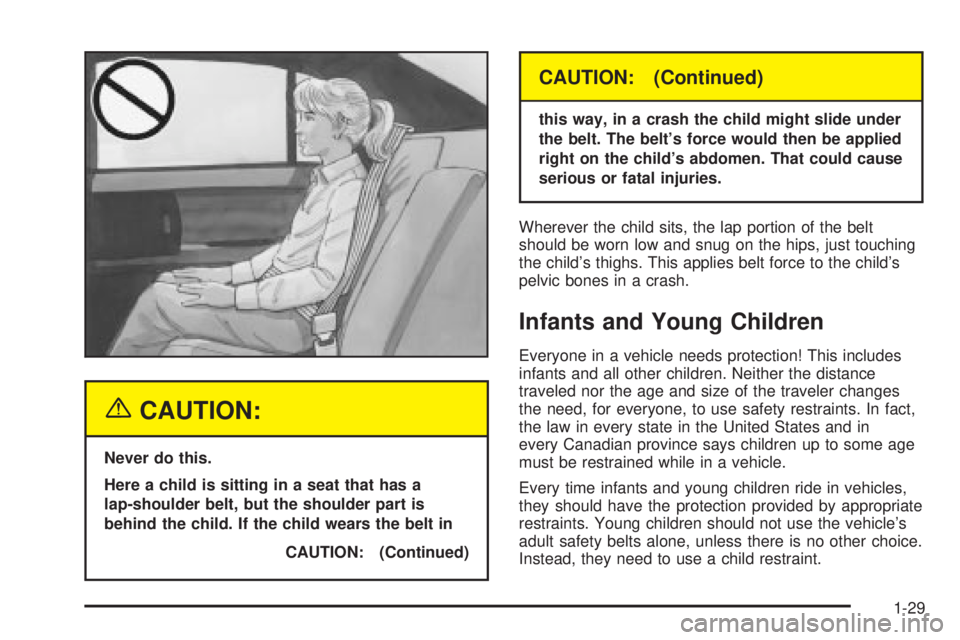
{CAUTION:
Never do this.
Here a child is sitting in a seat that has a
lap-shoulder belt, but the shoulder part is
behind the child. If the child wears the belt in
CAUTION: (Continued)
CAUTION: (Continued)
this way, in a crash the child might slide under
the belt. The belt's force would then be applied
right on the child's abdomen. That could cause
serious or fatal injuries.
Wherever the child sits, the lap portion of the belt
should be worn low and snug on the hips, just touching
the child's thighs. This applies belt force to the child's
pelvic bones in a crash.
Infants and Young Children
Everyone in a vehicle needs protection! This includes
infants and all other children. Neither the distance
traveled nor the age and size of the traveler changes
the need, for everyone, to use safety restraints. In fact,
the law in every state in the United States and in
every Canadian province says children up to some age
must be restrained while in a vehicle.
Every time infants and young children ride in vehicles,
they should have the protection provided by appropriate
restraints. Young children should not use the vehicle's
adult safety belts alone, unless there is no other choice.
Instead, they need to use a child restraint.
1-29
Page 37 of 372
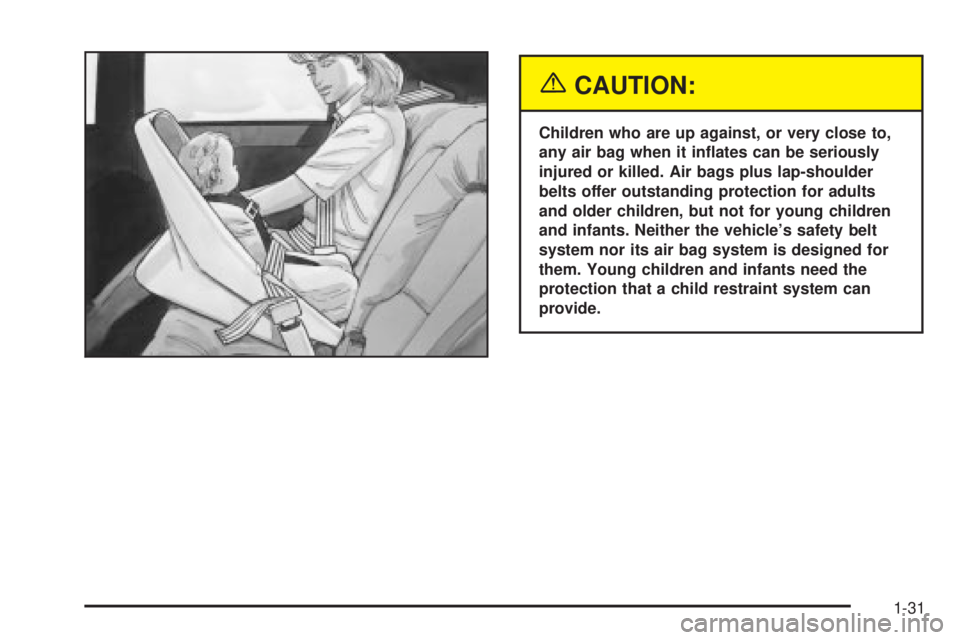
{CAUTION:
Children who are up against, or very close to,
any air bag when it in¯ates can be seriously
injured or killed. Air bags plus lap-shoulder
belts offer outstanding protection for adults
and older children, but not for young children
and infants. Neither the vehicle's safety belt
system nor its air bag system is designed for
them. Young children and infants need the
protection that a child restraint system can
provide.
1-31
Page 39 of 372
{CAUTION:
The body structure of a young child is quite
unlike that of an adult or older child, for whom
the safety belts are designed. A young child's
hip bones are still so small that the vehicle's
regular safety belt may not remain low on the
hip bones, as it should. Instead, it may settle
up around the child's abdomen. In a crash, the
belt would apply force on a body area that's
unprotected by any bony structure. This alone
could cause serious or fatal injuries. Young
children always should be secured in
appropriate child restraints.
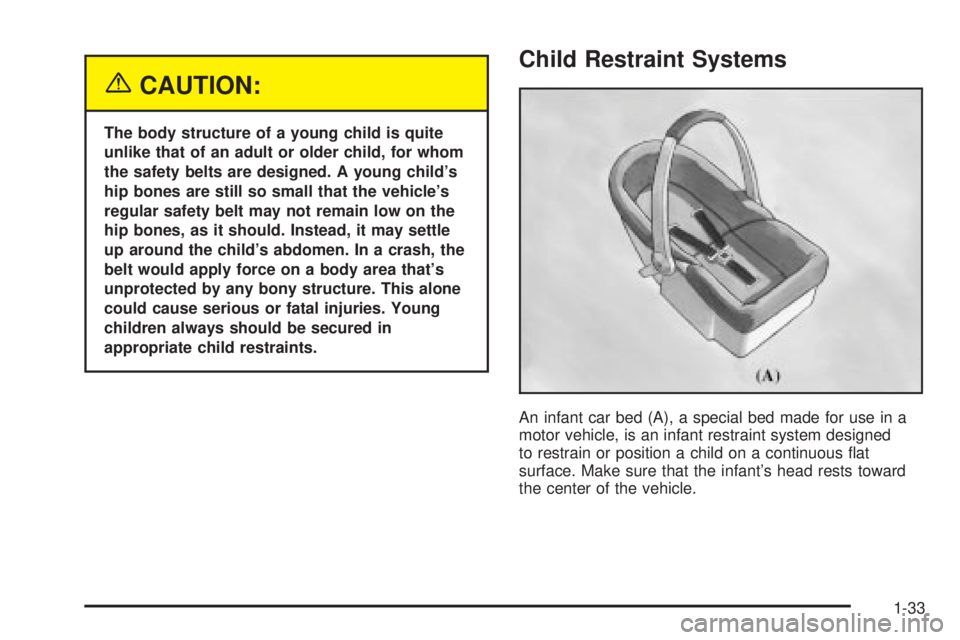
Child Restraint Systems
An infant car bed (A), a special bed made for use in a
motor vehicle, is an infant restraint system designed
to restrain or position a child on a continuous ¯at
surface. Make sure that the infant's head rests toward
the center of the vehicle.
1-33
Page 41 of 372
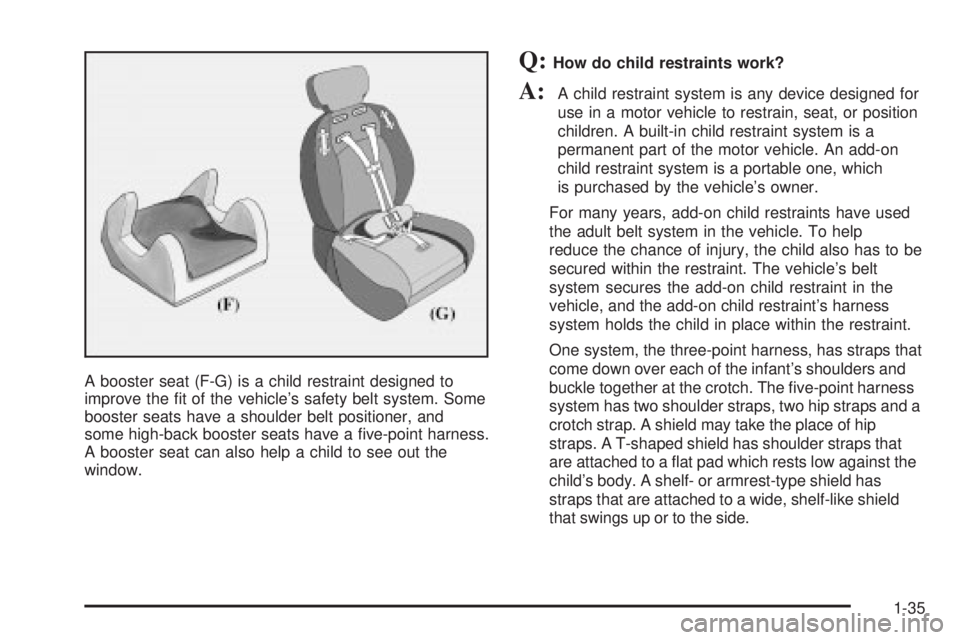
A booster seat (F-G) is a child restraint designed to
improve the ®t of the vehicle's safety belt system. Some
booster seats have a shoulder belt positioner, and
some high-back booster seats have a ®ve-point harness.
A booster seat can also help a child to see out the
window.
Q:How do child restraints work?
A:A child restraint system is any device designed for
use in a motor vehicle to restrain, seat, or position
children. A built-in child restraint system is a
permanent part of the motor vehicle. An add-on
child restraint system is a portable one, which
is purchased by the vehicle's owner.
For many years, add-on child restraints have used
the adult belt system in the vehicle. To help
reduce the chance of injury, the child also has to be
secured within the restraint. The vehicle's belt
system secures the add-on child restraint in the
vehicle, and the add-on child restraint's harness
system holds the child in place within the restraint.
One system, the three-point harness, has straps that
come down over each of the infant's shoulders and
buckle together at the crotch. The ®ve-point harness
system has two shoulder straps, two hip straps and a
crotch strap. A shield may take the place of hip
straps. A T-shaped shield has shoulder straps that
are attached to a ¯at pad which rests low against the
child's body. A shelf- or armrest-type shield has
straps that are attached to a wide, shelf-like shield
that swings up or to the side.
1-35
Page 42 of 372
When choosing a child restraint, be sure the child
restraint is designed to be used in a vehicle. If it is, it
will have a label saying that it meets federal motor
vehicle safety standards.
Then follow the instructions for the restraint. You may
®nd these instructions on the restraint itself or in a
booklet, or both. These restraints use the belt system in
your vehicle, but the child also has to be secured
within the restraint to help reduce the chance of personal
injury. When securing an add-on child restraint, refer
to the instructions that come with the restraint which may
be on the restraint itself or in a booklet, or both, and
to this manual. The child restraint instructions are
important, so if they are not available, obtain a
replacement copy from the manufacturer.Where to Put the Restraint
Accident statistics show that children are safer if they
are restrained in the rear rather than the front seat. We,
therefore, recommend that child restraints be secured
in a rear seat, including an infant riding in a rear-facing
infant seat, a child riding in a forward-facing child
seat and an older child riding in a booster seat.
Neverput a rear-facing child restraint in the front passenger
seat. Here's why:
{CAUTION:
A child in a rear-facing child restraint can be
seriously injured or killed if the right front
passenger's air bag in¯ates. This is because
the back of the rear-facing child restraint
would be very close to the in¯ating air bag.
Always secure a rear-facing child restraint in a
rear seat.
You may secure a forward-facing child
restraint in the right front seat, but before you
do, always move the front passenger seat as
far back as it will go. It's better to secure the
child restraint in a rear seat.
1-36
Page 47 of 372
With this system, use the LATCH system instead of the
vehicle's safety belts to secure a child restraint.
{CAUTION:
If a LATCH-type child restraint isn't attached to
its anchorage points, the restraint won't be
able to protect the child correctly. In a crash,
the child could be seriously injured or killed.
Make sure that a LATCH-type child restraint is
properly installed using the anchorage points,
or use the vehicle's safety belts to secure the
restraint. See ªSecuring a Child Restraint
Designed for the LATCH Systemº or ªSecuring
a Child Restraint in a Rear Seat Positionº in
the Index for information on how to secure a
child restraint in your vehicle.
Securing a Child Restraint Designed
for the LATCH System
1. Find the anchors for the seating position you want
to use, where the bottom of the seatback meets the
back of the seat cushion.
2. Put the child restraint on the seat.
3. Attach the anchor points on the child restraint to the
anchors in the vehicle. The child restraint
instructions will show you how.
4. If the child restraint is forward-facing, attach the top
strap to the top strap anchor. See
Top Strap on
page 1-37. Tighten the top strap according to
the child restraint instructions.
5. Push and pull the child restraint in different
directions to be sure it is secure.
To remove the child restraint, simply unhook the top
strap from the top tether anchor and then disconnect the
anchor points.
1-41