lock BUICK PARK AVENUE 2004 Owners Manual
[x] Cancel search | Manufacturer: BUICK, Model Year: 2004, Model line: PARK AVENUE, Model: BUICK PARK AVENUE 2004Pages: 410, PDF Size: 4.45 MB
Page 350 of 410
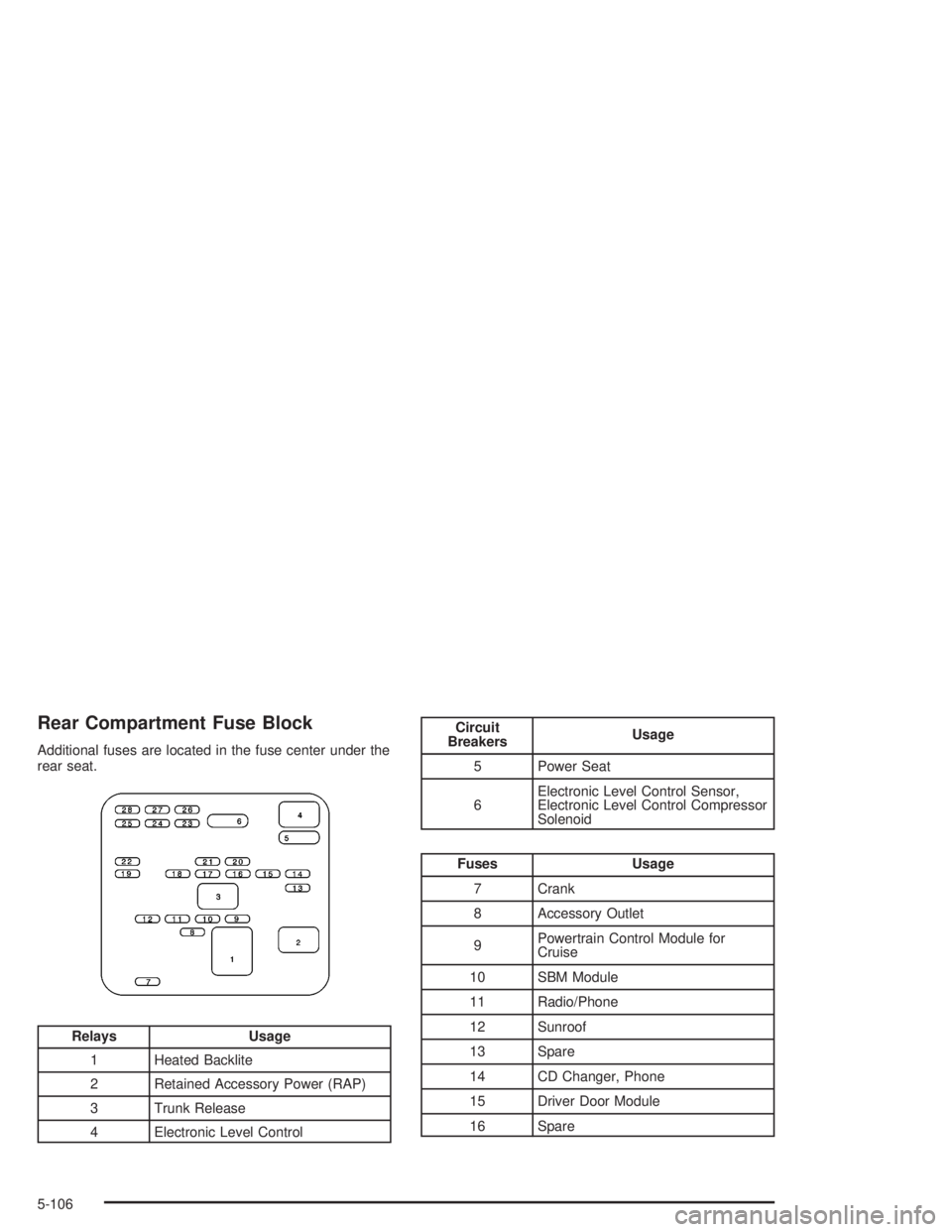
Rear Compartment Fuse Block
Additional fuses are located in the fuse center under the
rear seat.
Relays Usage
1 Heated Backlite
2 Retained Accessory Power (RAP)
3 Trunk Release
4 Electronic Level Control
Circuit
BreakersUsage
5 Power Seat
6Electronic Level Control Sensor,
Electronic Level Control Compressor
Solenoid
Fuses Usage
7 Crank
8 Accessory Outlet
9Powertrain Control Module for
Cruise
10 SBM Module
11 Radio/Phone
12 Sunroof
13 Spare
14 CD Changer, Phone
15 Driver Door Module
16 Spare
5-106
Page 374 of 410
At Least Twice a Year
Restraint System Check
Make sure the safety belt reminder light and all your belts,
buckles, latch plates, retractors and anchorages are
working properly. Look for any other loose or damaged
safety belt system parts. If you see anything that might
keep a safety belt system from doing its job, have it
repaired. Have any torn or frayed safety belts replaced.
Also look for any opened or broken air bag coverings,
and have them repaired or replaced. (The air bag
system does not need regular maintenance.)
Wiper Blade Check
Inspect wiper blades for wear or cracking. Replace
blade inserts that appear worn or damaged or that
streak or miss areas of the windshield. Also see
“Windshield Wiper and Wiper Blades” underCleaning
the Outside of Your Vehicle on page 5-93.
Weatherstrip Lubrication
Silicone grease on weatherstrips will make them
last longer, seal better, and not stick or squeak.
Apply silicone grease with a clean cloth. During very
cold, damp weather more frequent application may be
required. SeePart D: Recommended Fluids and
Lubricants on page 6-25.
Automatic Transaxle Check
Check the transaxle uid level; add if needed. See
Automatic Transaxle Fluid on page 5-23. A uid loss
may indicate a problem. Check the system and repair
if needed.
At Least Once a Year
Key Lock Cylinders Service
Lubricate the key lock cylinders with the lubricant
specied in Part D.
Body Lubrication Service
Lubricate all body door hinges. Also lubricate all hinges
and latches, including those for the hood, glove box
door and console door. Part D tells you what to
use. More frequent lubrication may be required when
exposed to a corrosive environment.
6-20
Page 375 of 410
Starter Switch Check
{CAUTION:
When you are doing this inspection, the
vehicle could move suddenly. If the vehicle
moves, you or others could be injured.
1. Before you start, be sure you have enough room
around the vehicle.
2. Firmly apply both the parking brake and the regular
brake. SeeParking Brake on page 2-29if
necessary.
Do not use the accelerator pedal, and be ready to
turn off the engine immediately if it starts.
3. Try to start the engine in each gear. The starter
should work only in PARK (P) or NEUTRAL (N).
If the starter works in any other position, your
vehicle needs service.
Automatic Transaxle Shift Lock Control
System Check
{CAUTION:
When you are doing this inspection, the
vehicle could move suddenly. If the vehicle
moves, you or others could be injured.
1. Before you start, be sure you have enough room
around the vehicle. It should be parked on a level
surface.
2. Firmly apply the parking brake. SeeParking Brake
on page 2-29if necessary.
Be ready to apply the regular brake immediately
if the vehicle begins to move.
3. With the engine off, turn the key to the RUN
position, but don’t start the engine. Without applying
the regular brake, try to move the shift lever out
of PARK (P) with normal effort. If the shift lever
moves out of PARK (P), your vehicle needs service.
6-21
Page 376 of 410
Ignition Transaxle Lock Check
While parked, and with the parking brake set, try to turn
the ignition key to LOCK in each shift lever position.
The key should turn to LOCK only when the
shift lever is in PARK (P).
The key should come out only in LOCK.
Parking Brake and Automatic Transaxle
Park (P) Mechanism Check
{CAUTION:
When you are doing this check, your vehicle
could begin to move. You or others could be
injured and property could be damaged.
Make sure there is room in front of your
vehicle in case it begins to roll. Be ready to
apply the regular brake at once should the
vehicle begin to move.Park on a fairly steep hill, with the vehicle facing
downhill. Keeping your foot on the regular brake,
set the parking brake.
To check the parking brake’s holding ability:
With the engine running and transaxle in
NEUTRAL (N), slowly remove foot pressure from
the regular brake pedal. Do this until the vehicle is
held by the parking brake only.
To check the PARK (P) mechanism’s holding
ability: With the engine running, shift to PARK (P).
Then release the parking brake followed by the
regular brake.
Underbody Flushing Service
At least every spring, use plain water to ush any
corrosive materials from the underbody. Take care to
clean thoroughly any areas where mud and other debris
can collect.
6-22
Page 379 of 410
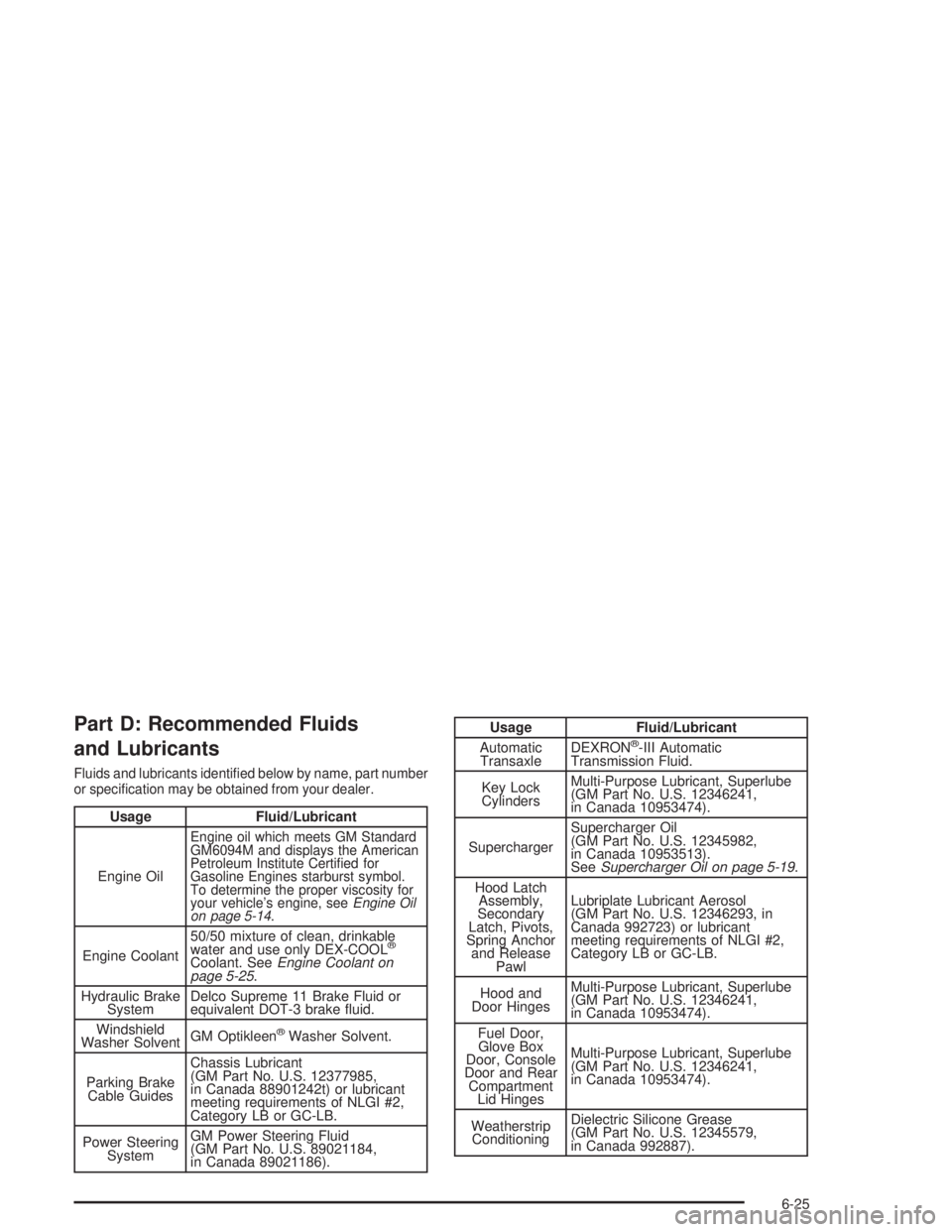
Part D: Recommended Fluids
and Lubricants
Fluids and lubricants identied below by name, part number
or specication may be obtained from your dealer.
Usage Fluid/Lubricant
Engine Oil
Engine oil which meets GM Standard
GM6094M and displays the American
Petroleum Institute Certied for
Gasoline Engines starburst symbol.
To determine the proper viscosity for
your vehicle’s engine, seeEngine Oil
on page 5-14.
Engine Coolant50/50 mixture of clean, drinkable
water and use only DEX-COOL®
Coolant. SeeEngine Coolant on
page 5-25.
Hydraulic Brake
SystemDelco Supreme 11 Brake Fluid or
equivalent DOT-3 brake uid.
Windshield
Washer SolventGM Optikleen
®Washer Solvent.
Parking Brake
Cable GuidesChassis Lubricant
(GM Part No. U.S. 12377985,
in Canada 88901242t) or lubricant
meeting requirements of NLGI #2,
Category LB or GC-LB.
Power Steering
SystemGM Power Steering Fluid
(GM Part No. U.S. 89021184,
in Canada 89021186).
Usage Fluid/Lubricant
Automatic
TransaxleDEXRON®-III Automatic
Transmission Fluid.
Key Lock
CylindersMulti-Purpose Lubricant, Superlube
(GM Part No. U.S. 12346241,
in Canada 10953474).
SuperchargerSupercharger Oil
(GM Part No. U.S. 12345982,
in Canada 10953513).
SeeSupercharger Oil on page 5-19.
Hood Latch
Assembly,
Secondary
Latch, Pivots,
Spring Anchor
and Release
PawlLubriplate Lubricant Aerosol
(GM Part No. U.S. 12346293, in
Canada 992723) or lubricant
meeting requirements of NLGI #2,
Category LB or GC-LB.
Hood and
Door HingesMulti-Purpose Lubricant, Superlube
(GM Part No. U.S. 12346241,
in Canada 10953474).
Fuel Door,
Glove Box
Door, Console
Door and Rear
Compartment
Lid HingesMulti-Purpose Lubricant, Superlube
(GM Part No. U.S. 12346241,
in Canada 10953474).
Weatherstrip
ConditioningDielectric Silicone Grease
(GM Part No. U.S. 12345579,
in Canada 992887).
6-25
Page 388 of 410
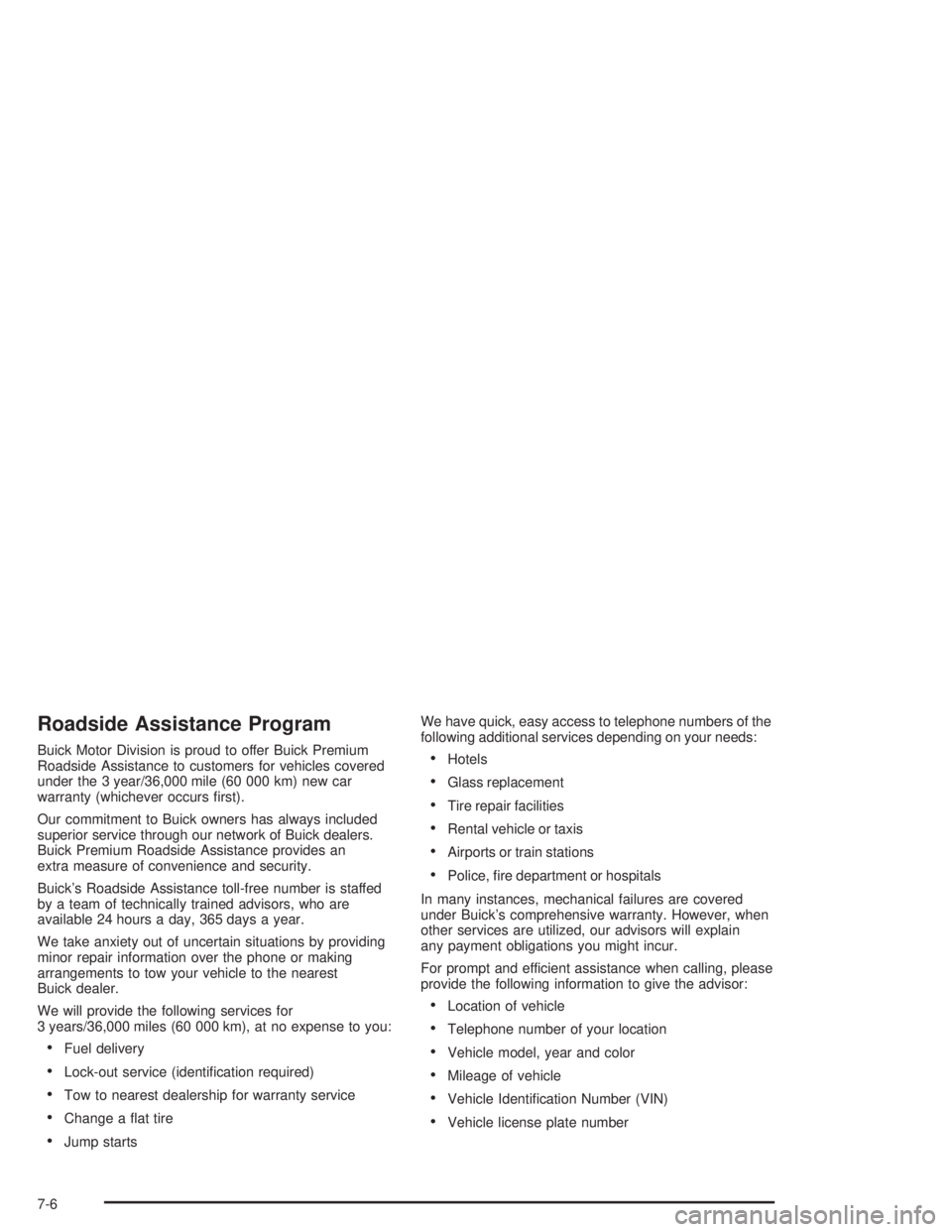
Roadside Assistance Program
Buick Motor Division is proud to offer Buick Premium
Roadside Assistance to customers for vehicles covered
under the 3 year/36,000 mile (60 000 km) new car
warranty (whichever occurs rst).
Our commitment to Buick owners has always included
superior service through our network of Buick dealers.
Buick Premium Roadside Assistance provides an
extra measure of convenience and security.
Buick’s Roadside Assistance toll-free number is staffed
by a team of technically trained advisors, who are
available 24 hours a day, 365 days a year.
We take anxiety out of uncertain situations by providing
minor repair information over the phone or making
arrangements to tow your vehicle to the nearest
Buick dealer.
We will provide the following services for
3 years/36,000 miles (60 000 km), at no expense to you:
Fuel delivery
Lock-out service (identication required)
Tow to nearest dealership for warranty service
Change a at tire
Jump startsWe have quick, easy access to telephone numbers of the
following additional services depending on your needs:
Hotels
Glass replacement
Tire repair facilities
Rental vehicle or taxis
Airports or train stations
Police, re department or hospitals
In many instances, mechanical failures are covered
under Buick’s comprehensive warranty. However, when
other services are utilized, our advisors will explain
any payment obligations you might incur.
For prompt and efficient assistance when calling, please
provide the following information to give the advisor:
Location of vehicle
Telephone number of your location
Vehicle model, year and color
Mileage of vehicle
Vehicle Identication Number (VIN)
Vehicle license plate number
7-6
Page 391 of 410
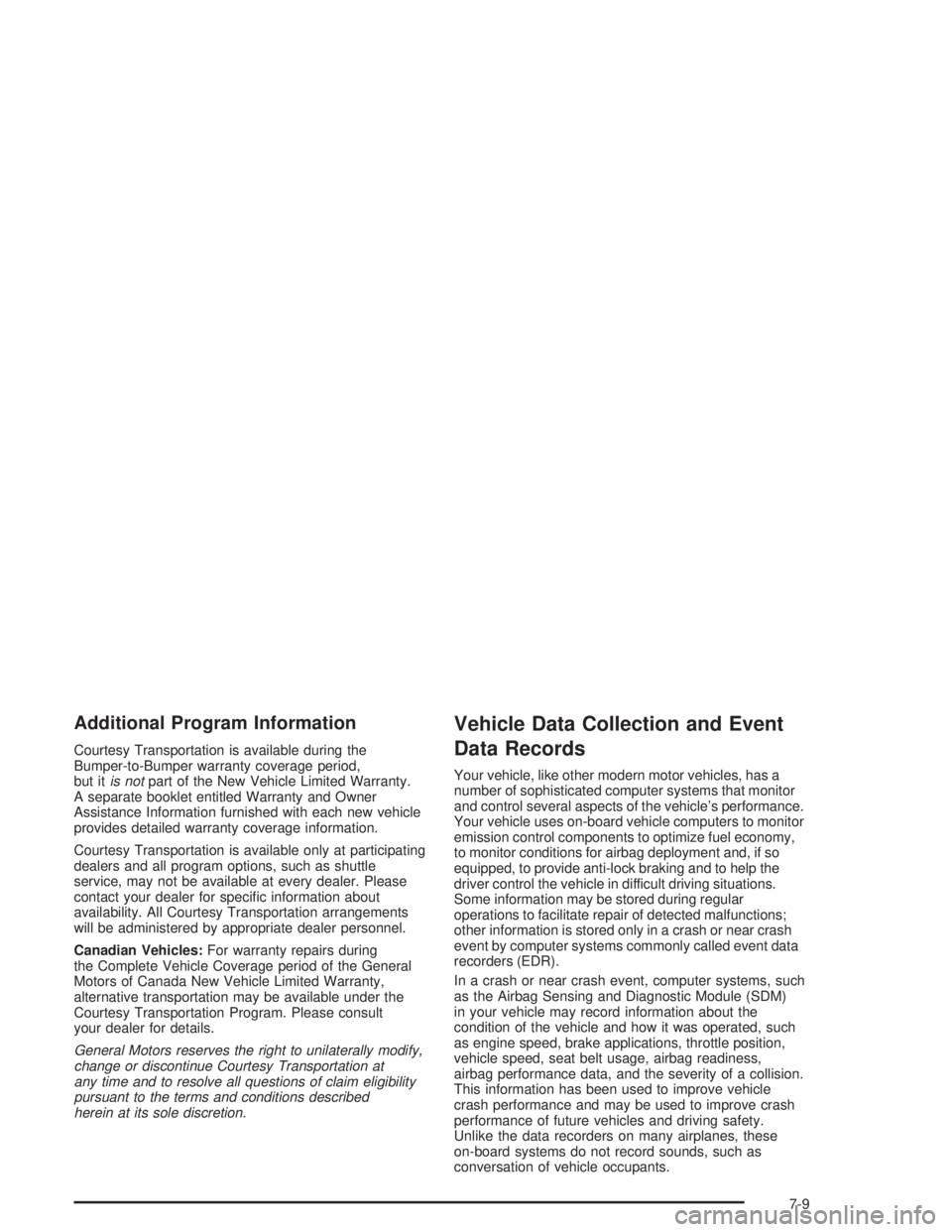
Additional Program Information
Courtesy Transportation is available during the
Bumper-to-Bumper warranty coverage period,
but itis notpart of the New Vehicle Limited Warranty.
A separate booklet entitled Warranty and Owner
Assistance Information furnished with each new vehicle
provides detailed warranty coverage information.
Courtesy Transportation is available only at participating
dealers and all program options, such as shuttle
service, may not be available at every dealer. Please
contact your dealer for specic information about
availability. All Courtesy Transportation arrangements
will be administered by appropriate dealer personnel.
Canadian Vehicles:For warranty repairs during
the Complete Vehicle Coverage period of the General
Motors of Canada New Vehicle Limited Warranty,
alternative transportation may be available under the
Courtesy Transportation Program. Please consult
your dealer for details.
General Motors reserves the right to unilaterally modify,
change or discontinue Courtesy Transportation at
any time and to resolve all questions of claim eligibility
pursuant to the terms and conditions described
herein at its sole discretion.
Vehicle Data Collection and Event
Data Records
Your vehicle, like other modern motor vehicles, has a
number of sophisticated computer systems that monitor
and control several aspects of the vehicle’s performance.
Your vehicle uses on-board vehicle computers to monitor
emission control components to optimize fuel economy,
to monitor conditions for airbag deployment and, if so
equipped, to provide anti-lock braking and to help the
driver control the vehicle in difficult driving situations.
Some information may be stored during regular
operations to facilitate repair of detected malfunctions;
other information is stored only in a crash or near crash
event by computer systems commonly called event data
recorders (EDR).
In a crash or near crash event, computer systems, such
as the Airbag Sensing and Diagnostic Module (SDM)
in your vehicle may record information about the
condition of the vehicle and how it was operated, such
as engine speed, brake applications, throttle position,
vehicle speed, seat belt usage, airbag readiness,
airbag performance data, and the severity of a collision.
This information has been used to improve vehicle
crash performance and may be used to improve crash
performance of future vehicles and driving safety.
Unlike the data recorders on many airplanes, these
on-board systems do not record sounds, such as
conversation of vehicle occupants.
7-9
Page 395 of 410
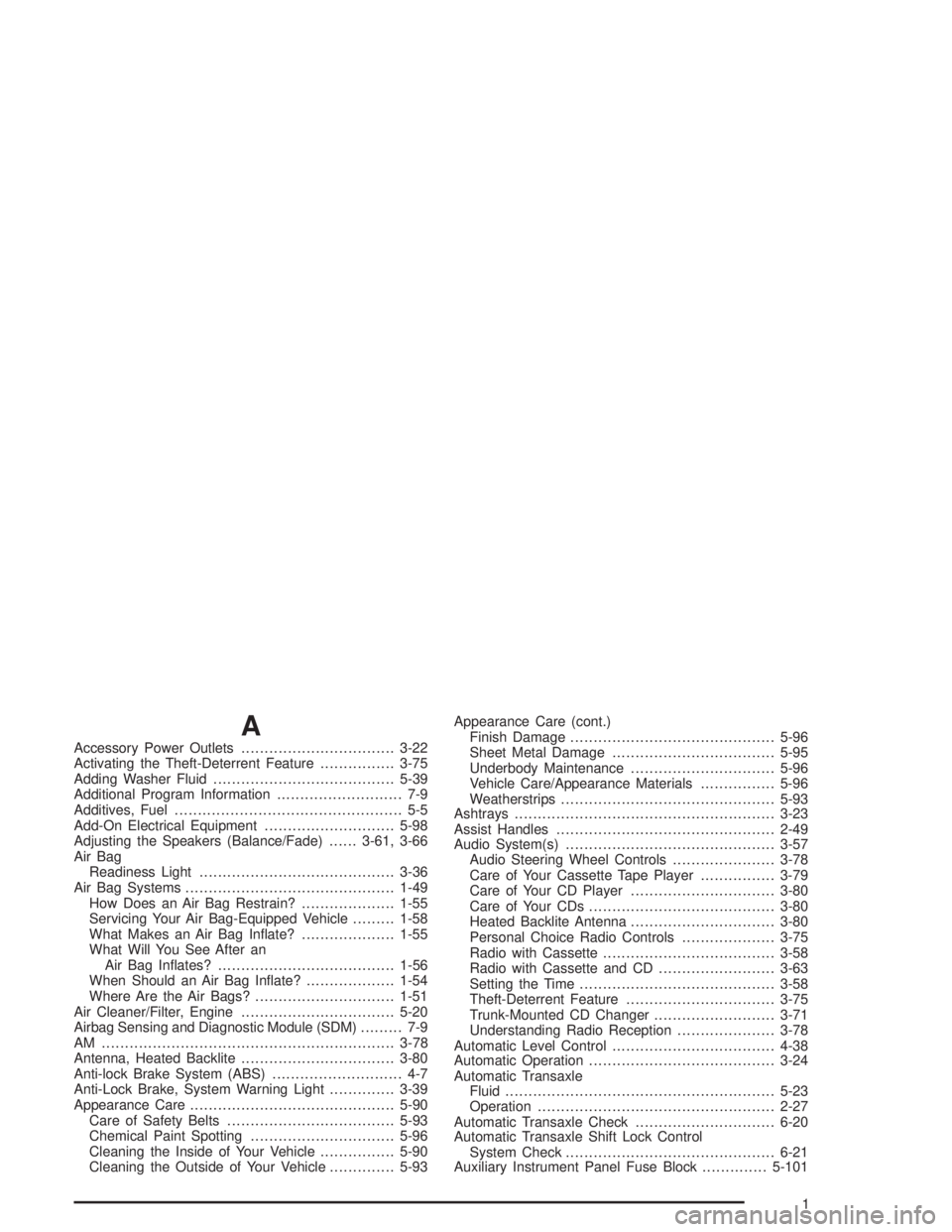
A
Accessory Power Outlets.................................3-22
Activating the Theft-Deterrent Feature................3-75
Adding Washer Fluid.......................................5-39
Additional Program Information........................... 7-9
Additives, Fuel................................................. 5-5
Add-On Electrical Equipment............................5-98
Adjusting the Speakers (Balance/Fade)......3-61, 3-66
Air Bag
Readiness Light..........................................3-36
Air Bag Systems.............................................1-49
How Does an Air Bag Restrain?....................1-55
Servicing Your Air Bag-Equipped Vehicle.........1-58
What Makes an Air Bag Inate?....................1-55
What Will You See After an
Air Bag Inates?......................................1-56
When Should an Air Bag Inate?...................1-54
Where Are the Air Bags?..............................1-51
Air Cleaner/Filter, Engine.................................5-20
Airbag Sensing and Diagnostic Module (SDM)......... 7-9
AM ...............................................................3-78
Antenna, Heated Backlite.................................3-80
Anti-lock Brake System (ABS)............................ 4-7
Anti-Lock Brake, System Warning Light..............3-39
Appearance Care............................................5-90
Care of Safety Belts....................................5-93
Chemical Paint Spotting...............................5-96
Cleaning the Inside of Your Vehicle................5-90
Cleaning the Outside of Your Vehicle..............5-93Appearance Care (cont.)
Finish Damage............................................5-96
Sheet Metal Damage...................................5-95
Underbody Maintenance...............................5-96
Vehicle Care/Appearance Materials................5-96
Weatherstrips..............................................5-93
Ashtrays........................................................3-23
Assist Handles...............................................2-49
Audio System(s).............................................3-57
Audio Steering Wheel Controls......................3-78
Care of Your Cassette Tape Player................3-79
Care of Your CD Player...............................3-80
Care of Your CDs........................................3-80
Heated Backlite Antenna...............................3-80
Personal Choice Radio Controls....................3-75
Radio with Cassette.....................................3-58
Radio with Cassette and CD.........................3-63
Setting the Time..........................................3-58
Theft-Deterrent Feature................................3-75
Trunk-Mounted CD Changer..........................3-71
Understanding Radio Reception.....................3-78
Automatic Level Control...................................4-38
Automatic Operation........................................3-24
Automatic Transaxle
Fluid..........................................................5-23
Operation...................................................2-27
Automatic Transaxle Check..............................6-20
Automatic Transaxle Shift Lock Control
System Check.............................................6-21
Auxiliary Instrument Panel Fuse Block..............5-101
1
Page 398 of 410
Customer Assistance Information (cont.)
Customer Assistance for Text
Telephone (TTY) Users............................... 7-4
Customer Assistance Offices........................... 7-4
Customer Satisfaction Procedure..................... 7-2
GM Mobility Program for Persons with
Disabilities................................................ 7-5
Reporting Safety Defects to General Motors.......7-11
Reporting Safety Defects to the
Canadian Government..............................7-11
Reporting Safety Defects to the
United States Government.........................7-10
Roadside Assistance Program......................... 7-6
Service Publications Ordering Information........7-11
Customizing Your Automatic Door Locks
Feature......................................................2-13
D
Daytime Running Lamps..................................3-13
Defensive Driving............................................. 4-2
Defogging and Defrosting.................................3-27
Delayed Entry Lighting.....................................3-15
Delayed Exit Lighting.......................................3-15
Delayed Locking.....................................2-11, 3-54
Dinghy Towing................................................4-32
Disabling the Theft-Deterrent Feature.................3-77
Doing Your Own Service Work........................... 5-3
Dolly Towing..................................................4-32Door
Central Door Unlocking System.....................2-11
Delayed Locking..........................................2-11
Door Ajar Reminder.....................................2-11
Locks........................................................2-10
Power Door Locks.......................................2-11
Programmable Automatic Door Locks.............2-12
Rear Door Security Locks.............................2-14
Driver
Position, Safety Belt.....................................1-12
Driver Information Center (DIC).........................3-47
DIC Controls and Displays............................3-47
DIC Vehicle Personalization..........................3-51
DIC Warnings and Messages........................3-50
Driving
At Night.....................................................4-17
City...........................................................4-21
Defensive..................................................... 4-2
Drunken....................................................... 4-3
Freeway.....................................................4-22
Hill and Mountain Roads..............................4-24
In Rain and on Wet Roads...........................4-18
Winter........................................................4-26
Driving On Grades..........................................4-44
Driving on Snow or Ice....................................4-27
Driving Through Deep Standing Water...............4-20
Driving Through Flowing Water.........................4-20
Driving with a Trailer.......................................4-42
Dual Automatic Climate Control System.............3-24
4
Page 401 of 410
How to Check........................................5-23, 5-70
How to Check and Add Oil...............................5-20
How to Check Power Steering Fluid..................5-38
How to Inspect the Engine Air Cleaner/Filter.......5-21
How to Use This Manual...................................... ii
How to Wear Safety Belts Properly...................1-12
Hydroplaning..................................................4-20
I
If No Steam Is Coming From Your Engine..........5-29
If Steam Is Coming From Your Engine...............5-28
If the Light Is Flashing.....................................3-42
If the Light Is On Steady.................................3-42
If You Are Caught in a Blizzard.........................4-28
If You Are Stuck in Sand, Mud, Ice or Snow.......4-30
If You Can’t See The HUD Image When the
Ignition is On..............................................3-20
If You Do Decide To Pull A Trailer.....................4-39
Ignition Positions.............................................2-24
Ignition Transaxle Lock Check..........................6-22
Infants and Young Children, Restraints...............1-30
Ination - Tire Pressure...................................5-69
Inspection
Brake System.............................................6-24
Engine Cooling System................................6-24
Exhaust System..........................................6-23
Fuel System...............................................6-24
Part C - Periodic Maintenance.......................6-23Inspection (cont.)
Steering, Suspension and Front Drive Axle
Boot and Seal.........................................6-23
Throttle System...........................................6-24
Instrument Panel
Cluster.......................................................3-33
Overview..................................................... 3-2
Instrument Panel Brightness.............................3-15
Interior Lamps................................................3-15J
Jump Starting.................................................5-44
K
Key Lock Cylinders Service..............................6-20
Key Reminder Warning....................................2-25
Keyless Entry System....................................... 2-5
Keys............................................................... 2-3
L
Lamps
Exterior......................................................3-12
Interior.......................................................3-15
Lap Belt........................................................1-19
Lap-Shoulder Belt...................................1-12, 1-21
7