5-29 BUICK RAINIER 2005 Owner's Manual
[x] Cancel search | Manufacturer: BUICK, Model Year: 2005, Model line: RAINIER, Model: BUICK RAINIER 2005Pages: 452, PDF Size: 2.6 MB
Page 305 of 452
Service............................................................5-3
Doing Your Own Service Work.........................5-4
Adding Equipment to the Outside of Your
Vehicle......................................................5-5
Fuel................................................................5-5
Gasoline Octane............................................5-5
Gasoline Specications....................................5-5
California Fuel...............................................5-5
Additives.......................................................5-6
Fuels in Foreign Countries...............................5-7
Filling Your Tank............................................5-7
Filling a Portable Fuel Container.......................5-9
Checking Things Under the Hood....................5-10
Hood Release..............................................5-10
Engine Compartment Overview.......................5-12
Engine Oil...................................................5-16
Engine Oil Life System..................................5-19
Engine Air Cleaner/Filter................................5-20
Automatic Transmission Fluid.........................5-22
Engine Coolant.............................................5-24
Radiator Pressure Cap..................................5-27
Engine Overheating.......................................5-27
Cooling System............................................5-29
Engine Fan Noise.........................................5-34
Power Steering Fluid.....................................5-35
Windshield Washer Fluid................................5-36Brakes........................................................5-37
Battery........................................................5-40
Jump Starting...............................................5-41
All-Wheel Drive..............................................5-46
Rear Axle.......................................................5-46
Front Axle......................................................5-47
Bulb Replacement..........................................5-48
Halogen Bulbs..............................................5-48
Headlamps, Front Turn Signal, Sidemarker,
and Parking Lamps....................................5-49
Taillamps and Turn Signal Lamps...................5-49
Replacement Bulbs.......................................5-50
Windshield Wiper Blade Replacement..............5-51
Tires..............................................................5-53
Tire Sidewall Labelling...................................5-54
Tire Terminology and Denitions.....................5-57
Ination - Tire Pressure.................................5-59
Tire Inspection and Rotation...........................5-60
When It Is Time for New Tires.......................5-62
Buying New Tires.........................................5-62
Uniform Tire Quality Grading..........................5-63
Wheel Alignment and Tire Balance..................5-64
Wheel Replacement......................................5-65
Tire Chains..................................................5-66
Accessory Inator.........................................5-67
Section 5 Service and Appearance Care
5-1
Page 317 of 452
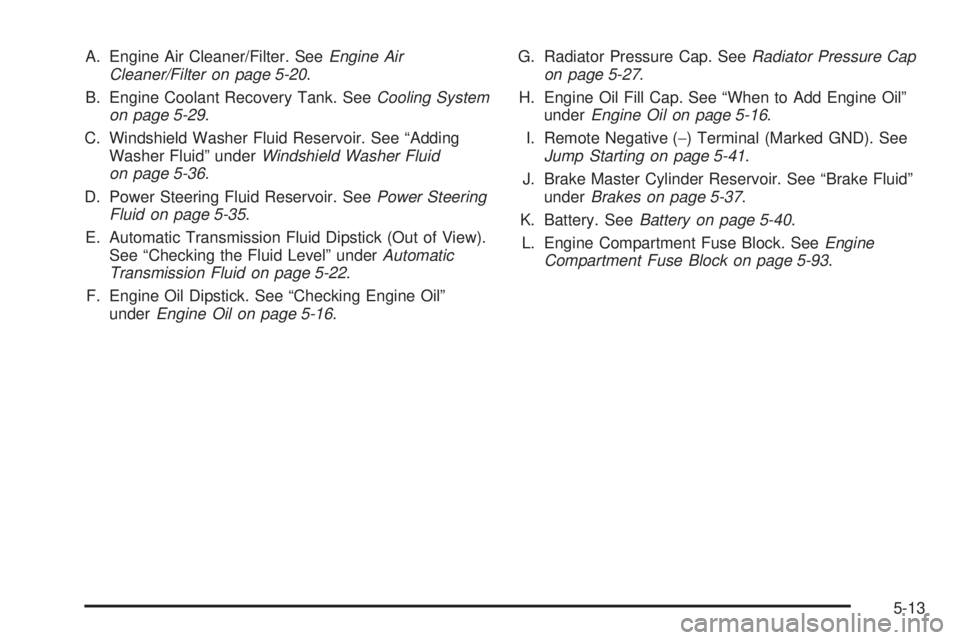
A. Engine Air Cleaner/Filter. SeeEngine Air
Cleaner/Filter on page 5-20.
B. Engine Coolant Recovery Tank. SeeCooling System
on page 5-29.
C. Windshield Washer Fluid Reservoir. See “Adding
Washer Fluid” underWindshield Washer Fluid
on page 5-36.
D. Power Steering Fluid Reservoir. SeePower Steering
Fluid on page 5-35.
E. Automatic Transmission Fluid Dipstick (Out of View).
See “Checking the Fluid Level” underAutomatic
Transmission Fluid on page 5-22.
F. Engine Oil Dipstick. See “Checking Engine Oil”
underEngine Oil on page 5-16.G. Radiator Pressure Cap. SeeRadiator Pressure Cap
on page 5-27.
H. Engine Oil Fill Cap. See “When to Add Engine Oil”
underEngine Oil on page 5-16.
I. Remote Negative (−) Terminal (Marked GND). See
Jump Starting on page 5-41.
J. Brake Master Cylinder Reservoir. See “Brake Fluid”
underBrakes on page 5-37.
K. Battery. SeeBattery on page 5-40.
L. Engine Compartment Fuse Block. SeeEngine
Compartment Fuse Block on page 5-93.
5-13
Page 319 of 452
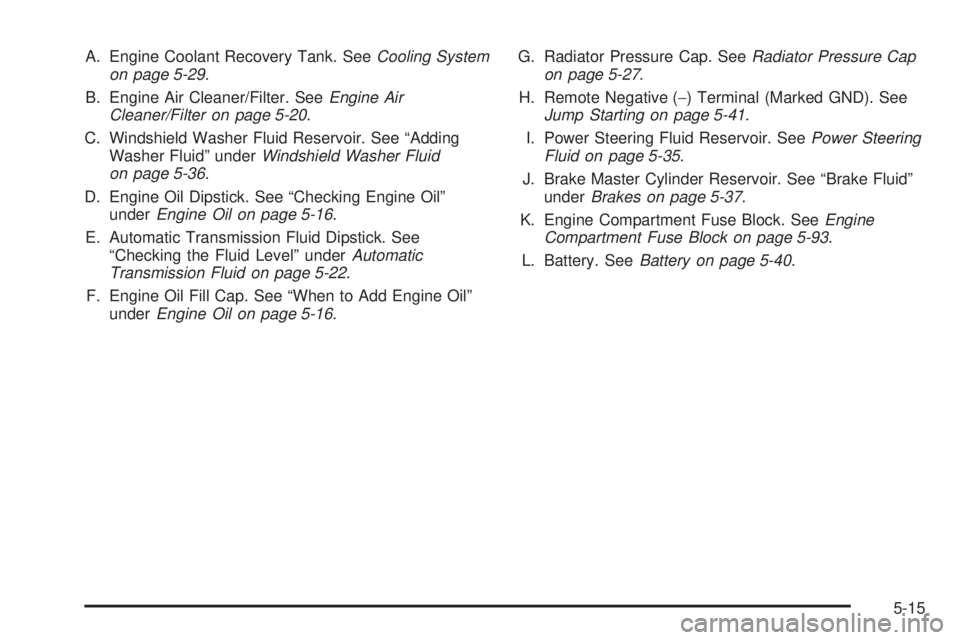
A. Engine Coolant Recovery Tank. SeeCooling System
on page 5-29.
B. Engine Air Cleaner/Filter. SeeEngine Air
Cleaner/Filter on page 5-20.
C. Windshield Washer Fluid Reservoir. See “Adding
Washer Fluid” underWindshield Washer Fluid
on page 5-36.
D. Engine Oil Dipstick. See “Checking Engine Oil”
underEngine Oil on page 5-16.
E. Automatic Transmission Fluid Dipstick. See
“Checking the Fluid Level” underAutomatic
Transmission Fluid on page 5-22.
F. Engine Oil Fill Cap. See “When to Add Engine Oil”
underEngine Oil on page 5-16.G. Radiator Pressure Cap. SeeRadiator Pressure Cap
on page 5-27.
H. Remote Negative (−) Terminal (Marked GND). See
Jump Starting on page 5-41.
I. Power Steering Fluid Reservoir. SeePower Steering
Fluid on page 5-35.
J. Brake Master Cylinder Reservoir. See “Brake Fluid”
underBrakes on page 5-37.
K. Engine Compartment Fuse Block. SeeEngine
Compartment Fuse Block on page 5-93.
L. Battery. SeeBattery on page 5-40.
5-15
Page 330 of 452
Checking Coolant
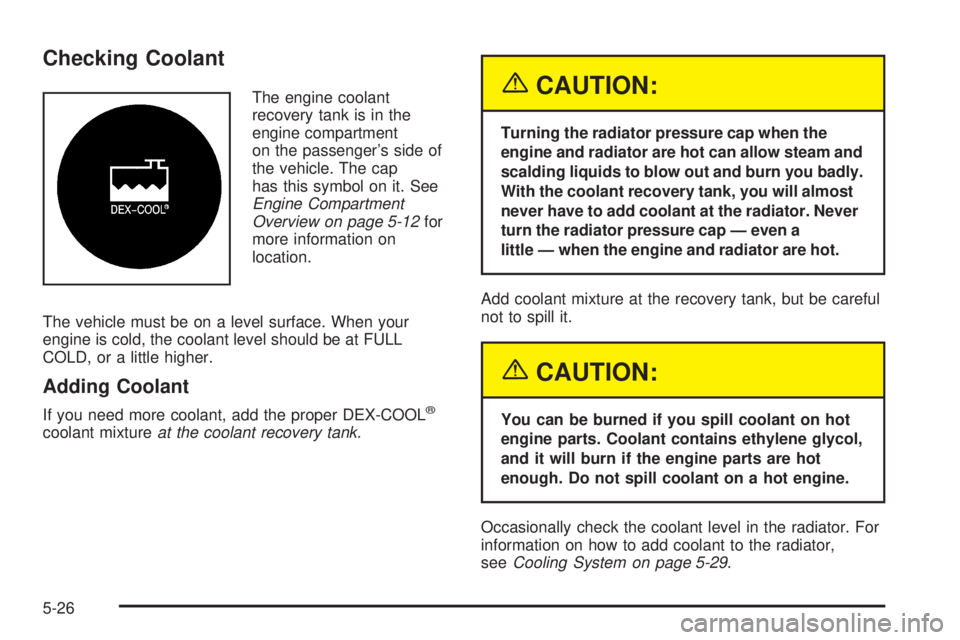
The engine coolant
recovery tank is in the
engine compartment
on the passenger’s side of
the vehicle. The cap
has this symbol on it. See
Engine Compartment
Overview on page 5-12for
more information on
location.
The vehicle must be on a level surface. When your
engine is cold, the coolant level should be at FULL
COLD, or a little higher.
Adding Coolant
If you need more coolant, add the proper DEX-COOL®
coolant mixtureat the coolant recovery tank.
{CAUTION:
Turning the radiator pressure cap when the
engine and radiator are hot can allow steam and
scalding liquids to blow out and burn you badly.
With the coolant recovery tank, you will almost
never have to add coolant at the radiator. Never
turn the radiator pressure cap — even a
little — when the engine and radiator are hot.
Add coolant mixture at the recovery tank, but be careful
not to spill it.
{CAUTION:
You can be burned if you spill coolant on hot
engine parts. Coolant contains ethylene glycol,
and it will burn if the engine parts are hot
enough. Do not spill coolant on a hot engine.
Occasionally check the coolant level in the radiator. For
information on how to add coolant to the radiator,
seeCooling System on page 5-29.
5-26
Page 333 of 452
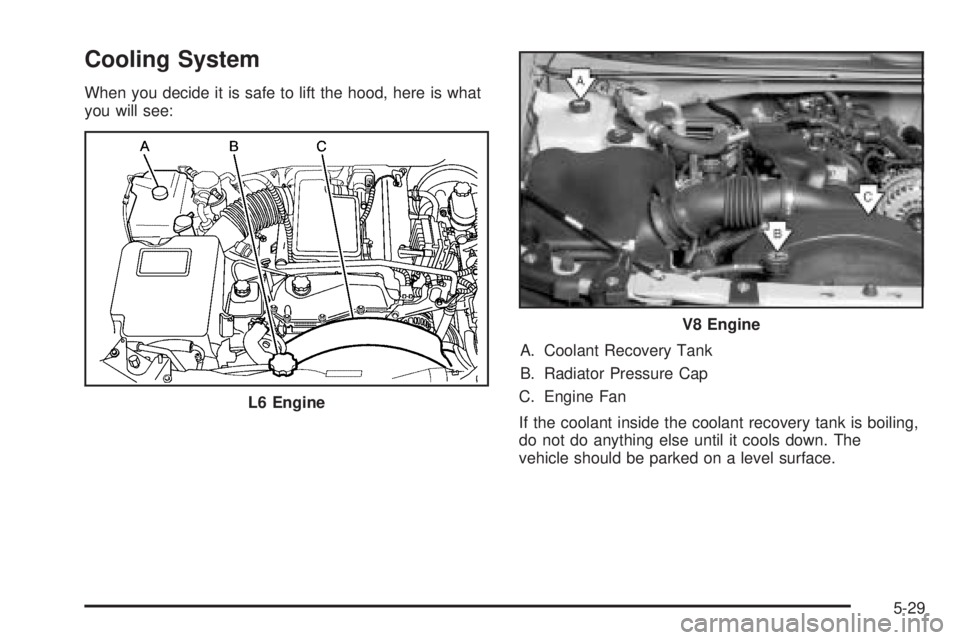
Cooling System
When you decide it is safe to lift the hood, here is what
you will see:
A. Coolant Recovery Tank
B. Radiator Pressure Cap
C. Engine Fan
If the coolant inside the coolant recovery tank is boiling,
do not do anything else until it cools down. The
vehicle should be parked on a level surface. L6 Engine
V8 Engine
5-29
Page 442 of 452
Content Theft-Deterrent....................................2-16
Control of a Vehicle.......................................... 4-5
Convenience Net............................................2-49
Coolant
Engine Temperature Gage............................3-34
Heater, Engine............................................2-21
Cooling System..............................................5-29
Cruise Control Lever.......................................3-11
Cruise Control Light........................................3-40
Customer Assistance Information
Courtesy Transportation.................................. 7-7
Customer Assistance for Text Telephone (TTY)
Users....................................................... 7-4
Customer Assistance Offices........................... 7-4
Customer Satisfaction Procedure..................... 7-2
GM Mobility Reimbursement Program............... 7-5
Reporting Safety Defects to General Motors....7-11
Reporting Safety Defects to the Canadian
Government............................................7-10
Reporting Safety Defects to the United
States Government...................................7-10
Roadside Assistance Program......................... 7-5
Service Publications Ordering Information........7-11
D
Daytime Running Lamps..................................3-14
Defensive Driving............................................. 4-2
Delayed Locking............................................... 2-9Doing Your Own Service Work........................... 5-4
Dome Lamp Override......................................3-17
Dome Lamps.................................................3-16
Door
Delayed Locking........................................... 2-9
Locks.......................................................... 2-7
Power Door Locks......................................... 2-8
Programmable Automatic Door Locks............... 2-9
Rear Door Security Locks.............................2-12
Driver
Position, Safety Belt.....................................1-12
Driver Information Center (DIC).........................3-43
DIC Operation and Displays..........................3-44
DIC Vehicle Customization............................3-50
DIC Warnings and Messages........................3-47
Driving
At Night.....................................................4-28
City...........................................................4-32
Defensive..................................................... 4-2
Drunken....................................................... 4-2
Freeway.....................................................4-33
Hill and Mountain Roads..............................4-36
In Rain and on Wet Roads...........................4-29
Rocking Your Vehicle to Get it Out.................4-43
Winter........................................................4-38
Dual Automatic Climate Control System.............3-19
DVD
Rear Seat Entertainment System..................3-109
4