lock BUICK RAINIER 2006 Owners Manual
[x] Cancel search | Manufacturer: BUICK, Model Year: 2006, Model line: RAINIER, Model: BUICK RAINIER 2006Pages: 470, PDF Size: 2.72 MB
Page 348 of 470
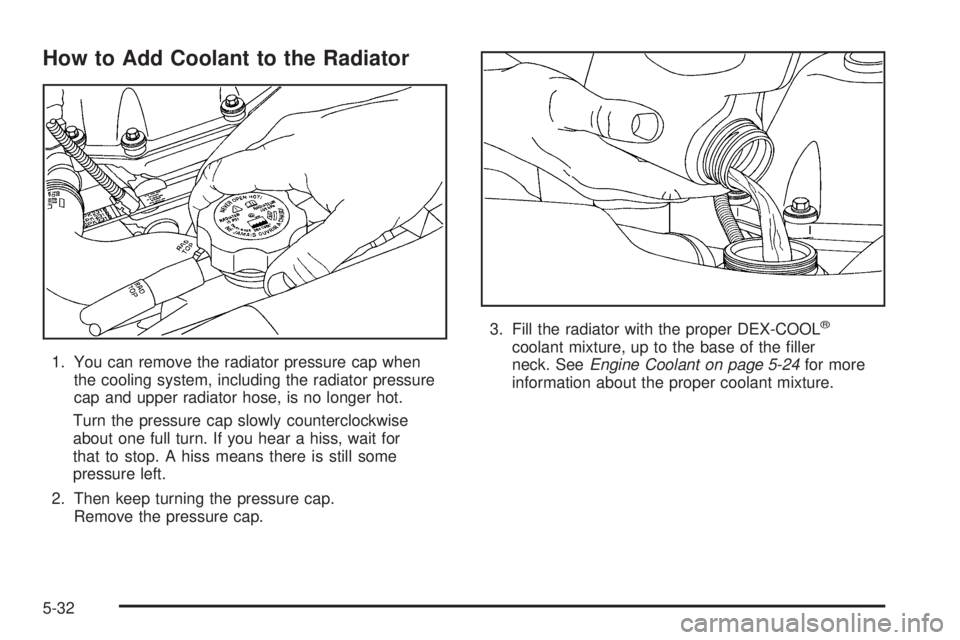
How to Add Coolant to the Radiator
1. You can remove the radiator pressure cap when
the cooling system, including the radiator pressure
cap and upper radiator hose, is no longer hot.
Turn the pressure cap slowly counterclockwise
about one full turn. If you hear a hiss, wait for
that to stop. A hiss means there is still some
pressure left.
2. Then keep turning the pressure cap.
Remove the pressure cap.3. Fill the radiator with the proper DEX-COOL
®
coolant mixture, up to the base of the ller
neck. SeeEngine Coolant on page 5-24for more
information about the proper coolant mixture.
5-32
Page 364 of 470
Headlamps, Front Turn Signal,
Sidemarker, and Parking Lamps
To replace a bulb, do the following:
1. Open the hood. SeeHood Release on page 5-11
for more information.
2. Remove the grille by grasping and pulling it
forward.
3. Lift the inner quick release clips.
4. Pull the headlamp assembly away from the vehicle.
5. Remove the cover from the headlamp bulb.
6. Disconnect the wiring harness.
7. Remove the bulb socket by turning it
counterclockwise. Pull the bulb from the socket.
8. Replace the bulb.
9. Reinstall by reversing Steps 1 through 6.
Taillamps and Turn Signal Lamps
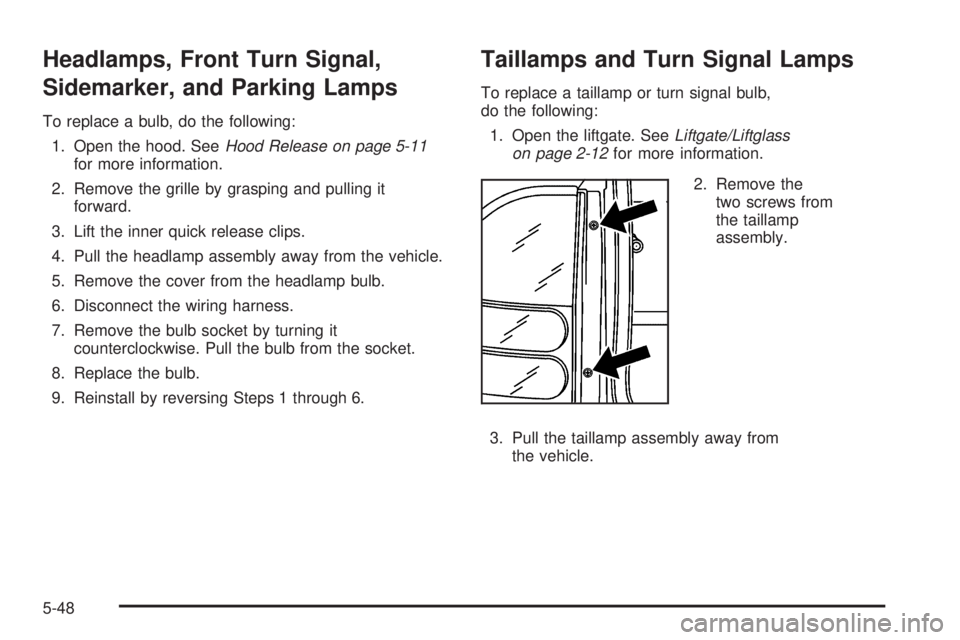
To replace a taillamp or turn signal bulb,
do the following:
1. Open the liftgate. SeeLiftgate/Liftglass
on page 2-12for more information.
2. Remove the
two screws from
the taillamp
assembly.
3. Pull the taillamp assembly away from
the vehicle.
5-48
Page 366 of 470
Windshield Replacement
Your vehicle is equipped with an acoustic windshield.
If you ever have to have your windshield replaced
be sure to get an acoustic windshield so you will
continue to have the benets an acoustic windshield
can provide.
Windshield Wiper Blade
Replacement
Windshield wiper blades should be inspected for wear
or cracking. SeeScheduled Maintenance on page 6-4.
Allowing the wiper blade arm to touch the windshield
when no wiper blade is installed could damage the
windshield. Any damage that occurs would not
be covered by your warranty. Do not allow the wiper
blade arm to touch the windshield.
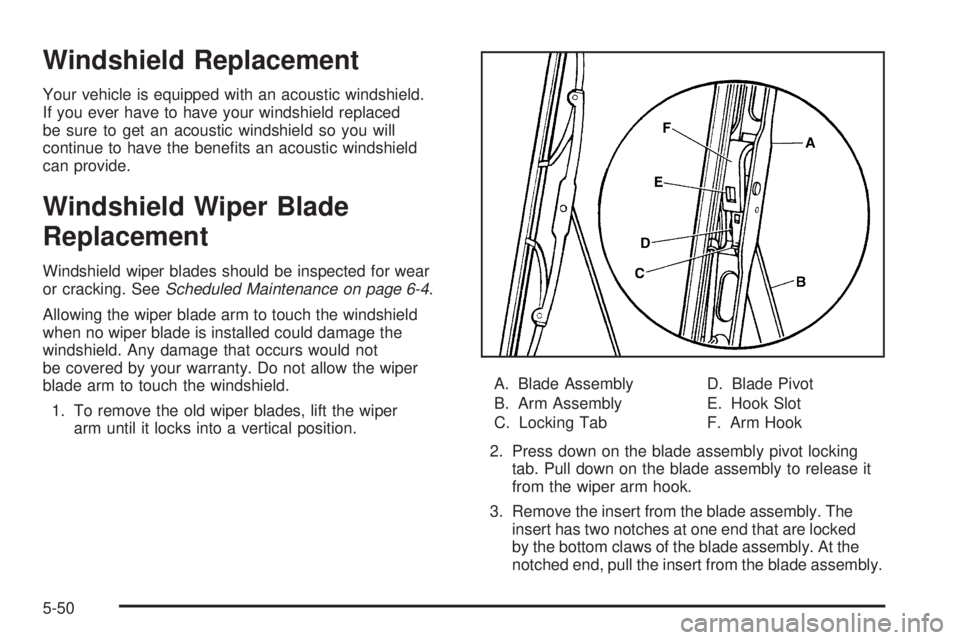
1. To remove the old wiper blades, lift the wiper
arm until it locks into a vertical position.A. Blade Assembly
B. Arm Assembly
C. Locking TabD. Blade Pivot
E. Hook Slot
F. Arm Hook
2. Press down on the blade assembly pivot locking
tab. Pull down on the blade assembly to release it
from the wiper arm hook.
3. Remove the insert from the blade assembly. The
insert has two notches at one end that are locked
by the bottom claws of the blade assembly. At the
notched end, pull the insert from the blade assembly.
5-50
Page 367 of 470
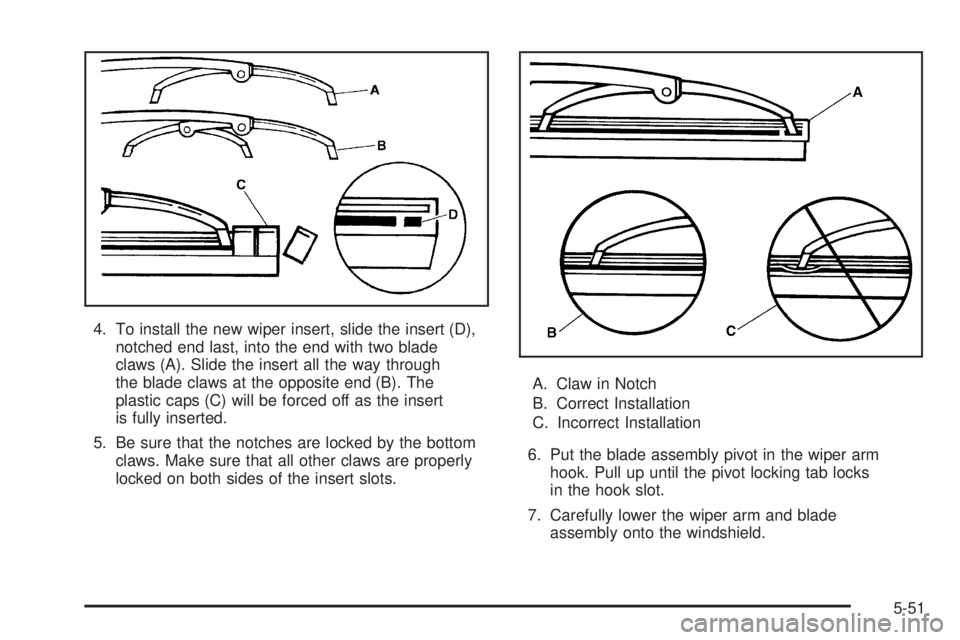
4. To install the new wiper insert, slide the insert (D),
notched end last, into the end with two blade
claws (A). Slide the insert all the way through
the blade claws at the opposite end (B). The
plastic caps (C) will be forced off as the insert
is fully inserted.
5. Be sure that the notches are locked by the bottom
claws. Make sure that all other claws are properly
locked on both sides of the insert slots.A. Claw in Notch
B. Correct Installation
C. Incorrect Installation
6. Put the blade assembly pivot in the wiper arm
hook. Pull up until the pivot locking tab locks
in the hook slot.
7. Carefully lower the wiper arm and blade
assembly onto the windshield.
5-51
Page 368 of 470
Backglass Wiper Blade Replacement
SeeWindshield Wiper Blade Replacement on page 5-50
for instructions on how to change the backglass wiper
blade. The backglass wiper blade will not lock in a
vertical position like the windshield wiper blade, so care
should be used when pulling it away from the vehicle.
Tires
Your new vehicle comes with high-quality tires made by
a leading tire manufacturer. If you ever have questions
about your tire warranty and where to obtain service,
see your GM Warranty booklet for details. For additional
information refer to the tire manufacturer’s booklet
included with your vehicle’s Owner Manual.
{CAUTION:
Poorly maintained and improperly used tires
are dangerous.
Overloading your tires can cause
overheating as a result of too much
friction. You could have an air-out and
a serious accident. SeeLoading Your
Vehicle on page 4-45.
Underinated tires pose the same danger
as overloaded tires. The resulting accident
could cause serious injury. Check all tires
frequently to maintain the recommended
pressure. Tire pressure should be checked
when your tires are cold. SeeInflation - Tire
Pressure on page 5-58.
Overinated tires are more likely to be
cut, punctured, or broken by a sudden
impact — such as when you hit a pothole.
Keep tires at the recommended pressure.
Worn, old tires can cause accidents. If your
tread is badly worn, or if your tires have
been damaged, replace them.
5-52
Page 379 of 470
If you must replace your vehicle’s tires with those that
do not have a TPC Spec number, make sure they
are the same size, load range, speed rating, and
construction type (radial and bias-belted tires) as your
vehicle’s original tires.
Your vehicle’s original equipment tires are listed on
the Tire and Loading Information Label. This label
is attached to the vehicle’s center pillar (B-pillar). See
Loading Your Vehicle on page 4-45, for more information
about the Tire and Loading Information Label.
Different Size Tires and Wheels
If you add wheels or tires that are a different size than
your original equipment wheels and tires, this may
affect the way your vehicle performs, including its
braking, ride and handling characteristics, stability and
resistance to rollover. Additionally, if your vehicle
has electronic systems such as, antilock brakes; traction
control; and electronic stability control, the performance
of these systems can be affected.
{CAUTION:
If you add different sized wheels, your
vehicle may not provide an acceptable level
of performance and safety if tires not
recommended for those wheels are selected.
You may increase the chance that you will
crash and suffer serious injury. Only use
GM specic wheel and tire systems developed
for your vehicle, and have them properly
installed by a GM certied technician.
SeeBuying New Tires on page 5-62andAccessories
and Modications on page 5-3for additional information.
5-63
Page 385 of 470
4. Press and release the switch to turn the air inator
on. The indicator light will remain on when the
inator is running.
The system has an internal clock to prevent the
system from overheating. The system will allow
about ve minutes of running time, then the
compressor will stop. The indicator light will then
begin to ash. When the indicator is off, the inator
can be started again by pressing the switch.
If the compressor is still hot, it may only run for a
short time before shutting off again.
5. Press and release the switch to turn the inator off.
Place the inator kit tools in the pouch and store
it in its proper location. Remove the inator hose
from the outlet during loading and unloading. Load
leveling will not function with the inator hose attached
to the inator outlet. SeeElectronically Controlled
Air Suspension System on page 4-50for more
information.To reinstall the cover, line up the tabs at the back of the
cover, put it in place and latch the tabs.
A continuous ashing indicator light may also indicate
a malfunction in the air suspension system. See
Electronically Controlled Air Suspension System on
page 4-50for more information.
If a Tire Goes Flat
It is unusual for a tire to blowout while you are driving,
especially if you maintain your vehicle’s tires properly.
If air goes out of a tire, it is much more likely to leak
out slowly. But if you should ever have a blowout, here
are a few tips about what to expect and what to do:
If a front tire fails, the at tire will create a drag that pulls
the vehicle toward that side. Take your foot off the
accelerator pedal and grip the steering wheel rmly.
Steer to maintain lane position, and then gently brake
to a stop well out of the traffic lane.
5-69
Page 387 of 470
{CAUTION:
Changing a tire can be dangerous. The vehicle
can slip off the jack and roll over or fall on you
or other people. You and they could be badly
injured or even killed. Find a level place to
change your tire. To help prevent the vehicle
from moving:
1. Set the parking brake rmly.
2. Put the shift lever in PARK (P).
3. Turn off the engine and do not restart
while the vehicle is raised.
4. Do not allow passengers to remain in
the vehicle.
To be even more certain the vehicle will not
move, you should put blocks at the front and
rear of the tire farthest away from the one
being changed. That would be the tire, on the
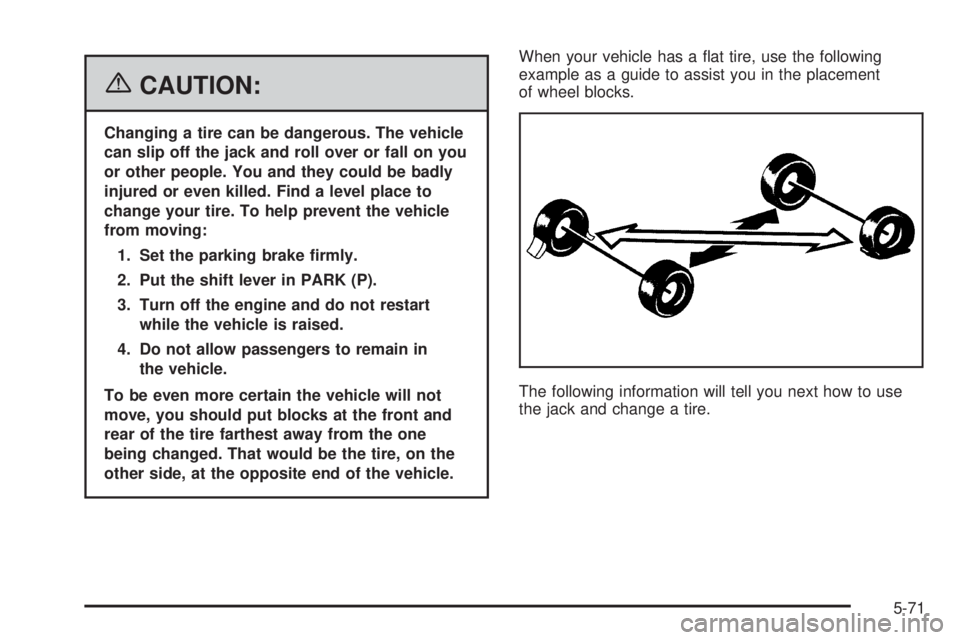
other side, at the opposite end of the vehicle.When your vehicle has a at tire, use the following
example as a guide to assist you in the placement
of wheel blocks.
The following information will tell you next how to use
the jack and change a tire.
5-71
Page 388 of 470
Removing the Spare Tire and Tools
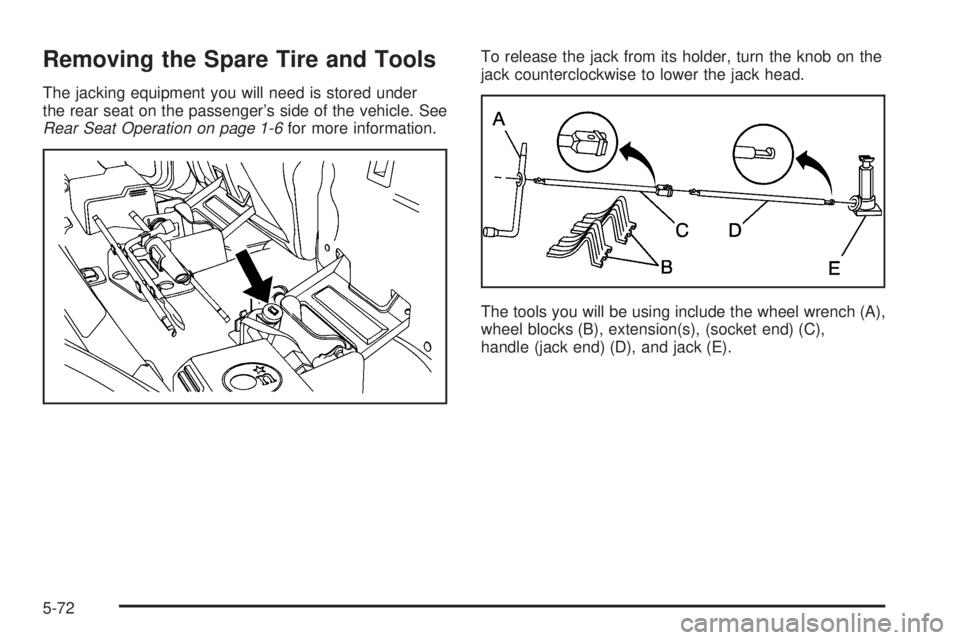
The jacking equipment you will need is stored under
the rear seat on the passenger’s side of the vehicle. See
Rear Seat Operation on page 1-6for more information.To release the jack from its holder, turn the knob on the
jack counterclockwise to lower the jack head.
The tools you will be using include the wheel wrench (A),
wheel blocks (B), extension(s), (socket end) (C),
handle (jack end) (D), and jack (E).
5-72
Page 389 of 470
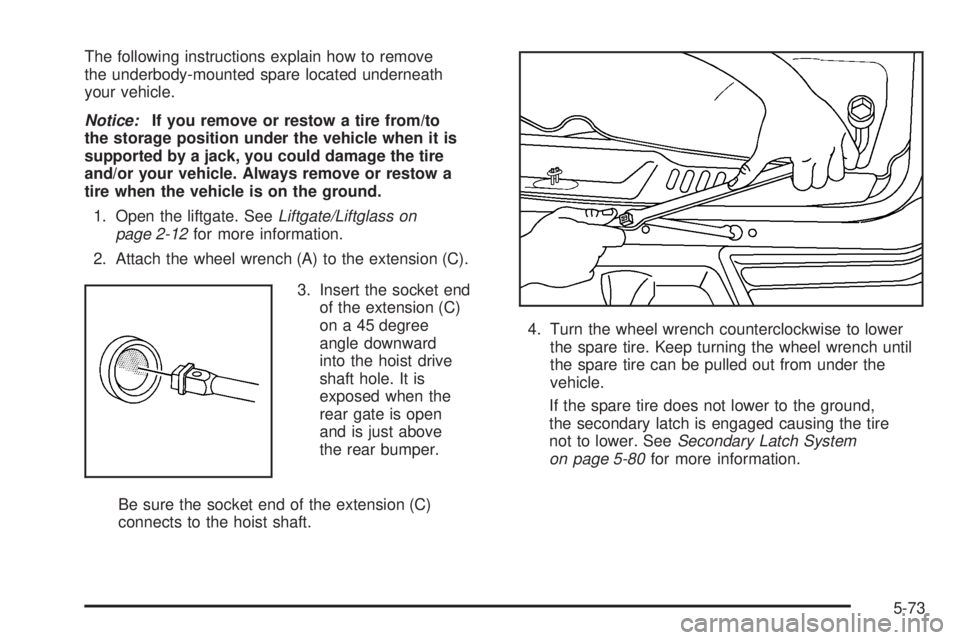
The following instructions explain how to remove
the underbody-mounted spare located underneath
your vehicle.
Notice:If you remove or restow a tire from/to
the storage position under the vehicle when it is
supported by a jack, you could damage the tire
and/or your vehicle. Always remove or restow a
tire when the vehicle is on the ground.
1. Open the liftgate. SeeLiftgate/Liftglass on
page 2-12for more information.
2. Attach the wheel wrench (A) to the extension (C).
3. Insert the socket end
of the extension (C)
on a 45 degree
angle downward
into the hoist drive
shaft hole. It is
exposed when the
rear gate is open
and is just above
the rear bumper.
Be sure the socket end of the extension (C)
connects to the hoist shaft.4. Turn the wheel wrench counterclockwise to lower
the spare tire. Keep turning the wheel wrench until
the spare tire can be pulled out from under the
vehicle.
If the spare tire does not lower to the ground,
the secondary latch is engaged causing the tire
not to lower. SeeSecondary Latch System
on page 5-80for more information.
5-73