fuel cap BUICK RAINIER 2006 User Guide
[x] Cancel search | Manufacturer: BUICK, Model Year: 2006, Model line: RAINIER, Model: BUICK RAINIER 2006Pages: 470, PDF Size: 2.72 MB
Page 325 of 470
{CAUTION:
If you spill fuel and then something ignites it,
you could be badly burned. Fuel can spray out
on you if you open the fuel cap too quickly.
This spray can happen if your tank is nearly
full, and is more likely in hot weather. Open
the fuel cap slowly and wait for any hiss noise
to stop. Then unscrew the cap all the way.
Be careful not to spill fuel. Do not top off or overll the
tank and wait a few seconds after you have nished
pumping before removing the nozzle. Clean fuel
from painted surfaces as soon as possible. See
Washing Your Vehicle on page 5-88.
When replacing the fuel cap, turn it clockwise until
it clicks. Make sure the cap is fully installed. The
diagnostic system can determine if the fuel cap has
been left off or improperly installed. This would allow
fuel to evaporate into the atmosphere. SeeMalfunction
Indicator Lamp on page 3-36.There may also be a light that comes on in the
instrument panel to let you know if your gas cap is
not properly installed. SeeCheck Gas Cap Light
on page 3-42for more information.
{CAUTION:
If a re starts while you are refueling, do not
remove the nozzle. Shut off the ow of fuel
by shutting off the pump or by notifying the
station attendant. Leave the area immediately.
Notice:If you need a new fuel cap, be sure to get
the right type. Your dealer can get one for you.
If you get the wrong type, it may not t properly.
This may cause your malfunction indicator lamp to
light and may damage your fuel tank and emissions
system. SeeMalfunction Indicator Lamp on
page 3-36.
5-9
Page 331 of 470
A. Engine Coolant Recovery Tank. SeeCooling System
on page 5-28.
B. Engine Air Cleaner/Filter. SeeEngine Air
Cleaner/Filter on page 5-20.
C. Windshield Washer Fluid Reservoir. See “Adding
Washer Fluid” underWindshield Washer Fluid
on page 5-35.
D. Engine Oil Dipstick. See “Checking Engine Oil”
underEngine Oil on page 5-15.
E. Automatic Transmission Fluid Dipstick. See
“Checking the Fluid Level” underAutomatic
Transmission Fluid on page 5-21.
F. Engine Oil Fill Cap. See “When to Add Engine Oil”
underEngine Oil on page 5-15.
G. Radiator Pressure Cap. SeeRadiator Pressure Cap
on page 5-26.
H. Remote Negative (−) Terminal (Marked GND).
SeeJump Starting on page 5-40.
I. Power Steering Fluid Reservoir. SeePower Steering
Fluid on page 5-34.
J. Brake Master Cylinder Reservoir. See “Brake Fluid”
underBrakes on page 5-36.
K. Engine Compartment Fuse Block. SeeEngine
Compartment Fuse Block on page 5-96.
L. Battery. SeeBattery on page 5-39.Engine Oil
Checking Engine Oil
It is a good idea to check your engine oil every time you
get fuel. In order to get an accurate reading, the oil
must be warm and the vehicle must be on level ground.
The engine oil dipstick handle is a yellow loop. See
Engine Compartment Overview on page 5-12for
the location of the engine oil dipstick.
1. Turn off the engine and give the oil several minutes
to drain back into the oil pan. If you do not do this,
the oil dipstick might not show the actual level.
2. Pull out the dipstick and clean it with a paper towel
or cloth, then push it back in all the way. Remove it
again, keeping the tip down, and check the level.
5-15
Page 350 of 470

Engine Fan Noise
Your vehicle has a clutched engine cooling fan. When
the clutch is engaged, the fan spins faster to provide
more air to cool the engine. In most everyday driving
conditions the clutch is not engaged. This improves fuel
economy and reduces fan noise. Under heavy vehicle
loading, trailer towing, and/or high outside temperatures,
the fan speed increases when the clutch engages so
you may hear an increase in fan noise. This is normal
and should not be mistaken as the transmission slipping
or making extra shifts. It is merely the cooling system
functioning properly. The fan will slow down when
additional cooling is not required and the clutch
disengages.
You may also hear this fan noise when you start the
engine. It will go away as the fan clutch disengages.
Power Steering Fluid
SeeEngine Compartment
Overview on page 5-12
for reservoir location.
When to Check Power Steering Fluid
It is not necessary to regularly check power steering uid
unless you suspect there is a leak in the system or
you hear an unusual noise. A uid loss in this system
could indicate a problem. Have the system inspected
and repaired.
How to Check Power Steering Fluid
To check the power steering uid, do the following:
1. Turn the key off and let the engine compartment
cool down.
2. Wipe the cap and the top of the reservoir clean.
5-34
Page 372 of 470
Tire Terminology and Denitions
Air Pressure:The amount of air inside the tire pressing
outward on each square inch of the tire. Air pressure
is expressed in pounds per square inch (psi) or
kilopascal (kPa).
Accessory Weight:This means the combined weight
of optional accessories. Some examples of optional
accessories are, automatic transmission, power steering,
power brakes, power windows, power seats, and air
conditioning.
Aspect Ratio:The relationship of a tire’s height to
its width.
Belt:A rubber coated layer of cords that is located
between the plies and the tread. Cords may be made
from steel or other reinforcing materials.
Bead:The tire bead contains steel wires wrapped by
steel cords that hold the tire onto the rim.
Bias Ply Tire:A pneumatic tire in which the plies are
laid at alternate angles less than 90 degrees to the
centerline of the tread.
Cold Ination Pressure:The amount of air pressure
in a tire, measured in pounds per square inch (psi)
or kilopascals (kPa) before a tire has built up heat from
driving. SeeInation - Tire Pressure on page 5-58.Curb Weight:This means the weight of a motor
vehicle with standard and optional equipment including
the maximum capacity of fuel, oil and coolant, but
without passengers and cargo.
DOT Markings:A code molded into the sidewall of a
tire signifying that the tire is in compliance with the
U.S. Department of Transportation (DOT) motor vehicle
safety standards. The DOT code includes the Tire
Identication Number (TIN), an alphanumeric designator
which can also identify the tire manufacturer, production
plant, brand and date of production.
GVWR:Gross Vehicle Weight Rating, seeLoading
Your Vehicle on page 4-45.
GAWR FRT:Gross Axle Weight Rating for the front
axle, seeLoading Your Vehicle on page 4-45.
GAWR RR:Gross Axle Weight Rating for the rear axle,
seeLoading Your Vehicle on page 4-45.
Intended Outboard Sidewall:The side of an
asymmetrical tire, that must always face outward
when mounted on a vehicle.
Kilopascal (kPa):The metric unit for air pressure.
Light Truck (LT-Metric) Tire:A tire used on light duty
trucks and some multipurpose passenger vehicles.
5-56
Page 374 of 470
UTQGS (Uniform Tire Quality Grading Standards):
A tire information system that provides consumers
with ratings for a tire’s traction, temperature, and
treadwear. Ratings are determined by tire manufacturers
using government testing procedures. The ratings are
molded into the sidewall of the tire. SeeUniform
Tire Quality Grading on page 5-64.
Vehicle Capacity Weight:The number of designated
seating positions multiplied by 150 lbs (68 kg) plus
the rated cargo load. SeeLoading Your Vehicle
on page 4-45.
Vehicle Maximum Load on the Tire:Load on an
individual tire due to curb weight, accessory weight,
occupant weight, and cargo weight.
Vehicle Placard:A label permanently attached to a
vehicle showing the vehicle’s capacity weight and
the original equipment tire size and recommended
ination pressure. See “Tire and Loading Information
Label” underLoading Your Vehicle on page 4-45.Ination - Tire Pressure
Tires need the correct amount of air pressure to operate
effectively.
Notice:Do not let anyone tell you that
under-ination or over-ination is all right. It is not.
If your tires do not have enough air (under-ination),
you can get the following:
Too much exing
Too much heat
Tire overloading
Premature or irregular wear
Poor handling
Reduced fuel economy
If your tires have too much air (over-ination),
you can get the following:
Unusual wear
Poor handling
Rough ride
Needless damage from road hazards
5-58
Page 421 of 470
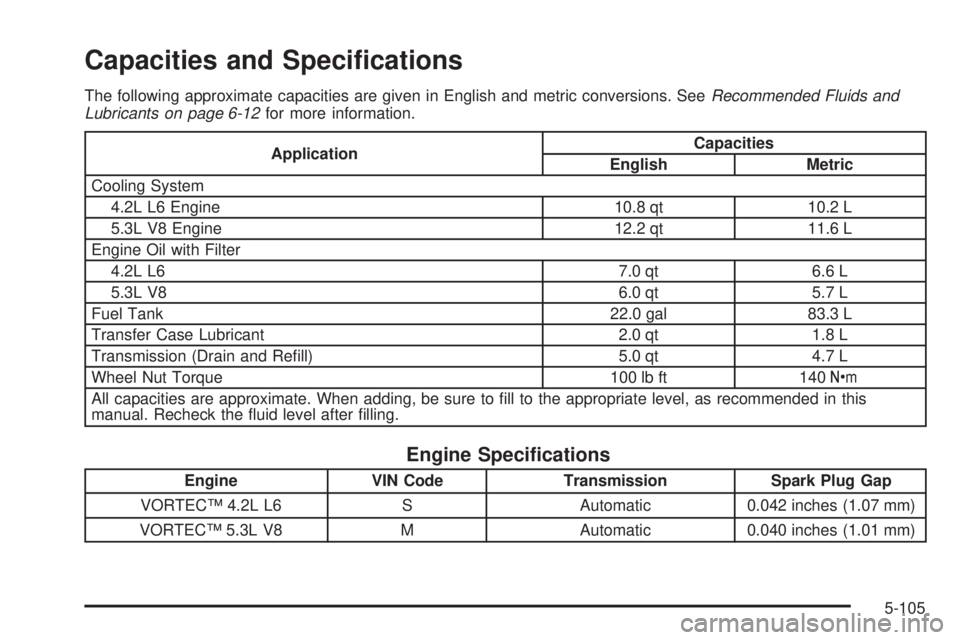
Capacities and Specications
The following approximate capacities are given in English and metric conversions. SeeRecommended Fluids and
Lubricants on page 6-12for more information.
ApplicationCapacities
English Metric
Cooling System
4.2L L6 Engine 10.8 qt 10.2 L
5.3L V8 Engine 12.2 qt 11.6 L
Engine Oil with Filter
4.2L L6 7.0 qt 6.6 L
5.3L V8 6.0 qt 5.7 L
Fuel Tank 22.0 gal 83.3 L
Transfer Case Lubricant 2.0 qt 1.8 L
Transmission (Drain and Rell) 5.0 qt 4.7 L
Wheel Nut Torque 100 lb ft 140Y
All capacities are approximate. When adding, be sure to ll to the appropriate level, as recommended in this
manual. Recheck the uid level after lling.
Engine Specications
Engine VIN Code Transmission Spark Plug Gap
VORTEC™ 4.2L L6 S Automatic 0.042 inches (1.07 mm)
VORTEC™ 5.3L V8 M Automatic 0.040 inches (1.01 mm)
5-105
Page 430 of 470
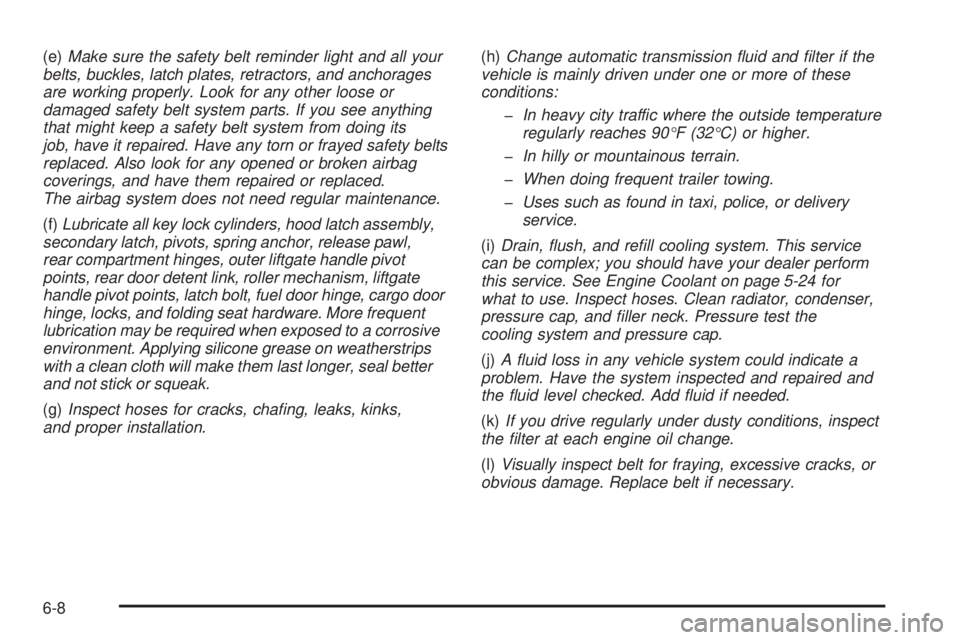
(e)Make sure the safety belt reminder light and all your
belts, buckles, latch plates, retractors, and anchorages
are working properly. Look for any other loose or
damaged safety belt system parts. If you see anything
that might keep a safety belt system from doing its
job, have it repaired. Have any torn or frayed safety belts
replaced. Also look for any opened or broken airbag
coverings, and have them repaired or replaced.
The airbag system does not need regular maintenance.
(f)Lubricate all key lock cylinders, hood latch assembly,
secondary latch, pivots, spring anchor, release pawl,
rear compartment hinges, outer liftgate handle pivot
points, rear door detent link, roller mechanism, liftgate
handle pivot points, latch bolt, fuel door hinge, cargo door
hinge, locks, and folding seat hardware. More frequent
lubrication may be required when exposed to a corrosive
environment. Applying silicone grease on weatherstrips
with a clean cloth will make them last longer, seal better
and not stick or squeak.
(g)Inspect hoses for cracks, chang, leaks, kinks,
and proper installation.(h)Change automatic transmission uid and lter if the
vehicle is mainly driven under one or more of these
conditions:
In heavy city traffic where the outside temperature
regularly reaches 90°F (32°C) or higher.
In hilly or mountainous terrain.
When doing frequent trailer towing.
Uses such as found in taxi, police, or delivery
service.
(i)Drain, ush, and rell cooling system. This service
can be complex; you should have your dealer perform
this service. See Engine Coolant on page 5-24 for
what to use. Inspect hoses. Clean radiator, condenser,
pressure cap, and ller neck. Pressure test the
cooling system and pressure cap.
(j)A uid loss in any vehicle system could indicate a
problem. Have the system inspected and repaired and
the uid level checked. Add uid if needed.
(k)If you drive regularly under dusty conditions, inspect
the lter at each engine oil change.
(l)Visually inspect belt for fraying, excessive cracks, or
obvious damage. Replace belt if necessary.
6-8
Page 458 of 470
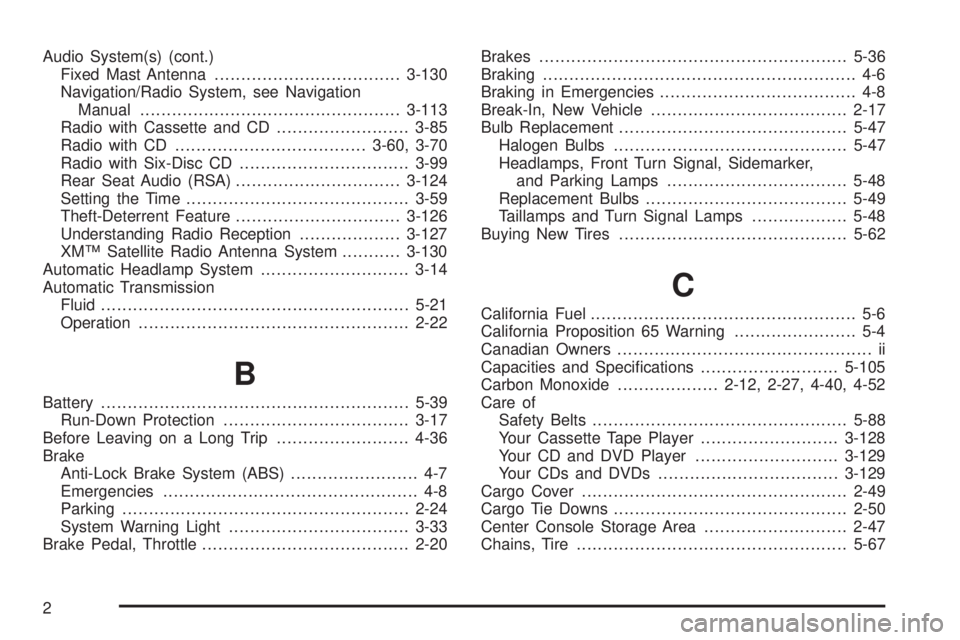
Audio System(s) (cont.)
Fixed Mast Antenna...................................3-130
Navigation/Radio System, see Navigation
Manual.................................................3-113
Radio with Cassette and CD.........................3-85
Radio with CD....................................3-60, 3-70
Radio with Six-Disc CD................................3-99
Rear Seat Audio (RSA)...............................3-124
Setting the Time..........................................3-59
Theft-Deterrent Feature...............................3-126
Understanding Radio Reception...................3-127
XM™ Satellite Radio Antenna System...........3-130
Automatic Headlamp System............................3-14
Automatic Transmission
Fluid..........................................................5-21
Operation...................................................2-22
B
Battery..........................................................5-39
Run-Down Protection...................................3-17
Before Leaving on a Long Trip.........................4-36
Brake
Anti-Lock Brake System (ABS)........................ 4-7
Emergencies................................................ 4-8
Parking......................................................2-24
System Warning Light..................................3-33
Brake Pedal, Throttle.......................................2-20Brakes..........................................................5-36
Braking........................................................... 4-6
Braking in Emergencies..................................... 4-8
Break-In, New Vehicle.....................................2-17
Bulb Replacement...........................................5-47
Halogen Bulbs............................................5-47
Headlamps, Front Turn Signal, Sidemarker,
and Parking Lamps..................................5-48
Replacement Bulbs......................................5-49
Taillamps and Turn Signal Lamps..................5-48
Buying New Tires...........................................5-62
C
California Fuel.................................................. 5-6
California Proposition 65 Warning....................... 5-4
Canadian Owners................................................ ii
Capacities and Specications..........................5-105
Carbon Monoxide...................2-12, 2-27, 4-40, 4-52
Care of
Safety Belts................................................5-88
Your Cassette Tape Player..........................3-128
Your CD and DVD Player...........................3-129
Your CDs and DVDs..................................3-129
Cargo Cover..................................................2-49
Cargo Tie Downs............................................2-50
Center Console Storage Area...........................2-47
Chains, Tire...................................................5-67
2
Page 461 of 470
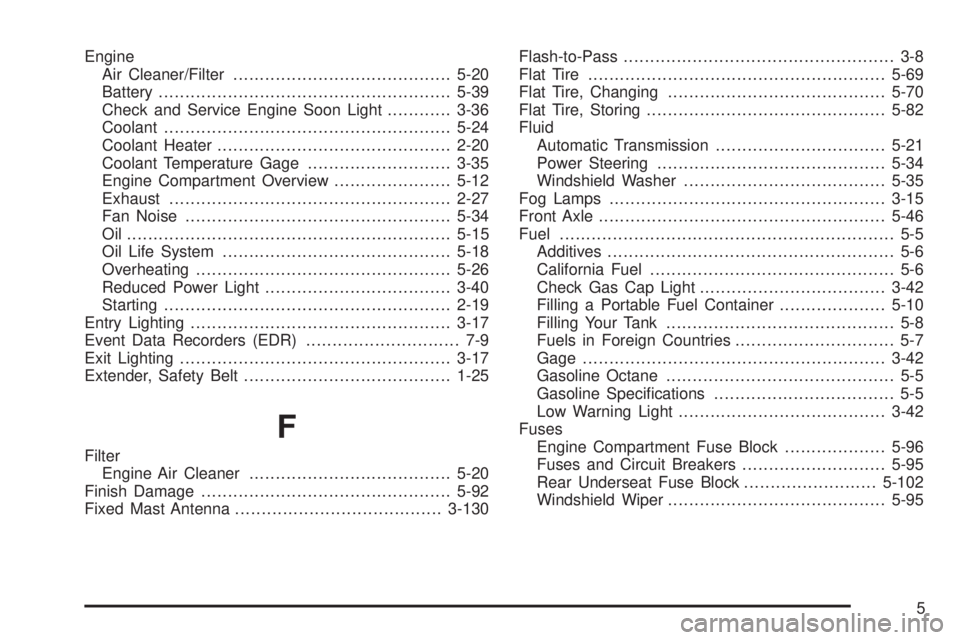
Engine
Air Cleaner/Filter.........................................5-20
Battery.......................................................5-39
Check and Service Engine Soon Light............3-36
Coolant......................................................5-24
Coolant Heater............................................2-20
Coolant Temperature Gage...........................3-35
Engine Compartment Overview......................5-12
Exhaust.....................................................2-27
Fan Noise..................................................5-34
Oil .............................................................5-15
Oil Life System...........................................5-18
Overheating................................................5-26
Reduced Power Light...................................3-40
Starting......................................................2-19
Entry Lighting.................................................3-17
Event Data Recorders (EDR)............................. 7-9
Exit Lighting...................................................3-17
Extender, Safety Belt.......................................1-25
F
Filter
Engine Air Cleaner......................................5-20
Finish Damage...............................................5-92
Fixed Mast Antenna.......................................3-130Flash-to-Pass................................................... 3-8
Flat Tire........................................................5-69
Flat Tire, Changing.........................................5-70
Flat Tire, Storing.............................................5-82
Fluid
Automatic Transmission................................5-21
Power Steering...........................................5-34
Windshield Washer......................................5-35
Fog Lamps....................................................3-15
Front Axle......................................................5-46
Fuel............................................................... 5-5
Additives...................................................... 5-6
California Fuel.............................................. 5-6
Check Gas Cap Light...................................3-42
Filling a Portable Fuel Container....................5-10
Filling Your Tank........................................... 5-8
Fuels in Foreign Countries.............................. 5-7
Gage.........................................................3-42
Gasoline Octane........................................... 5-5
Gasoline Specications.................................. 5-5
Low Warning Light.......................................3-42
Fuses
Engine Compartment Fuse Block...................5-96
Fuses and Circuit Breakers...........................5-95
Rear Underseat Fuse Block.........................5-102
Windshield Wiper.........................................5-95
5
Page 463 of 470
J
Jump Starting.................................................5-40
K
Keyless Entry System....................................... 2-4
Keys............................................................... 2-3
L
Labeling, Tire Sidewall.....................................5-53
Lamps
Battery Run-Down Protection.........................3-17
Dome........................................................3-16
Dome Lamp Override...................................3-16
Fog ...........................................................3-15
Reading.....................................................3-17
LATCH System
Child Restraints...........................................1-37
Liftgate/Liftglass..............................................2-12
Liftglass/Liftgate..............................................2-12
Light
Airbag Readiness........................................3-29
Anti-Lock Brake System Warning...................3-34
Brake System Warning.................................3-33
Charging System.........................................3-32
Check Gages Warning.................................3-41Light (cont.)
Check Gas Cap..........................................3-42
Cruise Control.............................................3-39
Gate Ajar...................................................3-41
Highbeam On.............................................3-40
Low Fuel Warning.......................................3-42
Malfunction Indicator....................................3-36
Passenger Airbag Status Indicator..................3-30
Passenger Safety Belt Reminder....................3-28
Reduced Engine Power................................3-40
Safety Belt Reminder...................................3-28
Security.....................................................3-39
Service All-Wheel-Drive................................3-41
StabiliTrak
®Indicator....................................3-35
StabiliTrak®Service......................................3-34
Lighting
Entry.........................................................3-17
Exit...........................................................3-17
Loading Your Vehicle.......................................4-45
Locking Rear Axle............................................ 4-8
Lockout Protection..........................................2-11
Locks
Delayed Locking........................................... 2-8
Door........................................................... 2-7
Lockout Protection.......................................2-11
Power Door.................................................. 2-8
Programmable Automatic Door Locks............... 2-9
Rear Door Security Locks.............................2-11
7