maintenance BUICK RAINIER 2006 User Guide
[x] Cancel search | Manufacturer: BUICK, Model Year: 2006, Model line: RAINIER, Model: BUICK RAINIER 2006Pages: 470, PDF Size: 2.72 MB
Page 314 of 470

When You Are Ready to Leave After
Parking on a Hill
1. Apply your regular brakes and hold the pedal down
while you:
start your engine,
shift into a gear, and
release the parking brake.
2. Let up on the brake pedal.
3. Drive slowly until the trailer is clear of the chocks.
4. Stop and have someone pick up and store
the chocks.
Maintenance When Trailer Towing
Your vehicle will need service more often when you’re
pulling a trailer. See the Maintenance Schedule for
more on this. Things that are especially important in
trailer operation are automatic transmission uid
(don’t overll), engine oil, axle lubricant, belt(s), cooling
system and brake system. Each of these is covered
in this manual, and the Index will help you nd
them quickly. If you’re trailering, it’s a good idea to
review these sections before you start your trip.
Check periodically to see that all hitch nuts and
bolts are tight.
4-62
Page 318 of 470
Tire Inspection and Rotation...........................5-60
When It Is Time for New Tires.......................5-61
Buying New Tires.........................................5-62
Different Size Tires and Wheels......................5-63
Uniform Tire Quality Grading..........................5-64
Wheel Alignment and Tire Balance..................5-65
Wheel Replacement......................................5-66
Tire Chains..................................................5-67
Accessory Inator.........................................5-68
If a Tire Goes Flat........................................5-69
Changing a Flat Tire.....................................5-70
Removing the Spare Tire and Tools................5-72
Removing the Flat Tire and Installing
the Spare Tire..........................................5-74
Secondary Latch System...............................5-80
Storing a Flat or Spare Tire and Tools............5-82
Spare Tire...................................................5-85
Appearance Care............................................5-85
Cleaning the Inside of Your Vehicle.................5-85
Fabric/Carpet...............................................5-87
Leather.......................................................5-87
Instrument Panel, Vinyl, and Other
Plastic Surfaces........................................5-88
Care of Safety Belts......................................5-88Washing Your Vehicle...................................5-88
Cleaning Exterior Lamps/Lenses.....................5-89
Finish Care..................................................5-89
Windshield, Backglass, and Wiper Blades.........5-90
Aluminum Wheels.........................................5-90
Tires...........................................................5-91
Sheet Metal Damage.....................................5-91
Finish Damage.............................................5-92
Underbody Maintenance................................5-92
Chemical Paint Spotting.................................5-92
Vehicle Care/Appearance Materials..................5-93
Vehicle Identication......................................5-94
Vehicle Identication Number (VIN).................5-94
Service Parts Identication Label.....................5-94
Electrical System............................................5-94
Add-On Electrical Equipment..........................5-94
Headlamps..................................................5-95
Windshield Wiper Fuses................................5-95
Power Windows and Other Power Options.......5-95
Fuses and Circuit Breakers............................5-95
Engine Compartment Fuse Block....................5-96
Rear Underseat Fuse Block..........................5-102
Capacities and Specications........................5-105
Section 5 Service and Appearance Care
5-2
Page 320 of 470
California Proposition 65 Warning
Most motor vehicles, including this one, contain and/or
emit chemicals known to the State of California to
cause cancer and birth defects or other reproductive
harm. Engine exhaust, many parts and systems
(including some inside the vehicle), many uids, and
some component wear by-products contain and/or
emit these chemicals.
Doing Your Own Service Work
{CAUTION:
You can be injured and your vehicle could be
damaged if you try to do service work on a
vehicle without knowing enough about it.
Be sure you have sufficient knowledge,
experience, the proper replacement parts,
and tools before you attempt any vehicle
maintenance task.
Be sure to use the proper nuts, bolts,
and other fasteners. English and metric
fasteners can be easily confused. If you
use the wrong fasteners, parts can later
break or fall off. You could be hurt.
If you want to do some of your own service work,
you will want to use the proper service manual. It tells
you much more about how to service your vehicle
than this manual can. To order the proper service
manual, seeService Publications Ordering Information
on page 7-14.
5-4
Page 321 of 470

Your vehicle has an airbag system. Before attempting
to do your own service work, seeServicing Your
Airbag-Equipped Vehicle on page 1-60.
You should keep a record with all parts receipts and
list the mileage and the date of any service work
you perform. SeeMaintenance Record on page 6-15.
Adding Equipment to the Outside
of Your Vehicle
Things you might add to the outside of your vehicle
can affect the airow around it. This may cause
wind noise and affect windshield washer performance.
Check with your dealer before adding equipment to
the outside of your vehicle.
Fuel
Use of the recommended fuel is an important part of
the proper maintenance of your vehicle.
Gasoline Octane
Use regular unleaded gasoline with a posted octane
rating of 87 or higher. If the octane rating is less than 87,
you may notice an audible knocking noise when you
drive, commonly referred to as spark knock. If this
occurs, use a gasoline rated at 87 octane or higher
as soon as possible. If you are using gasoline rated
at 87 octane or higher and you hear heavy knocking,
your engine needs service.
Gasoline Specications
At a minimum, gasoline should meet ASTM
specication D 4814 in the United States or
CAN/CGSB-3.5 in Canada. Some gasolines may
contain an octane-enhancing additive called
methylcyclopentadienyl manganese tricarbonyl (MMT).
General Motors recommends against the use of
gasolines containing MMT. SeeAdditives on page 5-6
for additional information.
5-5
Page 336 of 470
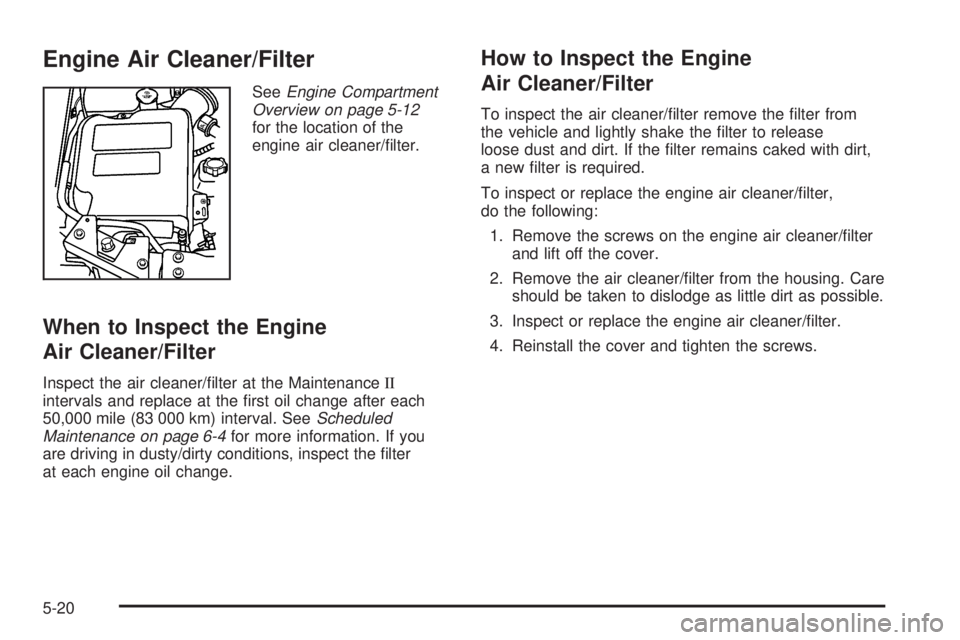
Engine Air Cleaner/Filter
SeeEngine Compartment
Overview on page 5-12
for the location of the
engine air cleaner/lter.
When to Inspect the Engine
Air Cleaner/Filter
Inspect the air cleaner/lter at the MaintenanceII
intervals and replace at the rst oil change after each
50,000 mile (83 000 km) interval. SeeScheduled
Maintenance on page 6-4for more information. If you
are driving in dusty/dirty conditions, inspect the lter
at each engine oil change.
How to Inspect the Engine
Air Cleaner/Filter
To inspect the air cleaner/lter remove the lter from
the vehicle and lightly shake the lter to release
loose dust and dirt. If the lter remains caked with dirt,
a new lter is required.
To inspect or replace the engine air cleaner/lter,
do the following:
1. Remove the screws on the engine air cleaner/lter
and lift off the cover.
2. Remove the air cleaner/lter from the housing. Care
should be taken to dislodge as little dirt as possible.
3. Inspect or replace the engine air cleaner/lter.
4. Reinstall the cover and tighten the screws.
5-20
Page 340 of 470
How to Add Automatic
Transmission Fluid
Refer to the Maintenance Schedule to determine what
kind of transmission uid to use. SeeRecommended
Fluids and Lubricants on page 6-12.
Add uid only after checking the transmission uid while
it is hot. A cold check is used only as a reference. If
the uid level is low, add only enough of the proper uid
to bring the level up to the HOT area for a hot check.
It does not take much uid, generally less than one pint
(0.5 L). Do not overll.
Notice:Use of the incorrect automatic transmission
uid may damage your vehicle, and the damages
may not be covered by your warranty. Always
use the automatic transmission uid listed in
Recommended Fluids and Lubricants on page 6-12.
After adding uid, recheck the uid level as
described under “How to Check Automatic
Transmission Fluid,” earlier in this section.
When the correct uid level is obtained, push the
dipstick back in all the way; then ip the handle
down to lock the dipstick in place.
Engine Coolant
The cooling system in your vehicle is lled with
DEX-COOL®engine coolant. This coolant is designed
to remain in your vehicle for ve years or 150,000 miles
(240 000 km), whichever occurs rst, if you add only
DEX-COOL
®extended life coolant.
The following explains your cooling system and how to
add coolant when it is low. If you have a problem
with engine overheating, seeEngine Overheating on
page 5-26.
A 50/50 mixture of clean, drinkable water and
DEX-COOL
®coolant will:
Give freezing protection down to−34°F (−37°C).
Give boiling protection up to 265°F (129°C).
Protect against rust and corrosion.
Help keep the proper engine temperature.
Let the warning lights and gages work as
they should.
Notice:Using coolant other than DEX-COOL
®may
cause premature engine, heater core, or radiator
corrosion. In addition, the engine coolant may
require changing sooner, at the rst maintenance
service after each 30,000 miles (50 000 km) or
24 months, whichever occurs rst. Any repairs
would not be covered by your warranty. Always use
DEX-COOL
®(silicate-free) coolant in your vehicle.
5-24
Page 352 of 470

Brakes
Brake Fluid
Your brake master cylinder
reservoir is lled with
DOT-3 brake uid. See
Engine Compartment
Overview on page 5-12
for the location of the
reservoir.
There are only two reasons why the brake uid level
in the reservoir might go down. The rst is that the brake
uid goes down to an acceptable level during normal
brake lining wear. When new linings are put in, the
uid level goes back up. The other reason is that uid
is leaking out of the brake system. If it is, you should
have your brake system xed, since a leak means that
sooner or later your brakes will not work well, or will
not work at all.So, it is not a good idea to top off your brake uid.
Adding brake uid will not correct a leak. If you add
uid when your linings are worn, then you will have
too much uid when you get new brake linings.
You should add or remove brake uid, as necessary,
only when work is done on the brake hydraulic system.
{CAUTION:
If you have too much brake uid, it can spill
on the engine. The uid will burn if the engine
is hot enough. You or others could be burned,
and your vehicle could be damaged. Add brake
uid only when work is done on the brake
hydraulic system. See “Checking Brake Fluid”
in this section.
Refer to the Maintenance Schedule to determine when
to check your brake uid. SeeScheduled Maintenance
on page 6-4.
5-36
Page 355 of 470
Replacing Brake System Parts
The braking system on a vehicle is complex. Its
many parts have to be of top quality and work well
together if the vehicle is to have really good braking.
Your vehicle was designed and tested with top-quality
GM brake parts. When you replace parts of your
braking system — for example, when your brake linings
wear down and you need new ones put in — be sure
you get new approved GM replacement parts. If you
do not, your brakes may no longer work properly.
For example, if someone puts in brake linings that are
wrong for your vehicle, the balance between your
front and rear brakes can change — for the worse.
The braking performance you have come to expect
can change in many other ways if someone puts in
the wrong replacement brake parts.
Battery
Your vehicle has a maintenance free battery. When
it is time for a new battery, get one that has the
replacement number shown on the original battery’s
label. We recommend an ACDelco
®replacement
battery. SeeEngine Compartment Overview on
page 5-12for battery location.Warning:Battery posts, terminals, and related
accessories contain lead and lead compounds,
chemicals known to the State of California to cause
cancer and reproductive harm. Wash hands after
handling.
Vehicle Storage
If you are not going to drive your vehicle for 25 days
or more, remove the black, negative (−) cable from
the battery. This will help keep your battery from
running down.
{CAUTION:
Batteries have acid that can burn you and
gas that can explode. You can be badly hurt
if you are not careful. SeeJump Starting on
page 5-40for tips on working around a battery
without getting hurt.
5-39
Page 366 of 470
Windshield Replacement
Your vehicle is equipped with an acoustic windshield.
If you ever have to have your windshield replaced
be sure to get an acoustic windshield so you will
continue to have the benets an acoustic windshield
can provide.
Windshield Wiper Blade
Replacement
Windshield wiper blades should be inspected for wear
or cracking. SeeScheduled Maintenance on page 6-4.
Allowing the wiper blade arm to touch the windshield
when no wiper blade is installed could damage the
windshield. Any damage that occurs would not
be covered by your warranty. Do not allow the wiper
blade arm to touch the windshield.
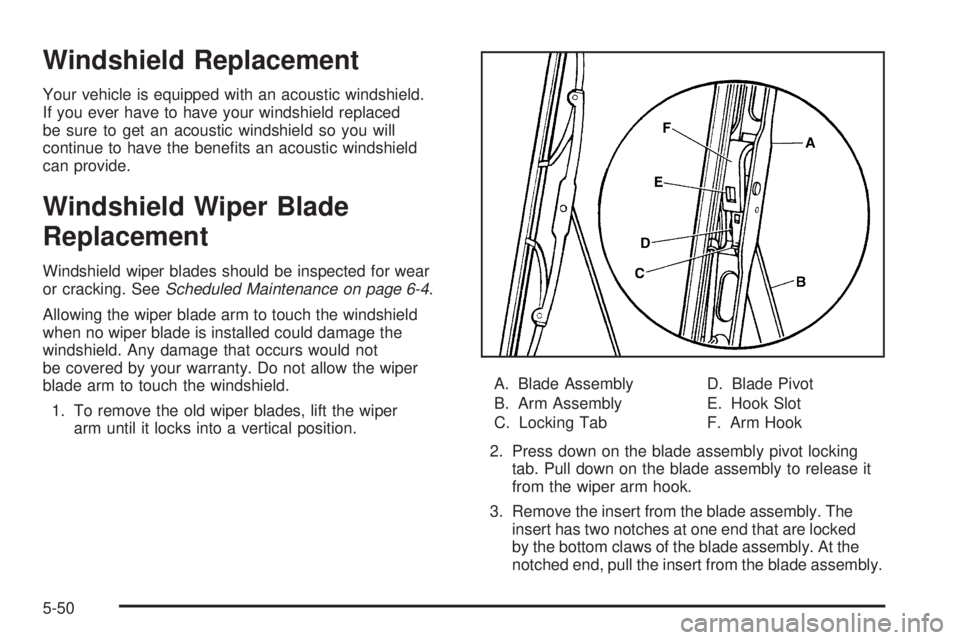
1. To remove the old wiper blades, lift the wiper
arm until it locks into a vertical position.A. Blade Assembly
B. Arm Assembly
C. Locking TabD. Blade Pivot
E. Hook Slot
F. Arm Hook
2. Press down on the blade assembly pivot locking
tab. Pull down on the blade assembly to release it
from the wiper arm hook.
3. Remove the insert from the blade assembly. The
insert has two notches at one end that are locked
by the bottom claws of the blade assembly. At the
notched end, pull the insert from the blade assembly.
5-50
Page 376 of 470
Tire Inspection and Rotation
Tires should be rotated every 5,000 to 8,000 miles
(8 000 to 13 000 km).
Any time you notice unusual wear, rotate your tires
as soon as possible and check wheel alignment. Also
check for damaged tires or wheels. SeeWhen It Is Time
for New Tires on page 5-61andWheel Replacement
on page 5-66for more information.
Make sure the spare tire is stored securely. Push, pull,
and then try to rotate or turn the tire. If it moves, use the
wheel wrench to tighten the cable. For information on
storing or removing the spare tire, seeChanging a Flat
Tire on page 5-70.
The purpose of regular rotation is to achieve more
uniform wear for all tires on the vehicle. The rst rotation
is the most important. SeeScheduled Maintenance
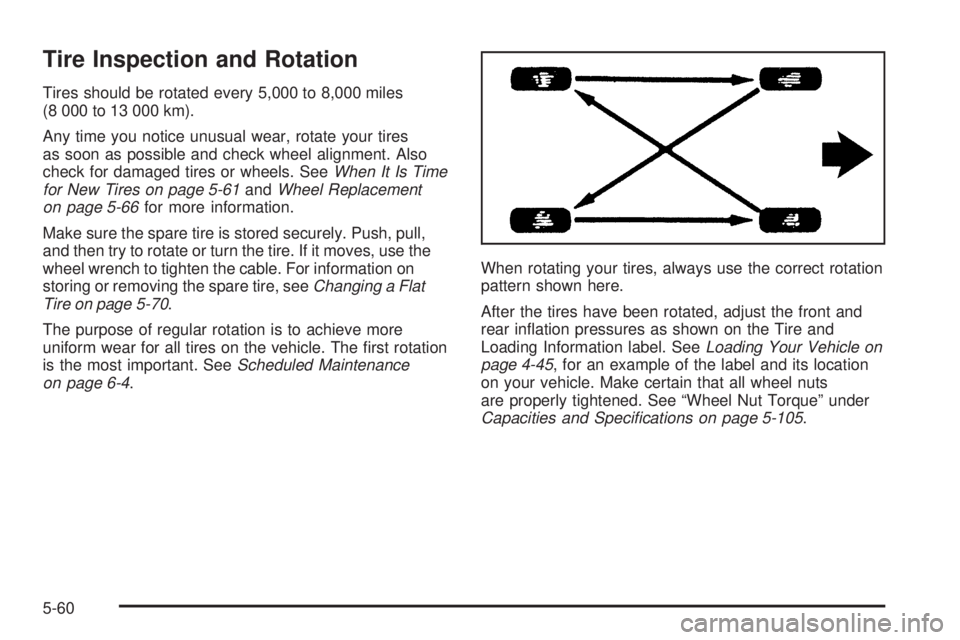
on page 6-4.When rotating your tires, always use the correct rotation
pattern shown here.
After the tires have been rotated, adjust the front and
rear ination pressures as shown on the Tire and
Loading Information label. SeeLoading Your Vehicle on
page 4-45, for an example of the label and its location
on your vehicle. Make certain that all wheel nuts
are properly tightened. See “Wheel Nut Torque” under
Capacities and Specications on page 5-105.
5-60