towing BUICK RAINIER 2006 Owner's Guide
[x] Cancel search | Manufacturer: BUICK, Model Year: 2006, Model line: RAINIER, Model: BUICK RAINIER 2006Pages: 470, PDF Size: 2.72 MB
Page 350 of 470

Engine Fan Noise
Your vehicle has a clutched engine cooling fan. When
the clutch is engaged, the fan spins faster to provide
more air to cool the engine. In most everyday driving
conditions the clutch is not engaged. This improves fuel
economy and reduces fan noise. Under heavy vehicle
loading, trailer towing, and/or high outside temperatures,
the fan speed increases when the clutch engages so
you may hear an increase in fan noise. This is normal
and should not be mistaken as the transmission slipping
or making extra shifts. It is merely the cooling system
functioning properly. The fan will slow down when
additional cooling is not required and the clutch
disengages.
You may also hear this fan noise when you start the
engine. It will go away as the fan clutch disengages.
Power Steering Fluid
SeeEngine Compartment
Overview on page 5-12
for reservoir location.
When to Check Power Steering Fluid
It is not necessary to regularly check power steering uid
unless you suspect there is a leak in the system or
you hear an unusual noise. A uid loss in this system
could indicate a problem. Have the system inspected
and repaired.
How to Check Power Steering Fluid
To check the power steering uid, do the following:
1. Turn the key off and let the engine compartment
cool down.
2. Wipe the cap and the top of the reservoir clean.
5-34
Page 430 of 470
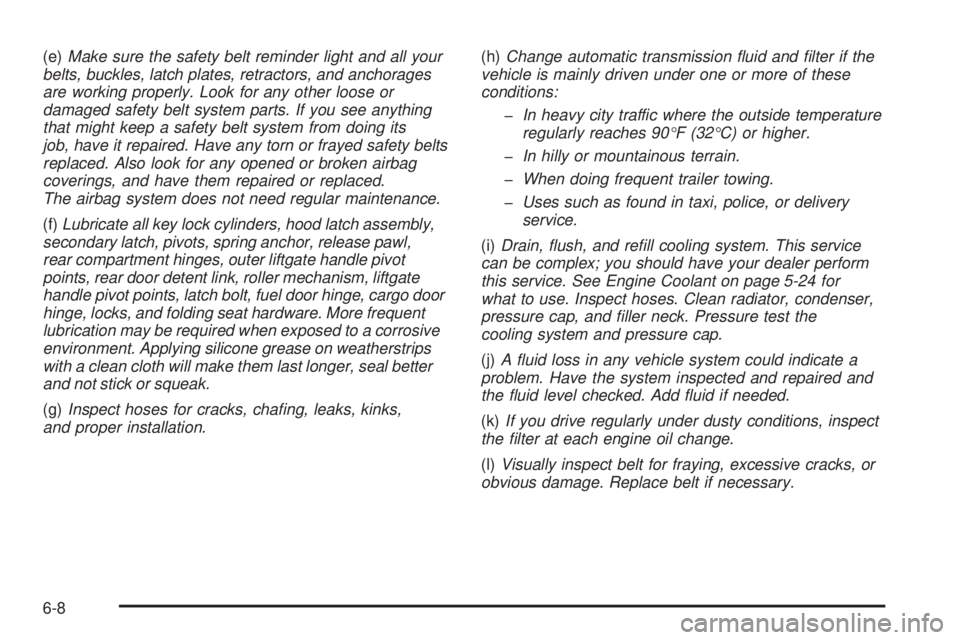
(e)Make sure the safety belt reminder light and all your
belts, buckles, latch plates, retractors, and anchorages
are working properly. Look for any other loose or
damaged safety belt system parts. If you see anything
that might keep a safety belt system from doing its
job, have it repaired. Have any torn or frayed safety belts
replaced. Also look for any opened or broken airbag
coverings, and have them repaired or replaced.
The airbag system does not need regular maintenance.
(f)Lubricate all key lock cylinders, hood latch assembly,
secondary latch, pivots, spring anchor, release pawl,
rear compartment hinges, outer liftgate handle pivot
points, rear door detent link, roller mechanism, liftgate
handle pivot points, latch bolt, fuel door hinge, cargo door
hinge, locks, and folding seat hardware. More frequent
lubrication may be required when exposed to a corrosive
environment. Applying silicone grease on weatherstrips
with a clean cloth will make them last longer, seal better
and not stick or squeak.
(g)Inspect hoses for cracks, chang, leaks, kinks,
and proper installation.(h)Change automatic transmission uid and lter if the
vehicle is mainly driven under one or more of these
conditions:
In heavy city traffic where the outside temperature
regularly reaches 90°F (32°C) or higher.
In hilly or mountainous terrain.
When doing frequent trailer towing.
Uses such as found in taxi, police, or delivery
service.
(i)Drain, ush, and rell cooling system. This service
can be complex; you should have your dealer perform
this service. See Engine Coolant on page 5-24 for
what to use. Inspect hoses. Clean radiator, condenser,
pressure cap, and ller neck. Pressure test the
cooling system and pressure cap.
(j)A uid loss in any vehicle system could indicate a
problem. Have the system inspected and repaired and
the uid level checked. Add uid if needed.
(k)If you drive regularly under dusty conditions, inspect
the lter at each engine oil change.
(l)Visually inspect belt for fraying, excessive cracks, or
obvious damage. Replace belt if necessary.
6-8
Page 452 of 470
If an Accident Occurs
Here is what to do if you are involved in an accident.
Try to relax and then check to make sure you are all
right. If you are uninjured, make sure that no one else
in your vehicle, or the other vehicle, is injured.
If there has been an injury, call 911 for help. Do not
leave the scene of an accident until all matters have
been taken care of. Move your vehicle only if its
position puts you in danger or you are instructed to
move it by a police officer.
Give only the necessary and requested information
to police and other parties involved in the accident.
Do not discuss your personal condition, mental frame
of mind, or anything unrelated to the accident. This
will help guard against post-accident legal action.
If you need roadside assistance, call GM Roadside
Assistance. SeeRoadside Assistance Program on
page 7-6for more information.
If your vehicle cannot be driven, know where the
towing service will be taking it. Get a card from the
tow truck operator or write down the driver’s name,
the service’s name, and the phone number.
Remove any valuables from your vehicle before it is
towed away. Make sure this includes your insurance
information and registration if you keep these items
in your vehicle.
Gather the important information you will need from
the other driver. Things like name, address, phone
number, driver’s license number, vehicle license
plate, vehicle make, model and model year, Vehicle
Identication Number (VIN), insurance company and
policy number, and a general description of the
damage to the other vehicle.
If possible, call your insurance company from the
scene of the accident. They will walk you through
the information they will need. If they ask for a
police report, phone or go to the police department
headquarters the next day and you can get a copy
of the report for a nominal fee. In some states with
“no fault” insurance laws, a report may not be
necessary. This is especially true if there are no
injuries and both vehicles are driveable.
Choose a reputable collision repair facility for your
vehicle. Whether you select a GM dealer or a private
collision repair facility to x the damage, make sure
you are comfortable with them. Remember, you
will have to feel comfortable with their work for a
long time.
Once you have an estimate, read it carefully and
make sure you understand what work will be
performed on your vehicle. If you have a question,
ask for an explanation. Reputable shops welcome
this opportunity.
7-12
Page 466 of 470
Q
Questions and Answers About Safety Belts.........1-12
R
Radiator Pressure Cap....................................5-26
Radios..........................................................3-58
Care of Your Cassette Tape Player...............3-128
Care of Your CD and DVD Player................3-129
Care of Your CDs and DVDs.......................3-129
Navigation/Radio System, see Navigation
Manual.................................................3-113
Radio with Cassette and CD.........................3-85
Radio with CD....................................3-60, 3-70
Radio with Six-Disc CD................................3-99
Rear Seat Audio........................................3-124
Setting the Time..........................................3-59
Theft-Deterrent..........................................3-126
Understanding Reception............................3-127
Rainsense™ Wipers.......................................... 3-9
Reading Lamps..............................................3-17
Rear Axle......................................................5-45
Locking........................................................ 4-8
Rear Climate Control System............................3-24
Rear Door Security Locks................................2-11
Rear Floor Storage Lid....................................2-48
Rear Safety Belt Comfort Guides......................1-23Rear Seat Audio (RSA)..................................3-124
Rear Seat Entertainment System.....................3-113
Rear Seat Operation......................................... 1-6
Rear Seat Passengers, Safety Belts..................1-20
Rear Windshield Washer/Wiper.........................3-10
Rearview Mirror, Automatic Dimming with
Compass....................................................2-35
Rearview Mirror, Automatic Dimming with
Compass and Temperature Display................2-37
Rearview Mirror, Automatic Dimming with
OnStar
®and Compass.................................2-31
Rearview Mirror, Automatic Dimming with
OnStar
®, Compass and Temperature Display . . . 2-33
Rearview Mirror with OnStar®...........................2-29
Rearview Mirror with OnStar®, Compass,
and Temperature Display..............................2-29
Rearview Mirrors.............................................2-29
Reclining Seatbacks, Power............................... 1-4
Recommended Fluids and Lubricants.................6-12
Recreational Vehicle Towing.............................4-50
Reduced Engine Power Light............................3-40
Remote Keyless Entry System............................ 2-4
Remote Keyless Entry System, Operation............ 2-5
Removing the Flat Tire and Installing the
Spare Tire..................................................5-74
Removing the Spare Tire and Tools...................5-72
Replacement Bulbs.........................................5-49
Replacement, Windshield.................................5-50
10
Page 469 of 470
Tires (cont.)
Ination - Tire Pressure................................5-58
Inator, Accessory.......................................5-68
Inspection and Rotation................................5-60
Installing the Spare Tire................................5-74
Removing the Flat Tire.................................5-74
Removing the Spare Tire and Tools...............5-72
Secondary Latch System..............................5-80
Spare Tire..................................................5-85
Storing a Flat or Spare Tire and Tools............5-82
Tire Sidewall Labeling..................................5-53
Tire Terminology and Denitions....................5-56
Uniform Tire Quality Grading.........................5-64
Wheel Alignment and Tire Balance.................5-65
Wheel Replacement.....................................5-66
When It Is Time for New Tires......................5-61
Towing
Recreational Vehicle.....................................4-50
Towing a Trailer..........................................4-52
Your Vehicle...............................................4-50
Traction
StabiliTrak
®System....................................... 4-9
Transmission
Fluid, Automatic...........................................5-21
Transmission Operation, Automatic....................2-22
Trip Odometer................................................3-27
Turn and Lane-Change Signals.......................... 3-7
Turn Signal/Multifunction Lever........................... 3-7
U
Understanding Radio Reception.......................3-127
Uniform Tire Quality Grading............................5-64
Universal Home Remote System.......................2-43
Operation...................................................2-43
V
Vehicle
Control........................................................ 4-5
Damage Warnings........................................... iv
Loading......................................................4-45
Symbols......................................................... iv
Vehicle Customization, DIC..............................3-52
Vehicle Data Collection and Event Data
Recorders.................................................... 7-9
Vehicle Identication
Number (VIN).............................................5-94
Service Parts Identication Label...................5-94
Vehicle Personalization....................................2-51
Memory Seat..............................................2-51
Ventilation Adjustment......................................3-23
Visors...........................................................2-15
Voltmeter Gage..............................................3-32
13