BUICK RAINIER 2007 User Guide
RAINIER 2007
BUICK
BUICK
https://www.carmanualsonline.info/img/43/35365/w960_35365-0.png
BUICK RAINIER 2007 User Guide
Page 25 of 534
The lap-shoulder belt may lock if you pull the
belt across you very quickly. If this happens,
let the belt go back slightly to unlock it.
Then pull the belt across you more slowly.
4. Push the latch plate into the buckle until it
clicks.
Pull up on the latch plate to make sure it is
secure.
If the belt is not long enough, seeSafety Belt
Extender on page 39.
Make sure the release button on the buckle is
positioned so you would be able to unbuckle
the safety belt quickly if you ever had to.
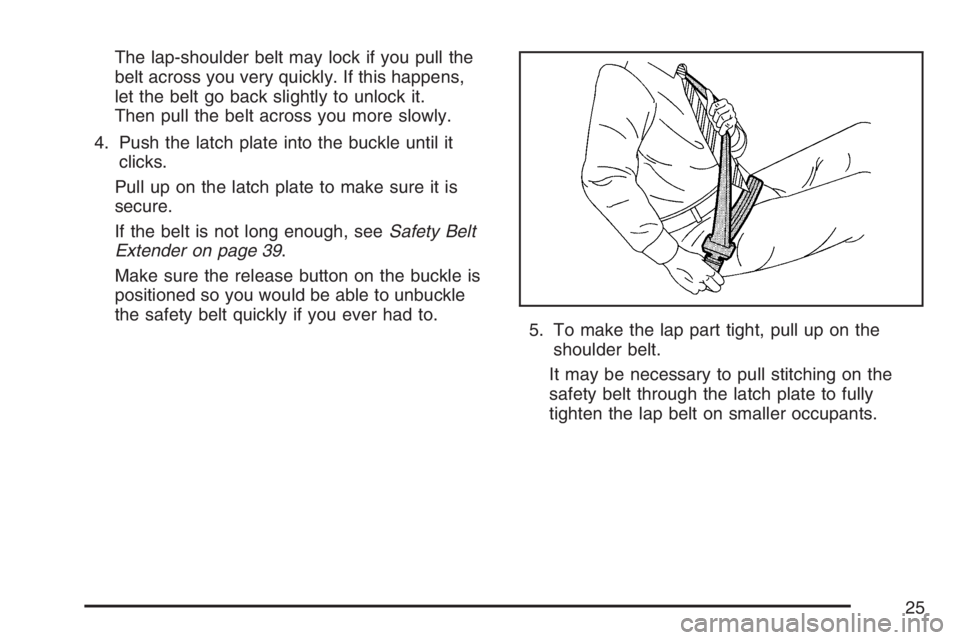
5. To make the lap part tight, pull up on the
shoulder belt.
It may be necessary to pull stitching on the
safety belt through the latch plate to fully
tighten the lap belt on smaller occupants.
25
Page 26 of 534
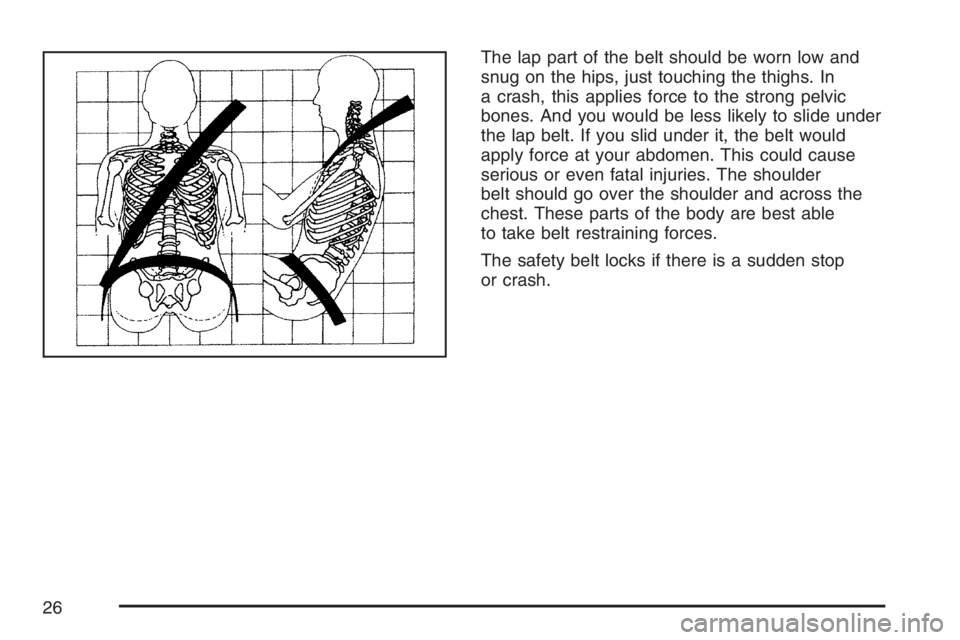
The lap part of the belt should be worn low and
snug on the hips, just touching the thighs. In
a crash, this applies force to the strong pelvic
bones. And you would be less likely to slide under
the lap belt. If you slid under it, the belt would
apply force at your abdomen. This could cause
serious or even fatal injuries. The shoulder
belt should go over the shoulder and across the
chest. These parts of the body are best able
to take belt restraining forces.
The safety belt locks if there is a sudden stop
or crash.
26
Page 27 of 534
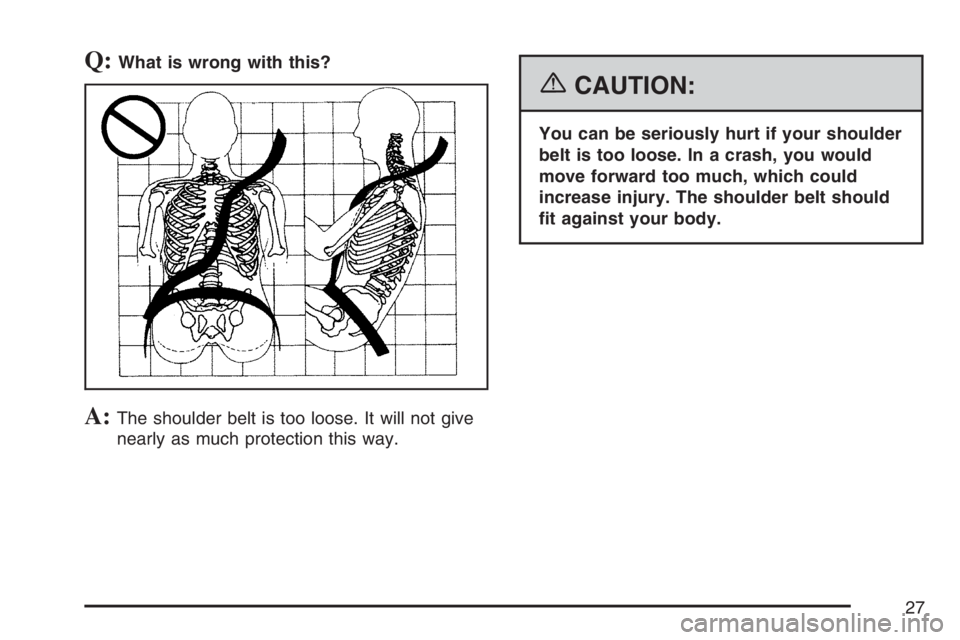
Q:What is wrong with this?
A:The shoulder belt is too loose. It will not give
nearly as much protection this way.
{CAUTION:
You can be seriously hurt if your shoulder
belt is too loose. In a crash, you would
move forward too much, which could
increase injury. The shoulder belt should
t against your body.
27
Page 28 of 534
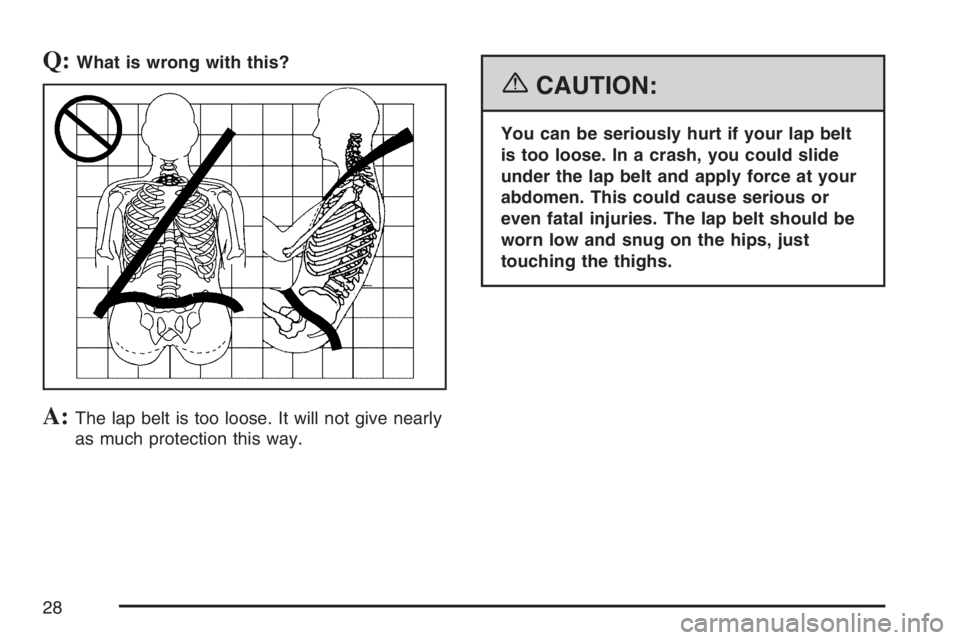
Q:What is wrong with this?
A:The lap belt is too loose. It will not give nearly
as much protection this way.
{CAUTION:
You can be seriously hurt if your lap belt
is too loose. In a crash, you could slide
under the lap belt and apply force at your
abdomen. This could cause serious or
even fatal injuries. The lap belt should be
worn low and snug on the hips, just
touching the thighs.
28
Page 29 of 534
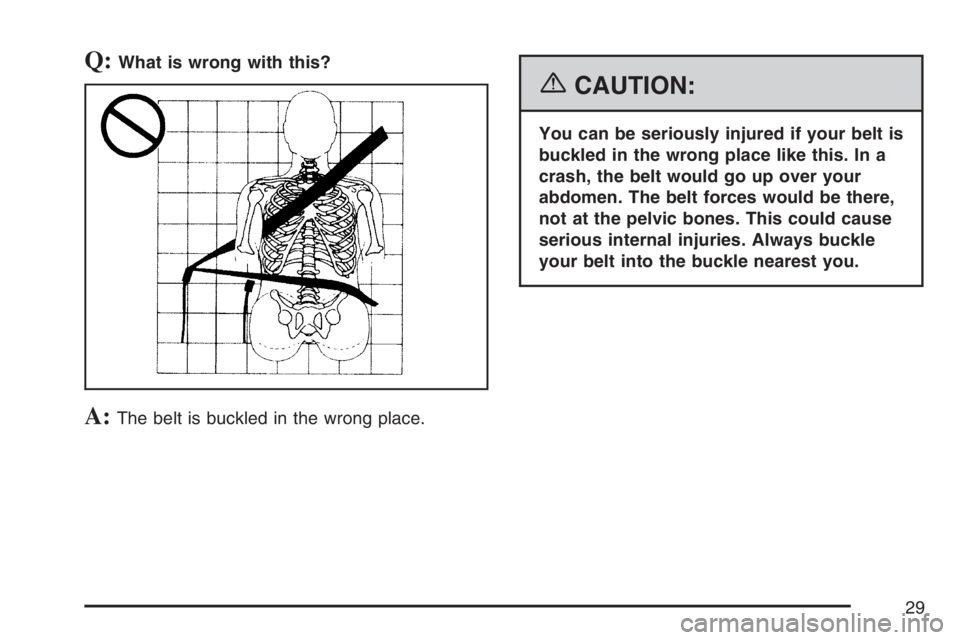
Q:What is wrong with this?
A:The belt is buckled in the wrong place.
{CAUTION:
You can be seriously injured if your belt is
buckled in the wrong place like this. In a
crash, the belt would go up over your
abdomen. The belt forces would be there,
not at the pelvic bones. This could cause
serious internal injuries. Always buckle
your belt into the buckle nearest you.
29
Page 30 of 534
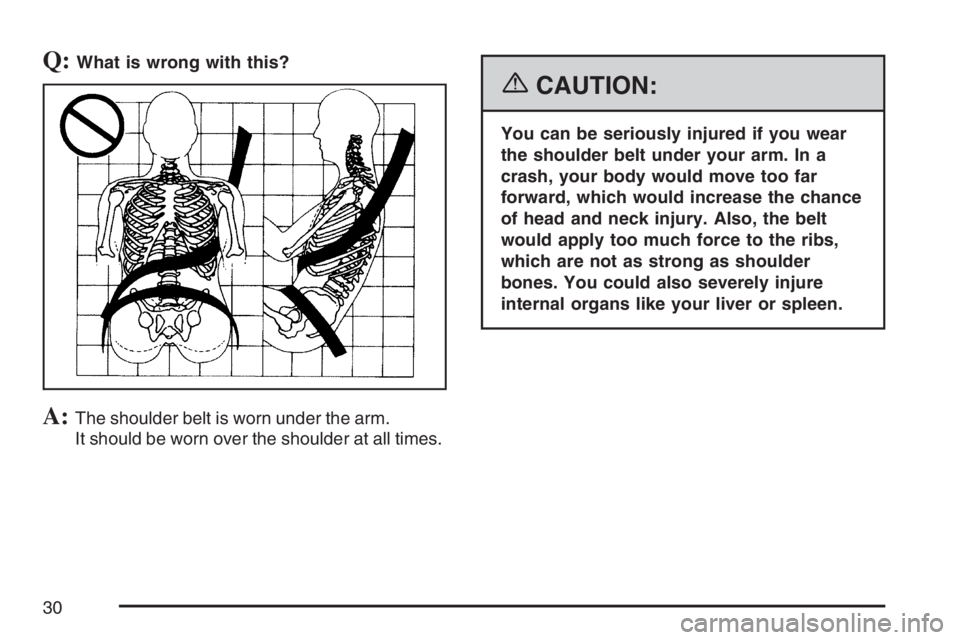
Q:What is wrong with this?
A:The shoulder belt is worn under the arm.
It should be worn over the shoulder at all times.
{CAUTION:
You can be seriously injured if you wear
the shoulder belt under your arm. In a
crash, your body would move too far
forward, which would increase the chance
of head and neck injury. Also, the belt
would apply too much force to the ribs,
which are not as strong as shoulder
bones. You could also severely injure
internal organs like your liver or spleen.
30
Page 31 of 534
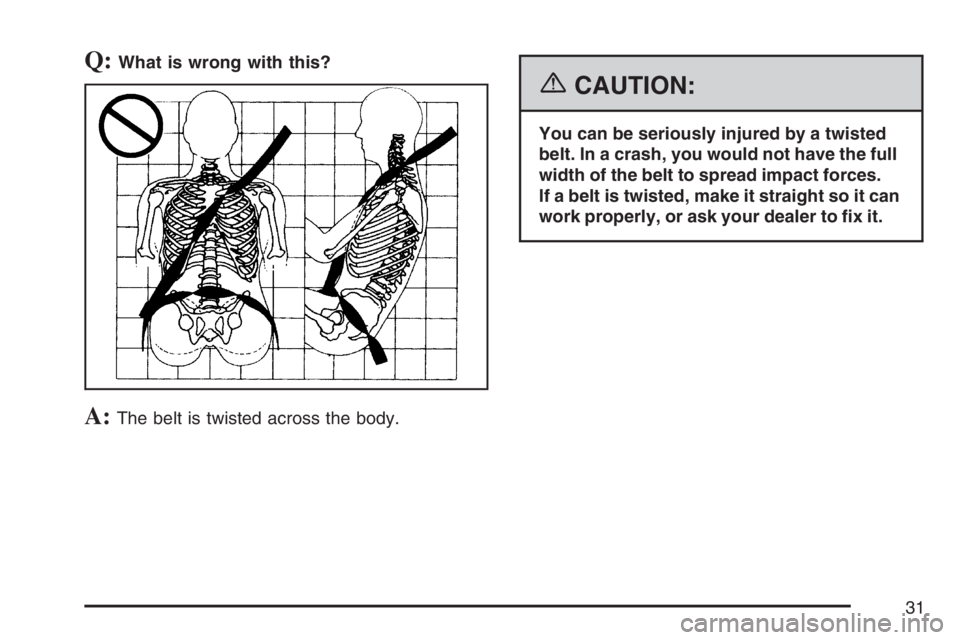
Q:What is wrong with this?
A:The belt is twisted across the body.
{CAUTION:
You can be seriously injured by a twisted
belt. In a crash, you would not have the full
width of the belt to spread impact forces.
If a belt is twisted, make it straight so it can
work properly, or ask your dealer to x it.
31
Page 32 of 534
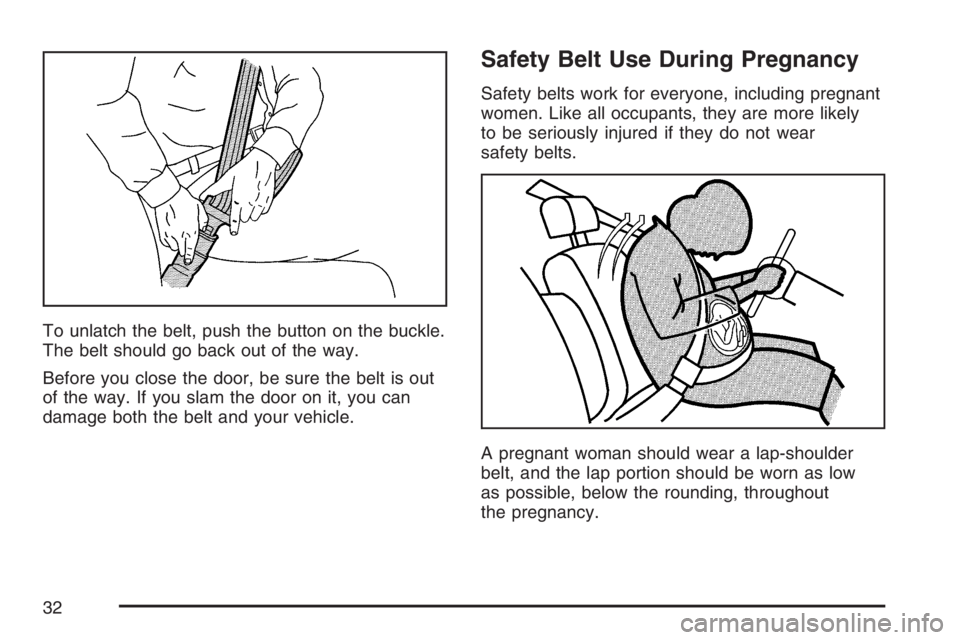
To unlatch the belt, push the button on the buckle.
The belt should go back out of the way.
Before you close the door, be sure the belt is out
of the way. If you slam the door on it, you can
damage both the belt and your vehicle.
Safety Belt Use During Pregnancy
Safety belts work for everyone, including pregnant
women. Like all occupants, they are more likely
to be seriously injured if they do not wear
safety belts.
A pregnant woman should wear a lap-shoulder
belt, and the lap portion should be worn as low
as possible, below the rounding, throughout
the pregnancy.
32
Page 33 of 534
The best way to protect the fetus is to protect
the mother. When a safety belt is worn properly,
it is more likely that the fetus will not be hurt
in a crash. For pregnant women, as for anyone,
the key to making safety belts effective is wearing
them properly.
Right Front Passenger Position
To learn how to wear the right front passenger’s
safety belt properly, seeDriver Position
on page 24.
The right front passenger’s safety belt works the
same way as the driver’s safety belt — except
for one thing. If you ever pull the shoulder portion
of the belt out all the way, you will engage the
child restraint locking feature. If this happens, let
the belt go back all the way and start again.
Rear Seat Passengers
It is very important for rear seat passengers to
buckle up! Accident statistics show that unbelted
people in the rear seat are hurt more often in
crashes than those who are wearing safety belts.
Rear passengers who are not safety belted
can be thrown out of the vehicle in a crash.
And they can strike others in the vehicle who are
wearing safety belts.
33
Page 34 of 534
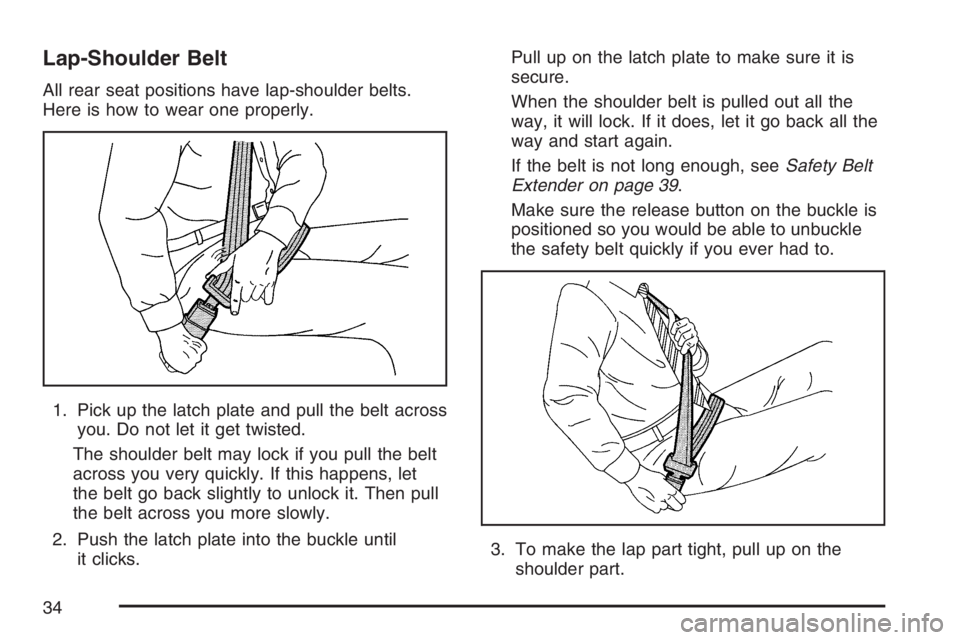
Lap-Shoulder Belt
All rear seat positions have lap-shoulder belts.
Here is how to wear one properly.
1. Pick up the latch plate and pull the belt across
you. Do not let it get twisted.
The shoulder belt may lock if you pull the belt
across you very quickly. If this happens, let
the belt go back slightly to unlock it. Then pull
the belt across you more slowly.
2. Push the latch plate into the buckle until
it clicks.Pull up on the latch plate to make sure it is
secure.
When the shoulder belt is pulled out all the
way, it will lock. If it does, let it go back all the
way and start again.
If the belt is not long enough, seeSafety Belt
Extender on page 39.
Make sure the release button on the buckle is
positioned so you would be able to unbuckle
the safety belt quickly if you ever had to.
3. To make the lap part tight, pull up on the
shoulder part.
34