change wheel BUICK RAINIER 2007 User Guide
[x] Cancel search | Manufacturer: BUICK, Model Year: 2007, Model line: RAINIER, Model: BUICK RAINIER 2007Pages: 534, PDF Size: 2.87 MB
Page 303 of 534
Scanning the Terrain
Off-road driving can take you over many different
kinds of terrain. You need to be familiar with
the terrain and its many different features.
Here are some things to consider.
Surface Conditions:Off-roading can take you
over hard-packed dirt, gravel, rocks, grass, sand,
mud, snow, or ice. Each of these surfaces
affects the steering, acceleration, and braking of
your vehicle in different ways. Depending upon the
kind of surface you are on, you may experience
slipping, sliding, wheel spinning, delayed
acceleration, poor traction, and longer braking
distances.Surface Obstacles:Unseen or hidden obstacles
can be hazardous. A rock, log, hole, rut, or
bump can startle you if you are not prepared for
them. Often these obstacles are hidden by
grass, bushes, snow, or even the rise and fall of
the terrain itself. Here are some things to consider:
Is the path ahead clear?
Will the surface texture change abruptly
up ahead?
Does the travel take you uphill or downhill?
There is more discussion of these subjects
later.
Will you have to stop suddenly or change
direction quickly?
When you drive over obstacles or rough terrain,
keep a rm grip on the steering wheel. Ruts,
troughs, or other surface features can jerk the
wheel out of your hands if you are not prepared.
303
Page 312 of 534
Driving in Mud, Sand, Snow, or Ice
When you drive in mud, snow, or sand, the wheels
will not get good traction. You cannot accelerate
as quickly, turning is more difficult, and you
will need longer braking distances.
It is best to use a low gear when you are in
mud —the deeper the mud, the lower the gear.
In really deep mud, the idea is to keep your vehicle
moving so you do not get stuck.
When you drive on sand, you will sense a change
in wheel traction. But it will depend upon how
loosely packed the sand is. On loosely packed
sand, such as on beaches or sand dunes, the tires
will tend to sink into the sand. This has an effect
on steering, accelerating, and braking. Drive
at a reduced speed and avoid sharp turns
or abrupt maneuvers.Hard packed snow and ice offer the worst tire
traction. On these surfaces, it is very easy to lose
control. On wet ice, for example, the traction is so
poor that you will have difficulty accelerating.
And, if you do get moving, poor steering and difficult
braking can cause you to slide out of control.
{CAUTION:
Driving on frozen lakes, ponds, or rivers
can be dangerous. Underwater springs,
currents under the ice, or sudden thaws
can weaken the ice. Your vehicle could
fall through the ice and you and your
passengers could drown. Drive your
vehicle on safe surfaces only.
312
Page 330 of 534
Rocking Your Vehicle to Get It Out
First, turn the steering wheel left and right.
That will clear the area around the front wheels.
Then shift back and forth between REVERSE (R)
and a forward gear, spinning the wheels as
little as possible. Release the accelerator pedal
while you shift, and press lightly on the accelerator
pedal when the transmission is in gear. By slowly
spinning the wheels in the forward and reverse
directions, you will cause a rocking motion that
may free your vehicle. If that does not get
your vehicle out after a few tries, it may need to
be towed out. If your vehicle does need to be
towed out, seeTowing Your Vehicle on page 337.
Loading Your Vehicle
It is very important to know how much weight your
vehicle can carry. This weight is called the
vehicle capacity weight and includes the weight of
all occupants, cargo, and all nonfactory-installed
options. Two labels on your vehicle show how
much weight it was designed to carry, the Tire and
Loading Information label and the Certication/Tire
label.
{CAUTION:
Do not load your vehicle any heavier than
the Gross Vehicle Weight Rating (GVWR),
or either the maximum front or rear Gross
Axle Weight Rating (GAWR). If you do,
parts on your vehicle can break, and it
can change the way your vehicle handles.
These could cause you to lose control
and crash. Also, overloading can shorten
the life of your vehicle.
330
Page 395 of 534
Properly torqued wheel nuts are necessary to help
prevent brake pulsation. When tires are rotated,
inspect brake pads for wear and evenly tighten
wheel nuts in the proper sequence to GM torque
specications.
Brake linings should always be replaced as
complete axle sets.
Brake Pedal Travel
See your dealer if the brake pedal does not return
to normal height, or if there is a rapid increase
in pedal travel. This could be a sign of brake
trouble.
Brake Adjustment
Every time you make a brake stop, your disc
brakes adjust for wear.
Replacing Brake System Parts
The braking system on a vehicle is complex. Its
many parts have to be of top quality and work well
together if the vehicle is to have really good
braking. Your vehicle was designed and tested
with top-quality GM brake parts. When you replace
parts of your braking system — for example,
when your brake linings wear down and you need
new ones put in — be sure you get new
approved GM replacement parts. If you do not,
your brakes may no longer work properly.
For example, if someone puts in brake linings that
are wrong for your vehicle, the balance between
your front and rear brakes can change — for
the worse. The braking performance you have
come to expect can change in many other ways
if someone puts in the wrong replacement
brake parts.
395
Page 426 of 534
Make certain that all wheel nuts are properly
tightened. See “Wheel Nut Torque” under
Capacities and Specications on page 474.
{CAUTION:
Rust or dirt on a wheel, or on the parts to
which it is fastened, can make wheel nuts
become loose after time. The wheel could
come off and cause an accident. When
you change a wheel, remove any rust or
dirt from places where the wheel attaches
to the vehicle. In an emergency, you can
use a cloth or a paper towel to do this;
but be sure to use a scraper or wire brush
later, if needed, to get all the rust or dirt
off. SeeChanging a Flat Tire on page 436.
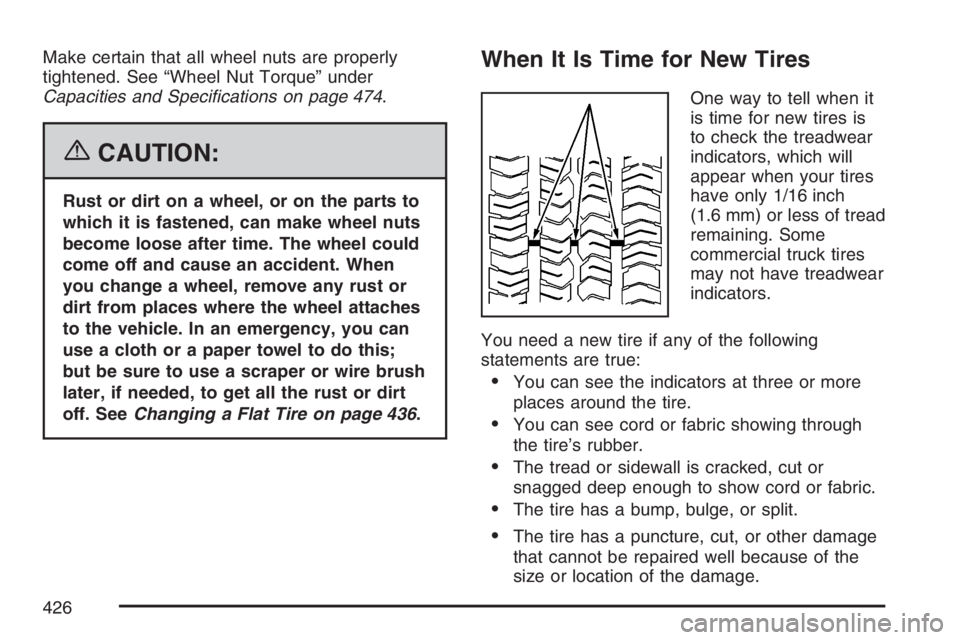
When It Is Time for New Tires
One way to tell when it
is time for new tires is
to check the treadwear
indicators, which will
appear when your tires
have only 1/16 inch
(1.6 mm) or less of tread
remaining. Some
commercial truck tires
may not have treadwear
indicators.
You need a new tire if any of the following
statements are true:
You can see the indicators at three or more
places around the tire.
You can see cord or fabric showing through
the tire’s rubber.
The tread or sidewall is cracked, cut or
snagged deep enough to show cord or fabric.
The tire has a bump, bulge, or split.
The tire has a puncture, cut, or other damage
that cannot be repaired well because of the
size or location of the damage.
426
Page 436 of 534
A rear blowout, particularly on a curve, acts much
like a skid and may require the same correction
you would use in a skid. In any rear blowout
remove your foot from the accelerator pedal. Get
the vehicle under control by steering the way
you want the vehicle to go. It may be very bumpy
and noisy, but you can still steer. Gently brake
to a stop, well off the road if possible.
{CAUTION:
Lifting a vehicle and getting under it to do
maintenance or repairs is dangerous
without the appropriate safety equipment
and training. The jack provided with your
vehicle is designed only for changing a
at tire. If it is used for anything else, you
or others could be badly injured or killed
if the vehicle slips off the jack. Use the
jack provided with your vehicle only for
changing a at tire.
If a tire goes at, the next part shows how to use the
jacking equipment to change a at tire safely.
Changing a Flat Tire
If a tire goes at, avoid further tire and wheel
damage by driving slowly to a level place. Turn on
your vehicle’s hazard warning ashers. See
Hazard Warning Flashers on page 154for more
information.
{CAUTION:
Changing a tire can be dangerous. The
vehicle can slip off the jack and roll over
or fall on you or other people. You and
they could be badly injured or even killed.
Find a level place to change your tire. To
help prevent the vehicle from moving:
1. Set the parking brake rmly.
2. Put the shift lever in PARK (P).
CAUTION: (Continued)
436
Page 437 of 534
CAUTION: (Continued)
3. Turn off the engine and do not restart
while the vehicle is raised.
4. Do not allow passengers to remain in
the vehicle.
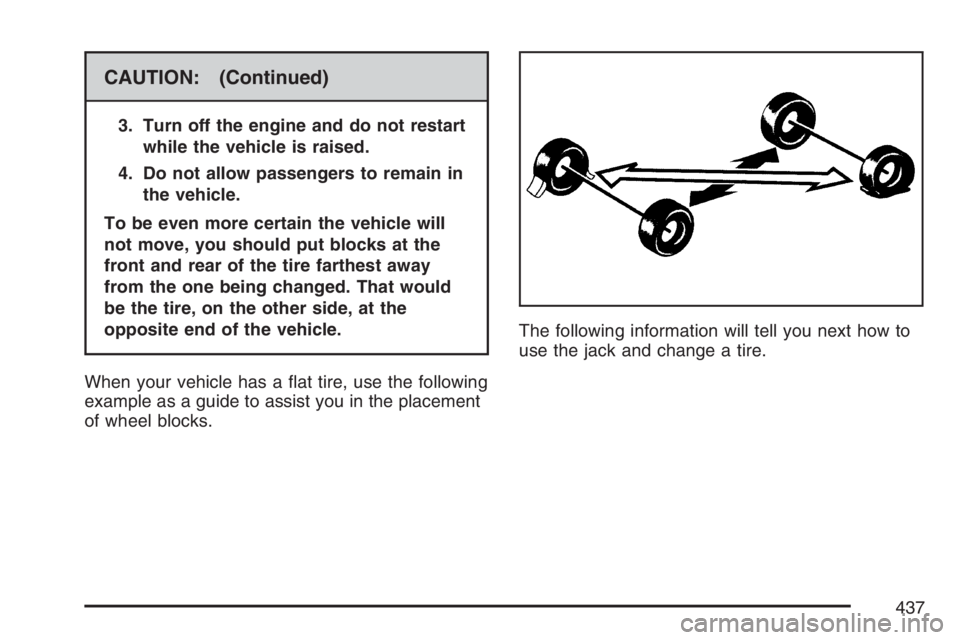
To be even more certain the vehicle will
not move, you should put blocks at the
front and rear of the tire farthest away
from the one being changed. That would
be the tire, on the other side, at the
opposite end of the vehicle.
When your vehicle has a at tire, use the following
example as a guide to assist you in the placement
of wheel blocks.The following information will tell you next how to
use the jack and change a tire.
437
Page 443 of 534
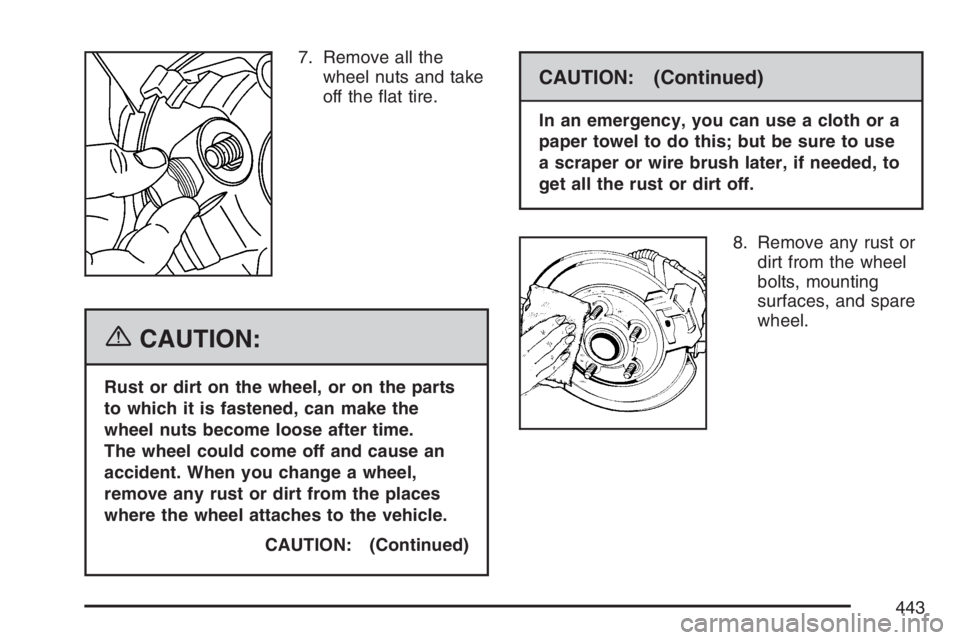
7. Remove all the
wheel nuts and take
off the at tire.
{CAUTION:
Rust or dirt on the wheel, or on the parts
to which it is fastened, can make the
wheel nuts become loose after time.
The wheel could come off and cause an
accident. When you change a wheel,
remove any rust or dirt from the places
where the wheel attaches to the vehicle.
CAUTION: (Continued)
CAUTION: (Continued)
In an emergency, you can use a cloth or a
paper towel to do this; but be sure to use
a scraper or wire brush later, if needed, to
get all the rust or dirt off.
8. Remove any rust or
dirt from the wheel
bolts, mounting
surfaces, and spare
wheel.
443
Page 531 of 534
Service (cont.)
All-Wheel-Drive Light................................ 196
California Proposition 65 Warning............. 357
Doing Your Own Work............................. 357
Engine Soon Light................................... 190
Publications Ordering Information............. 517
Servicing Your Airbag-Equipped Vehicle......... 84
Setting the Time.......................................... 217
Sheet Metal Damage................................... 460
Shifting Into Park (P)................................... 119
Shifting Out of Park (P)............................... 120
Signals, Turn and Lane-Change.................. 156
Spare Tire................................................... 453
Accessory Inator..................................... 434
Installing.................................................. 440
Removing................................................ 438
Storing..................................................... 450
Specications, Capacities............................ 474
Speedometer............................................... 179
StabiliTrak
®System..................................... 289
StabiliTrak®Indicator Light........................... 188
StabiliTrak®Service Light............................. 188
Starting Your Engine................................... 110
Steering...................................................... 294
Steering Wheel Controls, Audio................... 277
Steering Wheel, Tilt Wheel.......................... 154Storage Areas
Center Console Storage Area................... 144
Convenience Net..................................... 146
Glove Box................................................ 144
Luggage Carrier....................................... 145
Overhead Console................................... 144
Rear Floor Storage Lid............................ 146
Stuck in Sand, Mud, Ice, or Snow............... 329
Sun Visors.................................................. 105
Sunroof....................................................... 148
Suspension................................................. 337
T
Tachometer................................................. 179
Taillamps
Turn Signal Lamps................................... 405
Theft-Deterrent, Radio................................. 276
Theft-Deterrent Systems .............................. 105
Content Theft-Deterrent............................ 106
Passlock
®................................................ 107
Throttle, Adjustable...................................... 112
Tilt Wheel.................................................... 154
Tire
Pressure Light.......................................... 189
531
Page 532 of 534
Tires........................................................... 411
Aluminum Wheels, Cleaning..................... 459
Buying New Tires..................................... 427
Chains..................................................... 433
Changing a Flat Tire................................ 436
Cleaning.................................................. 460
Different Size........................................... 428
If a Tire Goes Flat................................... 435
Ination - Tire Pressure............................ 419
Inator, Accessory.................................... 434
Inspection and Rotation............................ 425
Installing the Spare Tire........................... 440
Pressure Monitor System......................... 420
Removing the Flat Tire............................. 440
Removing the Spare Tire and Tools......... 438
Secondary Latch System......................... 446
Spare Tire................................................ 453
Storing a Flat or Spare Tire and Tools..... 450
Tire Sidewall Labeling.............................. 412
Tire Terminology and Denitions............... 416
Uniform Tire Quality Grading.................... 429
Wheel Alignment and Tire Balance........... 431
Wheel Replacement................................. 432
When It Is Time for New Tires................. 426Towing
Recreational Vehicle................................. 337
Towing a Trailer....................................... 339
Your Vehicle............................................. 337
Traction
StabiliTrak
®System................................. 289
Transmission
Fluid, Automatic....................................... 375
Transmission Operation, Automatic.............. 114
Trip Odometer............................................. 179
Turn and Lane-Change Signals................... 156
Turn Signal/Multifunction Lever.................... 155
U
Understanding Radio Reception................... 278
Uniform Tire Quality Grading....................... 429
Universal Home Remote System........133, 134
Operation........................................135, 140
532