steering wheel BUICK RAINIER 2007 User Guide
[x] Cancel search | Manufacturer: BUICK, Model Year: 2007, Model line: RAINIER, Model: BUICK RAINIER 2007Pages: 534, PDF Size: 2.87 MB
Page 155 of 534
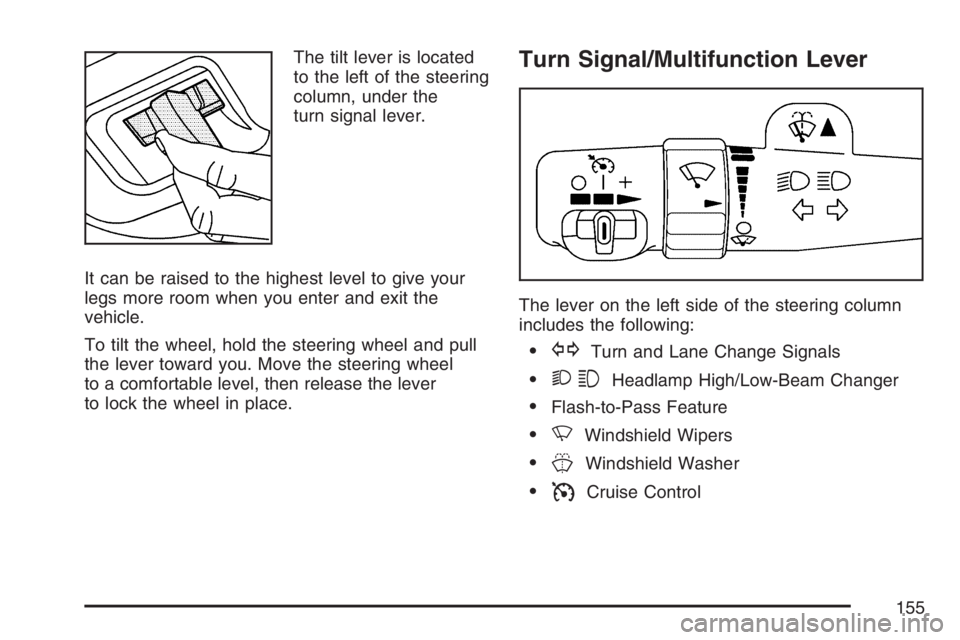
The tilt lever is located
to the left of the steering
column, under the
turn signal lever.
It can be raised to the highest level to give your
legs more room when you enter and exit the
vehicle.
To tilt the wheel, hold the steering wheel and pull
the lever toward you. Move the steering wheel
to a comfortable level, then release the lever
to lock the wheel in place.Turn Signal/Multifunction Lever
The lever on the left side of the steering column
includes the following:
GTurn and Lane Change Signals
23Headlamp High/Low-Beam Changer
Flash-to-Pass Feature
NWindshield Wipers
JWindshield Washer
ICruise Control
155
Page 159 of 534
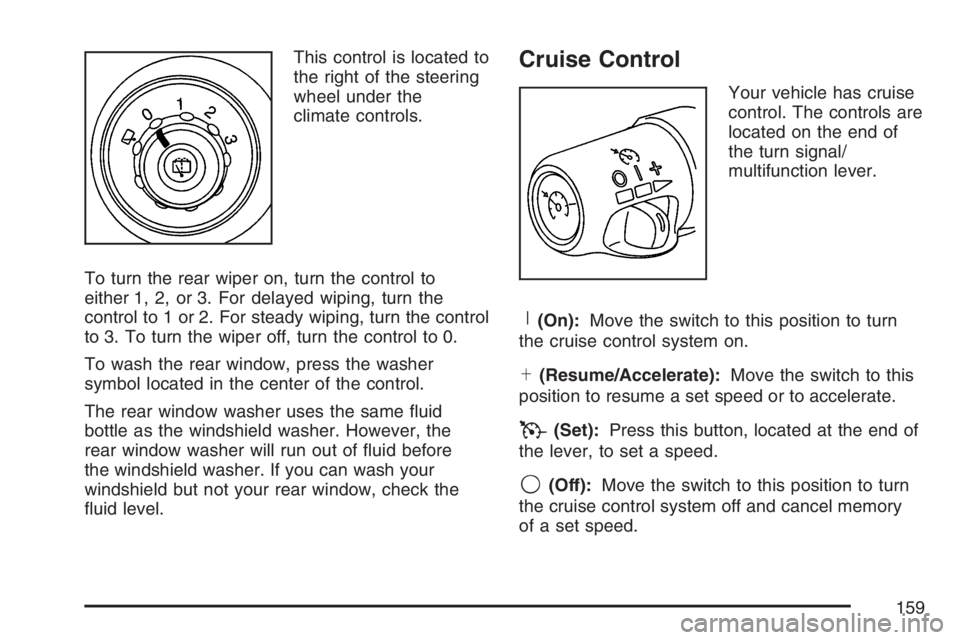
This control is located to
the right of the steering
wheel under the
climate controls.
To turn the rear wiper on, turn the control to
either 1, 2, or 3. For delayed wiping, turn the
control to 1 or 2. For steady wiping, turn the control
to 3. To turn the wiper off, turn the control to 0.
To wash the rear window, press the washer
symbol located in the center of the control.
The rear window washer uses the same uid
bottle as the windshield washer. However, the
rear window washer will run out of uid before
the windshield washer. If you can wash your
windshield but not your rear window, check the
uid level.Cruise Control
Your vehicle has cruise
control. The controls are
located on the end of
the turn signal/
multifunction lever.
R(On):Move the switch to this position to turn
the cruise control system on.
S(Resume/Accelerate):Move the switch to this
position to resume a set speed or to accelerate.
T(Set):Press this button, located at the end of
the lever, to set a speed.
9(Off):Move the switch to this position to turn
the cruise control system off and cancel memory
of a set speed.
159
Page 162 of 534
Passing Another Vehicle While Using
Cruise Control
Use the accelerator pedal to increase your speed.
When you take your foot off the pedal, your
vehicle will slow down to the cruise control speed
set earlier.
Using Cruise Control on Hills
How well your cruise control works on hills
depends upon your speed, load and the steepness
of the hills. When going up steep hills, you may
want to step on the accelerator pedal to maintain
your speed. When going downhill, you may
have to brake or shift to a lower gear to keep your
speed down. Of course, applying the brake
takes you out of cruise control. Many drivers nd
this to be too much trouble and do not use
cruise control on steep hills.
Ending Cruise Control
There are three ways to turn off the cruise control:
Step lightly on the brake pedal.
Move the cruise switch to off, or
Shift the transmission to NEUTRAL (N).
Erasing Speed Memory
When you turn off the cruise control or the
ignition, the cruise control set speed memory
is erased.
Headlamps
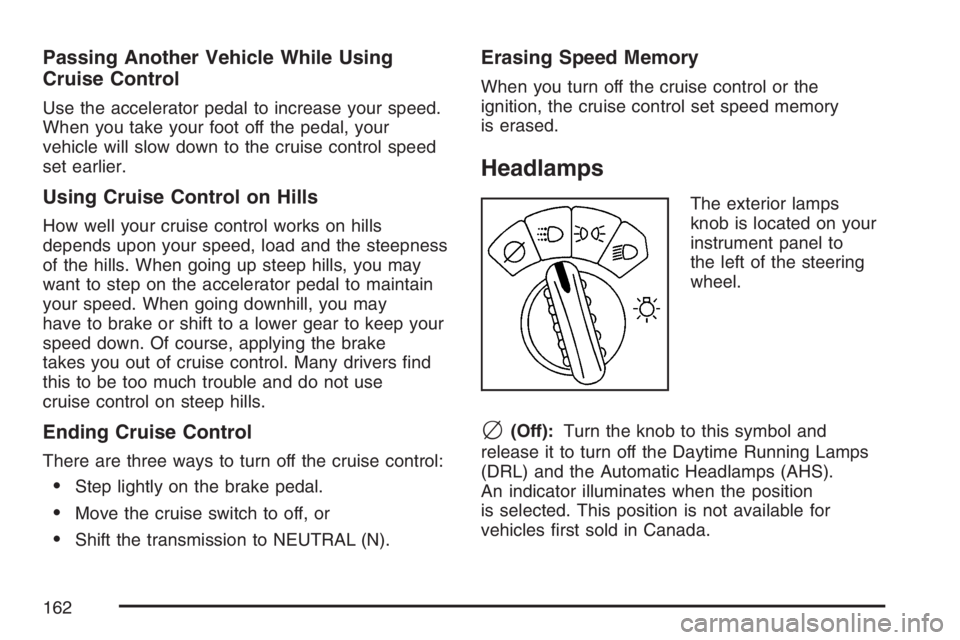
The exterior lamps
knob is located on your
instrument panel to
the left of the steering
wheel.
c(Off):Turn the knob to this symbol and
release it to turn off the Daytime Running Lamps
(DRL) and the Automatic Headlamps (AHS).
An indicator illuminates when the position
is selected. This position is not available for
vehicles rst sold in Canada.
162
Page 198 of 534
Driver Information Center (DIC)
The Driver Information Center (DIC) display is
located on the instrument panel cluster, below the
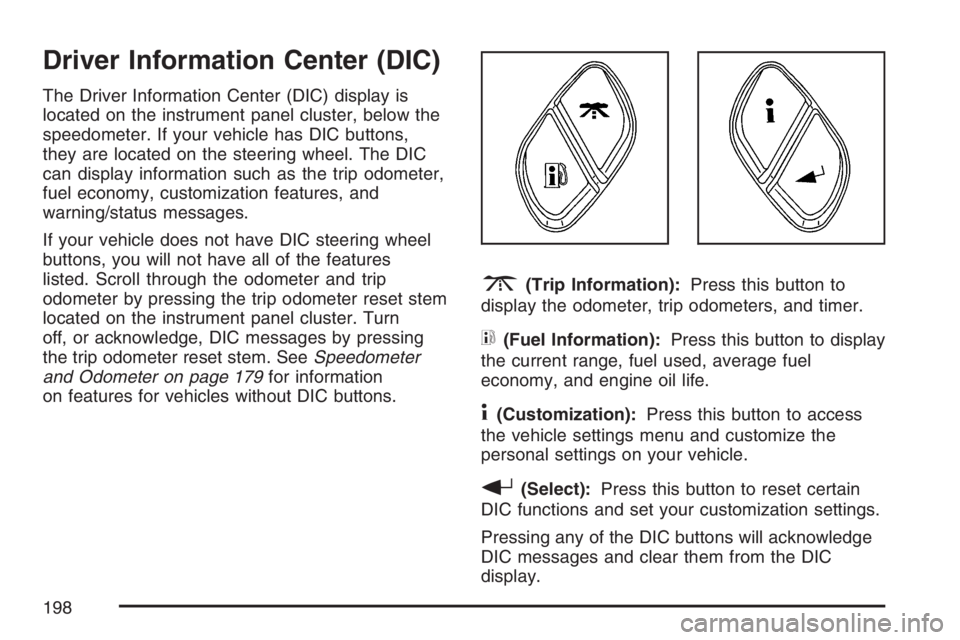
speedometer. If your vehicle has DIC buttons,
they are located on the steering wheel. The DIC
can display information such as the trip odometer,
fuel economy, customization features, and
warning/status messages.
If your vehicle does not have DIC steering wheel
buttons, you will not have all of the features
listed. Scroll through the odometer and trip
odometer by pressing the trip odometer reset stem
located on the instrument panel cluster. Turn
off, or acknowledge, DIC messages by pressing
the trip odometer reset stem. SeeSpeedometer
and Odometer on page 179for information
on features for vehicles without DIC buttons.
3(Trip Information):Press this button to
display the odometer, trip odometers, and timer.
t(Fuel Information):Press this button to display
the current range, fuel used, average fuel
economy, and engine oil life.
4(Customization):Press this button to access
the vehicle settings menu and customize the
personal settings on your vehicle.
r(Select):Press this button to reset certain
DIC functions and set your customization settings.
Pressing any of the DIC buttons will acknowledge
DIC messages and clear them from the DIC
display.
198
Page 199 of 534
DIC Operation and Displays
The DIC comes on when the ignition is on. After a
short delay the DIC will display the information
that was last displayed before the engine
was turned off.
If a problem is detected, a warning message will
appear on the display. Pressing the trip stem
will acknowledge any warning or service
messages. Pressing any of the DIC steering wheel
buttons — trip information, fuel information,
customization, or select button — will also
acknowledge any warnings or service messages.
You should take any message that appears on
the display seriously and remember that clearing
the message will only make the message
disappear, not correct the problem.
The DIC has different modes which can be
accessed by pressing the four DIC buttons located
on the steering wheel. These buttons are trip
information, fuel information, customization, and
select. The button functions are detailed in
the following pages.
Trip Information Button
3
(Trip Information):Press the trip
information button to scroll through the
ODOMETER, TRIP A, TRIP B, TIRE
PRESSURES, and TIMER.
Odometer:Press the trip information button until
ODOMETER appears on the display. This
mode shows the total distance the vehicle has
been driven in either miles or kilometers. Pressing
the reset stem located on the instrument cluster
with the vehicle off will also display the odometer.
Trip A:Press the trip information button until
TRIP A appears on the display. This mode shows
the current distance traveled since the last
reset for TRIP A in either miles or kilometers.
Trip B:Press the trip information button
until TRIP B appears on the display. This mode
shows the current distance traveled since the last
reset for TRIP B in either miles or kilometers.
199
Page 202 of 534
Customization Button
4
(Customization):Press the customization
button to access the VEHICLE SETTINGS menu
and customize the settings to your vehicle.
SeeDIC Vehicle Customization on page 208for
more information.
Select Button
r
(Select):Press the select button to reset
certain DIC functions, turn off or acknowledge
messages on the DIC display, and set your
customization settings. For example, this button
will allow you to reset the trip odometers, turn
off the FUEL LEVEL LOW message, and enables
you to scroll through and select the language
in which the DIC information will appear.
DIC Warnings and Messages
Messages are displayed on the DIC to notify the
driver that the status of the vehicle has changed
and that some action may be needed to correct the
condition. Multiple messages may appear one
after another.Some messages may not require immediate
action. Press any of the DIC buttons on the
steering wheel or the trip odometer reset stem on
the instrument panel cluster to acknowledge
that you received the messages and to clear them
from the display.
Some messages cannot be cleared from the
display because they are more urgent. These
messages require action before they can be
removed from the DIC display. Take any messages
that appear on the display seriously and remember
that clearing the messages will only make the
messages disappear, not correct the problem.
The following are the possible messages that can
be displayed and some information about them.
CHANGE ENGINE OIL
This message displays when the engine oil needs
to be changed and service is required for your
vehicle. SeeScheduled Maintenance on page 479
andEngine Oil on page 369for more information.
Also seeEngine Oil Life System on page 372
for information on how to reset the message. This
message clears itself after 10 seconds until the
next ignition cycle.
202
Page 215 of 534
If U.S. (ENGLISH) is chosen, all information will
be displayed in English units. For example,
distance will be displayed in miles (mi) and fuel
economy in miles per gallon (MPG). If METRIC
(km/L) is chosen, all information will be displayed
in metric units. For example, distance will be
displayed in kilometers (km) and fuel economy in
kilometers per liter (km/L). If METRIC (L/100 km)
is chosen, all information will be displayed in metric
units. For example, distance will be displayed in
kilometers (km) and fuel economy in liters per
100 kilometers (L/100 km).
Choose one of the available options and press the
customization button while it is displayed on the
DIC to select it and exit out of the customizable
options.
Audio System(s)
Determine which radio your vehicle has and then
read the pages following to familiarize yourself
with its features.
Driving without distraction is a necessity for a
safer driving experience. SeeDefensive Driving on
page 282. By taking a few moments to read this
manual and get familiar with your vehicle’saudio system, you can use it with less effort, as
well as take advantage of its features. While your
vehicle is parked, set up your audio system by
presetting your favorite radio stations, setting the
tone, and adjusting the speakers. Then, when
driving conditions permit, you can tune to
your favorite stations using the presets and
steering wheel controls if the vehicle has them.
{CAUTION:
This system provides you with a far
greater access to audio stations and
song listings. Giving extended attention
to entertainment tasks while driving can
cause a crash and you or others can be
injured or killed. Always keep your eyes
on the road and your mind on the
drive — avoid engaging in extended
searching while driving.
Keeping your mind on the drive is important for
safe driving. Here are some ways in which you can
help avoid distraction while driving.
215
Page 216 of 534
While your vehicle is parked:
Familiarize yourself with all of its controls.
Familiarize yourself with its operation.
Set up your audio system by presetting your
favorite radio stations, setting the tone, and
adjusting the speakers. Then, when driving
conditions permit, you can tune to your favorite
radio stations using the presets and steering
wheel controls if the vehicle has them.
Notice:Before adding any sound equipment
to your vehicle, such as an audio system,
CD player, CB radio, mobile telephone,
or two-way radio, make sure that it can be
added by checking with your dealer. Also,
check federal rules covering mobile radio and
telephone units. If sound equipment can be
added, it is very important to do it properly.
Added sound equipment may interfere with the
operation of your vehicle’s engine, radio, or
other systems, and even damage them.
Your vehicle’s systems may interfere with the
operation of sound equipment that has
been added.Notice:The chime signals related to safety
belts, parking brake, and other functions
of your vehicle operate through the
radio/entertainment system. If that equipment
is replaced or additional equipment is added
to your vehicle, the chimes may not work. Make
sure that replacement or additional equipment
is compatible with your vehicle before
installing it. SeeAccessories and Modifications
on page 356.
Your vehicle has a feature called Retained
Accessory Power (RAP). With RAP, the audio
system can be played even after the ignition
is turned off. SeeRetained Accessory
Power (RAP) on page 110for more information.
216
Page 277 of 534
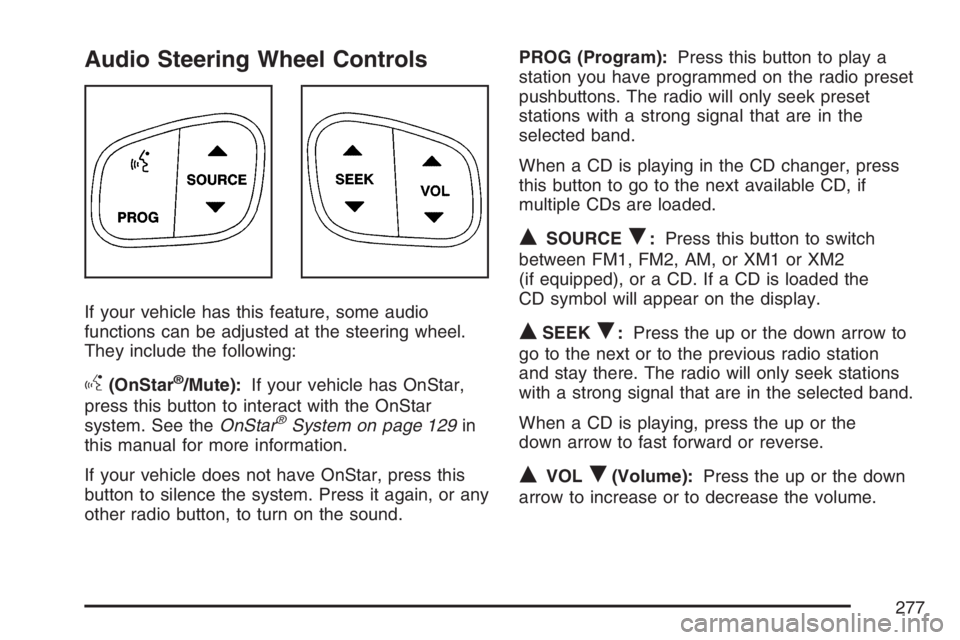
Audio Steering Wheel Controls
If your vehicle has this feature, some audio
functions can be adjusted at the steering wheel.
They include the following:
g(OnStar®/Mute):If your vehicle has OnStar,
press this button to interact with the OnStar
system. See theOnStar
®System on page 129in
this manual for more information.
If your vehicle does not have OnStar, press this
button to silence the system. Press it again, or any
other radio button, to turn on the sound.PROG (Program):Press this button to play a
station you have programmed on the radio preset
pushbuttons. The radio will only seek preset
stations with a strong signal that are in the
selected band.
When a CD is playing in the CD changer, press
this button to go to the next available CD, if
multiple CDs are loaded.
QSOURCER:Press this button to switch
between FM1, FM2, AM, or XM1 or XM2
(if equipped), or a CD. If a CD is loaded the
CD symbol will appear on the display.
QSEEKR:Press the up or the down arrow to
go to the next or to the previous radio station
and stay there. The radio will only seek stations
with a strong signal that are in the selected band.
When a CD is playing, press the up or the
down arrow to fast forward or reverse.
QVOLR(Volume):Press the up or the down
arrow to increase or to decrease the volume.
277
Page 281 of 534
Your Driving, the Road, and
Your Vehicle............................................ 282
Defensive Driving...................................... 282
Drunken Driving........................................ 283
Control of a Vehicle.................................. 286
Braking...................................................... 286
Anti-Lock Brake System (ABS).................. 287
Braking in Emergencies............................. 289
Locking Rear Axle..................................... 289
StabiliTrak
®System................................... 289
All-Wheel Drive (AWD) System.................. 293
Steering.................................................... 294
Off-Road Recovery.................................... 296
Passing..................................................... 296
Loss of Control.......................................... 298
Off-Road Driving........................................ 299
Driving at Night......................................... 314Driving in Rain and on Wet Roads............ 316
City Driving............................................... 319
Freeway Driving........................................ 320
Before Leaving on a Long Trip.................. 321
Highway Hypnosis..................................... 322
Hill and Mountain Roads........................... 323
Winter Driving........................................... 325
If Your Vehicle is Stuck in Sand, Mud,
Ice, or Snow.......................................... 329
Rocking Your Vehicle to Get It Out........... 330
Loading Your Vehicle................................ 330
Towing........................................................ 337
Towing Your Vehicle ................................. 337
Recreational Vehicle Towing...................... 337
Electronically Controlled Air Suspension
System.................................................. 337
Towing a Trailer........................................ 339
Section 4 Driving Your Vehicle
281