tires BUICK RAINIER 2007 Owner's Guide
[x] Cancel search | Manufacturer: BUICK, Model Year: 2007, Model line: RAINIER, Model: BUICK RAINIER 2007Pages: 534, PDF Size: 2.87 MB
Page 326 of 534
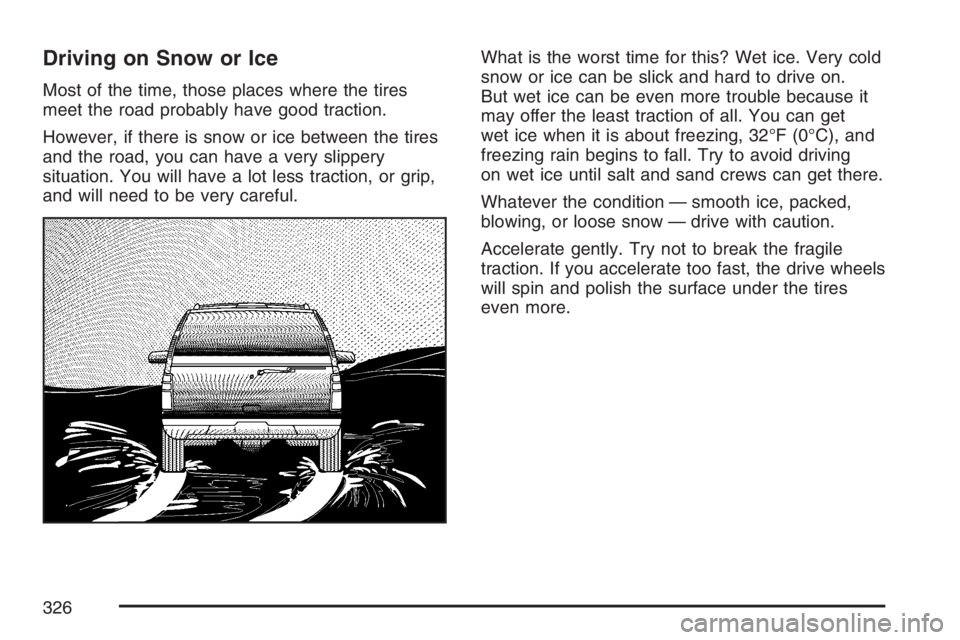
Driving on Snow or Ice
Most of the time, those places where the tires
meet the road probably have good traction.
However, if there is snow or ice between the tires
and the road, you can have a very slippery
situation. You will have a lot less traction, or grip,
and will need to be very careful.What is the worst time for this? Wet ice. Very cold
snow or ice can be slick and hard to drive on.
But wet ice can be even more trouble because it
may offer the least traction of all. You can get
wet ice when it is about freezing, 32°F (0°C), and
freezing rain begins to fall. Try to avoid driving
on wet ice until salt and sand crews can get there.
Whatever the condition — smooth ice, packed,
blowing, or loose snow — drive with caution.
Accelerate gently. Try not to break the fragile
traction. If you accelerate too fast, the drive wheels
will spin and polish the surface under the tires
even more.
326
Page 329 of 534
You will need a well-charged battery to restart the
vehicle, and possibly for signaling later on with
your headlamps. Let the heater run for a while.
Then, shut the engine off and close the window
almost all the way to preserve the heat. Start
the engine again and repeat this only when you
feel really uncomfortable from the cold. But do it as
little as possible. Preserve the fuel as long as
you can. To help keep warm, you can get out of
the vehicle and do some fairly vigorous exercises
every half hour or so until help comes.
If Your Vehicle is Stuck in Sand,
Mud, Ice, or Snow
In order to free your vehicle when it is stuck,
you will need to spin the wheels, but you do not
want to spin your wheels too fast. The method
known as rocking can help you get out when you
are stuck, but you must use caution.
{CAUTION:
If you let your vehicle’s tires spin at high
speed, they can explode, and you or others
could be injured. And, the transmission or
other parts of the vehicle can overheat.
That could cause an engine compartment
re or other damage. When you are stuck,
spin the wheels as little as possible. Do not
spin the wheels above 35 mph (55 km/h) as
shown on the speedometer.
Notice:Spinning the wheels can destroy parts
of your vehicle as well as the tires. If you
spin the wheels too fast while shifting
the transmission back and forth, you can
destroy the transmission.
For information about using tire chains on your
vehicle, seeTire Chains on page 433.
329
Page 331 of 534
Tire and Loading Information Label
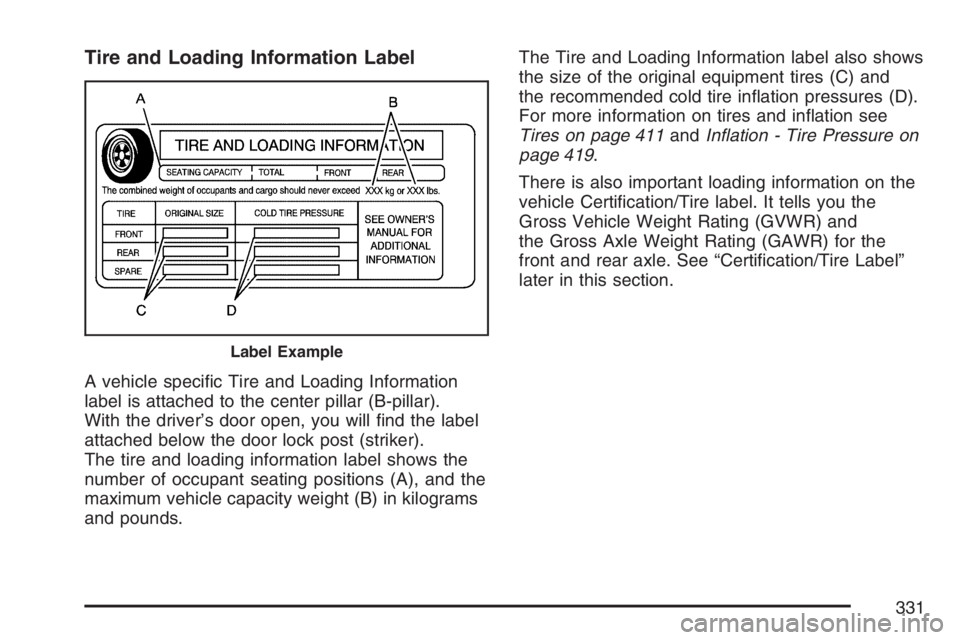
A vehicle specic Tire and Loading Information
label is attached to the center pillar (B-pillar).
With the driver’s door open, you will nd the label
attached below the door lock post (striker).
The tire and loading information label shows the
number of occupant seating positions (A), and the
maximum vehicle capacity weight (B) in kilograms
and pounds.The Tire and Loading Information label also shows
the size of the original equipment tires (C) and
the recommended cold tire ination pressures (D).
For more information on tires and ination see
Tires on page 411andInation - Tire Pressure on
page 419.
There is also important loading information on the
vehicle Certication/Tire label. It tells you the
Gross Vehicle Weight Rating (GVWR) and
the Gross Axle Weight Rating (GAWR) for the
front and rear axle. See “Certication/Tire Label”
later in this section.
Label Example
331
Page 334 of 534
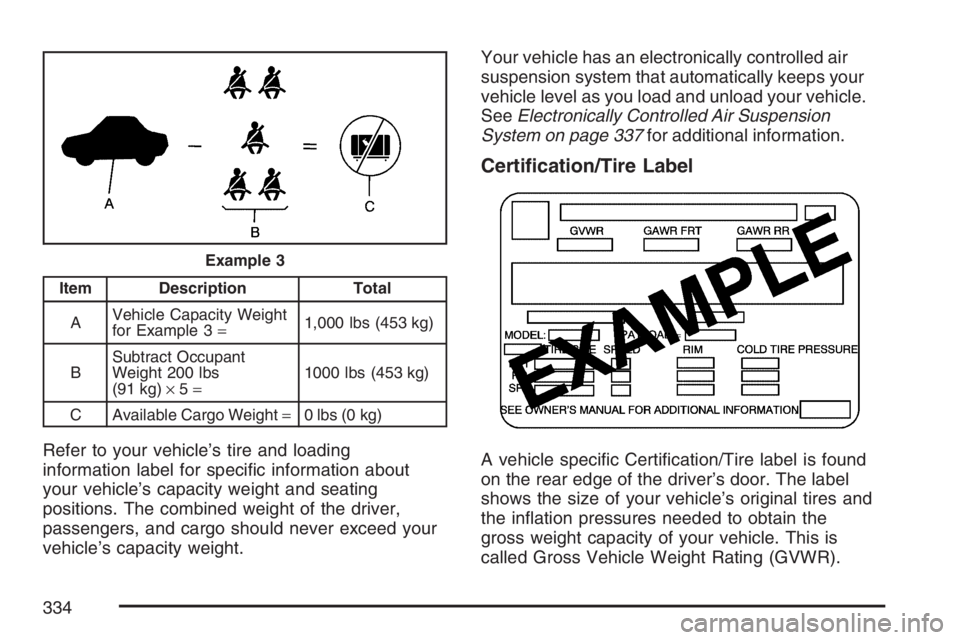
Item Description Total
AVehicle Capacity Weight
for Example 3=1,000 lbs (453 kg)
BSubtract Occupant
Weight 200 lbs
(91 kg)×5=1000 lbs (453 kg)
C Available Cargo Weight=0 lbs (0 kg)
Refer to your vehicle’s tire and loading
information label for specic information about
your vehicle’s capacity weight and seating
positions. The combined weight of the driver,
passengers, and cargo should never exceed your
vehicle’s capacity weight.Your vehicle has an electronically controlled air
suspension system that automatically keeps your
vehicle level as you load and unload your vehicle.
SeeElectronically Controlled Air Suspension
System on page 337for additional information.
Certication/Tire Label
A vehicle specic Certication/Tire label is found
on the rear edge of the driver’s door. The label
shows the size of your vehicle’s original tires and
the ination pressures needed to obtain the
gross weight capacity of your vehicle. This is
called Gross Vehicle Weight Rating (GVWR).
Example 3
334
Page 340 of 534
If You Do Decide To Pull A Trailer
If you do, here are some important points:
There are many different laws, including speed
limit restrictions, having to do with trailering.
Make sure your rig will be legal, not only where
you live but also where you’ll be driving.
A good source for this information can be state
or provincial police.
Consider using a sway control. See “Hitches”
later in this section.
Don’t tow a trailer at all during the rst
500 miles (800 km) your new vehicle is driven.
Your engine, axle or other parts could be
damaged.
Then, during the rst 500 miles (800 km) that
you tow a trailer, don’t drive over 50 mph
(80 km/h) and don’t make starts at full throttle.
This helps your engine and other parts of
your vehicle wear in at the heavier loads.
You can tow in DRIVE (D). You may want to
shift the transmission to THIRD (3) or, if
necessary, a lower gear selection if the
transmission shifts too often (e.g., under heavy
loads and/or hilly conditions).Three important considerations have to do
with weight:
the weight of the trailer,
the weight of the trailer tongue
and the weight on your vehicle’s tires.
Weight of the Trailer
How heavy can a trailer safely be?
It depends on how you plan to use your rig.
For example, speed, altitude, road grades, outside
temperature and how much your vehicle is used
to pull a trailer are all important. It can also depend
on any special equipment that you have on your
vehicle, and the amount of tongue weight the
vehicle can carry. See “Weight of the Trailer
Tongue” later in this section for more information.
Maximum trailer weight is calculated assuming
only the driver is in the tow vehicle and it has all
the required trailering equipment. The weight
of additional optional equipment, passengers and
cargo in the tow vehicle must be subtracted
from the maximum trailer weight.
340
Page 345 of 534
Total Weight on Your Vehicle’s Tires
Be sure your vehicle’s tires are inated to the
upper limit for cold tires. You’ll nd these numbers
on the Certication label at the rear edge of the
driver’s door or seeLoading Your Vehicle on
page 330for more information. Then be sure you
don’t go over the GVW limit for your vehicle,
or the GAWR, including the weight of the trailer
tongue. If you use a weight distributing hitch, make
sure you don’t go over the rear axle limit before
you apply the weight distribution spring bars.
Hitches
It’s important to have the correct hitch equipment.
Crosswinds, large trucks going by and rough roads
are a few reasons why you’ll need the right hitch.
Weight Distributing Hitches and Weight
Carrying Hitches
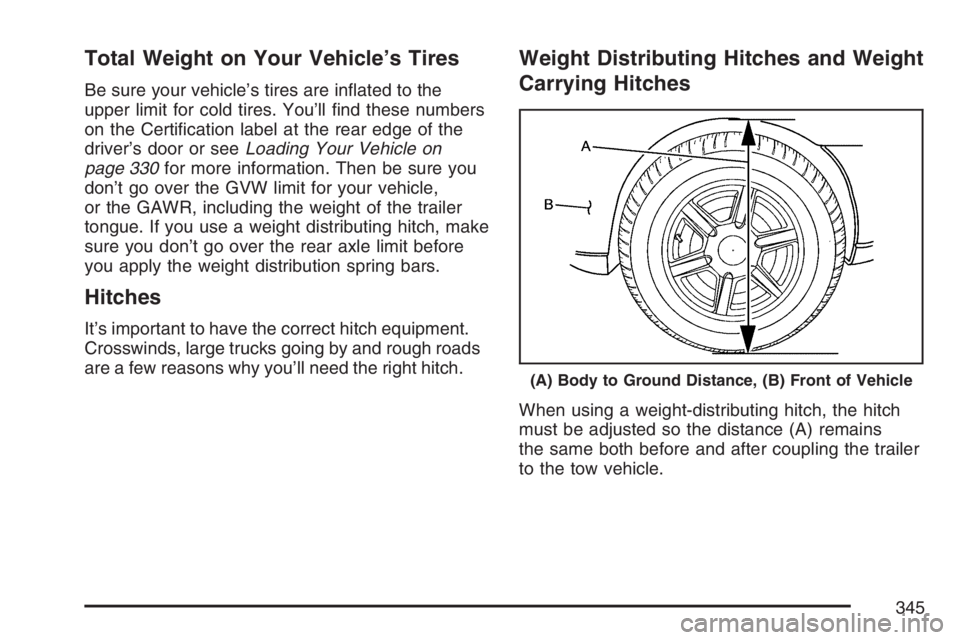
When using a weight-distributing hitch, the hitch
must be adjusted so the distance (A) remains
the same both before and after coupling the trailer
to the tow vehicle.
(A) Body to Ground Distance, (B) Front of Vehicle
345
Page 348 of 534
Before you start, check all trailer hitch parts and
attachments, safety chains, electrical connection,
lamps, tires and mirror adjustment. If the trailer
has electric brakes, start your vehicle and
trailer moving and then apply the trailer brake
controller by hand to be sure the brakes are
working. This lets you check your electrical
connection at the same time.
During your trip, check occasionally to be sure
that the load is secure, and that the lamps and any
trailer brakes are still working.
Following Distance
Stay at least twice as far behind the vehicle ahead
as you would when driving your vehicle without
a trailer. This can help you avoid situations
that require heavy braking and sudden turns.
Passing
You’ll need more passing distance up ahead when
you’re towing a trailer. And, because you’re a
good deal longer, you’ll need to go much farther
beyond the passed vehicle before you can
return to your lane.
Backing Up
Hold the bottom of the steering wheel with
one hand. Then, to move the trailer to the left, just
move that hand to the left. To move the trailer
to the right, move your hand to the right. Always
back up slowly and, if possible, have someone
guide you.
Making Turns
Notice:Making very sharp turns while
trailering could cause the trailer to come in
contact with the vehicle. Your vehicle could be
damaged. Avoid making very sharp turns
while trailering.
When you’re turning with a trailer, make wider
turns than normal. Do this so your trailer
won’t strike soft shoulders, curbs, road signs,
trees or other objects. Avoid jerky or sudden
maneuvers. Signal well in advance.
348
Page 354 of 534
Tires............................................................ 411
Tire Sidewall Labeling............................... 412
Tire Terminology and Denitions............... 416
Ination - Tire Pressure............................. 419
Tire Pressure Monitor System................... 420
Tire Inspection and Rotation...................... 425
When It Is Time for New Tires.................. 426
Buying New Tires...................................... 427
Different Size Tires and Wheels................ 428
Uniform Tire Quality Grading..................... 429
Wheel Alignment and Tire Balance............ 431
Wheel Replacement.................................. 432
Tire Chains............................................... 433
Accessory Inator...................................... 434
If a Tire Goes Flat.................................... 435
Changing a Flat Tire................................. 436
Removing the Spare Tire and Tools.......... 438
Removing the Flat Tire and Installing
the Spare Tire....................................... 440
Secondary Latch System........................... 446
Storing a Flat or Spare Tire and Tools...... 450
Spare Tire................................................. 453Appearance Care........................................ 453
Cleaning the Inside of Your Vehicle.......... 453
Fabric/Carpet............................................. 455
Leather...................................................... 456
Instrument Panel, Vinyl, and Other
Plastic Surfaces..................................... 456
Care of Safety Belts.................................. 457
Washing Your Vehicle............................... 457
Cleaning Exterior Lamps/Lenses................ 458
Finish Care............................................... 458
Windshield, Backglass, and
Wiper Blades......................................... 459
Aluminum Wheels...................................... 459
Tires......................................................... 460
Sheet Metal Damage................................. 460
Finish Damage.......................................... 460
Underbody Maintenance............................ 461
Chemical Paint Spotting............................ 461
Vehicle Care/Appearance Materials............ 462
Vehicle Identication.................................. 463
Vehicle Identication Number (VIN)........... 463
Service Parts Identication Label............... 463
Section 5 Service and Appearance Care
354
Page 395 of 534
Properly torqued wheel nuts are necessary to help
prevent brake pulsation. When tires are rotated,
inspect brake pads for wear and evenly tighten
wheel nuts in the proper sequence to GM torque
specications.
Brake linings should always be replaced as
complete axle sets.
Brake Pedal Travel
See your dealer if the brake pedal does not return
to normal height, or if there is a rapid increase
in pedal travel. This could be a sign of brake
trouble.
Brake Adjustment
Every time you make a brake stop, your disc
brakes adjust for wear.
Replacing Brake System Parts
The braking system on a vehicle is complex. Its
many parts have to be of top quality and work well
together if the vehicle is to have really good
braking. Your vehicle was designed and tested
with top-quality GM brake parts. When you replace
parts of your braking system — for example,
when your brake linings wear down and you need
new ones put in — be sure you get new
approved GM replacement parts. If you do not,
your brakes may no longer work properly.
For example, if someone puts in brake linings that
are wrong for your vehicle, the balance between
your front and rear brakes can change — for
the worse. The braking performance you have
come to expect can change in many other ways
if someone puts in the wrong replacement
brake parts.
395
Page 411 of 534
Tires
Your new vehicle comes with high-quality tires
made by a leading tire manufacturer. If you ever
have questions about your tire warranty and where
to obtain service, see your GM Warranty booklet
for details. For additional information refer to
the tire manufacturer’s booklet included with your
vehicle.
{CAUTION:
Poorly maintained and improperly used
tires are dangerous.
Overloading your vehicle’s tires can
cause overheating as a result of too
much friction. You could have an
air-out and a serious accident. See
Loading Your Vehicle on page 330.
CAUTION: (Continued)
CAUTION: (Continued)
Underinated tires pose the same
danger as overloaded tires. The
resulting accident could cause serious
injury. Check all tires frequently to
maintain the recommended pressure.
Tire pressure should be checked when
your vehicle’s tires are cold. See
Inflation - Tire Pressure on page 419.
Overinated tires are more likely to be
cut, punctured, or broken by a sudden
impact — such as when you hit a
pothole. Keep tires at the
recommended pressure.
Worn, old tires can cause accidents. If
the tire’s tread is badly worn, or if
your vehicle’s tires have been
damaged, replace them.
411