manual transmission BUICK RAINIER 2007 Owner's Manual
[x] Cancel search | Manufacturer: BUICK, Model Year: 2007, Model line: RAINIER, Model: BUICK RAINIER 2007Pages: 534, PDF Size: 2.87 MB
Page 351 of 534
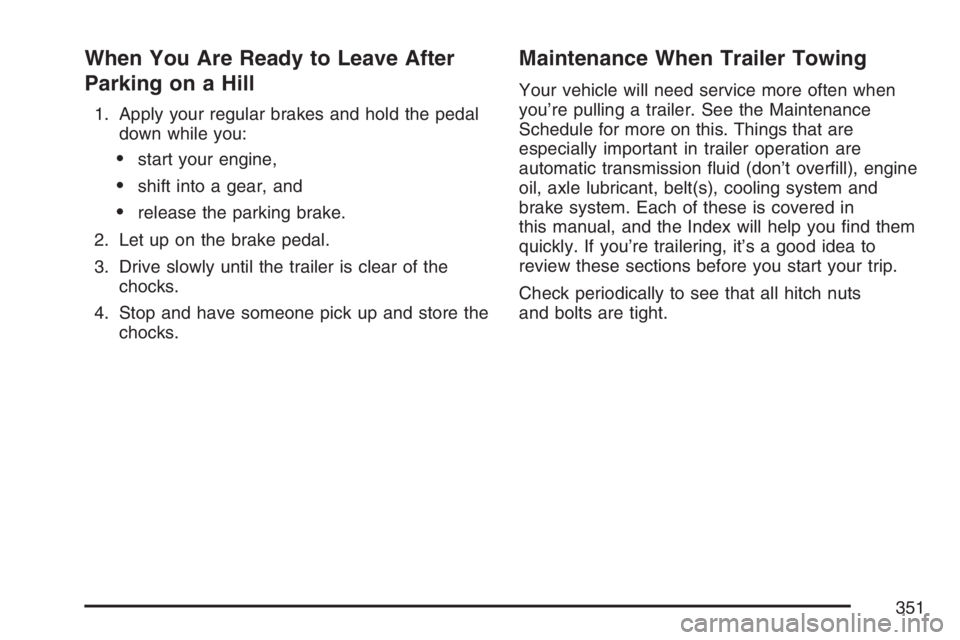
When You Are Ready to Leave After
Parking on a Hill
1. Apply your regular brakes and hold the pedal
down while you:
start your engine,
shift into a gear, and
release the parking brake.
2. Let up on the brake pedal.
3. Drive slowly until the trailer is clear of the
chocks.
4. Stop and have someone pick up and store the
chocks.
Maintenance When Trailer Towing
Your vehicle will need service more often when
you’re pulling a trailer. See the Maintenance
Schedule for more on this. Things that are
especially important in trailer operation are
automatic transmission uid (don’t overll), engine
oil, axle lubricant, belt(s), cooling system and
brake system. Each of these is covered in
this manual, and the Index will help you nd them
quickly. If you’re trailering, it’s a good idea to
review these sections before you start your trip.
Check periodically to see that all hitch nuts
and bolts are tight.
351
Page 397 of 534
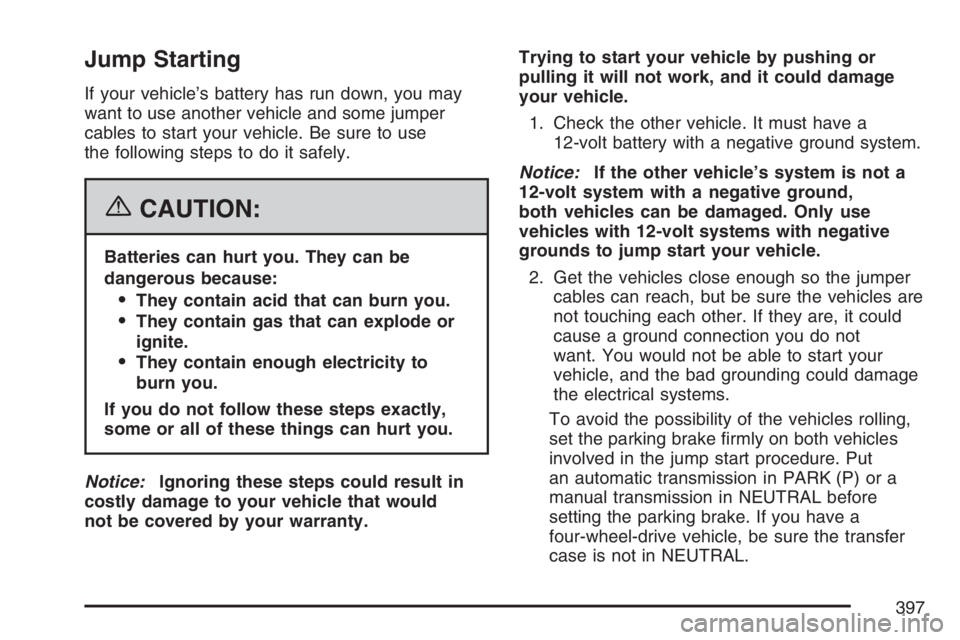
Jump Starting
If your vehicle’s battery has run down, you may
want to use another vehicle and some jumper
cables to start your vehicle. Be sure to use
the following steps to do it safely.
{CAUTION:
Batteries can hurt you. They can be
dangerous because:
They contain acid that can burn you.
They contain gas that can explode or
ignite.
They contain enough electricity to
burn you.
If you do not follow these steps exactly,
some or all of these things can hurt you.
Notice:Ignoring these steps could result in
costly damage to your vehicle that would
not be covered by your warranty.Trying to start your vehicle by pushing or
pulling it will not work, and it could damage
your vehicle.
1. Check the other vehicle. It must have a
12-volt battery with a negative ground system.
Notice:If the other vehicle’s system is not a
12-volt system with a negative ground,
both vehicles can be damaged. Only use
vehicles with 12-volt systems with negative
grounds to jump start your vehicle.
2. Get the vehicles close enough so the jumper
cables can reach, but be sure the vehicles are
not touching each other. If they are, it could
cause a ground connection you do not
want. You would not be able to start your
vehicle, and the bad grounding could damage
the electrical systems.
To avoid the possibility of the vehicles rolling,
set the parking brake rmly on both vehicles
involved in the jump start procedure. Put
an automatic transmission in PARK (P) or a
manual transmission in NEUTRAL before
setting the parking brake. If you have a
four-wheel-drive vehicle, be sure the transfer
case is not in NEUTRAL.
397
Page 474 of 534
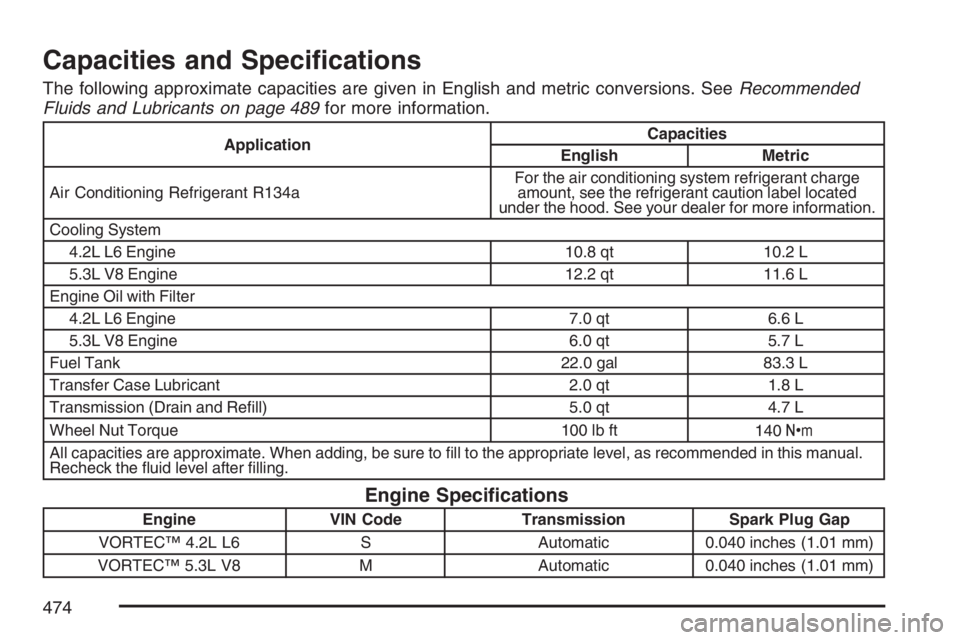
Capacities and Specications
The following approximate capacities are given in English and metric conversions. SeeRecommended
Fluids and Lubricants on page 489for more information.
ApplicationCapacities
English Metric
Air Conditioning Refrigerant R134aFor the air conditioning system refrigerant charge
amount, see the refrigerant caution label located
under the hood. See your dealer for more information.
Cooling System
4.2L L6 Engine 10.8 qt 10.2 L
5.3L V8 Engine 12.2 qt 11.6 L
Engine Oil with Filter
4.2L L6 Engine 7.0 qt 6.6 L
5.3L V8 Engine 6.0 qt 5.7 L
Fuel Tank 22.0 gal 83.3 L
Transfer Case Lubricant 2.0 qt 1.8 L
Transmission (Drain and Rell) 5.0 qt 4.7 L
Wheel Nut Torque 100 lb ft
140Y
All capacities are approximate. When adding, be sure to ll to the appropriate level, as recommended in this manual.
Recheck the uid level after lling.
Engine Specications
Engine VIN Code Transmission Spark Plug Gap
VORTEC™ 4.2L L6 S Automatic 0.040 inches (1.01 mm)
VORTEC™ 5.3L V8 M Automatic 0.040 inches (1.01 mm)
474
Page 517 of 534
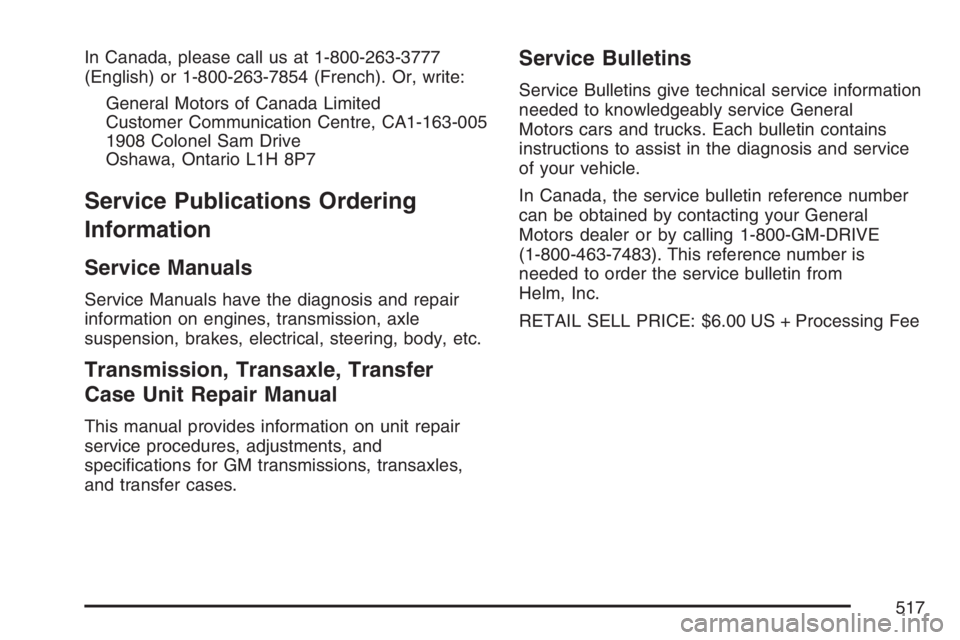
In Canada, please call us at 1-800-263-3777
(English) or 1-800-263-7854 (French). Or, write:
General Motors of Canada Limited
Customer Communication Centre, CA1-163-005
1908 Colonel Sam Drive
Oshawa, Ontario L1H 8P7
Service Publications Ordering
Information
Service Manuals
Service Manuals have the diagnosis and repair
information on engines, transmission, axle
suspension, brakes, electrical, steering, body, etc.
Transmission, Transaxle, Transfer
Case Unit Repair Manual
This manual provides information on unit repair
service procedures, adjustments, and
specications for GM transmissions, transaxles,
and transfer cases.
Service Bulletins
Service Bulletins give technical service information
needed to knowledgeably service General
Motors cars and trucks. Each bulletin contains
instructions to assist in the diagnosis and service
of your vehicle.
In Canada, the service bulletin reference number
can be obtained by contacting your General
Motors dealer or by calling 1-800-GM-DRIVE
(1-800-463-7483). This reference number is
needed to order the service bulletin from
Helm, Inc.
RETAIL SELL PRICE: $6.00 US + Processing Fee
517
Page 520 of 534
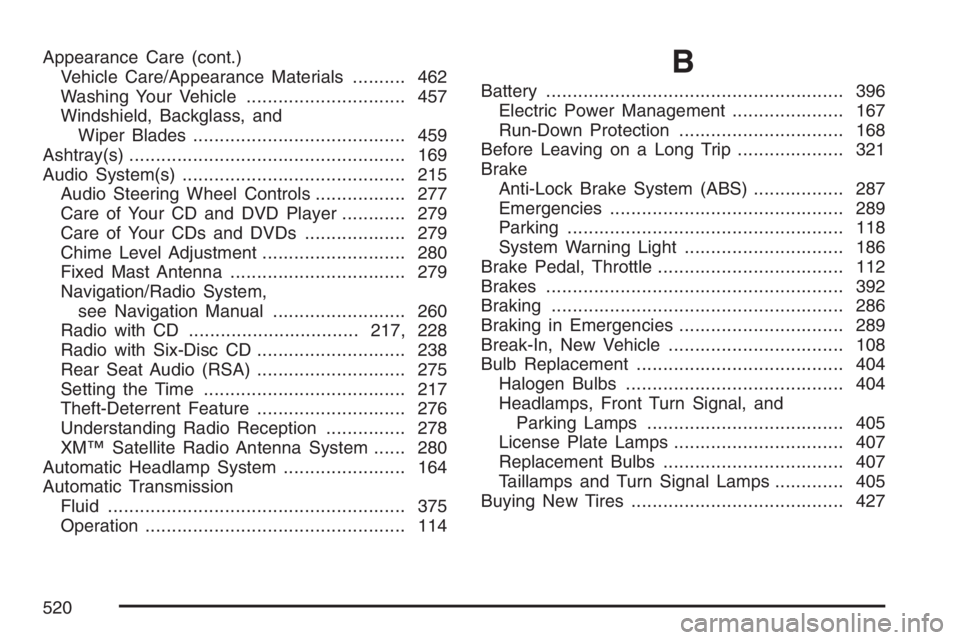
Appearance Care (cont.)
Vehicle Care/Appearance Materials.......... 462
Washing Your Vehicle.............................. 457
Windshield, Backglass, and
Wiper Blades........................................ 459
Ashtray(s).................................................... 169
Audio System(s).......................................... 215
Audio Steering Wheel Controls................. 277
Care of Your CD and DVD Player............ 279
Care of Your CDs and DVDs................... 279
Chime Level Adjustment........................... 280
Fixed Mast Antenna................................. 279
Navigation/Radio System,
see Navigation Manual......................... 260
Radio with CD................................217, 228
Radio with Six-Disc CD............................ 238
Rear Seat Audio (RSA)............................ 275
Setting the Time...................................... 217
Theft-Deterrent Feature............................ 276
Understanding Radio Reception............... 278
XM™ Satellite Radio Antenna System...... 280
Automatic Headlamp System....................... 164
Automatic Transmission
Fluid........................................................ 375
Operation................................................. 114B
Battery........................................................ 396
Electric Power Management..................... 167
Run-Down Protection............................... 168
Before Leaving on a Long Trip.................... 321
Brake
Anti-Lock Brake System (ABS)................. 287
Emergencies............................................ 289
Parking.................................................... 118
System Warning Light.............................. 186
Brake Pedal, Throttle................................... 112
Brakes........................................................ 392
Braking....................................................... 286
Braking in Emergencies............................... 289
Break-In, New Vehicle................................. 108
Bulb Replacement....................................... 404
Halogen Bulbs......................................... 404
Headlamps, Front Turn Signal, and
Parking Lamps..................................... 405
License Plate Lamps................................ 407
Replacement Bulbs.................................. 407
Taillamps and Turn Signal Lamps............. 405
Buying New Tires........................................ 427
520