seats BUICK RANDEZVOUS 2002 User Guide
[x] Cancel search | Manufacturer: BUICK, Model Year: 2002, Model line: RANDEZVOUS, Model: BUICK RANDEZVOUS 2002Pages: 455, PDF Size: 2.86 MB
Page 33 of 455

1-26
Q:If I'm a good driver, and I never drive far from
home, why should I wear safety belts?
A:You may be an excellent driver, but if you're in an
accident
-- even one that isn't your fault -- you
and your passengers can be hurt. Being a good
driver doesn't protect you from things beyond your
control, such as bad drivers.
Most accidents occur within 25 miles (40 km)
of home. And the greatest number of serious
injuries and deaths occur at speeds of less than
40 mph (65 km/h).
Safety belts are for everyone.
How to Wear Safety Belts Properly
Adults
This part is only for people of adult size.
Be aware that there are special things to know about
safety belts and children. And there are different rules
for smaller children and babies. If a child will be riding
in your vehicle, see the part of this manual called
ªChildren.º Follow those rules for everyone's protection.
First, you'll want to know which restraint systems your
vehicle has.
We'll start with the driver position.
Driver Position
This part describes the driver's restraint system.
Lap-Shoulder Belt
The driver has a lap-shoulder belt. Here's how to wear
it properly.
1. Close and lock the door.
2. Adjust the seat so you can sit up straight.
To see how, see ªSeatsº in the Index.
Page 59 of 455

1-52
Rear Safety Belt Comfort Guides for
Children and Small Adults
Your vehicle may have rear shoulder belt comfort
guides. This feature will provide added safety belt
comfort for older children who have outgrown booster
seats and for small adults. When installed on a shoulder
belt, the comfort guide better positions the belt away
from the neck and head.
There is one guide for each passenger position in the
second row rear seat. To provide added safety belt
comfort for children who have outgrown child restraints
and for smaller adults, the comfort guides may be
installed on the shoulder belts. Here's how to install a
comfort guide and use the safety belt:
Second Row Outside Positions
Page 68 of 455

1-61
A booster seat (F-G) is a child restraint designed to
improve the fit of the vehicle's safety belt system.
Some booster seats have a shoulder belt positioner,
and some high
-back booster seats have a five-point
harness. A booster seat can also help a child to see
out the window.
Q:How do child restraints work?
A:A child restraint system is any device designed for
use in a motor vehicle to restrain, seat, or position
children. A built
-in child restraint system is a
permanent part of the motor vehicle. An add
-on
child restraint system is a portable one, which is
purchased by the vehicle's owner.
For many years, add
-on child restraints have used
the adult belt system in the vehicle. To help reduce
the chance of injury, the child also has to be
secured within the restraint. The vehicle's belt
system secures the add
-on child restraint in the
vehicle, and the add
-on child restraint's harness
system holds the child in place within the restraint.
One system, the three
-point harness, has straps that
come down over each of the infant's shoulders and
buckle together at the crotch. The five
-point
harness system has two shoulder straps, two hip
straps and a crotch strap. A shield may take the
place of hip straps. A T
-shaped shield has shoulder
straps that are attached to a flat pad which rests low
against the child's body. A shelf
- or armrest-type
shield has straps that are attached to a wide,
shelf
-like shield that swings up or to the side.
Page 71 of 455

1-64
If you're using a top strap-equipped child restraint in the
second row center bench seat and need to temporarily
transport a flat tire for repair, move the child restraint to
a rear seat outboard position. See ªSecuring a Child
Restraint in a Rear Outside Seat Positionº for more on
this, including important safety information.
Once you have the top strap anchored, you'll be ready
to secure the child restraint itself. Tighten the top strap
when and as the child restraint manufacturer's
instructions say.
Your vehicle has top strap anchors already installed for
the rear seating positions. An anchor bar for a top strap
is located at the rear of the seat cushion for each second
row outboard seating position and the anchor bar for
the center position for the bench seat is located on the
floor behind the second row seats. If the vehicle has the
extended rear convenience center, you need to remove
a plastic plug and look under the convenience center to
find the anchor bar for the center position for the bench
seat. If the vehicle has a third row seat and the seatback
is upright, there is an anchor strap located between the
third row seatback and cushion to anchor the child
restraint for the second row center position bench seat.
If the vehicle has a third row seat and the seatback is
folded, there is anchor on the back of the third row
seat for the second row center position bench seat.There is also a top strap anchor for third row passenger's
side outside position. Locate the anchor symbol on the
flap of carpet behind the seat. Lift up the carpet to
access the anchor.
Captain's Chairs
Page 72 of 455

1-65
Second Row Outside Positions Bench SeatSecond Row Center Position Bench Seat
without Third Row Seat
Page 73 of 455

1-66
Second Row Center Position Bench Seat
with Third Row SeatSecond Row Center Position Bench Seat
with Third Row Seat Folded Down
Page 81 of 455
1-74
To remove the child restraint, just unbuckle the vehicle's
safety belt. When you remove the child restraint,
be sure to reconnect the lap and shoulder parts of the
belt so they will be ready to work for an adult or larger
child passenger.
Securing a Child Restraint in the
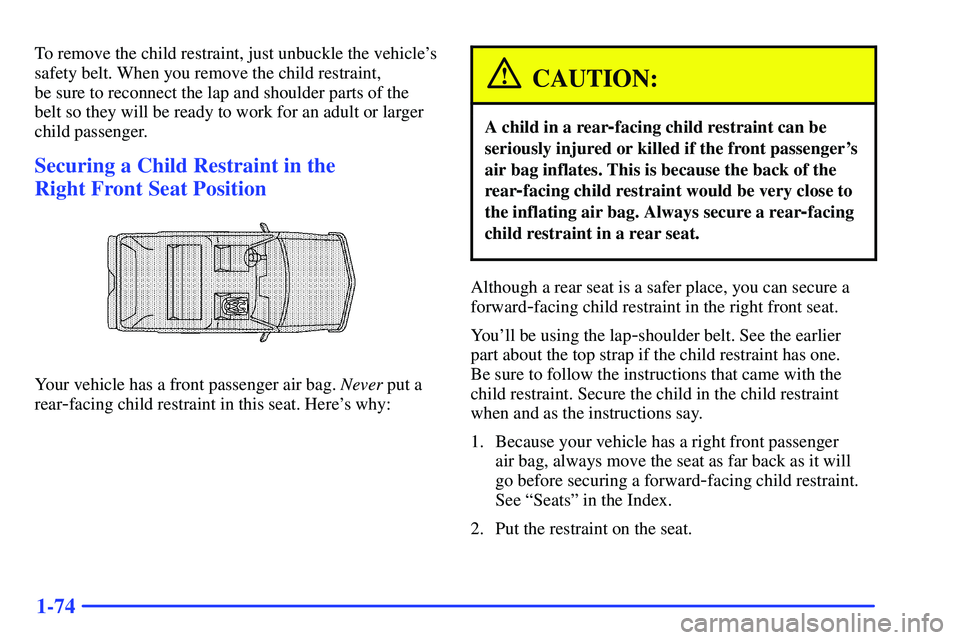
Right Front Seat Position
Your vehicle has a front passenger air bag. Never put a
rear
-facing child restraint in this seat. Here's why:
CAUTION:
A child in a rear-facing child restraint can be
seriously injured or killed if the front passenger's
air bag inflates. This is because the back of the
rear
-facing child restraint would be very close to
the inflating air bag. Always secure a rear
-facing
child restraint in a rear seat.
Although a rear seat is a safer place, you can secure a
forward
-facing child restraint in the right front seat.
You'll be using the lap
-shoulder belt. See the earlier
part about the top strap if the child restraint has one.
Be sure to follow the instructions that came with the
child restraint. Secure the child in the child restraint
when and as the instructions say.
1. Because your vehicle has a right front passenger
air bag, always move the seat as far back as it will
go before securing a forward
-facing child restraint.
See ªSeatsº in the Index.
2. Put the restraint on the seat.
Page 84 of 455
1-77
Older Children
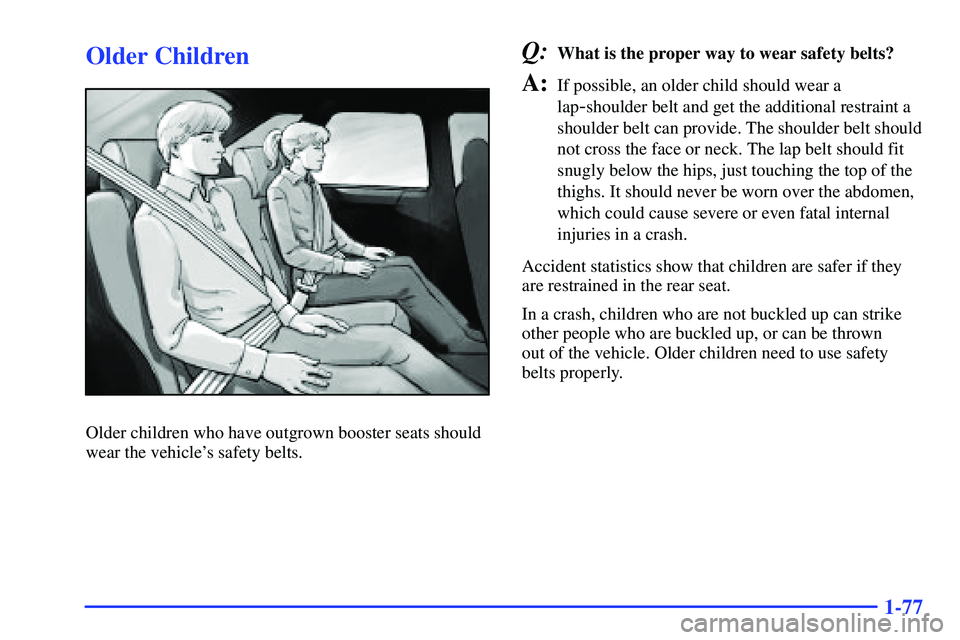
Older children who have outgrown booster seats should
wear the vehicle's safety belts.
Q:What is the proper way to wear safety belts?
A:If possible, an older child should wear a
lap
-shoulder belt and get the additional restraint a
shoulder belt can provide. The shoulder belt should
not cross the face or neck. The lap belt should fit
snugly below the hips, just touching the top of the
thighs. It should never be worn over the abdomen,
which could cause severe or even fatal internal
injuries in a crash.
Accident statistics show that children are safer if they
are restrained in the rear seat.
In a crash, children who are not buckled up can strike
other people who are buckled up, or can be thrown
out of the vehicle. Older children need to use safety
belts properly.
Page 101 of 455

2-13
Replacing the Battery in the Remote Transmitter
NOTICE:
When replacing the battery, use care not to
touch any of the circuitry. Static from your
body transferred to these surfaces may damage
the transmitter.
1. Insert a flat object, such as a coin, into the slot on the
side of the transmitter and twist to separate the halves.
2. Gently pry the battery out of the transmitter. Do not
use the metal flanges to ªpop outº the battery.
3. Replace the battery.
4. Reassemble the transmitter. Make sure the halves are
snapped together tightly so water will not get in.
5. Check the transmitter operation.
Center Console Switchbank
There is a center console switchbank located in the
instrument panel, below the comfort controls.
The switches will vary with the options that are
on your vehicle.
The center console switchbank consists of five switches.
The five possible switches are for the rear window
wiper/washer, the liftgate release, the traction disable,
the park aid disable, and the driver's and passenger's
heated seats. If your vehicle does not have some of the
options controlled by these switches, there will be a
blank button in its place.
For more information, see each of these features in
the Index.
Page 217 of 455

3-2
Comfort Controls
This section tells you how to make your air system work
for you.
With this system, you can control the heating, cooling
and ventilation in your vehicle. Your vehicle also has
a flow
-through ventilation system described later in
this section.
Dual Manual Comfort Control
Fan Knob
The left knob is used to select the force of air you want.
Turn the knob clockwise to increase fan speed and
counterclockwise to decrease fan speed. The fan must be
turned on for the air conditioning compressor to operate.Temperature Knob
The center knob controls the temperature of the air
coming through the system. Turn the knob clockwise
(toward the red area) for warmer air. Turn the knob
counterclockwise (toward the blue area) for cooler air.
Mode Knob
The right knob is used to select and determine the
direction of the air flowing into the vehicle.
(Upper): This setting directs air through the
instrument panel outlets and the rear console outlets.
(Bi-Level): This setting directs air into your
vehicle in two ways. Cooler air is directed toward your
upper body through the front instrument panel outlets
and the rear console outlets, while warmed air is
directed through the heater ducts at your feet.
(Lower): This setting brings in most of the air
through the floor ducts. It is also used to send air to the
rear of the vehicle. Keep the area under the front seats
free of objects that could obstruct airflow to the rear of
the vehicle.