fuel cap BUICK RANDEZVOUS 2003 User Guide
[x] Cancel search | Manufacturer: BUICK, Model Year: 2003, Model line: RANDEZVOUS, Model: BUICK RANDEZVOUS 2003Pages: 432, PDF Size: 2.75 MB
Page 295 of 432

The fuel cap is located on
the driver’s side of the
vehicle.
While refueling, let the fuel
cap hang by the tether as
shown.To remove the fuel cap, turn it slowly to the left
(counterclockwise). The fuel cap has spring in it;
if you let go of the cap too soon, it will spring back
to the right.
{CAUTION:
If you get fuel on yourself and then something
ignites it, you could be badly burned. Fuel can
spray out on you if you open the fuel cap too
quickly. This spray can happen if your tank is
nearly full, and is more likely in hot weather.
Open the fuel cap slowly and wait for any
“hiss” noise to stop. Then unscrew the cap all
the way.
Be careful not to spill fuel. Clean fuel from painted
surfaces as soon as possible. SeeCleaning the Outside
of Your Vehicle on page 5-80.
When you put the fuel cap back on, turn it to the right
(clockwise) until you hear a clicking sound. Make
sure you fully install the cap. The diagnostic system can
determine if the fuel cap has been left off or improperly
installed. This would allow fuel to evaporate into the
atmosphere. SeeMalfunction Indicator Lamp on
page 3-40.
5-7
2003 - Rendezvous OM
Page 296 of 432

The malfunction indicator lamp (SERVICE ENGINE
SOON or CHECK ENGINE light) will come on if the fuel
cap is not properly installed.
Notice:If you need a new fuel cap, be sure to get
the right type. Your dealer can get one for you.
If you get the wrong type, it may not fit properly.
This may cause your malfunction indicator lamp to
light and may damage your fuel tank and emissions
system. See “Malfunction Indicator Lamp” in the
Index.Filling a Portable Fuel Container
{CAUTION:
Never fill a portable fuel container while it is in
your vehicle. Static electricity discharge from
the container can ignite the gasoline vapor.
You can be badly burned and your vehicle
damaged if this occurs. To help avoid injury to
you and others:
•Dispense gasoline only into approved
containers.
•Do not fill a container while it is inside a
vehicle, in a vehicle’s trunk, pickup bed or
on any surface other than the ground.
•Bring the fill nozzle in contact with the
inside of the fill opening before operating
the nozzle. Contact should be maintained
until the filling is complete.
•Don’t smoke while pumping gasoline.
5-8
2003 - Rendezvous OM
Page 297 of 432
Checking Things Under
the Hood
{CAUTION:
An electric fan under the hood can start up
and injure you even when the engine is not
running. Keep hands, clothing and tools away
from any underhood electric fan.
{CAUTION:
Things that burn can get on hot engine parts
and start afire. These include liquids like fuel,
oil, coolant, brakefluid, windshield washer and
otherfluids, and plastic or rubber. You or
others could be burned. Be careful not to drop
or spill things that will burn onto a hot engine.
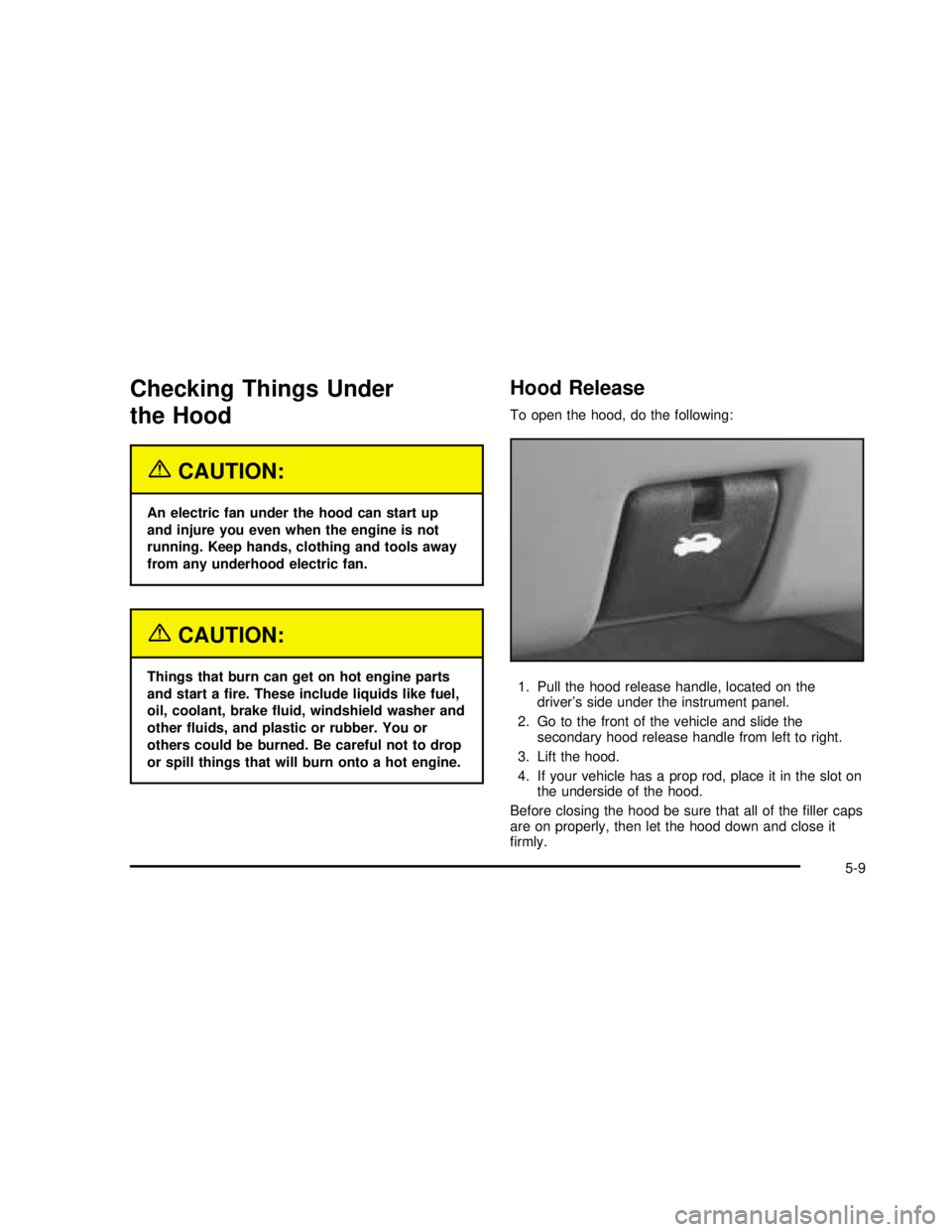
Hood Release
To open the hood, do the following:
1. Pull the hood release handle, located on the
driver’s side under the instrument panel.
2. Go to the front of the vehicle and slide the
secondary hood release handle from left to right.
3. Lift the hood.
4. If your vehicle has a prop rod, place it in the slot on
the underside of the hood.
Before closing the hood be sure that all of thefiller caps
are on properly, then let the hood down and close it
firmly.
5-9
2003 - Rendezvous OM
Page 299 of 432

E. Brake Master Cylinder
F. Windshield Washer Fluid Reservoir
G. Battery
H. Radiator Pressure Cap
I. Engine Oil Fill Cap
J. Engine Oil Dipstick
K. Engine Air Cleaner/Filter
L. Coolant Recovery Tank
Engine Oil
If the low engine oil level message appears on the
instrument cluster, it means you need to check your
engine oil level right away. For more information,
seeLow Engine Oil Level Message on page 3-47.
You should check your engine oil level regularly; this is
an added reminder.
Checking Engine Oil
It’s a good idea to check your engine oil every time you
get fuel. In order to get an accurate reading, the oil
must be warm and the vehicle must be on level ground.
The engine oil dipstick is
located at the front of the
engine compartment,
near the center. The
dipstick handle has a
bright, yellow loop design
for easy identification.
SeeEngine Compartment Overview on page 5-10for
more information on location.
Turn off the engine and give the oil several minutes to
drain back into the oil pan. If you don’t, the oil
dipstick might not show the actual level.
Pull out the dipstick and clean it with a paper towel or
cloth, then push it back in all the way. Remove it again,
keeping the tip down, and check the level.
5-11
2003 - Rendezvous OM
Page 337 of 432

Inflation -- Tire Pressure
The Certification/Tire label, which is on the rear edge of
the driver’s door, shows the correct inflation pressures
for your tires when they’re cold.“Cold”means your
vehicle has been sitting for at least three hours or driven
no more than 1 mile (1.6 km).
Notice:Don’t let anyone tell you that underinflation
or overinflation is all right. It’s not. If your tires
don’t have enough air (underinflation), you can get
the following:
•Too muchflexing
•Too much heat
•Tire overloading
•Bad wear
•Bad handling
•Bad fuel economy
If your tires have too much air (overinflation), you
can get the following:
•Unusual wear
•Bad handling
•Rough ride
•Needless damage from road hazards
When to Check
Check your tires once a month or more.
Don’t forget your compact spare tire. It should be at
60 psi (420 kPa).
How to Check
Use a good quality pocket-type gage to check tire
pressure. You can’t tell if your tires are properly inflated
simply by looking at them. Radial tires may look
properly inflated even when they’re underinflated.
Be sure to put the valve caps back on the valve stems.
They help prevent leaks by keeping out dirt and
moisture.
Check Tire Pressure System
Your vehicle may have a check tire pressure system
that can alert you to a large change in the pressure of
one tire. The system won’t alert you before you drive
that a tire is low orflat. You must begin driving before
the system will work properly.
The LOW TIRE PRESSURE HOLD SET TO RESET
message will appear on the Driver Information Center
(DIC) and the LOW TIRE PRESSURE message
will come on the message center if pressure difference
(low pressure) is detected in one tire. In the following
conditions, the LOW TIRE PRESSURE message
5-49
2003 - Rendezvous OM
Page 380 of 432

Capacities and Specifications
The following approximate capacities are given in English and metric conversions.
Please refer toPart D: Recommended Fluids and Lubricants on page 6-15for more information.
ApplicationCapacities
English Metric
Air Conditioning Refrigerant (R134a) 1.7 lbs. 0.8 kg
Automatic Transaxle
Pan Removal and Replacement
Complete Overhaul7.4 quarts
10.0 quarts7.0 L
9.5 L
AWD Automatic Transaxle
Pan Removal and Replacement
Complete Overhaul8.7 quarts
10.8 quarts8.3 L
10.3 L
Cooling System with A/C 9.6 quarts 9.1 L
Engine Oil with Filter 4.5 quarts 4.3 L
Fuel Capacity 18.0 gallons 68.1 L
Rear Differential Fluid Capacity 2.1 quarts 1.9 L
Transfer Case Fluid Capacity 0.6 pints 290 ml
Wheel Nut Torque 100 lb ft 140Y
5-92
2003 - Rendezvous OM
Page 395 of 432

Part C: Periodic Maintenance
Inspections
Listed in this part are inspections and services which
should be performed at least twice a year (for instance,
each spring and fall).You should let your dealer’s
service department or other qualified service center do
these jobs. Make sure any necessary repairs are
completed at once.
Proper procedures to perform these services may be
found in a service manual. SeeService Publications
Ordering Information on page 7-9.
Steering, Suspension and Front
Drive Axle Boot and Seal Inspection
Inspect the front and rear suspension and steering
system for damaged, loose or missing parts, signs of
wear or lack of lubrication. Inspect the power steering
lines and hoses for proper hook-up, binding, leaks,
cracks, chang, etc. Clean and then inspect the drive
axle boot seals for damage, tears or leakage. Replace
seals if necessary.
Exhaust System Inspection
Inspect the complete exhaust system. Inspect the body
near the exhaust system. Look for broken, damaged,
missing or out-of-position parts as well as open seams,
holes, loose connections or other conditions which
could cause a heat build-up in theoor pan or could let
exhaust fumes into the vehicle. SeeEngine Exhaust
on page 2-29.
Fuel System Inspection
Inspect the complete fuel system for damage or leaks.
Engine Cooling System Inspection
Inspect the hoses and have them replaced if they
are cracked, swollen or deteriorated. Inspect all pipes,
ttings and clamps; replace as needed. Clean the
outside of the radiator and air conditioning condenser.
To help ensure proper operation, a pressure test of
the cooling system and pressure cap is recommended
at least once a year.
6-13
2003 - Rendezvous OM
Page 411 of 432

A
About Driving Your Vehicle.....................................ii
Accessory Inflator...........................................5-57
Accessory Power Outlets.................................3-23
Adding Washer Fluid.......................................5-32
Additional Program Information........................... 7-8
Additives, Fuel................................................. 5-6
Add-On Electrical Equipment............................5-85
Adjusting the Captain’s Chairs
(Second Row).............................................1-12
Adjusting the Speakers....................3-67, 3-74, 3-84
Air Bag
Readiness Light..........................................3-37
Air Bag Systems.............................................1-67
How Does an Air Bag Restrain?....................1-73
Servicing Your Air Bag-Equipped Vehicle.........1-76
What Makes an Air Bag Inflate?....................1-73
What Will You See After an Air Bag Inflates?......1-74
When Should an Air Bag Inflate?...................1-72
Where Are the Air Bags?..............................1-70
Air Cleaner/Filter, Engine.................................5-15
All Overseas Locations...................................... 7-4
All-Wheel Drive......................................5-41, 5-77
All-Wheel Drive Disable Warning Message..........3-49
All-Wheel-Drive (AWD) System.........................4-11
Aluminum or Chrome-Plated Wheels..................5-82
AM .............................................................3-108
Antenna, Integrated Windshield.......................3-110Antenna, XM™ Satellite Radio Antenna System . . . 3-110
Anti-lock Brake System (ABS)............................ 4-8
Anti-Lock Brake, System Warning Light..............3-39
Appearance Care............................................5-77
Care of Safety Belts....................................5-80
Chemical Paint Spotting...............................5-83
Cleaning the Inside of Your Vehicle................5-78
Cleaning the Outside of Your Vehicle..............5-80
Finish Damage............................................5-83
GM Vehicle Care/Appearance Materials..........5-83
Sheet Metal Damage...................................5-82
Underbody Maintenance...............................5-83
Weatherstrips..............................................5-80
Arming with the Power Lock Switch...................2-15
Arming with the Remote Keyless Entry
Transmitter
.................................................2-16
Ashtrays
........................................................3-24
Audio Speakers
..............................................3-95
Audio System(s)
.............................................3-64
Audio Steering Wheel Controls
....................3-107
Care of Your Cassette Tape Player
...............3-108
Care of Your CD and DVD Player
................3-109
Care of Your CDs and DVDs
.......................3-109
Integrated Windshield Antenna
.....................3-110
Radio with Cassette and CD
.........................3-71
Radio with CD
............................................3-65
Radio with Six-Disc CD
................................3-82
Rear Seat Audio (RSA)
...............................3-105
1
2003 - Rendezvous OM
Page 412 of 432

Audio System(s) (cont.)
Setting the Time..........................................3-65
Theft-Deterrent Feature...............................3-106
Understanding Radio Reception...................3-108
XM™Satellite Radio Antenna System...........3-110
Auto Door Lock/Unlock....................................3-59
Automatic Door Lock/Unlock.............................2-48
Automatic Headlamp System............................3-13
Automatic Level Control...................................4-33
Automatic Operation........................................3-29
Automatic Transaxle
Fluid..........................................................5-17
Operation...................................................2-22
Automatic Transaxle Check..............................6-10
Automatic Transaxle Shift Lock Control
System Check.............................................6-11
B
Backing Up....................................................4-39
Battery..........................................................5-36
Battery Replacement......................................... 2-7
Battery Run-Down Protection............................3-17
Before Leaving on a Long Trip.........................4-22
Before You Drive............................................3-94
Bench Seat, Split............................................. 1-7
Body Lubrication Service..................................6-10
Brake
Low Fluid Warning Message.........................3-51
Parking......................................................2-25Brake (cont.)
System Inspection.......................................6-14
System Warning Light..................................3-38
Brake Fluid....................................................5-33
Brake Wear...................................................5-35
Brakes..........................................................5-33
Braking........................................................... 4-7
Braking in Emergencies..................................... 4-9
Break-In, New Vehicle.....................................2-18
Bulb Replacement...........................................5-42
Front Turn Signal, Sidemarker and
Parking Lamps.........................................5-44
Halogen Bulbs............................................5-43
Headlamps.................................................5-43
Replacement Bulbs......................................5-46
Taillamps and Back-Up Lamps.......................5-45
Taillamps, Turn Signal, and Stoplamps............5-45
Buying New Tires...........................................5-53C
California Fuel.................................................. 5-5
Canada........................................................... 7-4
Canadian Owners................................................ ii
Canadian Roadside Assistance........................... 7-6
Canceling the Rear Door Security Locks............2-10
Capacities and Specifications............................5-92
Captain Chairs, Rear.......................................1-12
Carbon Monoxide...................4-25, 4-34, 2-11, 2-29
2
2003 - Rendezvous OM