spare wheel BUICK RANDEZVOUS 2003 Owner's Manual
[x] Cancel search | Manufacturer: BUICK, Model Year: 2003, Model line: RANDEZVOUS, Model: BUICK RANDEZVOUS 2003Pages: 432, PDF Size: 2.75 MB
Page 185 of 432

PASS-Key®III Security Message
If you are ever driving and this message comes on and
stays on, you will be able to restart your engine if
you turn it off.
Your PASS-Key
®III system, however, is not working
properly and must be serviced by your dealer. Your
vehicle is not protected by the PASS-Key
®III system at
this time. SeePASS-Key®III on page 2-16for more
information.
All-Wheel Drive Disable Warning
Message
Your vehicle may have this message. If it does, it will
come on when there is a spare tire on the vehicle, or
when the anti-lock brake system warning light comes on,
or when the rear differentialfluid is overheating. This
message will go out when the differentialfluid cools.
The all-wheel-drive system will be disabled until the
compact spare tire is replaced by a full-size tire. If the
warning message is still on after putting on the full-size
tire, you need to reset the warning message. To
reset the warning message, turn the ignition off and
then back on again. If the message stays on, see your
dealer right away. SeeAll-Wheel Drive (AWD)
System on page 4-11for more information. United States
Canada
United StatesCanada
3-49
2003 - Rendezvous OM
Page 339 of 432

The system completes the calibration process during
driving. The system“learns”the pressure at each
tire throughout the operating speed range of your
vehicle. The system normally takes between 30 and
60 minutes of driving to learn the tire pressures.
The system normally takes 10 to 20 minutes of driving
in each speed range to learn tire pressures. The
speed ranges are 20 to 40 mph (32 to 64 km/h), 40 to
60 mph (64 to 96 km/h) and above 60 mph (96 km/h).
This time may be longer depending on your individual
driving habits. The learning process does not need to be
completed during a single trip. Once learned, the
system will remember the tire pressure until the system
is reset.
Tire Inspection and Rotation
Tires should be rotated every 7,500 miles (12 500 km).
Any time you notice unusual wear, rotate your tires
as soon as possible and check wheel alignment. Also
check for damaged tires or wheels. SeeWhen It Is Time
for New Tires on page 5-52andWheel Replacement
on page 5-55for more information.
Make sure the spare tire is stored securely. Push, pull,
and then try to rotate or turn the tire, If it moves,
use the folding wrench to tighten the cable. See“Storing
a Flat or Spare Tire and Tools”inChanging a Flat
Tire on page 5-59.The purpose of regular rotation is to achieve more
uniform wear for all tires on the vehicle. Thefirst rotation
is the most important. See“Part A: Scheduled
Maintenance Services,”in Section 6, for scheduled
rotation intervals.
When rotating your tires, always use the correct rotation
pattern shown here.
Don’t include the compact spare tire in your tire rotation.
After the tires have been rotated, adjust the front and
rear inflation pressures as shown on the
Certification/Tire label.
Reset the check tire pressure system, if equipped. See
Check Tire Pressure System on page 5-49.
5-51
2003 - Rendezvous OM
Page 341 of 432

•The tire has a bump, bulge or split.
•The tire has a puncture, cut or other damage that
can’t be repaired well because of the size or
location of the damage.
Buying New Tires
Tofind out what kind and size of tires you need, look at
the Certification/Tire label.
The tires installed on your vehicle when it was new had
a Tire Performance Criteria Specification (TPC Spec)
number on each tire’s sidewall. When you get new tires,
get ones with that same TPC Spec number. That way
your vehicle will continue to have tires that are designed
to give proper endurance, handling, speed rating,
traction, ride and other things during normal service on
your vehicle. If your tires have an all-season tread
design, the TPC number will be followed by an“MS”
(for mud and snow).
If you ever replace your tires with those not having a
TPC Spec number, make sure they are the same size,
load range, speed rating and construction type (bias,
bias-belted or radial) as your original tires.
{CAUTION:
Mixing tires could cause you to lose control
while driving. If you mix tires of different sizes
or types (radial and bias-belted tires), the
vehicle may not handle properly, and you
could have a crash. Using tires of different
sizes may also cause damage to your vehicle.
Be sure to use the same size and type tires on
all wheels. It’s all right to drive with your
compact spare temporarily, it was developed
for use on your vehicle. See“Compact Spare
Tire”in the index.
{CAUTION:
If you use bias-ply tires on your vehicle, the
wheel rimflanges could develop cracks after
many miles of driving. A tire and/or wheel
could fail suddenly, causing a crash. Use only
radial-ply tires with the wheels on your vehicle.
5-53
2003 - Rendezvous OM
Page 342 of 432

Uniform Tire Quality Grading
Quality grades can be found where applicable on the
tire sidewall between tread shoulder and maximum
section width. For example:
Treadwear 200 Traction AA Temperature A
The following information relates to the system
developed by the United States National Highway
Traffic Safety Administration, which grades tires by
treadwear, traction and temperature performance.
(This applies only to vehicles sold in the United States.)
The grades are molded on the sidewalls of most
passenger car tires. The Uniform Tire Quality Grading
system does not apply to deep tread, winter-type
snow tires, space-saver or temporary use spare tires,
tires with nominal rim diameters of 10 to 12 inches
(25 to 30 cm), or to some limited-production tires.
While the tires available on General Motors passenger
cars and light trucks may vary with respect to these
grades, they must also conform to federal safety
requirements and additional General Motors Tire
Performance Criteria (TPC) standards.
Treadwear
The treadwear grade is a comparative rating based on
the wear rate of the tire when tested under controlled
conditions on a specified government test course.
For example, a tire graded 150 would wear one and
a half (1.5) times as well on the government course asa tire graded 100. The relative performance of tires
depends upon the actual conditions of their use,
however, and may depart significantly from the norm
due to variations in driving habits, service practices and
differences in road characteristics and climate.
Traction–AA, A, B, C
The traction grades, from highest to lowest, are AA, A,
B, and C. Those grades represent the tire’s ability
to stop on wet pavement as measured under controlled
conditions on specified government test surfaces of
asphalt and concrete. A tire marked C may have poor
traction performance. Warning: The traction grade
assigned to this tire is based on straight-ahead braking
traction tests, and does not include acceleration,
cornering, hydroplaning, or peak traction characteristics.
Temperature–A, B, C
The temperature grades are A (the highest), B, and C,
representing the tire’s resistance to the generation
of heat and its ability to dissipate heat when tested
under controlled conditions on a specified indoor
laboratory test wheel. Sustained high temperature can
cause the material of the tire to degenerate and
reduce tire life, and excessive temperature can lead to
sudden tire failure. The grade C corresponds to a
level of performance which all passenger car tires must
meet under the Federal Motor Vehicle Safety Standard
5-54
2003 - Rendezvous OM
Page 349 of 432
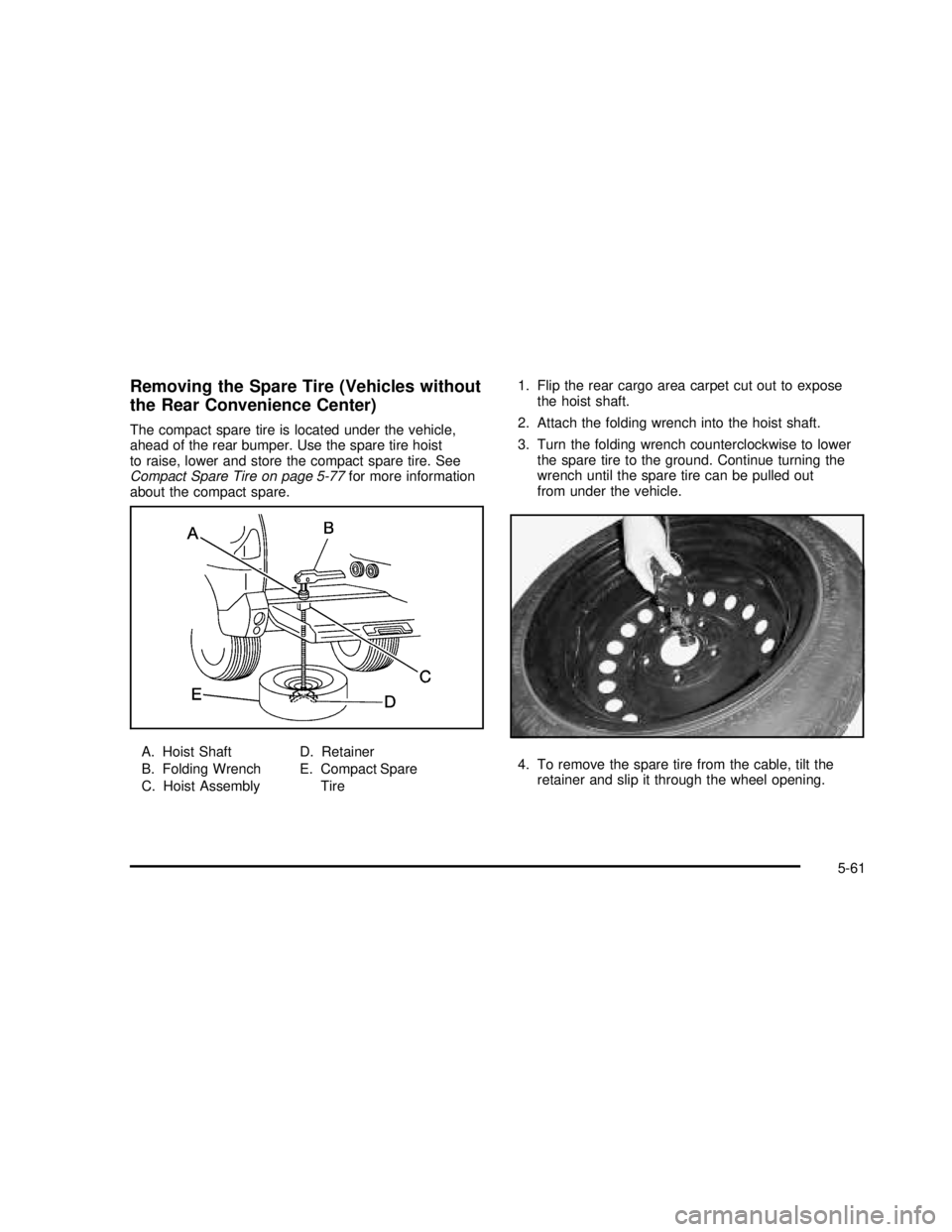
Removing the Spare Tire (Vehicles without
the Rear Convenience Center)
The compact spare tire is located under the vehicle,
ahead of the rear bumper. Use the spare tire hoist
to raise, lower and store the compact spare tire. See
Compact Spare Tire on page 5-77for more information
about the compact spare.
A. Hoist Shaft
B. Folding Wrench
C. Hoist AssemblyD. Retainer
E. Compact Spare
Tire1. Flip the rear cargo area carpet cut out to expose
the hoist shaft.
2. Attach the folding wrench into the hoist shaft.
3. Turn the folding wrench counterclockwise to lower
the spare tire to the ground. Continue turning the
wrench until the spare tire can be pulled out
from under the vehicle.
4. To remove the spare tire from the cable, tilt the
retainer and slip it through the wheel opening.
5-61
2003 - Rendezvous OM
Page 352 of 432

5. To remove the spare tire from the cable, tilt the
retainer and slip it through the wheel opening.
6. After removing the spare tire, turn the wrench
clockwise to raise the cable back up.
Do not store a full-size or aflat road tire under the
vehicle. See“Storing a Flat or Spare Tire and
Tools”later in this section.
To continue changing theflat tire see“Removing the
Flat Tire and Installing the Spare Tire”later in this
section.If the spare tire will not lower, the secondary latch may
be engaged causing the tire not to lower. Do the
following to check the cable:
1. Check under the vehicle to see if the cable is
visible.
2. If it’s not visible, see“Secondary Latch System”
following.
If it is visible,first try to tighten the cable by turning
the folding wrench clockwise until you hear two
clicks or feel it skip twice. You cannot over-tighten
the cable.
3. Then loosen the cable by turning the wrench
counterclockwise three or four turns.
4. If the spare tire has not lowered, tighten the cable
all the way and then loosen it at least two times.
If the spare tire did lower to the ground, continue
with Step 5 under“Removing the Spare Tire
(Vehicles with the Rear Convenience Center)”
earlier in this section.
5. If you still cannot lower the spare tire to the ground,
see“Secondary Latch System”following.
5-64
2003 - Rendezvous OM
Page 355 of 432

8. Grasp the spare tire with both hands and pull it out
from under the vehicle.
9. Reach under the vehicle and remove the folding
wrench and jack.
10. When the spare tire has been completely lowered,
tilt the retainer and slip it through the wheel
opening.
11. If the cable is hanging, turn the wrench clockwise to
raise the cable back up.
Have the hoist assembly inspected as soon as you can.
You will not be able to store a spare tire using the
hoist assembly until it has been repaired or replaced.
Removing the Flat Tire and Installing
the Spare Tire
1. If there is a wheel cover, loosen the plastic nut
caps with the wheel wrench. They won’t come
off. Then, using theflat end of the wheel wrench,
pry along the edge of the cover until it comes off. Be
careful; the edges may be sharp. Don’t try to
remove the cover with your bare hands.
If your vehicle has aluminum wheels, remove the
wheel nut caps using the wheel wrench.
2. Loosen the wheel
nuts - but do not remove
them - using the
folding wrench. (Turn the
handle about
180 degrees, thenflip the
handle back to the
starting position. This
avoids taking the wrench
off the lug nut for
each turn.)
For wheels with a wheel lock key, use the wheel
lock key between the lock nut and folding wrench.
The key is supplied in the front passenger door
pocket.
5-67
2003 - Rendezvous OM
Page 356 of 432

Notice:To help avoid damage to lock nut or wheel
lock key, do not use an impact wrench with this key.
3. Near each wheel, there is
a notch in the vehicle’s
body. Position the jack
and raise the jack head
until itfitsfirmly into the
notch in the vehicle’s
frame nearest theflat tire.
Notice:Do not place the jack under the rear axle
control arms or you may damage your vehicle. Only
use the areas shown for proper jack location.
Do not raise the vehicle yet. Put the compact spare
tire near you.
{CAUTION:
Getting under a vehicle when it is jacked up is
dangerous. If the vehicle slips off the jack you
could be badly injured or killed. Never get under
a vehicle when it is supported only by a jack.
{CAUTION:
Raising your vehicle with the jack improperly
positioned can damage the vehicle and even
make the vehicle fall. To help avoid personal
injury and vehicle damage, be sure tofit the
jack lift head into the proper location before
raising the vehicle.
5-68
2003 - Rendezvous OM
Page 357 of 432

4. Attach the folding
wrench to the jack, and
turn the wrench
clockwise to raise the
jack head 3 inches
(7.6 cm).
5. Raise the vehicle by turning the folding wrench
clockwise in the jack. Raise the vehicle far
enough off the ground so that there is enough room
for the spare tire tofit under the wheel well.
6. Remove all the wheel nuts and take off theflat tire.
7. Remove any rust or dirt
from the wheel bolts,
mounting surfaces
and spare wheel.
{CAUTION:
Rust or dirt on the wheel, or on the parts to
which it is fastened, can make the wheel nuts
become loose after a time. The wheel could
come off and cause an accident. When you
change a wheel, remove any rust or dirt from
the places where the wheel attaches to the
vehicle. In an emergency, you can use a cloth
or a paper towel to do this; but be sure to use
a scraper or wire brush later, if you need to, to
get all the rust or dirt off.
{CAUTION:
Never use oil or grease on studs or nuts. If
you do, the nuts might come loose. Your wheel
could fall off, causing a serious accident.
8. Install the spare tire and put the wheel nuts back on
with the rounded end of the nuts toward the wheel.
Tighten each nut by hand until the wheel is held
against the hub.
5-69
2003 - Rendezvous OM
Page 358 of 432

9. Lower the vehicle by attaching the folding wrench to
the jack and turning the wrench counterclockwise.
Lower the jack completely.
10. Tighten the wheel nuts
firmly in a crisscross
sequence, as shown.
{CAUTION:
Incorrect wheel nuts or improperly tightened
wheel nuts can cause the wheel to become
loose and even come off. This could lead to an
accident. Be sure to use the correct wheel
nuts. If you have to replace them, be sure to
get new GM original equipment wheel nuts.
Stop somewhere as soon as you can and have
the nuts tightened with a torque wrench to 100
lb-ft (140Y).
Notice:Improperly tightened wheel nuts can lead
to brake pulsation and rotor damage. To avoid
expensive brake repairs, evenly tighten the wheel
nuts in the proper sequence and to the proper
torque specification.
11. Don’t try to put a wheel cover on the compact spare
tire. It won’tfit. Store the wheel cover securely in
the rear of the vehicle until you have theflat
tire repaired or replaced.
Notice:Wheel covers won’tfit on your compact
spare. If you try to put a wheel cover on your
compact spare, you could damage the cover or
the spare.
5-70
2003 - Rendezvous OM