lock BUICK RANDEZVOUS 2006 User Guide
[x] Cancel search | Manufacturer: BUICK, Model Year: 2006, Model line: RANDEZVOUS, Model: BUICK RANDEZVOUS 2006Pages: 478, PDF Size: 2.97 MB
Page 26 of 478

Removing the Stowable Seat
1. Remove the convenience center, if it is in
the vehicle. SeeRear Convenience Center
on page 2-43for more information.
2. Make sure all items are off the stowable seat.
3. If the seatback is down, put the seatback in
its upright position before removing the seat.
See “Folding the Seatback” listed previously.
4. From the front of the bench seat, remove the
two nuts from the brackets, located on the oor
on each side.
5. From behind the bench seat, fold the
seatback down.
6. Remove the rear nuts located on the oor on
each side.
7. Remove the seat by rocking it slightly toward the
rear of the vehicle and then pulling it out through
the rear of the vehicle. This should be done in
one motion.
8. Put the nuts back onto the screws so the nuts
do not get misplaced.
Replacing the Stowable Seat
{CAUTION:
If the seatback is not locked, it could move
forward in a sudden stop or crash. That could
cause injury to the person sitting there. Always
push and pull on the seatback to be sure it is
locked.
{CAUTION:
A seat that is not locked into place properly
can move around in a collision or sudden stop.
People in the vehicle could be injured. Be sure
to lock the seat into place properly when
installing it.
1-20
Page 27 of 478

{CAUTION:
A safety belt that is improperly routed, not
properly attached, or twisted will not provide
the protection needed in a crash. The person
wearing the belt could be seriously injured.
After installing the seat, always check to be
sure that the safety belts are properly routed
and attached, and are not twisted.
Do not put the stowable seat in so that it faces
rearward. The stowable seat has to go in before the
rear convenience center. SeeRear Convenience
Center on page 2-43for more information.
The stowable seat has seat position labels, located on
the back of the seat, showing where the seat must go.
The seat must be placed in the proper location for the
legs to attach correctly.Make sure that the seatback is folded forward before
beginning this procedure.
1. Remove the nuts from the screws.
2. Place the stowable seat on the vehicle oor so
that the brackets are placed over the screws.
3. Reinstall the nuts back onto the screws.
Torque to approximately 18 lb ft (25Y).
4. Try to raise the seat to make sure that it is
locked down.
5. Raise the seatback to its upright position.
Push and pull on the seatback to make sure
that it is locked into place.
1-21
Page 33 of 478
Q:If I am a good driver, and I never drive far from
home, why should I wear safety belts?
A:You may be an excellent driver, but if you are in an
accident — even one that is not your fault — you
and your passengers can be hurt. Being a good
driver does not protect you from things beyond your
control, such as bad drivers.
Most accidents occur within 25 miles (40 km)
of home. And the greatest number of serious
injuries and deaths occur at speeds of less
than 40 mph (65 km/h).
Safety belts are for everyone.
How to Wear Safety Belts Properly
This part is only for people of adult size.
Be aware that there are special things to know about
safety belts and children. And there are different
rules for smaller children and babies. If a child will be
riding in your vehicle, seeOlder Children on page 1-45
orInfants and Young Children on page 1-48. Follow
those rules for everyone’s protection.
First, you will want to know which restraint systems your
vehicle has.
We will start with the driver position.
Driver Position
Lap-Shoulder Belt
The driver has a lap-shoulder belt. Here is how to
wear it properly.
1. Close and lock the door.
2. Adjust the seat so you can sit up straight.
To see how, see “Seats” in the Index.
1-27
Page 34 of 478
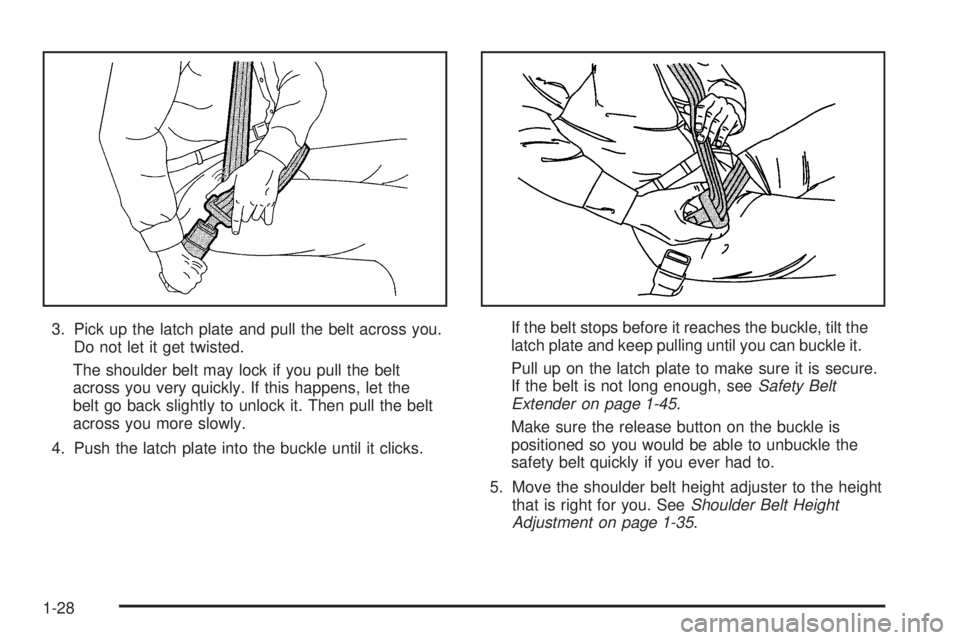
3. Pick up the latch plate and pull the belt across you.
Do not let it get twisted.
The shoulder belt may lock if you pull the belt
across you very quickly. If this happens, let the
belt go back slightly to unlock it. Then pull the belt
across you more slowly.
4. Push the latch plate into the buckle until it clicks.If the belt stops before it reaches the buckle, tilt the
latch plate and keep pulling until you can buckle it.
Pull up on the latch plate to make sure it is secure.
If the belt is not long enough, seeSafety Belt
Extender on page 1-45.
Make sure the release button on the buckle is
positioned so you would be able to unbuckle the
safety belt quickly if you ever had to.
5. Move the shoulder belt height adjuster to the height
that is right for you. SeeShoulder Belt Height
Adjustment on page 1-35.
1-28
Page 35 of 478
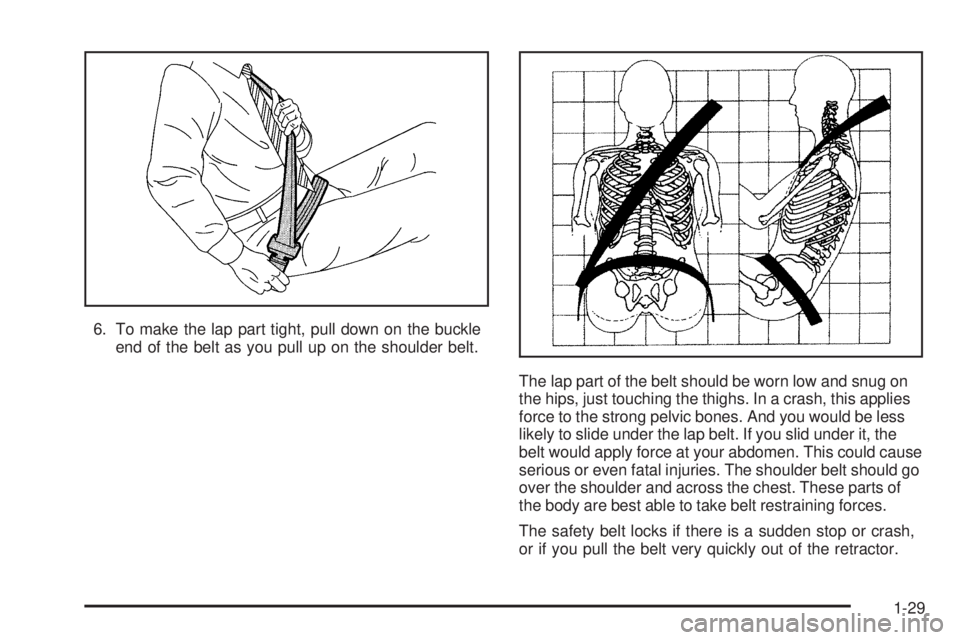
6. To make the lap part tight, pull down on the buckle
end of the belt as you pull up on the shoulder belt.
The lap part of the belt should be worn low and snug on
the hips, just touching the thighs. In a crash, this applies
force to the strong pelvic bones. And you would be less
likely to slide under the lap belt. If you slid under it, the
belt would apply force at your abdomen. This could cause
serious or even fatal injuries. The shoulder belt should go
over the shoulder and across the chest. These parts of
the body are best able to take belt restraining forces.
The safety belt locks if there is a sudden stop or crash,
or if you pull the belt very quickly out of the retractor.
1-29
Page 41 of 478

To unlatch the belt, just push the button on the buckle.
The belt should go back out of the way.
Before you close the door, be sure the belt is out of
the way. If you slam the door on it, you can damage
both the belt and your vehicle.
Shoulder Belt Height Adjustment
Before you begin to drive, move the shoulder belt
height adjuster to the height that is right for you.
Adjust the height so that the shoulder portion of the
belt is centered on your shoulder. The belt should
be away from your face and neck, but not falling off
your shoulder.
To move it down, push
down on the button (A)
and move the height
adjuster to the desired
position. You can move
the height adjuster
up by pushing up on
the shoulder belt guide.
After you move the height adjuster to where you want
it, try to move it down without pushing the button
down to make sure it has locked into position.
1-35
Page 42 of 478

Safety Belt Use During Pregnancy
Safety belts work for everyone, including pregnant
women. Like all occupants, they are more likely to be
seriously injured if they do not wear safety belts.
A pregnant woman should wear a lap-shoulder belt,
and the lap portion should be worn as low as possible,
below the rounding, throughout the pregnancy.
The best way to protect the fetus is to protect the
mother. When a safety belt is worn properly, it is more
likely that the fetus will not be hurt in a crash. For
pregnant women, as for anyone, the key to making
safety belts effective is wearing them properly.
Right Front Passenger Position
To learn how to wear the right front passenger’s safety
belt properly, seeDriver Position on page 1-27.
The right front passenger’s safety belt works the same
way as the driver’s safety belt — except for one thing.
If you ever pull the shoulder portion of the belt out all the
way, you will engage the child restraint locking feature.
If this happens, just let the belt go back all the way and
start again.
Rear Outside Passenger Positions
It is very important for rear seat passengers to
buckle up! Accident statistics show that unbelted people
in the rear seat are hurt more often in crashes than
those who are wearing safety belts.
Rear passengers who are not safety belted can be
thrown out of the vehicle in a crash. And they can strike
others in the vehicle who are wearing safety belts.
1-36
Page 43 of 478

Lap-Shoulder Belt
The positions next to the windows have lap-shoulder
belts. Here is how to wear a lap-shoulder belt properly.
1. Pick up the latch plate and pull the belt across you.
Do not let it get twisted.
The shoulder belt may lock if you pull the belt
across you very quickly. If this happens, let the
belt go back slightly to unlock it. Then pull the
belt across you more slowly.
2. Push the latch plate into the buckle until it clicks.If the belt stops before it reaches the buckle, tilt the
latch plate and keep pulling until you can buckle it.
Pull up on the latch plate to make sure it is secure.
If the belt is not long enough, seeSafety Belt
Extender on page 1-45. Make sure the release
button on the buckle is positioned so you would
be able to unbuckle the safety belt quickly if
you ever had to.
1-37
Page 44 of 478

3. To make the lap part tight, pull down on the buckle
end of the belt as you pull up on the shoulder part.
The lap part of the belt should be worn low and snug
on the hips, just touching the thighs. In a crash,
this applies force to the strong pelvic bones. And you
would be less likely to slide under the lap belt. If you slid
under it, the belt would apply force at your abdomen.
This could cause serious or even fatal injuries. The
shoulder belt should go over the shoulder and across
the chest. These parts of the body are best able to
take belt restraining forces.
The safety belt locks if there is a sudden stop or a crash,
or if you pull the belt very quickly out of the retractor.
1-38
Page 47 of 478

2. Insert the metal knob on the shoulder belt into the
keyhole on the lap belt buckle as shown. Be sure
to slide the shoulder belt part into the keyhole until
it locks into place.3. To make the lap belt longer, tilt the latch plate and
pull it along the belt.
1-41