tire size BUICK RANDEZVOUS 2006 User Guide
[x] Cancel search | Manufacturer: BUICK, Model Year: 2006, Model line: RANDEZVOUS, Model: BUICK RANDEZVOUS 2006Pages: 478, PDF Size: 2.97 MB
Page 390 of 478
Different Size Tires and Wheels
If you add wheels or tires that are a different size than
your original equipment wheels and tires, this may
affect the way your vehicle performs, including its
braking, ride and handling characteristics, stability and
resistance to rollover. Additionally, if your vehicle
has electronic systems such as, antilock brakes; traction
control; and electronic stability control, the performance
of these systems can be affected.
{CAUTION:
If you add different sized wheels, your
vehicle may not provide an acceptable level
of performance and safety if tires not
recommended for those wheels are selected.
You may increase the chance that you will
crash and suffer serious injury. Only use
GM specic wheel and tire systems developed
for your vehicle, and have them properly
installed by a GM certied technician.
SeeBuying New Tires on page 5-62andAccessories
and Modications on page 5-3for additional information.
Uniform Tire Quality Grading
Quality grades can be found where applicable on the
tire sidewall between tread shoulder and maximum
section width. For example:
Treadwear 200 Traction AA Temperature A
The following information relates to the system
developed by the United States National Highway
Traffic Safety Administration, which grades tires by
treadwear, traction and temperature performance.
(This applies only to vehicles sold in the United States.)
The grades are molded on the sidewalls of most
passenger car tires. The Uniform Tire Quality Grading
system does not apply to deep tread, winter-type
snow tires, space-saver or temporary use spare tires,
tires with nominal rim diameters of 10 to 12 inches
(25 to 30 cm), or to some limited-production tires.
While the tires available on General Motors passenger
cars and light trucks may vary with respect to these
grades, they must also conform to federal safety
requirements and additional General Motors Tire
Performance Criteria (TPC) standards.
5-64
Page 393 of 478

Used Replacement Wheels
{CAUTION:
Putting a used wheel on your vehicle is
dangerous. You cannot know how it has been
used or how far it has been driven. It could fail
suddenly and cause a crash. If you have to
replace a wheel, use a new GM original
equipment wheel.
Tire Chains
{CAUTION:
Do not use tire chains. There is not enough
clearance. Tire chains used on a vehicle
without the proper amount of clearance can
cause damage to the brakes, suspension,
CAUTION: (Continued)
CAUTION: (Continued)
or other vehicle parts. The area damaged by
the tire chains could cause you to lose control
of your vehicle and you or others may be
injured in a crash.
Use another type of traction device only if
its manufacturer recommends it for use on
your vehicle and tire size combination and
road conditions. Follow that manufacturer’s
instructions. To help avoid damage to your
vehicle, drive slowly, readjust or remove the
device if it is contacting your vehicle, and
do not spin the wheels. If you do nd traction
devices that will t, install them on the
front tires for front-wheel-drive vehicles.
If your vehicle has all-wheel drive, install
traction devices on either the front tires or
all four tires, but never on the rear tires only.
5-67
Page 400 of 478

5. Turn the wrench clockwise to raise the cable back
up after removing the spare tire.
Do not store a full-size or a at road tire under the
vehicle. SeeStoring a Flat or Spare Tire and
Tools on page 5-84.
To continue changing the at tire, seeRemoving the
Flat Tire and Installing the Spare Tire on page 5-77.
If the spare tire will not lower, the secondary latch may
be engaged causing the tire not to lower.Do the following to check the cable:
1. Check under the vehicle to see if the cable is visible.
2. If it is not visible, seeSecondary Latch System
on page 5-81.
If it is visible, rst try to tighten the cable by
turning the folding wrench clockwise until you
hear two clicks or feel it skip twice. You cannot
over-tighten the cable.
3. Loosen the cable by turning the wrench
counterclockwise three or four turns.
4. If the spare tire has not lowered, tighten the cable
all the way and then loosen it at least two times.
If the spare tire did lower to the ground, continue
with Step 4 under “Removing the Spare Tire
(Vehicles without the Rear Convenience Center)”
listed previously.
5. If you still cannot lower the spare tire to the ground,
seeSecondary Latch System on page 5-81.
5-74
Page 402 of 478

6. Turn the wrench clockwise to raise the cable back
up after removing the spare tire.
Do not store a full-size or a at road tire under the
vehicle. SeeStoring a Flat or Spare Tire and
Tools on page 5-84.
To continue changing the at tire, seeRemoving the
Flat Tire and Installing the Spare Tire on page 5-77.
If the spare tire will not lower, the secondary latch may
be engaged causing the tire not to lower.Do the following to check the cable:
1. Check under the vehicle to see if the cable is visible.
2. If it is not visible, seeSecondary Latch System
on page 5-81.
If it is visible, rst try to tighten the cable by turning
the folding wrench clockwise until you hear two
clicks or feel it skip twice. You cannot over-tighten
the cable.
3. Loosen the cable by turning the wrench
counterclockwise three or four turns.
4. If the spare tire has not lowered, tighten the cable
all the way and then loosen it at least two times.
If the spare tire did lower to the ground, continue
with Step 5 under “Removing the Spare Tire
(Vehicles with the Rear Convenience Center)”
listed previously.
5. If you still cannot lower the spare tire to the ground,
seeSecondary Latch System on page 5-81.
5-76
Page 410 of 478
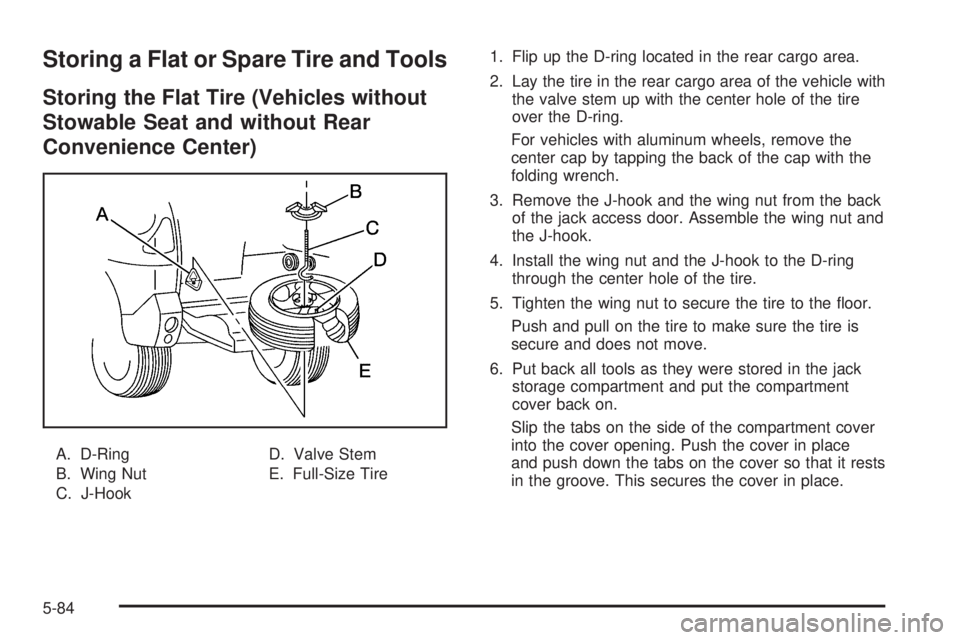
Storing a Flat or Spare Tire and Tools
Storing the Flat Tire (Vehicles without
Stowable Seat and without Rear
Convenience Center)
A. D-Ring
B. Wing Nut
C. J-HookD. Valve Stem
E. Full-Size Tire1. Flip up the D-ring located in the rear cargo area.
2. Lay the tire in the rear cargo area of the vehicle with
the valve stem up with the center hole of the tire
over the D-ring.
For vehicles with aluminum wheels, remove the
center cap by tapping the back of the cap with the
folding wrench.
3. Remove the J-hook and the wing nut from the back
of the jack access door. Assemble the wing nut and
the J-hook.
4. Install the wing nut and the J-hook to the D-ring
through the center hole of the tire.
5. Tighten the wing nut to secure the tire to the oor.
Push and pull on the tire to make sure the tire is
secure and does not move.
6. Put back all tools as they were stored in the jack
storage compartment and put the compartment
cover back on.
Slip the tabs on the side of the compartment cover
into the cover opening. Push the cover in place
and push down the tabs on the cover so that it rests
in the groove. This secures the cover in place.
5-84
Page 411 of 478
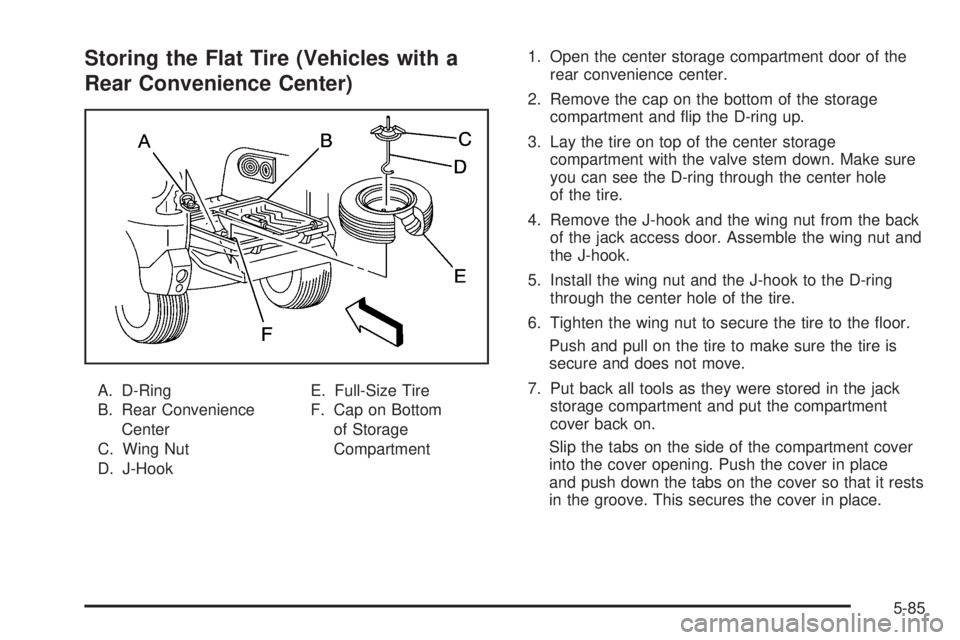
Storing the Flat Tire (Vehicles with a
Rear Convenience Center)
A. D-Ring
B. Rear Convenience
Center
C. Wing Nut
D. J-HookE. Full-Size Tire
F. Cap on Bottom
of Storage
Compartment1. Open the center storage compartment door of the
rear convenience center.
2. Remove the cap on the bottom of the storage
compartment and ip the D-ring up.
3. Lay the tire on top of the center storage
compartment with the valve stem down. Make sure
you can see the D-ring through the center hole
of the tire.
4. Remove the J-hook and the wing nut from the back
of the jack access door. Assemble the wing nut and
the J-hook.
5. Install the wing nut and the J-hook to the D-ring
through the center hole of the tire.
6. Tighten the wing nut to secure the tire to the oor.
Push and pull on the tire to make sure the tire is
secure and does not move.
7. Put back all tools as they were stored in the jack
storage compartment and put the compartment
cover back on.
Slip the tabs on the side of the compartment cover
into the cover opening. Push the cover in place
and push down the tabs on the cover so that it rests
in the groove. This secures the cover in place.
5-85
Page 412 of 478
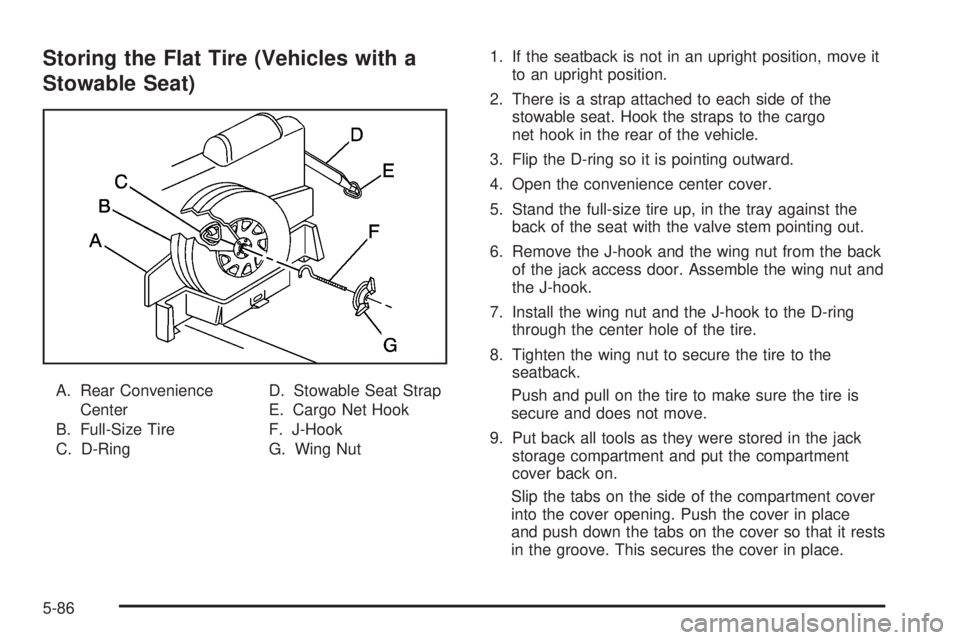
Storing the Flat Tire (Vehicles with a
Stowable Seat)
A. Rear Convenience
Center
B. Full-Size Tire
C. D-RingD. Stowable Seat Strap
E. Cargo Net Hook
F. J-Hook
G. Wing Nut1. If the seatback is not in an upright position, move it
to an upright position.
2. There is a strap attached to each side of the
stowable seat. Hook the straps to the cargo
net hook in the rear of the vehicle.
3. Flip the D-ring so it is pointing outward.
4. Open the convenience center cover.
5. Stand the full-size tire up, in the tray against the
back of the seat with the valve stem pointing out.
6. Remove the J-hook and the wing nut from the back
of the jack access door. Assemble the wing nut and
the J-hook.
7. Install the wing nut and the J-hook to the D-ring
through the center hole of the tire.
8. Tighten the wing nut to secure the tire to the
seatback.
Push and pull on the tire to make sure the tire is
secure and does not move.
9. Put back all tools as they were stored in the jack
storage compartment and put the compartment
cover back on.
Slip the tabs on the side of the compartment cover
into the cover opening. Push the cover in place
and push down the tabs on the cover so that it rests
in the groove. This secures the cover in place.
5-86
Page 413 of 478
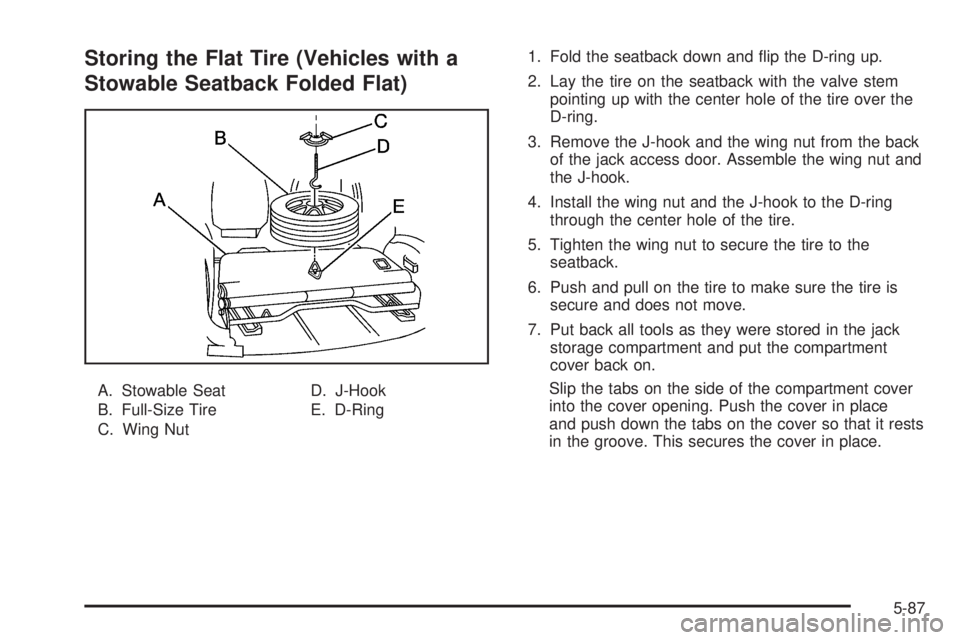
Storing the Flat Tire (Vehicles with a
Stowable Seatback Folded Flat)
A. Stowable Seat
B. Full-Size Tire
C. Wing NutD. J-Hook
E. D-Ring1. Fold the seatback down and ip the D-ring up.
2. Lay the tire on the seatback with the valve stem
pointing up with the center hole of the tire over the
D-ring.
3. Remove the J-hook and the wing nut from the back
of the jack access door. Assemble the wing nut and
the J-hook.
4. Install the wing nut and the J-hook to the D-ring
through the center hole of the tire.
5. Tighten the wing nut to secure the tire to the
seatback.
6. Push and pull on the tire to make sure the tire is
secure and does not move.
7. Put back all tools as they were stored in the jack
storage compartment and put the compartment
cover back on.
Slip the tabs on the side of the compartment cover
into the cover opening. Push the cover in place
and push down the tabs on the cover so that it rests
in the groove. This secures the cover in place.
5-87
Page 415 of 478
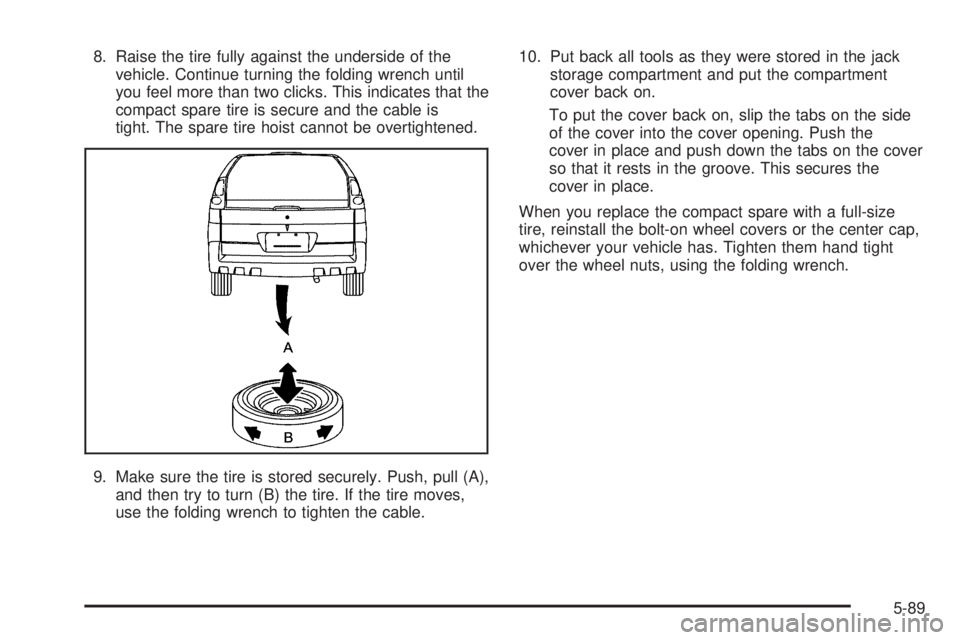
8. Raise the tire fully against the underside of the
vehicle. Continue turning the folding wrench until
you feel more than two clicks. This indicates that the
compact spare tire is secure and the cable is
tight. The spare tire hoist cannot be overtightened.
9. Make sure the tire is stored securely. Push, pull (A),
and then try to turn (B) the tire. If the tire moves,
use the folding wrench to tighten the cable.10. Put back all tools as they were stored in the jack
storage compartment and put the compartment
cover back on.
To put the cover back on, slip the tabs on the side
of the cover into the cover opening. Push the
cover in place and push down the tabs on the cover
so that it rests in the groove. This secures the
cover in place.
When you replace the compact spare with a full-size
tire, reinstall the bolt-on wheel covers or the center cap,
whichever your vehicle has. Tighten them hand tight
over the wheel nuts, using the folding wrench.
5-89
Page 416 of 478
Compact Spare Tire
Although the compact spare tire was fully inated when
your vehicle was new, it can lose air after a time.
Check the ination pressure regularly. It should be
60 psi (420 kPa).
After installing the compact spare on your vehicle,
you should stop as soon as possible and make sure
your spare tire is correctly inated. The compact
spare is made to perform well at speeds up to 65 mph
(105 km/h) for distances up to 3,000 miles (5 000 km),
so you can nish your trip and have your full-size
tire repaired or replaced where you want. Of course,
it’s best to replace your spare with a full-size tire as soon
as you can. Your spare will last longer and be in good
shape in case you need it again.
Notice:When the compact spare is installed, do
not take your vehicle through an automatic car
wash with guide rails. The compact spare can get
caught on the rails. That can damage the tire
and wheel, and maybe other parts of your vehicle.
Don’t use your compact spare on other vehicles.And don’t mix your compact spare tire or wheel with
other wheels or tires. They won’t t. Keep your spare
tire and its wheel together.
Notice:Tire chains will not t your compact spare.
Using them can damage your vehicle and can
damage the chains too. Do not use tire chains on
your compact spare.
All-Wheel Drive
After installing a compact spare tire on a vehicle with
all-wheel drive you will need to drive with light to
moderate acceleration, for 10 seconds, in a straight line.
This action will allow the vehicle to detect the compact
spare tire and disable the all-wheel drive system.
The AWD DISABLE message will come on in the
message center indicating that the all-wheel drive
system is off. You may detect a slight pull during this
time, but this is normal.
Notice:You may damage your vehicle’s all-wheel
drive system if your vehicle is driven for an extended
period with a compact spare tire installed and the
all-wheel drive system in operations. SeeAll-Wheel
Drive (AWD) System on page 4-12for more
information.
5-90