height BUICK RANDEZVOUS 2006 Owner's Manual
[x] Cancel search | Manufacturer: BUICK, Model Year: 2006, Model line: RANDEZVOUS, Model: BUICK RANDEZVOUS 2006Pages: 478, PDF Size: 2.97 MB
Page 7 of 478
Front Seats......................................................1-3
Manual Seats................................................1-3
Six-Way Power Seats.....................................1-4
Manual Lumbar..............................................1-5
Heated Seats.................................................1-5
Reclining Seatbacks........................................1-6
Head Restraints.............................................1-8
Rear Seats.......................................................1-8
Rear Seat Operation.......................................1-8
Split Bench Seats...........................................1-8
Captain Chairs.............................................1-14
Stowable Seat..............................................1-18
Safety Belts...................................................1-22
Safety Belts: They Are for Everyone................1-22
Questions and Answers About Safety Belts......1-26
How to Wear Safety Belts Properly.................1-27
Driver Position..............................................1-27
Shoulder Belt Height Adjustment.....................1-35
Safety Belt Use During Pregnancy..................1-36Right Front Passenger Position.......................1-36
Rear Outside Passenger Positions..................1-36
Center Rear Passenger Position.....................1-40
Rear Safety Belt Comfort Guides....................1-42
Safety Belt Pretensioners...............................1-45
Safety Belt Extender.....................................1-45
Child Restraints.............................................1-45
Older Children..............................................1-45
Infants and Young Children............................1-48
Child Restraint Systems.................................1-51
Where to Put the Restraint.............................1-54
Lower Anchors and Tethers for
Children (LATCH)......................................1-55
Securing a Child Restraint in a
Rear Outside Seat Position.........................1-65
Securing a Child Restraint in the
Center Rear Seat Position..........................1-67
Securing a Child Restraint in the
Right Front Seat Position............................1-69
Section 1 Seats and Restraint Systems
1-1
Page 34 of 478
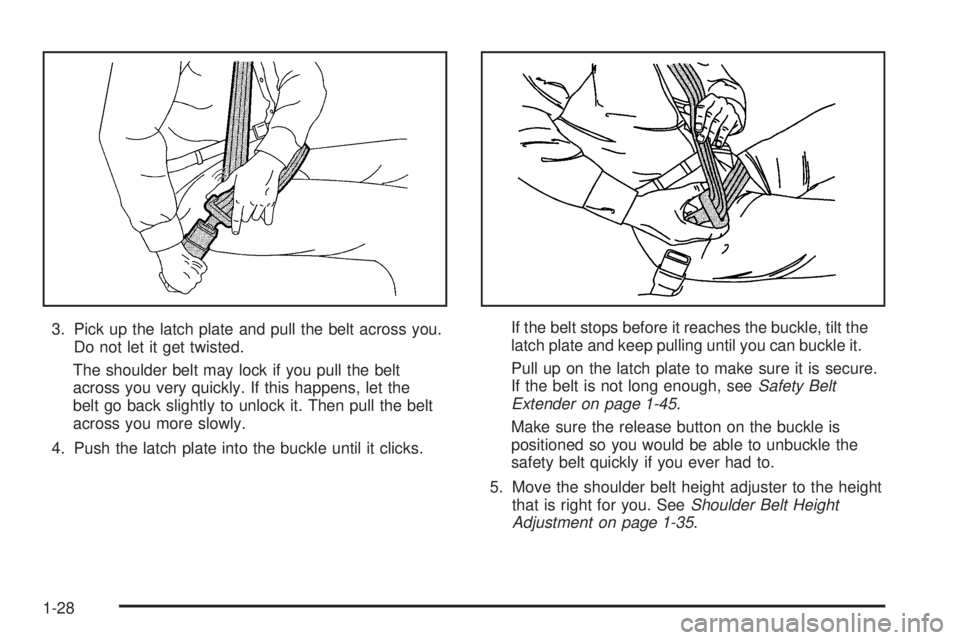
3. Pick up the latch plate and pull the belt across you.
Do not let it get twisted.
The shoulder belt may lock if you pull the belt
across you very quickly. If this happens, let the
belt go back slightly to unlock it. Then pull the belt
across you more slowly.
4. Push the latch plate into the buckle until it clicks.If the belt stops before it reaches the buckle, tilt the
latch plate and keep pulling until you can buckle it.
Pull up on the latch plate to make sure it is secure.
If the belt is not long enough, seeSafety Belt
Extender on page 1-45.
Make sure the release button on the buckle is
positioned so you would be able to unbuckle the
safety belt quickly if you ever had to.
5. Move the shoulder belt height adjuster to the height
that is right for you. SeeShoulder Belt Height
Adjustment on page 1-35.
1-28
Page 41 of 478

To unlatch the belt, just push the button on the buckle.
The belt should go back out of the way.
Before you close the door, be sure the belt is out of
the way. If you slam the door on it, you can damage
both the belt and your vehicle.
Shoulder Belt Height Adjustment
Before you begin to drive, move the shoulder belt
height adjuster to the height that is right for you.
Adjust the height so that the shoulder portion of the
belt is centered on your shoulder. The belt should
be away from your face and neck, but not falling off
your shoulder.
To move it down, push
down on the button (A)
and move the height
adjuster to the desired
position. You can move
the height adjuster
up by pushing up on
the shoulder belt guide.
After you move the height adjuster to where you want
it, try to move it down without pushing the button
down to make sure it has locked into position.
1-35
Page 56 of 478
Q:What are the different types of add-on child
restraints?
A:Add-on child restraints, which are purchased by the
vehicle’s owner, are available in four basic types.
Selection of a particular restraint should take
into consideration not only the child’s weight, height
and age but also whether or not the restraint will
be compatible with the motor vehicle in which it
will be used.
For most basic types of child restraints, there are
many different models available. When purchasing
a child restraint, be sure it is designed to be
used in a motor vehicle. If it is, the restraint will
have a label saying that it meets federal motor
vehicle safety standards.
The restraint manufacturer’s instructions that come
with the restraint, state the weight and height
limitations for a particular child restraint. In addition,
there are many kinds of restraints available for
children with special needs.
{CAUTION:
Newborn infants need complete support,
including support for the head and neck.
This is necessary because a newborn infant’s
neck is weak and its head weighs so much
compared with the rest of its body. In a crash,
an infant in a rear-facing seat settles into
the restraint, so the crash forces can be
distributed across the strongest part of an
infant’s body, the back and shoulders. Infants
always should be secured in appropriate
infant restraints.
1-50
Page 92 of 478
Adding Equipment to Your
Airbag-Equipped Vehicle
Q:Is there anything I might add to the front
or sides of the vehicle that could keep the
airbags from working properly?
A:Yes. If you add things that change your vehicle’s
frame, bumper system, front end or side sheet
metal or height, they may keep the airbag system
from working properly. Also, the airbag system may
not work properly if you relocate any of the airbag
sensors. If you have any questions about this,
you should contact Customer Assistance before you
modify your vehicle. The phone numbers and
addresses for Customer Assistance are in Step Two
of the Customer Satisfaction Procedure in this
manual. SeeCustomer Satisfaction Procedure
on page 7-2.
Q:Because I have a disability, I have to get my
vehicle modied. How can I nd out whether
this will affect my airbag system?
A:Changing or moving any parts of the front seats,
safety belts, the airbag sensing and diagnostic
module (located under the driver’s seat), or
the inside rearview mirror can affect the operation
of the airbag system. If you have questions,
call Customer Assistance. The phone numbers
and addresses for Customer Assistance are in
Step Two of the Customer Satisfaction Procedure
in this manual. SeeCustomer Satisfaction
Procedure on page 7-2.
1-86
Page 165 of 478

3. Press the UP or DN buttons until the HUD image is
easy to see and then press the DN button until the
HUD image is as low as possible, but remains
in full view straight ahead near the front bumper.
The HUD image can only be adjusted up and down,
not side-to-side.
4. To turn the image off, turn the dimmer knob
counterclockwise until it stops.
If the sun comes out or it becomes cloudy, you may
need to adjust the HUD brightness again using
the dimmer knob. Polarized sunglasses could make the
HUD image harder to see.
When you rst start the vehicle the display will show
BUICK and the Buick logo for a few seconds. If it is cold
outside, this display may stay on for up to a minute.
Clean the inside of the windshield as needed to remove
any dirt or lm that reduces the sharpness or clarity
of the HUD image.To clean the HUD, spray household glass cleaner on a
soft, clean cloth. Wipe the HUD lens gently, then dry
it. Do not spray cleaner directly on the lens because the
cleaner could leak into the unit.
If the ignition is on and you cannot see the HUD image,
check to see if one of the following conditions exist:
The HUD unit is covered
The HUD dimmer knob is adjusted incorrectly
The HUD image is not adjusted to the proper height
Ambient light in the direction your vehicle is
facing, is low
A fuse is blown. SeeFuses and Circuit Breakers
on page 5-101.
Keep in mind that the windshield is part of the HUD.
SeeWindshield Replacement on page 5-49.
3-23
Page 362 of 478

Brake Wear
Your vehicle has four-wheel disc brakes.
Disc brake pads have built-in wear indicators that make
a high-pitched warning sound when the brake pads
are worn and new pads are needed. The sound
may come and go or be heard all the time your
vehicle is moving, except when you are pushing on
the brake pedal rmly.
{CAUTION:
The brake wear warning sound means that
soon your brakes will not work well. That
could lead to an accident. When you hear the
brake wear warning sound, have your vehicle
serviced.
Notice:Continuing to drive with worn-out brake
pads could result in costly brake repair.Some driving conditions or climates may cause a brake
squeal when the brakes are rst applied or lightly
applied. This does not mean something is wrong with
your brakes.
Properly torqued wheel nuts are necessary to help
prevent brake pulsation. When tires are rotated, inspect
brake pads for wear and evenly tighten wheel nuts in
the proper sequence to GM torque specications.
Brake linings should always be replaced as complete
axle sets.
Brake Pedal Travel
See your dealer if the brake pedal does not return to
normal height, or if there is a rapid increase in
pedal travel. This could be a sign of brake trouble.
Brake Adjustment
Every time you apply the brakes, with or without the
vehicle moving, your brakes adjust for wear.
5-36
Page 378 of 478

Tire Sidewall Labeling
Useful information about a tire is molded into its
sidewall. The examples below show a typical passenger
vehicle tire and a compact spare tire sidewall.
(A) Tire Size:The tire size is a combination of letters
and numbers used to dene a particular tire’s width,
height, aspect ratio, construction type, and service
description. See the “Tire Size” illustration later in this
section for more detail.(B) TPC Spec (Tire Performance Criteria
Specication):Original equipment tires designed to
GM’s specic tire performance criteria have a TPC
specication code molded onto the sidewall. GM’s TPC
specications meet or exceed all federal safety
guidelines.
(C) DOT (Department of Transportation):The
Department of Transportation (DOT) code indicates that
the tire is in compliance with the U.S. Department of
Transportation Motor Vehicle Safety Standards.
(D) Tire Identication Number (TIN):The letters and
numbers following DOT (Department of Transportation)
code is the Tire Identication Number (TIN). The TIN
shows the manufacturer and plant code, tire size, and
date the tire was manufactured. The TIN is molded onto
both sides of the tire, although only one side may have
the date of manufacture.
(E) Tire Ply Material:The type of cord and number of
plies in the sidewall and under the tread.
(F) Uniform Tire Quality Grading (UTQG):Tire
manufacturers are required to grade tires based on
three performance factors: treadwear, traction, and
temperature resistance. For more information see
Uniform Tire Quality Grading on page 5-64.
(G) Maximum Cold Ination Load Limit:Maximum
load that can be carried and the maximum pressure
needed to support that load. Passenger (P-Metric) Tire Example
5-52
Page 379 of 478

(A) Temporary Use Only:The compact spare tire or
temporary use tire has a tread life of approximately
3,000 miles (5 000 km) and should not be driven
at speeds over 65 mph (105 km/h). The compact spare
tire is for emergency use when a regular road tire
has lost air and gone at. If your vehicle has a compact
spare tire, seeCompact Spare Tire on page 5-90
andIf a Tire Goes Flat on page 5-69.
(B) Tire Ply Material:The type of cord and number of
plies in the sidewall and under the tread.(C) Tire Identication Number (TIN):The letters
and numbers following the DOT (Department of
Transportation) code is the Tire Identication Number
(TIN). The TIN shows the manufacturer and plant code,
tire size, and date the tire was manufactured. The
TIN is molded onto both sides of the tire, although only
one side may have the date of manufacture.
(D) Maximum Cold Ination Load Limit:Maximum
load that can be carried and the maximum pressure
needed to support that load.
(E) Tire Ination:The temporary use tire or compact
spare tire should be inated to 60 psi (420 kPa).
For more information on tire pressure and ination
seeInation - Tire Pressure on page 5-57.
(F) Tire Size:A combination of letters and numbers
dene a tire’s width, height, aspect ratio, construction
type and service description. The letter T as the
rst character in the tire size means the tire is for
temporary use only.
(G) TPC Spec (Tire Performance Criteria
Specication):Original equipment tires designed to
GM’s specic tire performance criteria have a TPC
specication code molded onto the sidewall. GM’s TPC
specications meet or exceed all federal safety
guidelines. Compact Spare Tire Example
5-53
Page 380 of 478

Tire Size
The following illustration shows an example of a typical
passenger vehicle tire size.
(A) Passenger (P-Metric) Tire:The United States
version of a metric tire sizing system. The letter P as
the rst character in the tire size means a passenger
vehicle tire engineered to standards set by the U.S. Tire
and Rim Association.
(B) Tire Width:The three-digit number indicates the
tire section width in millimeters from sidewall to sidewall.(C) Aspect Ratio:A two-digit number that indicates
the tire height-to-width measurements. For example,
if the tire size aspect ratio is 60, as shown in item C of
the illustration, it would mean that the tire’s sidewall
is 60 percent as high as it is wide.
(D) Construction Code:A letter code is used to
indicate the type of ply construction in the tire. The
letter R means radial ply construction; the letter D means
diagonal or bias ply construction; and the letter B means
belted-bias ply construction.
(E) Rim Diameter:Diameter of the wheel in inches.
(F) Service Description:These characters represent
the load range and speed rating of the tire. The load
index represents the load carry capacity a tire is certied
to carry. The load index can range from 1 to 279. The
speed rating is the maximum speed a tire is certied
to carry a load. Speed ratings range from A to Z.
5-54