lights BUICK RANDEZVOUS 2007 User Guide
[x] Cancel search | Manufacturer: BUICK, Model Year: 2007, Model line: RANDEZVOUS, Model: BUICK RANDEZVOUS 2007Pages: 528, PDF Size: 2.99 MB
Page 196 of 528

To clean the HUD, spray household glass cleaner
on a soft, clean cloth. Wipe the HUD lens gently,
then dry it. Do not spray cleaner directly on the lens
because the cleaner could leak into the unit.
If the ignition is on and you cannot see the HUD
image, check to see if one of the following
conditions exist:
The HUD unit is covered
The HUD dimmer knob is adjusted incorrectly
The HUD image is not adjusted to the
proper height
Ambient light in the direction your vehicle is
facing, is low
A fuse is blown. SeeFuses and Circuit
Breakers on page 463.
Keep in mind that the windshield is part of the
HUD. SeeWindshield Replacement on page 404.
Ultrasonic Rear Parking
Assist (URPA)
The Ultrasonic Rear Parking Assist (URPA)
system is designed to help you park, while the
vehicle is in REVERSE (R). It operates only at very
low speeds, less than 3 mph (5 km/h). URPA
can help make parking easier and to help
you avoid colliding with objects such as parked
vehicles. The URPA system can detect objects up
to 5 feet (1.5 m) behind the vehicle, and tell
you how close these objects are from your rear
bumper.
Your vehicle’s URPA operates when the shift lever
is moved into REVERSE (R) and the vehicle
speed is less than 3 mph (5 km/h). Four ultrasonic
sensors located at the rear bumper are used to
detect the distance to the object. The URPA
display is located inside the vehicle, near the rear
window. It has three color-coded lights used to
provide distance and system information to
the driver.
196
Page 197 of 528
{CAUTION:
The Ultrasonic Rear Park Assist (URPA)
system does not replace driver vision.
URPA does not:
Operate above speeds of 3 mph
(5 km/h).
Detect objects more than 5 feet
(1.5 meters) behind the vehicle. This
distance may be less during warmer
or humid weather.
Detect objects that are below the
bumper, underneath the vehicle, or
that are very close to the vehicle.
Detect children, pedestrians,
bicyclists, or pets.
So if you do not use proper care before
backing up, you could hit a vehicle, child,
pedestrian, bicyclist, or pet, resulting in
vehicle damage, injury, or death. Even
though the vehicle has the URPA system,
always check carefully before backing up
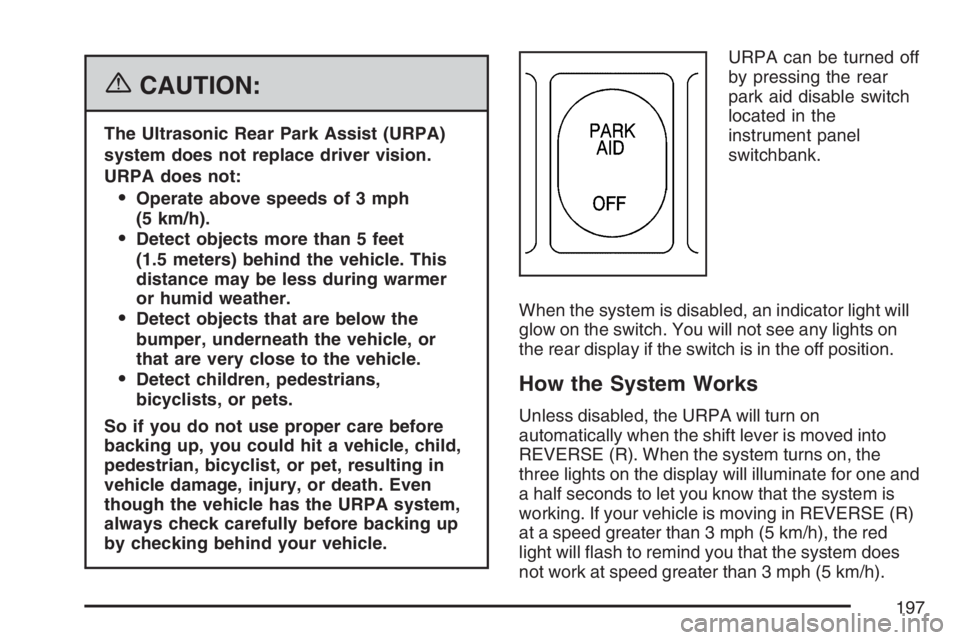
by checking behind your vehicle.URPA can be turned off
by pressing the rear
park aid disable switch
located in the
instrument panel
switchbank.
When the system is disabled, an indicator light will
glow on the switch. You will not see any lights on
the rear display if the switch is in the off position.How the System Works
Unless disabled, the URPA will turn on
automatically when the shift lever is moved into
REVERSE (R). When the system turns on, the
three lights on the display will illuminate for one and
a half seconds to let you know that the system is
working. If your vehicle is moving in REVERSE (R)
at a speed greater than 3 mph (5 km/h), the red
light will ash to remind you that the system does
not work at speed greater than 3 mph (5 km/h).
197
Page 198 of 528

If an object is detected at a REVERSE (R) speed
of less than 3 mph (5 km/h), one of the following
will occur:
Description English Metric
amber light 5 ft 1.5 m
amber/amber lights 40 in 1.0 m
amber/amber/red lights &
continuous chime20 in 0.5 m
amber/amber/red lights
ashing & continuous
chime1 ft 0.3 m
A chime will sound the rst time an object is
detected between 20 inches (0.5 m) and 5 feet
(1.5 m) away.
URPA cannot detect objects that are above liftgate
level. In order for the rear sensors to recognize
an object, it must be within detection range behind
the vehicle.
When the System Does Not Seem to
Work Properly
The light may ash red when the vehicle is in
REVERSE (R) if the ultrasonic sensors are
not kept clean. So be sure to keep your rear
bumper free of mud, dirt, snow, ice, and slush.
Other conditions that may affect system
performance include things like the vibrations from
a jackhammer or the compression of air brakes
on a very large truck. If after cleaning the
rear bumper and then driving forward at least
15 mph (25 km/h), the display continues to ash
red, see your dealer.
If a trailer was attached to your vehicle, or a
bicycle or an object was on the back of, or hanging
out of your liftgate during your last drive cycle,
the light may also ash red. The light will continue
to ash whenever in REVERSE (R) until your
vehicle is driven forward at least 15 mph (25 km/h)
without any obstructions behind the vehicle.
For cleaning instructions, seeWashing Your
Vehicle on page 455.
198
Page 211 of 528

Warning Lights, Gages, and
Indicators
This part describes the warning lights and gages
that may be on your vehicle. The pictures will
help you locate them.
Warning lights and gages can signal that
something is wrong before it becomes serious
enough to cause an expensive repair or
replacement. Paying attention to your warning
lights and gages could also save you or others
from injury.
Warning lights come on when there may be or is a
problem with one of your vehicle’s functions. As
you will see in the details on the next few
pages, some warning lights come on briey when
you start the engine just to let you know they
are working. If you are familiar with this section,
you should not be alarmed when this happens.Gages can indicate when there may be or is a
problem with one of your vehicle’s functions. Often
gages and warning lights work together to let you
know when there’s a problem with your vehicle.
When one of the warning lights comes on and
stays on when you are driving, or when one of the
gages shows there may be a problem, check
the section that tells you what to do about
it. Please follow this manual’s advice. Waiting to
do repairs can be costly – and even dangerous. So
please get to know your warning lights and
gages. They are a big help.
Your vehicle also has a message center that
works along with the warning lights and gages.
SeeMessage Center on page 225.
211
Page 212 of 528
Instrument Panel Cluster
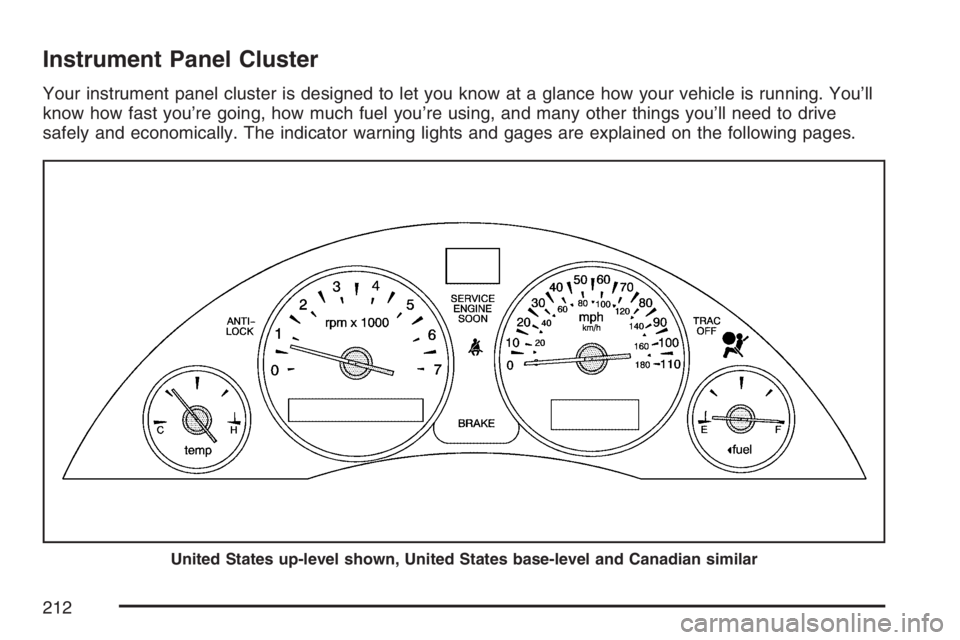
Your instrument panel cluster is designed to let you know at a glance how your vehicle is running. You’ll
know how fast you’re going, how much fuel you’re using, and many other things you’ll need to drive
safely and economically. The indicator warning lights and gages are explained on the following pages.
United States up-level shown, United States base-level and Canadian similar
212
Page 218 of 528

Your vehicle has a rear seat that will accommodate
a rear-facing child restraint. A label on your sun
visor says, “Never put a rear-facing child seat
in the front.” This is because the risk to the
rear-facing child is so great, if the airbag deploys.
{CAUTION:
Even though the passenger sensing
system is designed to turn off the
passenger’s frontal airbag if the system
detects a rear-facing child restraint, no
system is failsafe, and no one can
guarantee that an airbag will not deploy
under some unusual circumstance, even
though it is turned off. We recommend
that rear-facing child restraints be secured
in the rear seat, even if the airbag is off.
If the word OFF or the off symbol is lit on the
airbag status indicator, it means that the
passenger sensing system has turned off the right
front passenger’s frontal airbag. SeePassenger
Sensing System on page 98for more on this,
including important safety information.If, after several seconds, all status indicator lights
remain on, or if there are no lights at all, there
may be a problem with the lights or the passenger
sensing system. See your dealer for service.
{CAUTION:
If the off indicator and the airbag
readiness light ever come on together, it
means that something may be wrong with
the airbag system. If this ever happens,
have the vehicle serviced promptly,
because an adult-size person sitting in the
right front passenger seat may not have
the protection of the frontal airbag. See
Airbag Readiness Light on page 215.
218
Page 240 of 528

DIC Vehicle Personalization
The DIC is used to program the choices of
two drivers. The drivers are recognized as
DRIVER 1 or DRIVER 2 in the DIC display. You
will let the DIC know which driver you are by using
your Remote Keyless Entry (RKE) transmitter.
Each RKE transmitter was pre-programmed
to belong to DRIVER 1 or DRIVER 2 and the
corresponding numbers, 1 or 2, appear on
the back of the transmitters. Each transmitter may
be programmed differently for each driver’s
preferences (lights, doors, horn, or activate the
programmed radio stations for driver 1 or driver 2)
using your RKE transmitter.
After you press the LOCK button on your RKE
transmitter and the ignition key is in ON, the DIC
will display the identied driver number. The
vehicle will also recall the vehicle customization
features that were last programmed to correspond
to your RKE transmitter.
If you unlock your vehicle using your key instead
of your RKE transmitter, the DIC will not change
drivers and your vehicle will recall the information
from the last transmitter used.If your vehicle does not have a DIC, you do not
have available the vehicle customization features
using the RKE transmitter.
Entering Programming Mode
To program features, your vehicle must be in the
programming mode. Do the following:
1. Turn the ignition key to ON with the vehicle in
PARK (P).
To avoid excessive drain on the battery, it is
recommended that the headlamps are
turned off.
2. Press and release the MODE button, scrolling
through the DIC messages, until
PERSONALIZATION PRESS SET TO BEGIN
is displayed.
3. Press the SET button and TO SELECT
DRIVER PRESS REMOTE LOCK will appear.
Press the LOCK button on the Remote Keyless
Entry (RKE) transmitter. This identies which
RKE transmitter is being programmed by
displaying PERSONALIZATION FOR
DRIVER 1 or DRIVER 2.
240
Page 246 of 528

Remote Door Unlock
The remote door unlock feature can be
programmed to one of the following modes:
DRIVER/ALL:With the rst press of UNLOCK on
the Remote Keyless Entry (RKE) transmitter,
the driver’s door will unlock, and with the second
press of UNLOCK, within ve seconds of the
rst press, all passenger’s doors will unlock.
ALL:All doors will unlock with every press of
UNLOCK on the RKE transmitter.
Your vehicle was originally programmed to ALL.
The mode may have been changed since then.
To determine the current mode, or to change
the mode, do the following:
1. Follow the instructions for “Entering
Programming Mode” listed previously.
2. Press the MODE button until REMOTE DOOR
UNLOCK appears on the DIC.
3. Press the SET button until the arrow is before
DRIVER/ALL or ALL.The mode you selected is now set. You can either
exit programming mode by following the
instructions later in this section or program the
next feature available on your vehicle.
Unlock Feedback
The unlock feedback feature can be programmed
to one of the following modes:
LIGHTS:This mode does the following:
During the day, when the ignition is in OFF
and UNLOCK on the Remote Keyless Entry
(RKE) transmitter is pressed, the headlamps
and parking lamps will ash.
During the night, when the ignition is in OFF,
the headlamps and parking lamps will be
activated for 30 seconds when UNLOCK is
pressed on the RKE transmitter. If you would
like to change the amount of time the
lamps stay on, change the headlamp exit
delay feature.
OFF:The headlamps and parking lamps will not
ash when UNLOCK is pressed on the RKE
transmitter.
246
Page 247 of 528

Your vehicle was originally programmed to
LIGHTS. The mode may have been changed
since then. To determine the current mode, or to
change the mode, do the following:
1. Follow the instructions for “Entering
Programming Mode” listed previously.
2. Follow the instructions for programming
HEADLMP EXIT DELAY earlier in this section,
to make sure which mode it is programmed to.
3. Press the MODE button until UNLOCK
FEEDBACK appears on the DIC.
4. Press the SET button until the arrow is before
LIGHTS or OFF.
5. Press the MODE button until you have
determined which mode you prefer, to
follow with the personalization.
The mode you selected is now set. You can either
exit programming mode by following the
instructions later in this section or program the
next feature available on your vehicle.Lock Feedback
The lock feedback feature can be programmed to
one of the following modes:
OFF:When LOCK is pressed on the Remote
Keyless Entry (RKE) transmitter, the headlamps
and parking lamps will not ash and the horn
will not sound.
LIGHTS:When LOCK is pressed on the RKE
transmitter, the headlamps and parking lamps will
ash briey.
LIGHTS and HORN:When LOCK is pressed a
second time on the RKE transmitter within
ve seconds, the headlamps and parking lamps
will ash briey and the horn will sound.
247
Page 248 of 528

Your vehicle was originally programmed to
LIGHTS and HORN. The mode may have been
changed since then. To determine the current
mode, or to change the mode, do the following:
1. Follow the instructions for “Entering
Programming Mode” listed previously.
2. Press the MODE button until LOCK
FEEDBACK appears on the DIC.
3. Press the SET button until the arrow is before
OFF, LIGHTS or LIGHTS and HORN.
The mode you selected is now set. You can either
exit programming mode by following the
instructions later in this section or program the
next feature available on your vehicle.
Seat Recall
The seat recall feature can be programmed to one
of the following modes:
ON:The previously programmed memory seat
position will be recalled when the UNLOCK button
is pressed on the Remote Keyless Entry (RKE)
transmitter.OFF:No memory seat position will be recalled
when you press the UNLOCK button on the RKE
transmitter.
To determine the mode to which your vehicle is
programmed or to program your vehicle to a
different mode, do the following:
1. Follow the instructions for “Entering
Programming Mode” listed previously.
2. Press the MODE button until SEAT RECALL
appears on the DIC.
3. Press the SET button until the arrow is before
ON or OFF.
If the seat recall feature has been programmed to
ON, the seat recall feature can also be
programmed to one of the following modes:
MEMORY:The position recalled will be the
memory driving position.
248