air condition BUICK RANDEZVOUS 2007 Owner's Guide
[x] Cancel search | Manufacturer: BUICK, Model Year: 2007, Model line: RANDEZVOUS, Model: BUICK RANDEZVOUS 2007Pages: 528, PDF Size: 2.99 MB
Page 414 of 528
When to Check
Check your tires once a month or more. Do not
forget to check the compact spare tire, it should be
at 60 psi (420 kPa). For additional information
regarding the compact spare tire, seeCompact
Spare Tire on page 450.
How to Check
Use a good quality pocket-type gage to check tire
pressure. You cannot tell if your tires are properly
inated simply by looking at them. Radial tires
may look properly inated even when they are
under-inated. Check the tire’s ination pressure
when the tires are cold. Cold means your vehicle
has been sitting for at least three hours or driven no
more than 1 mile (1.6 km).
Remove the valve cap from the tire valve stem.
Press the tire gage rmly onto the valve to
get a pressure measurement. If the cold tire
ination pressure matches the recommended
pressure on the Tire and Loading Information
label, no further adjustment is necessary. If the
ination pressure is low, add air until you reach
the recommended amount.If you overll the tire, release air by pushing on
the metal stem in the center of the tire valve.
Re-check the tire pressure with the tire gage.
Be sure to put the valve caps back on the valve
stems. They help prevent leaks by keeping out dirt
and moisture.
Check Tire Pressure System
Your vehicle may have a check tire pressure
system that can alert you to a large change in the
pressure of one tire. The system won’t alert you
before you drive that a tire is low or at. You must
begin driving before the system will work properly.
The LOW TIRE PRESSURE HOLD SET TO
RESET message will appear on the Driver
Information Center (DIC) and the LOW TIRE
PRESSURE message will come on the message
center if pressure difference, or low pressure, is
detected in one tire. In the following conditions, the
LOW TIRE PRESSURE message may not come on
even if the tire pressure is low, or it may come on
when the tire pressure is actually normal:
More than one tire is low
Only one tire is replaced with a new tire during
service
414
Page 422 of 528

Wheel Alignment and Tire Balance
The tires and wheels on your vehicle were aligned
and balanced carefully at the factory to give you
the longest tire life and best overall performance.
Adjustments to wheel alignment and tire balancing
will not be necessary on a regular basis. However,
if you notice unusual tire wear or your vehicle
pulling to one side or the other, the alignment may
need to be checked. If you notice your vehicle
vibrating when driving on a smooth road, your tires
and wheels may need to be rebalanced. See your
dealer for proper diagnosis.
Wheel Replacement
Replace any wheel that is bent, cracked, or badly
rusted or corroded. If wheel nuts keep coming
loose, the wheel, wheel bolts, and wheel nuts
should be replaced. If the wheel leaks air, replace
it (except some aluminum wheels, which can
sometimes be repaired). See your dealer if any
of these conditions exist.
Your dealer will know the kind of wheel you need.
Each new wheel should have the same
load-carrying capacity, diameter, width, offset
and be mounted the same way as the one
it replaces.
422
Page 459 of 528
Finish Damage
Any stone chips, fractures or deep scratches in
the nish should be repaired right away. Bare
metal will corrode quickly and may develop into
major repair expense.
Minor chips and scratches can be repaired with
touch-up materials available from your dealer.
Larger areas of nish damage can be corrected
in your dealer’s body and paint shop.
Underbody Maintenance
Chemicals used for ice and snow removal and dust
control can collect on the underbody. If these are
not removed, corrosion and rust can develop on the
underbody parts such as fuel lines, frame, oor pan,
and exhaust system even though they have
corrosion protection.
At least every spring, ush these materials from the
underbody with plain water. Clean any areas where
mud and debris can collect. Dirt packed in close
areas of the frame should be loosened before being
ushed. Your dealer or an underbody car washing
system can do this for you.
Chemical Paint Spotting
Some weather and atmospheric conditions can
create a chemical fallout. Airborne pollutants can
fall upon and attack painted surfaces on the
vehicle. This damage can take two forms: blotchy,
ring-shaped discolorations, and small, irregular
dark spots etched into the paint surface.
Although no defect in the paint job causes this, GM
will repair, at no charge to the owner, the surfaces
of new vehicles damaged by this fallout condition
within 12 months or 12,000 miles (20 000 km) of
purchase, whichever occurs rst.
459
Page 466 of 528
Underhood Fuse Block
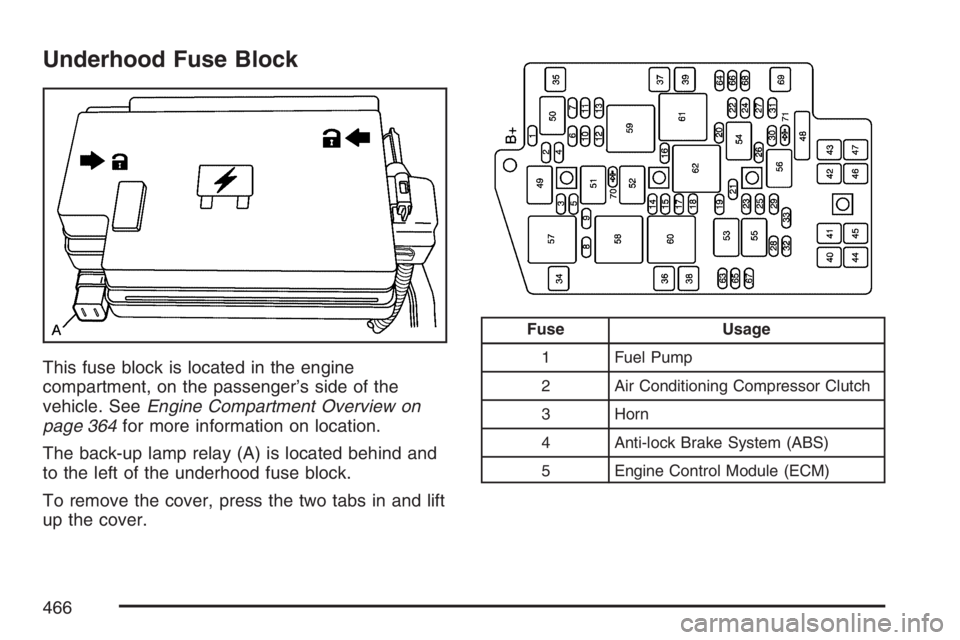
This fuse block is located in the engine
compartment, on the passenger’s side of the
vehicle. SeeEngine Compartment Overview on
page 364for more information on location.
The back-up lamp relay (A) is located behind and
to the left of the underhood fuse block.
To remove the cover, press the two tabs in and lift
up the cover.
Fuse Usage
1 Fuel Pump
2 Air Conditioning Compressor Clutch
3 Horn
4 Anti-lock Brake System (ABS)
5 Engine Control Module (ECM)
466
Page 468 of 528

Fuse Usage
39 Engine Cooling Fan 1
40Main Battery Fuse for Retained
Accessory Power Relay and
Accessory Relay
41Main Battery Fuse for Heated Seats,
Air Conditioning, Defogger
44Main Battery Fuse for Power
Outlets, Level Control, Power Seats,
Mirrors, and Body Computer
46Main Battery Fuse for Climate
Control Blower and Ignition 3 Relay
47Main Battery Fuse for Ignition
Switch, Radio, Heads-Up Display
(HUD), Remote Keyless Entry
(RKE), Instrument Cluster, Air
Conditioning, and Body Computer
70
§Diode for Air Conditioning
Compressor Clutch
§71Diode for Ignition
Relay Usage
49 Horn
50 Fuel Pump
51 Air Conditioning Clutch
52 Daytime Running Lamps (DRL)
53 Low-Beam Headlamps
54 Parking Lamps
55 High-Beam Headlamps
56 Fog Lamps
57 Starter Relay
58 Cooling Fan Series/Parallel
59 Powertrain
60 Cooling Fan 2
61 Cooling Fan 1
62 Ignition
468
Page 469 of 528

Capacities and Specications
The following approximate capacities are given in English and metric conversions. SeeRecommended
Fluids and Lubricants on page 485for more information.
ApplicationCapacities
English Metric
Air Conditioning Refrigerant R134aFor the air conditioning system refrigerant charge
amount, see the refrigerant caution label located
under the hood. See your dealer for more
information.
Automatic Transaxle (Pan Removal and Replacement) 7.4 qt 7.0 L
Cooling System 11.3 qt 10.7 L
Engine Oil with Filter 4.0 qt 3.8 L
Fuel Capacity 18.0 gal 68.1 L
Wheel Nut Torque 100 ft lb
140Y
Engine Specications
Engine VIN Code Transaxle Spark Plug Gap
3.5L V6 L Automatic 0.060 inches (1.52 mm)
469
Page 473 of 528
Your Vehicle and the Environment
Proper vehicle maintenance not only helps to keep
your vehicle in good working condition, but also
helps the environment. All recommended
maintenance is important. Improper vehicle
maintenance can even affect the quality of the air
we breathe. Improper uid levels or the wrong
tire ination can increase the level of emissions
from your vehicle. To help protect our environment,
and to keep your vehicle in good condition, be
sure to maintain your vehicle properly.
Using the Maintenance Schedule
We at General Motors want to help you keep your
vehicle in good working condition. But we do
not know exactly how you will drive it. You may
drive very short distances only a few times a week.
Or you may drive long distances all the time in
very hot, dusty weather. You may use your vehicle
in making deliveries. Or you may drive it to
work, to do errands, or in many other ways.
Because of all the different ways people use their
vehicles, maintenance needs vary. You may
need more frequent checks and replacements. So
please read the following and note how you
drive. If you have any questions on how to keep
your vehicle in good condition, see your GM
Goodwrench
®dealer.
473
Page 475 of 528
If you want to purchase service information, see
Service Publications Ordering Information on
page 510.
Owner Checks and Services on page 480tells you
what should be checked, when to check it, and
what you can easily do to help keep your vehicle in
good condition.
The proper replacement parts, uids, and
lubricants to use are listed inRecommended
Fluids and Lubricants on page 485andNormal
Maintenance Replacement Parts on page 486.
When your vehicle is serviced, make sure these
are used. All parts should be replaced and all
necessary repairs done before you or anyone else
drives the vehicle. We recommend the use of
genuine GM parts.Scheduled Maintenance
When the CHANGE ENGINE OIL message comes
on, it means that service is required for your
vehicle. Have your vehicle serviced as soon as
possible within the next 600 miles (1 000 km). It is
possible that, if you are driving under the best
conditions, the engine oil life system may
not indicate that vehicle service is necessary for
over a year. However, your engine oil and
lter must be changed at least once a year and at
this time the system must be reset. Your GM
Goodwrench
®dealer has GM-trained service
technicians who will perform this work using
genuine GM parts and reset the system.
475
Page 479 of 528

Maintenance Footnotes
(a)Visually inspect brake lines and hoses for
proper hook-up, binding, leaks, cracks, chang,
etc. Inspect disc brake pads for wear and rotors for
surface condition. Inspect other brake parts,
including calipers, parking brake, etc. Check
parking brake adjustment.
(b)Visually inspect front and rear suspension and
steering system for damaged, loose, or missing
parts or signs of wear. Inspect power steering lines
and hoses for proper hook-up, binding, leaks,
cracks, chang, etc.
(c)Visually inspect hoses and have them replaced
if they are cracked, swollen, or deteriorated.
Inspect all pipes, ttings and clamps; replace with
genuine GM parts as needed. To help ensure
proper operation, a pressure test of the cooling
system and pressure cap and cleaning the outside
of the radiator and air conditioning condenser is
recommended at least once a year.(d)Visually inspect wiper blades for wear or
cracking. Replace wiper blades that appear worn
or damaged or that streak or miss areas of
the windshield.
(e)Make sure the safety belt reminder light and all
your belts, buckles, latch plates, retractors, and
anchorages are working properly. Look for
any other loose or damaged safety belt system
parts. If you see anything that might keep a safety
belt system from doing its job, have it repaired.
Have any torn or frayed safety belts replaced. Also
look for any opened or broken airbag coverings,
and have them repaired or replaced. The
airbag system does not need regular maintenance.
(f)Lubricate all key lock cylinders, hood latch
assemblies, secondary latches, pivots, spring
anchor and release pawl, hood and door hinges,
rear folding seats, and liftgate hinges. More
frequent lubrication may be required when
exposed to a corrosive environment. Applying
silicone grease on weatherstrips with a clean cloth
will make them last longer, seal better, and not
stick or squeak.
479
Page 480 of 528

(h)Change automatic transaxle uid and lter if
the vehicle is mainly driven under one or more of
these conditions:
In heavy city traffic where the outside
temperature regularly reaches 90°F (32°C) or
higher.
In hilly or mountainous terrain.
When doing frequent trailer towing.
Uses such as found in taxi, police, or delivery
service.
(i)Drain, ush, and rell cooling system. This
service can be complex; you should have
your dealer perform this service. See Engine
Coolant on page 375 for what to use. Inspect
hoses. Clean radiator, condenser, pressure cap,
and ller neck. Pressure test the cooling
system and pressure cap.
(j)Check system for interference or binding and
for damaged or missing parts. Replace parts
as needed. Replace any components that have
high effort or excessive wear. Do not lubricate
accelerator or cruise control cables.(k)If you drive regularly under dusty conditions,
the lter may require replacement more often.
(l)If you drive regularly under dusty conditions,
inspect the lter at each engine oil change.
(m)Visually inspect belt for fraying, excessive
cracks, or obvious damage. Replace belt if
necessary.
Owner Checks and Services
These owner checks and services should be
performed at the intervals specied to help ensure
the safety, dependability, and emission control
performance of your vehicle. Your GM
Goodwrench
®dealer can assist you with these
checks and services.
Be sure any necessary repairs are completed at
once. Whenever any uids or lubricants are added
to your vehicle, make sure they are the proper
ones, as shown inRecommended Fluids and
Lubricants on page 485.
480