steering wheel BUICK RANDEZVOUS 2007 Owner's Guide
[x] Cancel search | Manufacturer: BUICK, Model Year: 2007, Model line: RANDEZVOUS, Model: BUICK RANDEZVOUS 2007Pages: 528, PDF Size: 2.99 MB
Page 317 of 528
If you have the Anti-Lock Brake System (ABS),
remember: It helps avoid only the braking skid. If
you do not have ABS, then in a braking skid,
where the wheels are no longer rolling, release
enough pressure on the brakes to get the wheels
rolling again. This restores steering control.
Push the brake pedal down steadily when you
have to stop suddenly. As long as the wheels are
rolling, you will have steering control.
Driving at Night
Night driving is more dangerous than day driving.
One reason is that some drivers are likely to
be impaired — by alcohol or drugs, with night
vision problems, or by fatigue.
Here are some tips on night driving.
Drive defensively.
Do not drink and drive.
Adjust the inside rearview mirror to reduce the
glare from headlamps behind you.
Since you cannot see as well, you may need
to slow down and keep more space between
you and other vehicles.
Slow down, especially on higher speed roads.
Your vehicle’s headlamps can light up only so
much road ahead.
In remote areas, watch for animals.
If you are tired, pull off the road in a safe
place and rest.
No one can see as well at night as in the daytime.
But as we get older these differences increase.
A 50-year-old driver may require at least twice as
much light to see the same thing at night as a
20-year-old.
What you do in the daytime can also affect your
night vision. For example, if you spend the
day in bright sunshine you are wise to wear
sunglasses. Your eyes will have less trouble
adjusting to night. But if you are driving, do not
wear sunglasses at night. They may cut down on
glare from headlamps, but they also make a
lot of things invisible.
317
Page 329 of 528
If you do not have TCS, accelerate gently. Try not
to break the fragile traction. If you accelerate
too fast, the drive wheels will spin and polish the
surface under the tires even more.
Unless you have the Anti-Lock Brake System
(ABS), you will want to brake very gently, too. If
you do have ABS, seeAnti-Lock Brake System
(ABS) on page 307. ABS improves your vehicle’s
stability when you make a hard stop on a
slippery road. Whether you have ABS or not, you
will want to begin stopping sooner than you
would on dry pavement. Without ABS, if you feel
your vehicle begin to slide, let up on the brakes
a little. Push the brake pedal down steadily to get
the most traction you can.
Remember, unless you have ABS, if you brake so
hard that your wheels stop rolling, you will just
slide. Brake so your wheels always keep rolling
and you can still steer.
Whatever your braking system, allow greater
following distance on any slippery road.
Watch for slippery spots. The road might be
ne until you hit a spot that is covered with
ice. On an otherwise clear road, ice patches
may appear in shaded areas where the
sun cannot reach, such as around clumps oftrees, behind buildings, or under bridges.
Sometimes the surface of a curve or an
overpass may remain icy when the
surrounding roads are clear. If you see a
patch of ice ahead of you, brake before you
are on it. Try not to brake while you are
actually on the ice, and avoid sudden steering
maneuvers.
If You Are Caught in a Blizzard
If you are stopped by heavy snow, you could be in
a serious situation. You should probably stay
with your vehicle unless you know for sure that you
are near help and you can hike through the
snow. Here are some things to do to summon
help and keep yourself and your passengers safe:
Turn on your hazard ashers.
Tie a red cloth to your vehicle to alert police
that you have been stopped by the snow.
Put on extra clothing or wrap a blanket
around you. If you do not have blankets
or extra clothing, make body insulators from
newspapers, burlap bags, rags, oor
mats — anything you can wrap around
yourself or tuck under your clothing to
keep warm.
329
Page 332 of 528

Rocking Your Vehicle to Get It Out
First, turn the steering wheel left and right.
That will clear the area around the front wheels. If
your vehicle has traction control, you should
turn the traction control system off. SeeTraction
Control System (TCS) on page 310. Then
shift back and forth between REVERSE (R) and a
forward gear, spinning the wheels as little as
possible. Release the accelerator pedal while you
shift, and press lightly on the accelerator pedal
when the transaxle is in gear. By slowly spinning
the wheels in the forward and reverse directions,
you will cause a rocking motion that may free your
vehicle. If that does not get your vehicle out
after a few tries, it may need to be towed out. If
your vehicle does need to be towed out, see
Towing Your Vehicle on page 337.
Loading Your Vehicle
It is very important to know how much weight your
vehicle can carry. This weight is called the vehicle
capacity weight and includes the weight of all
occupants, cargo, and all nonfactory-installed
options. Two labels on your vehicle show how much
weight it may properly carry, the Tire and Loading
Information label and the Certication/Tire label.
{CAUTION:
Do not load your vehicle any heavier than
the Gross Vehicle Weight Rating (GVWR),
or either the maximum front or rear Gross
Axle Weight Rating (GAWR). If you do,
parts on your vehicle can break, and it
can change the way your vehicle handles.
These could cause you to lose control
and crash. Also, overloading can shorten
the life of your vehicle.
332
Page 339 of 528

Dinghy Towing
Your vehicle was not designed to be towed with
all of its wheels on the ground. It can be towed
with two of its wheels on the ground. See “Dolly
Towing” following.
Dolly Towing
To dolly tow your vehicle, do the following:
1. Put the front wheels on a dolly.
2. Put the vehicle in PARK (P).
3. Set the parking brake and then remove
the key.
4. Clamp the steering wheel in a straight-ahead
position with a clamping device designed for
towing.
5. Release the parking brake.
Level Control
On vehicles equipped with automatic level control,
the rear of the vehicle is automatically kept
level as you load or unload your vehicle. However,
you should still not exceed the GVWR or the
GAWR. SeeLoading Your Vehicle on page 332.
You may hear the compressor operating when you
load or unload your vehicle, and periodically as
the system self-adjusts. This is normal. The
compressor should operate for brief periods of
time. If the sound continues for an extended period
of time, your vehicle needs service.
Using heavier suspension components to get
added durability might not change your weight
ratings. Ask your dealer to help you load
your vehicle the right way.
339
Page 348 of 528
Backing Up
Hold the bottom of the steering wheel with
one hand. Then, to move the trailer to the left,
just move that hand to the left. To move the trailer
to the right, move your hand to the right. Always
back up slowly and, if possible, have someone
guide you.
Making Turns
Notice:Making very sharp turns while
trailering could cause the trailer to come in
contact with the vehicle. Your vehicle could be
damaged. Avoid making very sharp turns
while trailering.
When you are turning with a trailer, make wider
turns than normal. Do this so your trailer will
not strike soft shoulders, curbs, road signs, trees
or other objects. Avoid jerky or sudden
maneuvers. Signal well in advance.
Turn Signals When Towing a Trailer
When you tow a trailer, your vehicle has to have
extra wiring.
The arrows on your instrument panel will ash
whenever you signal a turn or lane change.
Properly hooked up, the trailer lamps will also
ash, telling other drivers you are about to turn,
change lanes or stop.
When towing a trailer, the arrows on your
instrument panel will ash for turns even if the
bulbs on the trailer are burned out. Thus, you may
think drivers behind you are seeing your signal
when they are not. It is important to check
occasionally to be sure the trailer bulbs are still
working.
348
Page 410 of 528
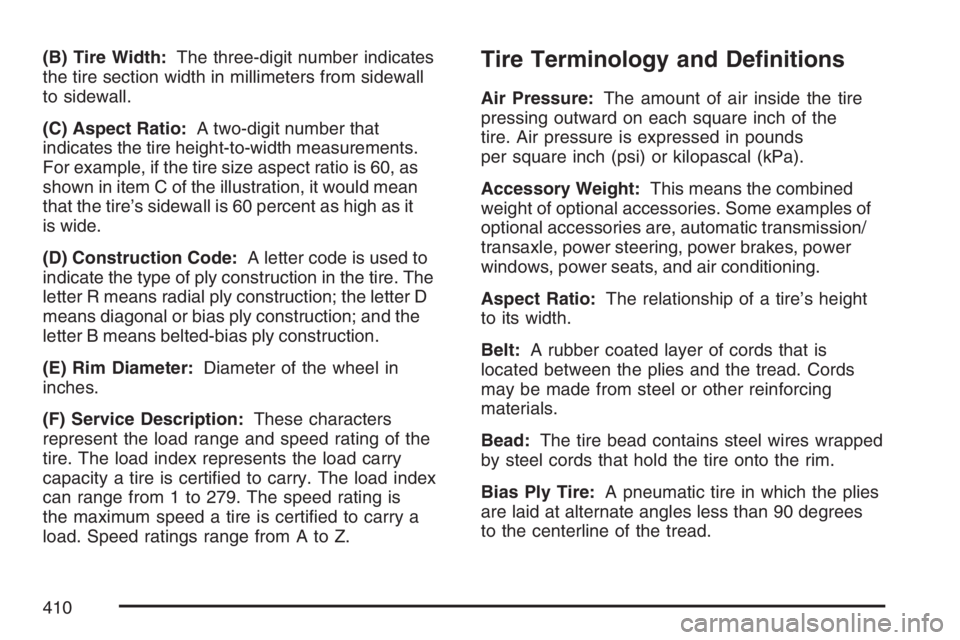
(B) Tire Width:The three-digit number indicates
the tire section width in millimeters from sidewall
to sidewall.
(C) Aspect Ratio:A two-digit number that
indicates the tire height-to-width measurements.
For example, if the tire size aspect ratio is 60, as
shown in item C of the illustration, it would mean
that the tire’s sidewall is 60 percent as high as it
is wide.
(D) Construction Code:A letter code is used to
indicate the type of ply construction in the tire. The
letter R means radial ply construction; the letter D
means diagonal or bias ply construction; and the
letter B means belted-bias ply construction.
(E) Rim Diameter:Diameter of the wheel in
inches.
(F) Service Description:These characters
represent the load range and speed rating of the
tire. The load index represents the load carry
capacity a tire is certied to carry. The load index
can range from 1 to 279. The speed rating is
the maximum speed a tire is certied to carry a
load. Speed ratings range from A to Z.Tire Terminology and Denitions
Air Pressure:The amount of air inside the tire
pressing outward on each square inch of the
tire. Air pressure is expressed in pounds
per square inch (psi) or kilopascal (kPa).
Accessory Weight:This means the combined
weight of optional accessories. Some examples of
optional accessories are, automatic transmission/
transaxle, power steering, power brakes, power
windows, power seats, and air conditioning.
Aspect Ratio:The relationship of a tire’s height
to its width.
Belt:A rubber coated layer of cords that is
located between the plies and the tread. Cords
may be made from steel or other reinforcing
materials.
Bead:The tire bead contains steel wires wrapped
by steel cords that hold the tire onto the rim.
Bias Ply Tire:A pneumatic tire in which the plies
are laid at alternate angles less than 90 degrees
to the centerline of the tread.
410
Page 427 of 528

If a Tire Goes Flat
It is unusual for a tire to blowout while you are
driving, especially if you maintain your vehicle’s
tires properly. If air goes out of a tire, it is much
more likely to leak out slowly. But if you should ever
have a blowout, here are a few tips about what to
expect and what to do:
If a front tire fails, the at tire will create a drag that
pulls the vehicle toward that side. Take your foot off
the accelerator pedal and grip the steering wheel
rmly. Steer to maintain lane position, and then
gently brake to a stop well out of the traffic lane.A rear blowout, particularly on a curve, acts much
like a skid and may require the same correction you
would use in a skid. In any rear blowout remove
your foot from the accelerator pedal. Get the vehicle
under control by steering the way you want the
vehicle to go. It may be very bumpy and noisy, but
you can still steer. Gently brake to a stop, well off
the road if possible.
{CAUTION:
Lifting a vehicle and getting under it to
do maintenance or repairs is dangerous
without the appropriate safety equipment
and training. The jack provided with your
vehicle is designed only for changing a
at tire. If it is used for anything else, you
or others could be badly injured or killed
if the vehicle slips off the jack. Use the
jack provided with your vehicle only for
changing a at tire.
If a tire goes at, the next part shows how to use the
jacking equipment to change a at tire safely.
427
Page 464 of 528

Fuse Usage
1 Empty
2 Steering Wheel Radio Controls
3 Power Door Locks
4 Empty
5 Empty
6 Empty
7 Empty
8 Empty
Fuse Usage
9 Empty
10Turn Signal and Hazard Lamp
Flashers
11 Power Seats
12Electronic Level Control (ELC)
Compressor
13 Liftgate and Endgate
14 Rear Auxiliary Power Outlet
15Electronic Level Control (ELC)
Compressor Relay and Height
Sensor
16 Heated Mirrors
17 Power Mirrors
18 Ignition 1 Module
19 Turn Signal Switch
21 Rear Defogger
22 Airbag Module
24 TCC Switch
25 HVAC Blower Motor
464
Page 514 of 528

Ashtray(s).................................................... 200
Audio System(s).......................................... 250
Audio Steering Wheel Controls................. 296
Care of Your CD and DVD Player............ 298
Care of Your CDs and DVDs................... 298
Fixed Mast Antenna................................. 299
Navigation/Radio System, see
Navigation Manual................................ 277
Radio with CD......................................... 252
Radio with Six-Disc CD............................ 262
Rear Seat Audio (RSA)............................ 293
Setting the Time...................................... 252
Theft-Deterrent Feature............................ 296
Understanding Radio Reception............... 297
XM™ Satellite Radio Antenna System...... 299
Automatic Headlamp System....................... 187
Automatic Transaxle
Fluid........................................................ 372
Operation................................................. 132
B
Battery........................................................ 393
Run-Down Protection............................... 192
Before Leaving on a Long Trip.................... 323
Bench Seat, Split.......................................... 15Brake
Anti-Lock Brake System (ABS)................. 307
Emergencies............................................ 309
Low Fluid Warning Message.................... 232
Parking.................................................... 135
System Warning Light.............................. 219
Brakes........................................................ 389
Braking....................................................... 306
Braking in Emergencies............................... 309
Break-In, New Vehicle................................. 127
Bulb Replacement....................................... 399
Halogen Bulbs......................................... 399
Headlamps, Front Turn Signal,
Sidemarker, and Parking Lamps........... 399
Replacement Bulbs.................................. 404
Taillamps and Back-Up Lamps................. 402
Taillamps, Turn Signal, and Stoplamps..... 401
Buying New Tires........................................ 418
C
Calibration................................................... 238
California Fuel............................................. 357
California Proposition 65 Warning................ 355
Canadian Owners........................................... 3
Capacities and Specications...................... 469
Captain Chairs, Rear..................................... 21
514
Page 525 of 528

Seats (cont.)
Memory, Mirrors......................................... 11
Power Seats.............................................. 10
Rear Seat Operation.................................. 15
Reclining Seatbacks................................... 13
Split Bench Seats...................................... 15
Stowable Seat........................................... 26
Secondary Latch System............................. 441
Securing a Child Restraint
Center Rear Seat Position......................... 82
Rear Outside Seat Position........................ 79
Right Front Seat Position........................... 84
Security Message, PASS-Key
®III ................ 231
Service........................................................ 354
Accessories and Modications.................. 354
Adding Equipment to the Outside of
Your Vehicle......................................... 356
California Proposition 65 Warning............. 355
Doing Your Own Work............................. 355
Engine Soon Light................................... 222
Publications Ordering Information............. 510
Traction System Warning Message.......... 226
Vehicle Soon Message............................. 233
Servicing Your Airbag-Equipped Vehicle....... 102
Setting the Time.......................................... 252
Sheet Metal Damage................................... 458Shifting Into Park (P)................................... 136
Shifting Out of Park (P)............................... 138
Shoulder Belt Height Adjuster........................ 45
Signals, Turn and Lane-Change.................. 178
Spare Tire
Accessory Inator..................................... 425
Compact.................................................. 450
Installing.................................................. 436
Removing................................................ 429
Storing..................................................... 444
Specications, Capacities............................ 469
Speedometer............................................... 213
Split Bench Seats......................................... 15
Starting Your Engine................................... 129
Steering...................................................... 311
Steering Wheel Controls, Audio................... 296
Steering Wheel, Tilt Wheel.......................... 177
Storage Areas
Cell Phone Storage Area......................... 159
Convenience Net..................................... 164
Cupholder(s)............................................ 158
Floor Console Storage Area..................... 160
Front Armrest Storage Area...................... 160
Glove Box................................................ 158
Overhead Console................................... 159
Rear Convenience Center........................ 165
525