change wheel BUICK RANDEZVOUS 2007 Owner's Manual
[x] Cancel search | Manufacturer: BUICK, Model Year: 2007, Model line: RANDEZVOUS, Model: BUICK RANDEZVOUS 2007Pages: 528, PDF Size: 2.99 MB
Page 103 of 528

Adding Equipment to Your
Airbag-Equipped Vehicle
Q:Is there anything I might add to the front
or sides of the vehicle that could keep the
airbags from working properly?
A:Yes. If you add things that change your
vehicle’s frame, bumper system, height,
front end or side sheet metal, they may keep
the airbag system from working properly.
Also, the airbag system may not work properly
if you relocate any of the airbag sensors. If
you have any questions about this, you should
contact Customer Assistance before you
modify your vehicle. The phone numbers and
addresses for Customer Assistance are in
Step Two of the Customer Satisfaction
Procedure in this manual. SeeCustomer
Satisfaction Procedure on page 492.
Q:Because I have a disability, I have to get
my vehicle modied. How can I nd out
whether this will affect my airbag system?
A:Changing or moving any parts of the
front seats, safety belts, the airbag sensing
and diagnostic module, the inside rearview
mirror, steering wheel, or airbag wiring
can affect the operation of the airbag system.
If you have questions, call Customer
Assistance. The phone numbers and
addresses for Customer Assistance are in
Step Two of the Customer Satisfaction
Procedure in this manual. SeeCustomer
Satisfaction Procedure on page 492.
103
Page 171 of 528

Instrument Panel Overview........................ 174
Hazard Warning Flashers.......................... 176
Other Warning Devices............................. 176
Horn.......................................................... 176
Tilt Wheel.................................................. 177
Turn Signal/Multifunction Lever.................. 177
Turn and Lane-Change Signals................. 178
Headlamp High/Low-Beam Changer.......... 179
Flash-to-Pass............................................ 179
Windshield Wipers..................................... 179
Windshield Washer.................................... 180
Rear Window Wiper/Washer...................... 180
Cruise Control........................................... 181
Exterior Lamps.......................................... 185
Daytime Running Lamps (DRL)................. 186
Automatic Headlamp System..................... 187
Fog Lamps................................................ 187
Interior Lamps........................................... 188
Instrument Panel Brightness...................... 188
Interior Lamps Control............................... 188
Headlamp Exit Delay................................. 189
Entry Lighting............................................ 189
Delayed Lighting........................................ 190
Exit Lighting.............................................. 190
Perimeter Lighting..................................... 191Front Reading Lamps................................ 191
Rear Reading Lamps................................ 191
Cargo Lamp.............................................. 192
Battery Run-Down Protection..................... 192
Instrument Panel Switchbank..................... 192
Head-Up Display (HUD)............................ 193
Ultrasonic Rear Parking Assist (URPA)...... 196
Accessory Power Outlet(s)........................ 199
Ashtray(s) and Cigarette Lighter................ 200
Climate Controls......................................... 200
Climate Control System............................. 200
Dual Climate Control System..................... 203
Dual Automatic Climate Control System.... 206
Outlet Adjustment...................................... 210
Warning Lights, Gages, and Indicators..... 211
Instrument Panel Cluster........................... 212
Speedometer and Odometer...................... 213
Trip Odometer........................................... 213
Tachometer............................................... 214
Safety Belt Reminder Light........................ 215
Airbag Readiness Light............................. 215
Passenger Airbag Status Indicator............. 217
Brake System Warning Light..................... 219
Anti-Lock Brake System Warning Light...... 220
Section 3 Instrument Panel
171
Page 172 of 528

Traction Control System (TCS) Warning
Light...................................................... 220
Engine Coolant Temperature Gage............ 221
Malfunction Indicator Lamp........................ 222
Fuel Gage................................................. 225
Message Center.......................................... 225
Passenger Seatbelt Reminder Message..... 226
Service Traction System Warning
Message................................................ 226
Traction Active Message........................... 227
Engine Coolant Temperature Warning
Message................................................ 227
Charging System Indicator Message.......... 228
Reduced Engine Power Message.............. 228
Low Oil Pressure Message........................ 229
Change Engine Oil Message..................... 230
Door Ajar Warning Message...................... 230
Rear Hatch Ajar Warning Message............ 230
Check Gas Cap Message......................... 231
PASS-Key
®III Security Message............... 231
Low Washer Fluid Warning Message......... 231
Low Fuel Warning Message...................... 232
Low Brake Fluid Warning Message........... 232
Service Vehicle Soon Message................. 233Program Mode Message........................... 233
Remote Keyless Entry Transmitter Battery
Low Warning Message........................... 234
Parking Lamp Warning Message............... 234
Highbeam Out Warning Message.............. 235
Driver Information Center (DIC).................. 235
DIC Controls and Displays........................ 236
DIC Compass............................................ 238
DIC Vehicle Personalization....................... 240
Audio System(s)......................................... 250
Setting the Time........................................ 252
Radio with CD........................................... 252
Radio with Six-Disc CD............................. 262
XM Radio Messages................................. 276
Navigation/Radio System........................... 277
Rear Seat Entertainment System............... 277
Rear Seat Audio (RSA)............................. 293
Theft-Deterrent Feature............................. 296
Audio Steering Wheel Controls.................. 296
Radio Reception........................................ 297
Care of Your CDs and DVDs.................... 298
Care of the CD and DVD Player............... 298
Fixed Mast Antenna.................................. 299
XM™ Satellite Radio Antenna System....... 299
Section 3 Instrument Panel
172
Page 177 of 528
Tilt Wheel
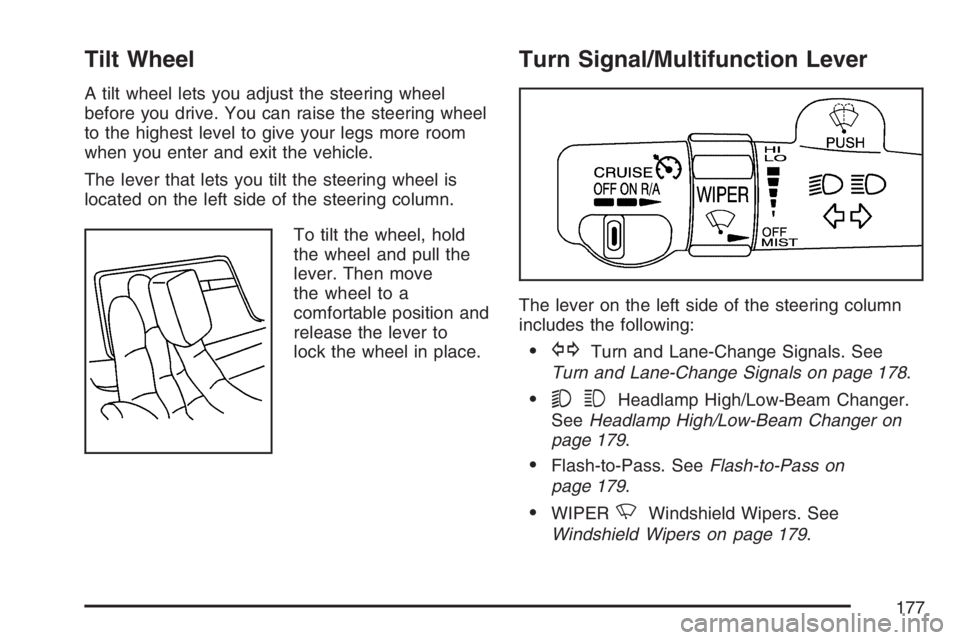
A tilt wheel lets you adjust the steering wheel
before you drive. You can raise the steering wheel
to the highest level to give your legs more room
when you enter and exit the vehicle.
The lever that lets you tilt the steering wheel is
located on the left side of the steering column.
To tilt the wheel, hold
the wheel and pull the
lever. Then move
the wheel to a
comfortable position and
release the lever to
lock the wheel in place.
Turn Signal/Multifunction Lever
The lever on the left side of the steering column
includes the following:
GTurn and Lane-Change Signals. See
Turn and Lane-Change Signals on page 178.
53Headlamp High/Low-Beam Changer.
SeeHeadlamp High/Low-Beam Changer on
page 179.
Flash-to-Pass. SeeFlash-to-Pass on
page 179.
WIPERNWindshield Wipers. See
Windshield Wipers on page 179.
177
Page 182 of 528
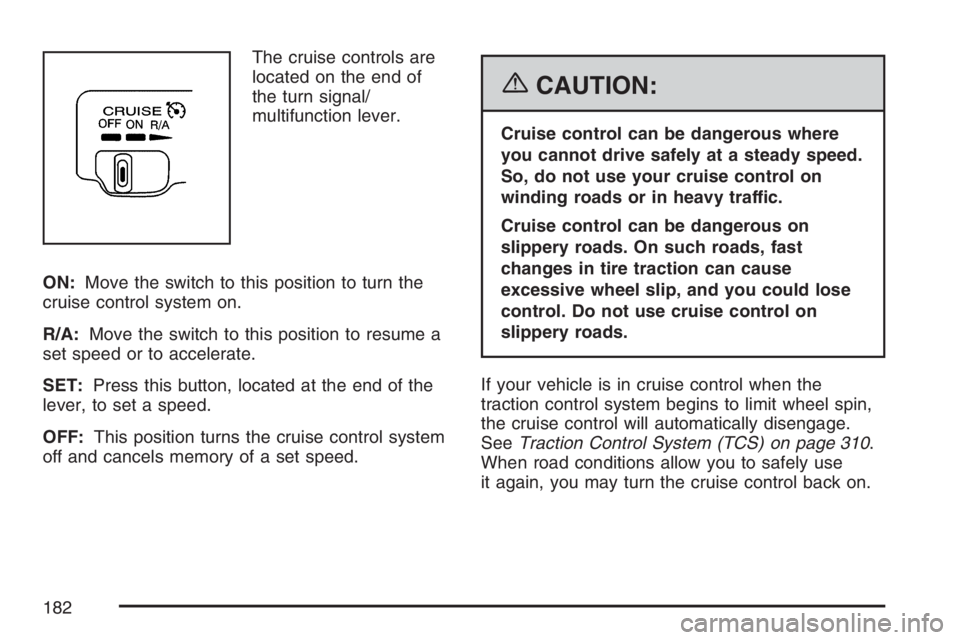
The cruise controls are
located on the end of
the turn signal/
multifunction lever.
ON:Move the switch to this position to turn the
cruise control system on.
R/A:Move the switch to this position to resume a
set speed or to accelerate.
SET:Press this button, located at the end of the
lever, to set a speed.
OFF:This position turns the cruise control system
off and cancels memory of a set speed.
{CAUTION:
Cruise control can be dangerous where
you cannot drive safely at a steady speed.
So, do not use your cruise control on
winding roads or in heavy traffic.
Cruise control can be dangerous on
slippery roads. On such roads, fast
changes in tire traction can cause
excessive wheel slip, and you could lose
control. Do not use cruise control on
slippery roads.
If your vehicle is in cruise control when the
traction control system begins to limit wheel spin,
the cruise control will automatically disengage.
SeeTraction Control System (TCS) on page 310.
When road conditions allow you to safely use
it again, you may turn the cruise control back on.
182
Page 194 of 528

The Head-Up Display also displays a CHECK
GAGES message. The following messages could
appear on the instrument panel cluster when
CHECK GAGES appears:
Engine Coolant Temperature Warning. See
Engine Coolant Temperature Warning
Message on page 227.
Low Oil Pressure. SeeLow Oil Pressure
Message on page 229.
Charging System Indicator. SeeCharging
System Indicator Message on page 228.
Low Brake Fluid Warning. SeeLow Brake
Fluid Warning Message on page 232.
Under warning conditions, the CHECK GAGES
message will illuminate in the HUD. Look at
the instrument panel cluster for more information.Notice:If you try to use the HUD image as a
parking aid, you may misjudge the distance
and damage your vehicle. Do not use the HUD
image as a parking aid.
The HUD controls are
located to the left of the
steering wheel on the
instrument panel.
When the HUD is on, the speedometer reading will
always be displayed. The current audio system
information will only be displayed for three seconds
after the radio, tape or CD track status changes.
This will happen whenever one of the radio controls
is pressed, either on the radio or on the audio
steering wheel controls, if equipped.
194
Page 308 of 528
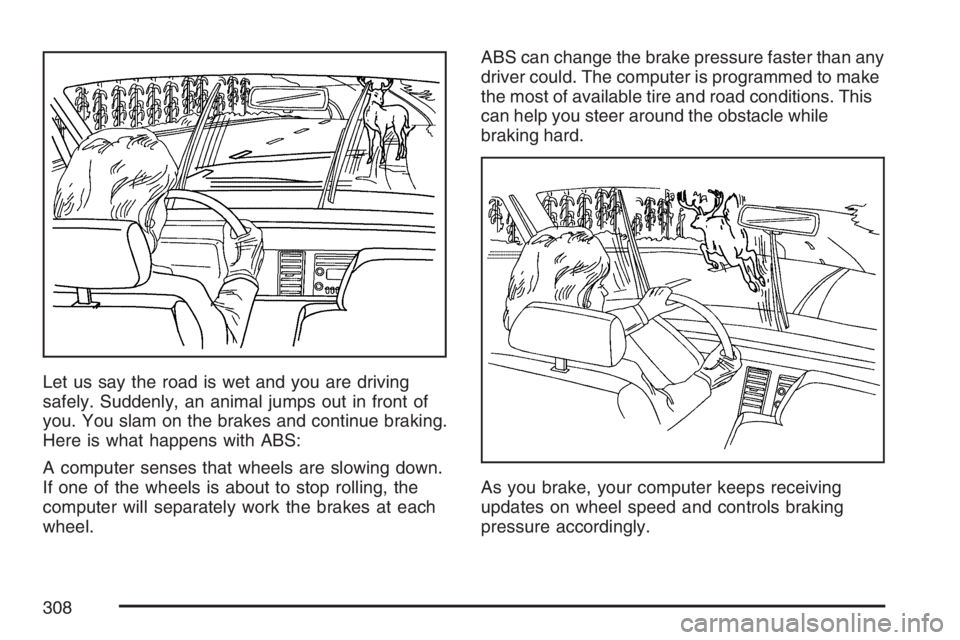
Let us say the road is wet and you are driving
safely. Suddenly, an animal jumps out in front of
you. You slam on the brakes and continue braking.
Here is what happens with ABS:
A computer senses that wheels are slowing down.
If one of the wheels is about to stop rolling, the
computer will separately work the brakes at each
wheel.ABS can change the brake pressure faster than any
driver could. The computer is programmed to make
the most of available tire and road conditions. This
can help you steer around the obstacle while
braking hard.
As you brake, your computer keeps receiving
updates on wheel speed and controls braking
pressure accordingly.
308
Page 309 of 528

Remember: ABS does not change the time you
need to get your foot up to the brake pedal
or always decrease stopping distance. If you get
too close to the vehicle in front of you, you will not
have time to apply your brakes if that vehicle
suddenly slows or stops. Always leave enough
room up ahead to stop, even though you
have ABS.
Using ABS
Do not pump the brakes. Just hold the brake
pedal down rmly and let anti-lock work for you.
You may feel a slight brake pedal pulsation
or notice some noise, but this is normal.
Braking in Emergencies
At some time, nearly every driver gets into a
situation that requires hard braking.If you have ABS, you can steer and brake at the
same time. However, if you do not have ABS, your
rst reaction — to hit the brake pedal hard and hold
it down — may be the wrong thing to do. Your
wheels can stop rolling. Once they do, the vehicle
cannot respond to your steering. Momentum will
carry it in whatever direction it was headed when
the wheels stopped rolling. That could be off the
road, into the very thing you were trying to avoid, or
into traffic.
If you do not have ABS, use a “squeeze” braking
technique. This will give you maximum braking
while maintaining steering control. You can do this
by pushing on the brake pedal with steadily
increasing pressure.
In an emergency, you will probably want to
squeeze the brakes hard without locking the
wheels. If you hear or feel the wheels sliding, ease
off the brake pedal. This will help you retain
steering control. If you do have ABS, it is different.
SeeAnti-Lock Brake System (ABS) on page 307.
In many emergencies, steering can help you
more than even the very best braking.
309
Page 311 of 528
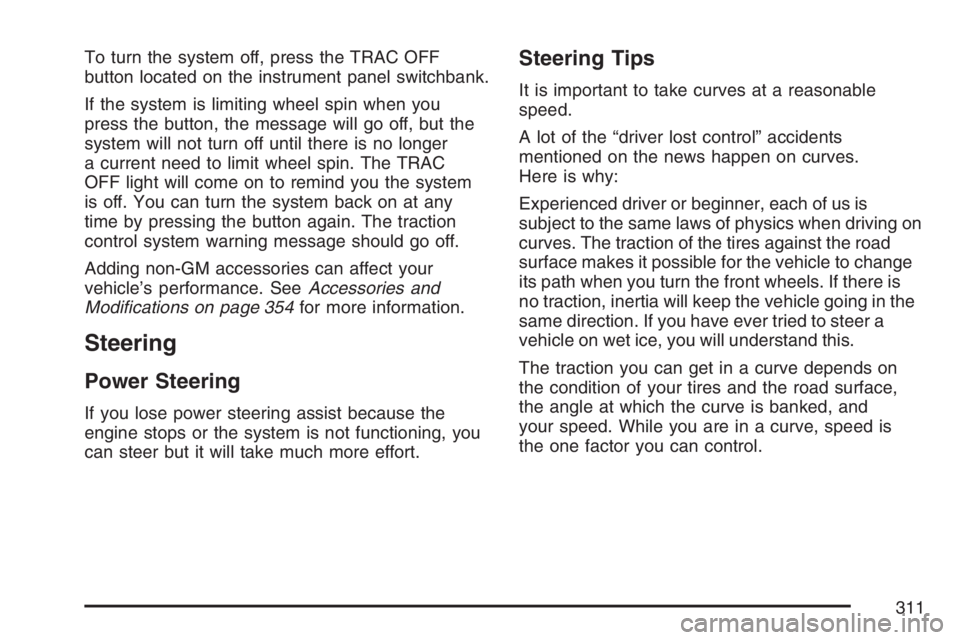
To turn the system off, press the TRAC OFF
button located on the instrument panel switchbank.
If the system is limiting wheel spin when you
press the button, the message will go off, but the
system will not turn off until there is no longer
a current need to limit wheel spin. The TRAC
OFF light will come on to remind you the system
is off. You can turn the system back on at any
time by pressing the button again. The traction
control system warning message should go off.
Adding non-GM accessories can affect your
vehicle’s performance. SeeAccessories and
Modications on page 354for more information.
Steering
Power Steering
If you lose power steering assist because the
engine stops or the system is not functioning, you
can steer but it will take much more effort.
Steering Tips
It is important to take curves at a reasonable
speed.
A lot of the “driver lost control” accidents
mentioned on the news happen on curves.
Here is why:
Experienced driver or beginner, each of us is
subject to the same laws of physics when driving on
curves. The traction of the tires against the road
surface makes it possible for the vehicle to change
its path when you turn the front wheels. If there is
no traction, inertia will keep the vehicle going in the
same direction. If you have ever tried to steer a
vehicle on wet ice, you will understand this.
The traction you can get in a curve depends on
the condition of your tires and the road surface,
the angle at which the curve is banked, and
your speed. While you are in a curve, speed is
the one factor you can control.
311
Page 316 of 528

Skidding
In a skid, a driver can lose control of the vehicle.
Defensive drivers avoid most skids by taking
reasonable care suited to existing conditions, and
by not overdriving those conditions. But skids
are always possible.
The three types of skids correspond to your
vehicle’s three control systems. In the braking skid,
your wheels are not rolling. In the steering or
cornering skid, too much speed or steering in a
curve causes tires to slip and lose cornering force.
And in the acceleration skid, too much throttle
causes the driving wheels to spin.
A cornering skid is best handled by easing your
foot off the accelerator pedal.
If you have the Traction Control System (TCS),
remember: It helps avoid only the acceleration
skid. SeeTraction Control System (TCS) on
page 310. If you do not have this system, or if the
system is off, then an acceleration skid is also
best handled by easing your foot off the
accelerator pedal.If your vehicle starts to slide, ease your foot off the
accelerator pedal and quickly steer the way you
want the vehicle to go. If you start steering quickly
enough, your vehicle may straighten out. Always be
ready for a second skid if it occurs.
Of course, traction is reduced when water, snow,
ice, gravel, or other material is on the road.
For safety, you will want to slow down and adjust
your driving to these conditions. It is important
to slow down on slippery surfaces because
stopping distance will be longer and vehicle control
more limited.
While driving on a surface with reduced traction, try
your best to avoid sudden steering, acceleration, or
braking, including reducing vehicle speed by
shifting to a lower gear. Any sudden changes could
cause the tires to slide. You may not realize the
surface is slippery until your vehicle is skidding.
Learn to recognize warning clues — such as
enough water, ice, or packed snow on the road to
make a mirrored surface — and slow down when
you have any doubt.
316