door lock BUICK REGAL 1993 User Guide
[x] Cancel search | Manufacturer: BUICK, Model Year: 1993, Model line: REGAL, Model: BUICK REGAL 1993Pages: 308, PDF Size: 16.35 MB
Page 64 of 308
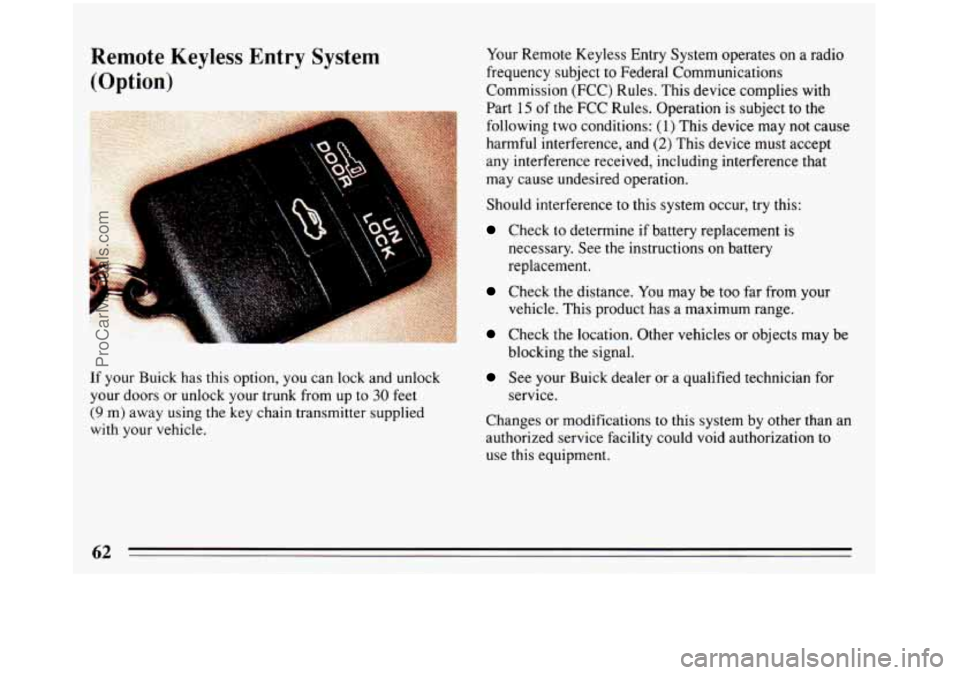
Remote Keyless Entry System
(Option)
If your Buick has this option, you can lock and unlock
your doors or unlock your trunk from up to
30 feet
(9 m) away using the key chain transmitter supplied
with your vehicle. Your
Remote Keyless Entry System operates
on a radio
frequency subject
to Federal Communications
Commission (FCC)
Rules. This device complies with
Part
15 of the FCC Rules. Operation is subject to the
following two conditions:
(1) This device may not cause
harmful interference, and
(2) This device must accept
any interference received, including interference that
may cause undesired operation.
Should interference to this system occur, try this:
Check to determine if battery replacement is
necessary. See the instructions on battery
replacement.
vehicle. This product has a maximum range.
Check the distance. You may be too far from your
Check the location. Other vehicles or objects may be
See your Buick dealer or a qualified technician for
blocking the
signal.
service.
Changes or modifications
to this system by other than an
authorized service facility could void authorization to
use this equipment.
62
ProCarManuals.com
Page 65 of 308
Operation
The driver’s door will unlock automatically when
UNLOCK is pressed. If UNLOCK, is pressed twice
quickly,
all doors will unlock. The interior lights will
also come on for approximately
40 seconds and go off
when the ignition is turned on.
All doors will lock when
DOOR is pressed.
The trunk
will unlock when the opened trunk symbol is
pressed, but only
when the transaxle is in PARK.
Matching Transmitter(s) To Your Vehicle
Each key chain transmitter is coded to prevent another
transmitter from unlocking your vehicle. If a transmitter
is
lost or stolen, a replacement can be purchased through
your dealer. Remember to bring the remaining
transmitter with you when
you go to your dealer. When
the dealer matches
the replacement transmitter to your
vehicle, the remaining transmitter must also be matched.
Once the
new transmitter is coded, the lost transmitter
will
not unlock your vehicle.
You can match a transmitter to as many different
vehicles as you own, provided they are equipped with
exactly the same model system
. (General Motors offers
several different models
of these systems on their vehicles.) Each vehicle can
have only two transmitters
matched to
it.
See your dealer to match transmitters to another vehicle.
Battery Replacement
Under normal use, the batteries in your key chain
transmitter should last about two years.
You can tell the batteries are weak if the transmitter
won’t work at the normal range
in any location. If you
have to get close to your vehicle before the transmitter
works, it’s probably time to change the batteries.
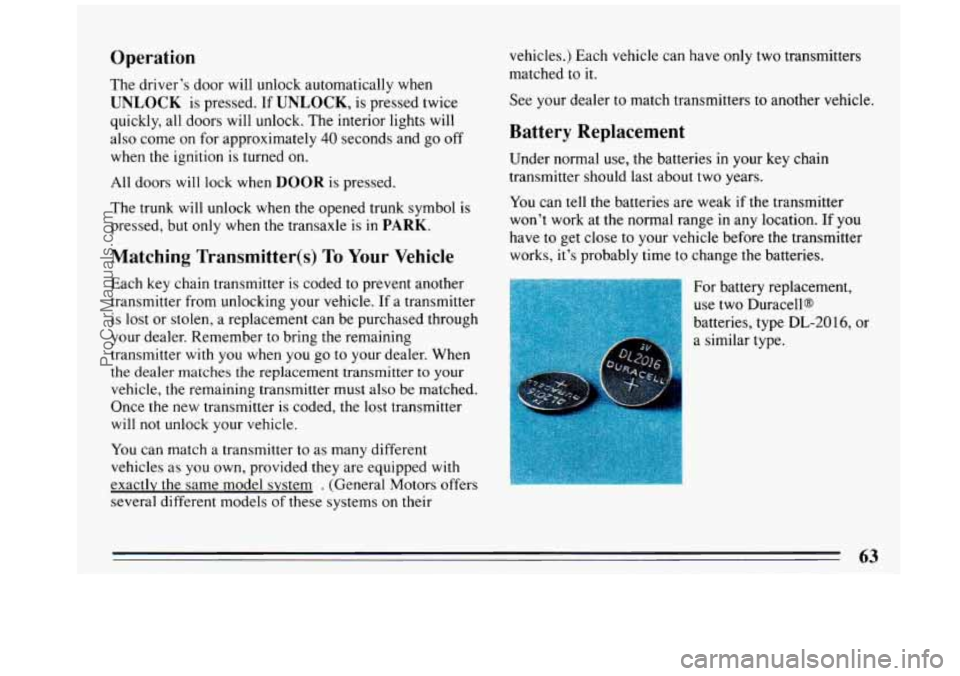
For battery replacement,
use two DuracellB
batteries, type
DL-2016, or
a similar type.
63
ProCarManuals.com
Page 66 of 308
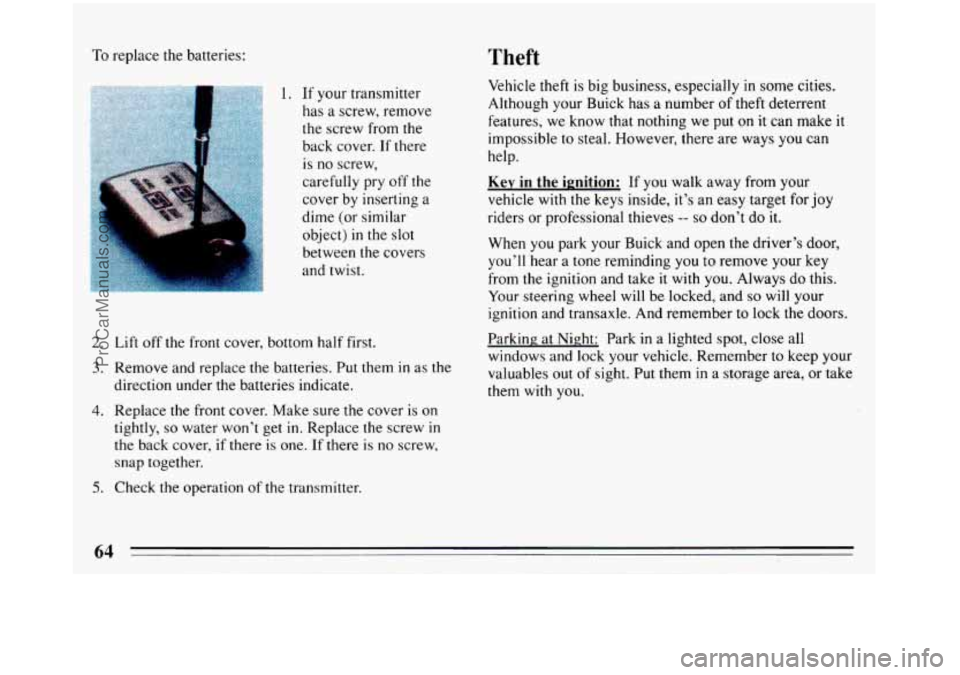
To replace the batteries: Theft
1. If your transmitter
has
a screw, remove
the screw from the
back cover.
If there
is no screw,
carefully pry off the
cover by inserting a
dime (or similar
object)
in the slot
between the covers
and twist.
2. Lift off the front cover, bottom half first.
3. Remove and replace the batteries. Put them in as the
direction under the batteries indicate.
4. Replace the front cover. Make sure the cover is on
tightly, so water won’t get in. Replace the screw in
the back cover, if there is one. If there is no screw,
snap together.
5. Check the operation of the transmitter. Vehicle
theft is big business, especially in some cities.
Although your Buick has a number of theft deterrent
features, we know that nothing we put on
it can make it
impossible
to steal. However, there are ways you can
help.
Key in the ignition: If you walk away from your
vehicle with the keys inside, it’s
an easy target for joy
riders or professional thieves
-- so don’t do it.
When you park your Buick and open the driver’s door,
you’ll hear a tone reminding you to remove your key
from the ignition and take it with you. Always do this.
Your steering wheel will be locked, and
so will your
ignition and transaxle. And remember to lock
the doors.
Parking at
Night: Park in a lighted spot, close all
windows and
lock your vehicle. Remember to keep your
valuables
out of sight. Put them in a storage area, or take
them with
you.
64
ProCarManuals.com
Page 67 of 308
Parking Lots: If you park in a lot where someone will
be watching your vehicle, it’s best
to lock it up and take
your keys. But what
if you have to leave your ignition
key? What if
you have to leave something valuable in
your vehicle?
0 Put your valuables in a storage area, like your trunk
or glove box.
0 Lock the glove box.
0 Lock all the doors except the driver’s.
0 Then take the door key with you.
New Vehicle ‘LBreak-In99
Your modern Buick doesn’t need an elaborate
“break-in.” But
it will perform better
run if you follow these guidelines:
Don’t drive at any one speed -- fast or sin
-- for the first 500 miles (804. km,)Jon’+ .,,, ii’ ’
make full-throttle starts.
Avoid making hard stops for the
first 200
miles (322 km) or so. During this time your
new brake linings aren’t yet broken
in. Hard
stops with new linings can mean premature
wear and earlier replacement.
Follow this
“breaking-in” guideline every time you get
lew brake linings.
.ti“”.: .-,i- t.,/ +
65
ProCarManuals.com
Page 122 of 308
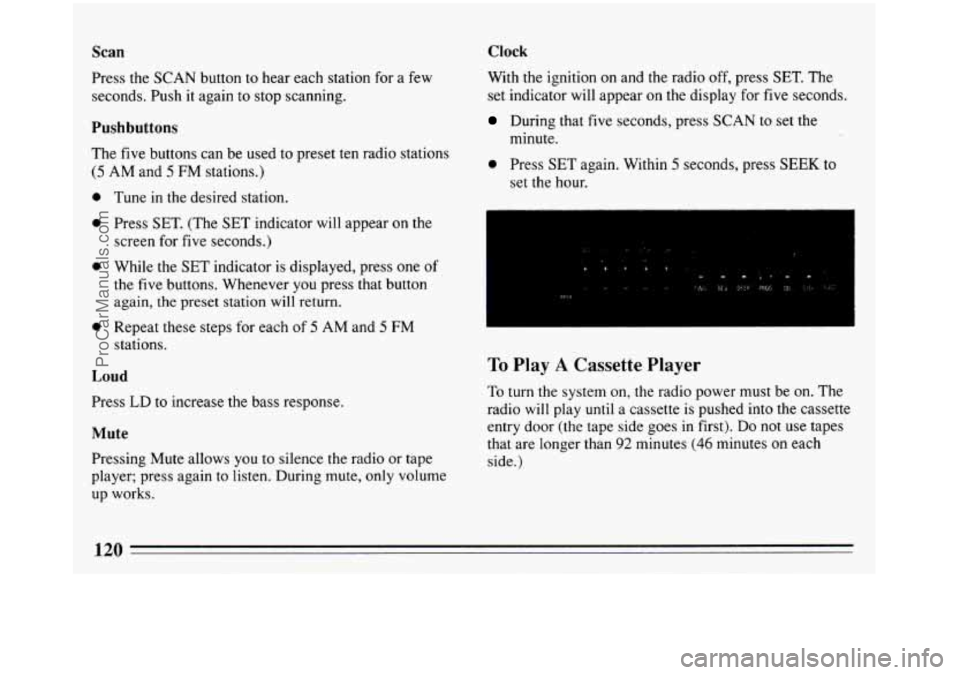
Scan
Press the SCAN button to hear each station for a few
seconds. Push it again to stop scanning.
Pushbuttons
The five buttons can be used to preset ten radio stations
(5 AM and 5 FM stations.)
0
0
0
0
Tune in the desired station.
Press SET. (The SET indicator will appear on the
screen for five seconds.)
While the
SET indicator is displayed, press one of
the five buttons. Whenever you press that button
again,
the preset station will return.
Repeat these steps for each
of 5 AM and 5 FM
stations.
Loud
Press LD to increase the bass response.
Mute
Pressing Mute allows you to silence the radio or tape
player; press again to listen. During mute, only volume
up works.
Clock
With the ignition on and the radio off, press SET. The
set indicator will appear on the display for five seconds.
During that five seconds, press SCAN to set the
0 Press SET again. Within 5 seconds, press SEEK to
minute.
set the hour.
To Play A Cassette Player
To turn the system on, the radio power must be on. The
radio will play until a cassette is pushed into the cassette
entry door
(the tape side goes in first). Do not use tapes
that are longer than
92 minutes (46 minutes on each
side.)
120
___ ~ -
ProCarManuals.com
Page 219 of 308
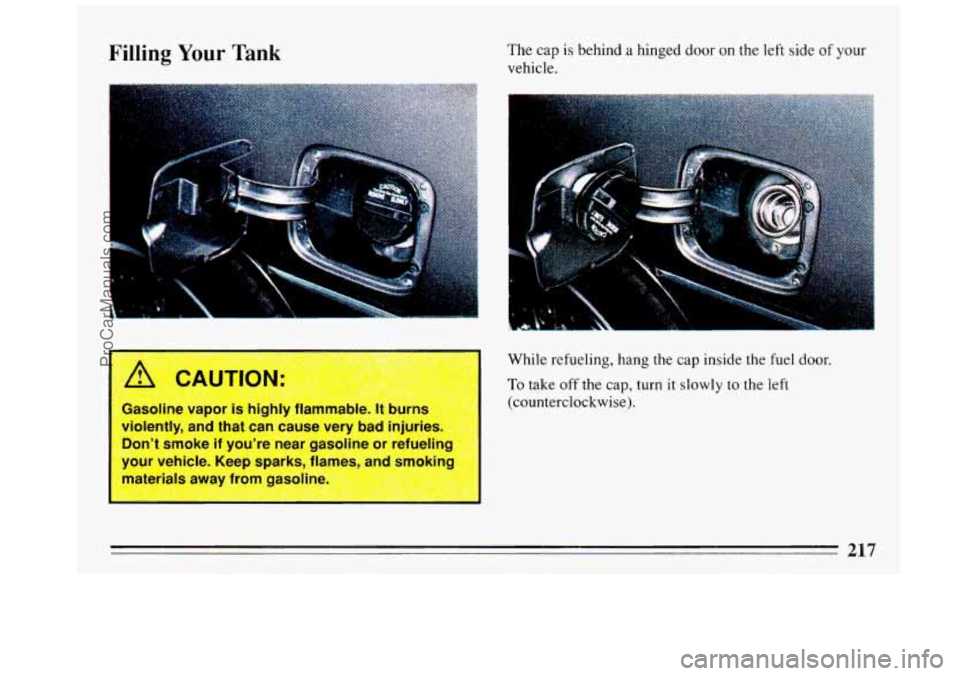
Filling Your Tank The cap is behind a hinged door on the left side of your
vehicle.
11ne vapor IS nlghly Tlarnrnao
violently, and that can cause very Dad injuries.
Don’t smoke if you’re near gasoline or refuelin
your vehicle. Keep sparks, flames, (rr4erials away
+rqm ga-line. ~~2;: LMk
While refueling, hang the cap inside the fuel door.
To take off the cap, turn it slowly to the kft
(counterclockwise).
217
ProCarManuals.com
Page 226 of 308
When to Change Engine Oil: See if any one of these
is true for you:
Most trips are less than 4 miles (6 km).
9 It’s below freezing outside and most trips are less
9 The engi.ne is at low speed most of the time (as in
door-to-door delivery, or in stop-and-go traffic).
You tow a trailer often. .-
9 Most trips are through dusty places.
If
any one of thes,e is true for your vehicle, then you
need to change your oil and filter every
3,000 miles (5
000 km) or 3 months -- whichever comes first.
If none of them is true, change the oil every 7,500 miles
(12
500 km) or 12 months -- whichever comes first.
Change the filter at the first
oil change and at every
other
oil change after that.
Engine Block Heater: An engine block heater can be a
big help if you have to park outside in very cold
than
10 miles (16 km).
weather,
-20 F (-29 C)
or colder. If your vehicle has
this option, see ”Engine
Block Heater” in the Index.
What to Do with Used Oil:
Used engine oil contains things that ha\, zaused
skin cancer in laboratory animals. Don’t let use6 oil stay on your skin for very long. Clean your
skin and nails with soap and water, or a good
hand cleaner. Wash
or properly throw away
4othing or rags containing used engine oil
Used oil can be a real threat to the environment. If you
change your own oil, be sure
to drain all free-flowing oil
from the filter before disposal. Don’t ever dispose of oil
by pouring
it on the ground, into sewers, or into streams
or bodies of water. Instead, recycle
it by taking it to a
place that collects used oil.
If you have a problem
224
ProCarManuals.com
Page 259 of 308
Fuses and Circuit Breakers
The wiring circuits in your car are protected from short
circuits by a combination
of fuses, circuit breakers, and
fusible themdi links in the wiring itself.
This greatly
reduces the chance
of fires caused by electrical problems.
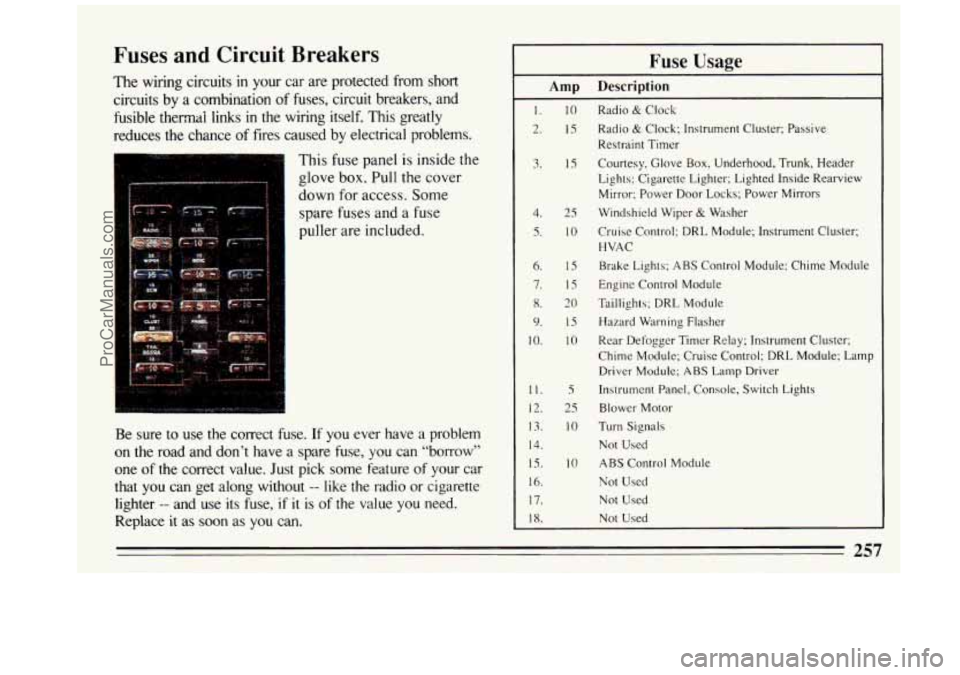
This fuse panel is inside the
glove box. Pull the cover
down for access. Some
spare fuses and
a fuse
puller are included.
Be sure
to use the correct fuse. If you ever have a problem
on the road and don’t have
a spare fuse, you can “borrow”
one of the correct value. Just pick some feature of your car
that you can get along without
-- like the radio or cigarette
lighter
-- and use its fuse, if it is of the value you need.
Replace
it as soon as you can.
Fuse Usage
Amp Description
1.
2.
3.
10
15
15
4.
5.
6.
7.
8.
9.
10.
11.
12.
13.
14.
1s.
16.
17.
18.
25
10
1s
15
20
15
10
5
25
10
10
Radio & Clock
Radio
& Clock; Instrument Cluster; Passive
Restraint Timer
Courtesy, Glove Box, Underhood, Trunk, Header
Lights; Cigarette Lighter; Lighted Inside Rearview Mirror; Power Door Locks; Power Mirrors
Windshield Wiper
& Washer
Cruise Control: DRL Module; Instrument Cluster;
HVAC
Brake Lights;
ABS Control Module; Chime Module
Engine Control Module
Taillights; DRL Module
Hazard Warning Flasher
Rear Defogger Timer Relay: Instrument Cluster;
Chime Module; Cruise Control; DRL Module; Lamp
Driver
Module; ABS Lamp Driver
Instrument Panel. Console, Switch Lights
Blower Motor
Turn Signals
Not Used ABS Control Module
Not Used Not Used
Not Used
257
ProCarManuals.com
Page 279 of 308
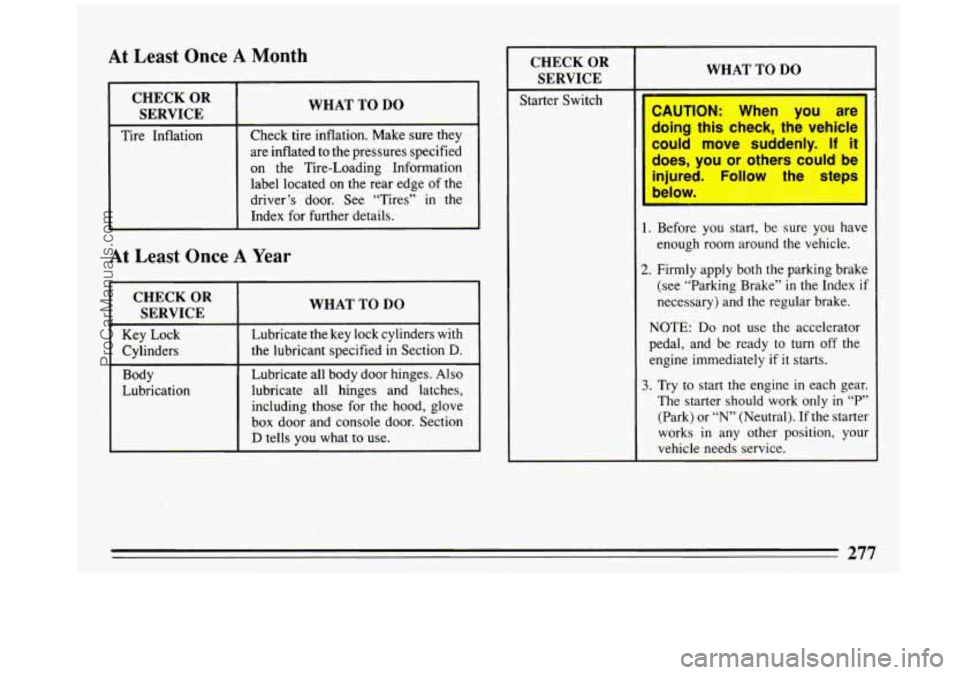
At Least Once A Month
CHECK OR
SERVICE
Tire Inflation
WHAT TO DO
Check tire inflation. Make sure they
are inflated
to the pressures specified
on the Tire-Loading Information
label located on the rear edge of
the
driver’s door. See “Tires” in the
Index for further details.
c!%&lkY 1 --“-+
Starter Switch
At Least Once A Year
I CHECKOR
SERVICE
I WHAT TO DO
Key Lock
the lubricant specified in Section
D. Cylinders Lubricate the
key lock cylinders with
Body
Lubrication Lubricate all
body door hinges.
Also
lubricate all hinges and latches,
including those for the hood, glove
box door and console door. Section
D tells you what to use.
1. Before you start, be sure you have
enough room around the vehicle.
2. Firmly apply both the parking brake
(see “Parking Brake”
in the Index if
necessary) and the regular brake.
NOTE:
Do not use the accelerator
pedal, and
be ready to turn off the
engine immediately if
it starts.
3. Try to start the engine in each gear.
The starter should work only in “P”
(Park) or
“N” (Neutral). If the starter
works
in any other position, your
vehicle needs service.
277
ProCarManuals.com
Page 283 of 308
~~ - -
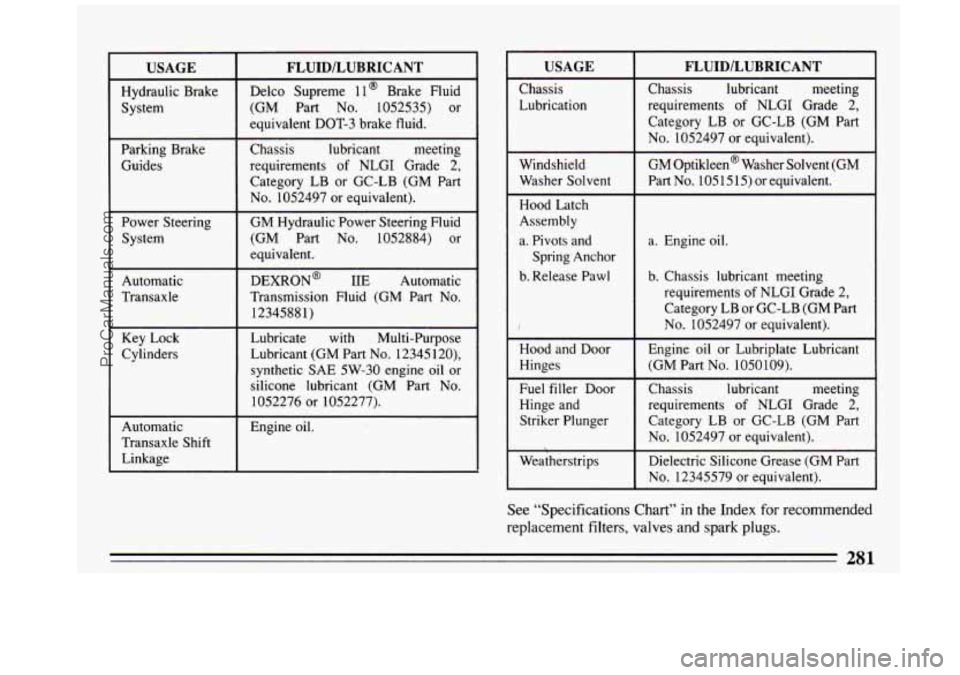
USAGE
FLUID/LUBRICANT
Hydraulic
Brake
(GM Part No. 1052535) or
System Delco Supreme 1 l@ Brake Fluid
equivalent DOT-3 brake fluid.
Parking Brake
Category LB or GC-LB (GM Part
requirements
of NLGI Grade
2,
Guides Chassis lubricant meeting
No.
1052497
or equivalent).
Power Steering
Transmission Fluid (GM Part No.
Transaxle DEXRON@
IIE Automatic
Automatic (GM Part
No. 1052884) or
System GM
Hydraulic Power Steering Fluid
equivalent.
1234588 1)
Key Lock Lubricate with Multi-Purpose
Cylinders Lubricant (GM
Part No. 12345120),
synthetic SAE 5W-30 engine
oil or
silicone lubricant (GM Part No.
1052276 or 1052277).
Automatic
Transaxle Shift Engine oil.
Linkage
USAGE
Chassis
Lubrication
Windshield
Washer Solvent
Hood Latch
Assembly
a. Pivots and
b. Release Pawl
Spring
Anchor
i
Hood and Door
Hinges
Fuel
filler Door
Hinge and
Striker Plunger
Weatherstrips
FLUIDlLUBRICANT
Chassis lubricant meeting
requirements
of NLGI Grade 2,
Category LB or GC-LB (GM Part
No. 1052497 or equivalent).
GM Optikleen@ Washer Solvent (GM
Part No.
105 15 15) or equivalent.
a. Engine oil.
b. Chassis lubricant meeting
requirements
of NLGI Grade 2,
Category LB or GC-LB (GM Part
No. 1052497 or equivalent).
Engine
oil or Lubriplate Lubricant
(GM Part No. 1050109).
Chassis lubricant meeting
requirements
of NLGI Grade 2,
Category LB
or GC-LB (GM Part
No. 1052497 or equivalent).
Dielectric Silicone Grease (GM Part
No. 12345579 or equivalent).
See “Specifications Chart” in the Index for recommended
replacement filters, valves and spark plugs.
301
ProCarManuals.com