key BUICK REGAL 1993 User Guide
[x] Cancel search | Manufacturer: BUICK, Model Year: 1993, Model line: REGAL, Model: BUICK REGAL 1993Pages: 308, PDF Size: 16.35 MB
Page 66 of 308
To replace the batteries: Theft
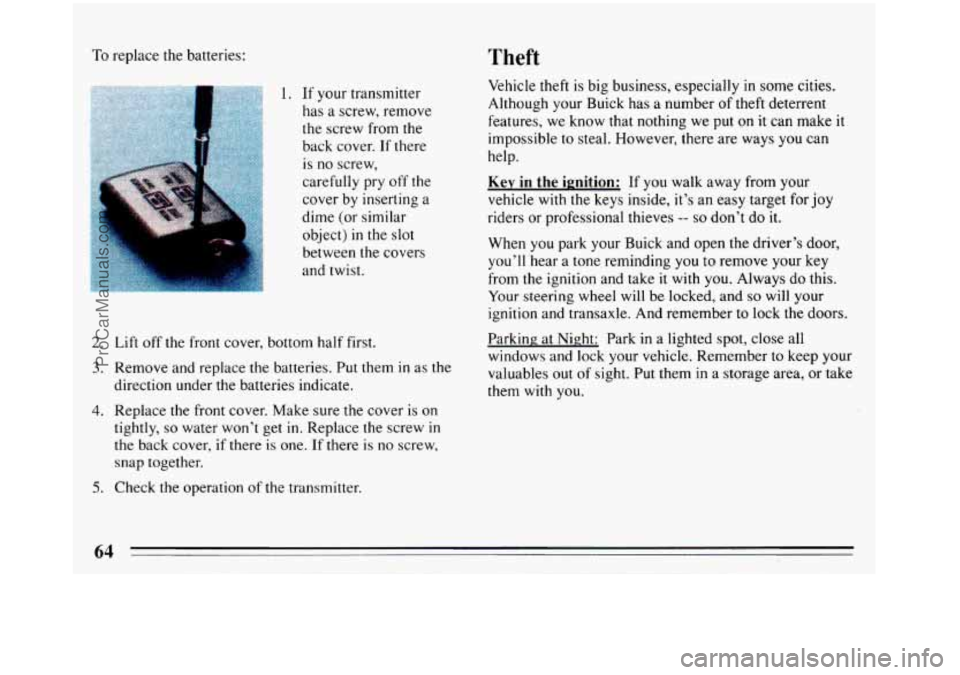
1. If your transmitter
has
a screw, remove
the screw from the
back cover.
If there
is no screw,
carefully pry off the
cover by inserting a
dime (or similar
object)
in the slot
between the covers
and twist.
2. Lift off the front cover, bottom half first.
3. Remove and replace the batteries. Put them in as the
direction under the batteries indicate.
4. Replace the front cover. Make sure the cover is on
tightly, so water won’t get in. Replace the screw in
the back cover, if there is one. If there is no screw,
snap together.
5. Check the operation of the transmitter. Vehicle
theft is big business, especially in some cities.
Although your Buick has a number of theft deterrent
features, we know that nothing we put on
it can make it
impossible
to steal. However, there are ways you can
help.
Key in the ignition: If you walk away from your
vehicle with the keys inside, it’s
an easy target for joy
riders or professional thieves
-- so don’t do it.
When you park your Buick and open the driver’s door,
you’ll hear a tone reminding you to remove your key
from the ignition and take it with you. Always do this.
Your steering wheel will be locked, and
so will your
ignition and transaxle. And remember to lock
the doors.
Parking at
Night: Park in a lighted spot, close all
windows and
lock your vehicle. Remember to keep your
valuables
out of sight. Put them in a storage area, or take
them with
you.
64
ProCarManuals.com
Page 67 of 308
Parking Lots: If you park in a lot where someone will
be watching your vehicle, it’s best
to lock it up and take
your keys. But what
if you have to leave your ignition
key? What if
you have to leave something valuable in
your vehicle?
0 Put your valuables in a storage area, like your trunk
or glove box.
0 Lock the glove box.
0 Lock all the doors except the driver’s.
0 Then take the door key with you.
New Vehicle ‘LBreak-In99
Your modern Buick doesn’t need an elaborate
“break-in.” But
it will perform better
run if you follow these guidelines:
Don’t drive at any one speed -- fast or sin
-- for the first 500 miles (804. km,)Jon’+ .,,, ii’ ’
make full-throttle starts.
Avoid making hard stops for the
first 200
miles (322 km) or so. During this time your
new brake linings aren’t yet broken
in. Hard
stops with new linings can mean premature
wear and earlier replacement.
Follow this
“breaking-in” guideline every time you get
lew brake linings.
.ti“”.: .-,i- t.,/ +
65
ProCarManuals.com
Page 68 of 308
Ignition Key Positions
I ACCESSORY
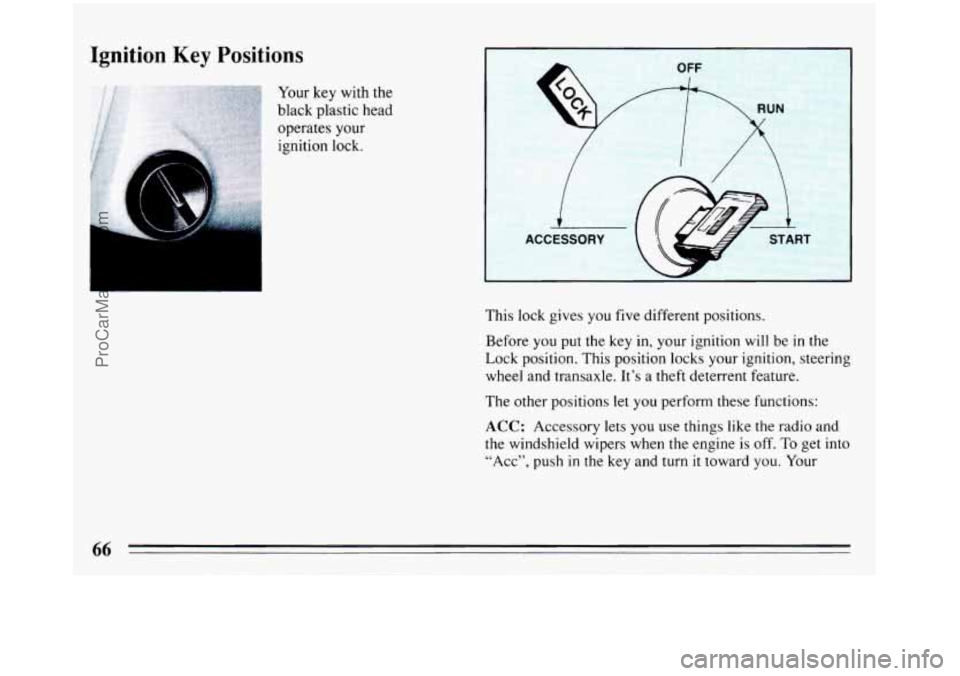
This lock gives you five different positions.
Before you put the key in, your ignition will be in the
Lock position. This position locks your ignition, steering
wheel and transaxle. It’s a theft deterrent feature.
The other positions let
you perform these functions:
ACC: Accessory lets you use things like the radio and
the windshield wipers when the engine is off.
To get into
“Acc”, push
in the key and turn it toward you. Your
66
ProCarManuals.com
Page 69 of 308
steering wheel will remain locked, just as it was before Starting Your Engine
you inserted the key.
turn the steering wheel. It doesn’t lock the steering number for your engine. You will find the
VIN at the top
in motion while the engine is
off ( example, if your car Identification Number” in the Index.) Follow the proper
is being pushed). steps to start the engine.
Engines start
differently. The 8th digit of your Vehicle
OFF:’ This position lets YOU turn Off the engine but Still
Identification Number (VIN) shows the code letter or
wheel like “Lock.” Use “Off’ if
YOU must have your car
left of your instrument panel. (See ‘‘Vehicle
RUN: This is the position for driving.
START: This position starts your engine. Move your shift lever to
“F”’ (Park)
or “N’ (Neutral).
Your engine won’t start in any other position
-- that’s a
safety feature. To restart when you’re already moving,
use
“N’ (Neutral) only.
Don’t try to shift t
moving. If you do,
transaxle. Shift to ... . -
67
ProCarManuals.com
Page 70 of 308
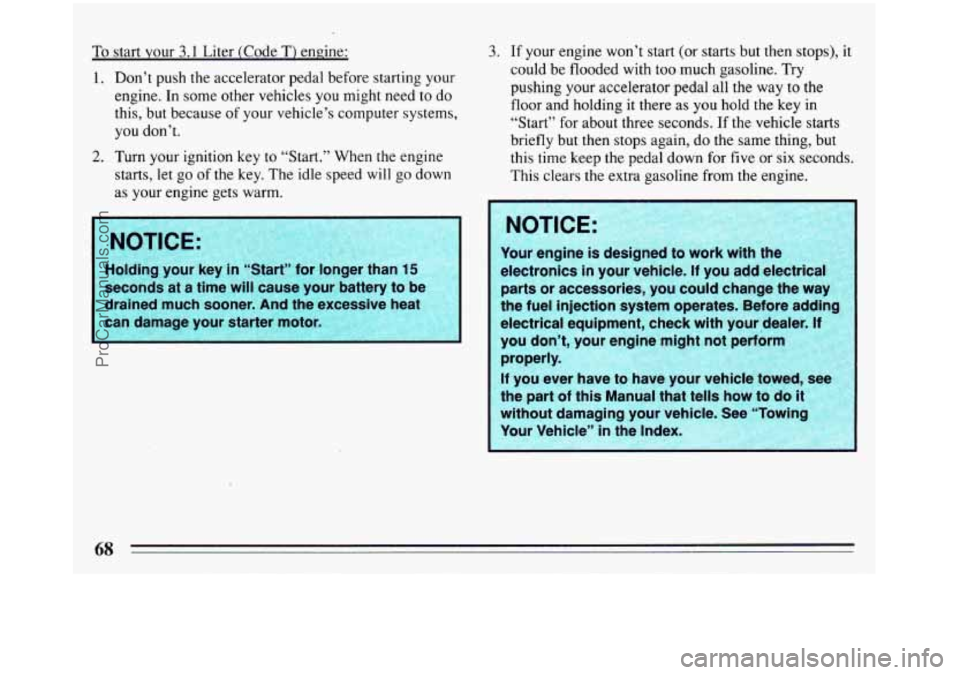
To start your 3.1 Liter (Code T) engine:
1. Don’t push
the accelerator pedal before starting your
engine. In some other vehicles you might need to do
this, but because of your vehicle’s computer systems,
you don’t.
starts, let
go of the key. The idle speed will go down
as your engine gets warm.
2. Turn your ignition key to “Start.” When the engine
omng your Key In “Start” for longer tna
seconds at a time will cause your battery to
t
drained much sooner. And the excessive hear
3. If your engine won’t start (or starts but then stops), it
could be flooded with too much gasoline. Try
pushing your accelerator pedal all the
way to the
floor and holding it there
as you hold the key in
“Start” for about three seconds. If the vehicle starts
briefly but then stops again, do
the same thing, but
this time keep the pedal down for five
or six seconds.
This clears the extra gasoline from the engine.
[ electronics in your vehicle. If you add electrical
parts or accessories, you could change the way
the fuel injection system operates. Before adding
electrical equipment, check with your dealer.
1-
you don’t, your engine might not perforn
properly.
If you ever have to have your vehicle towed, see
the part
of this Manual that tells how to do it
without damaging your vehicle. See “Towing
Your Vehicle” in the Index.
4
-$,.-q*+&< ..,-. >%--:* ..“I)“:.. , .--..:<::.,: m.v;,,, ,‘‘Tmy, ““,u, .; ::x,.* ..,, L, W“ . , ~’‘&&‘, ’~=:.*>:** . .. l\l_ $p;Y-.T@ b
68
ProCarManuals.com
Page 71 of 308
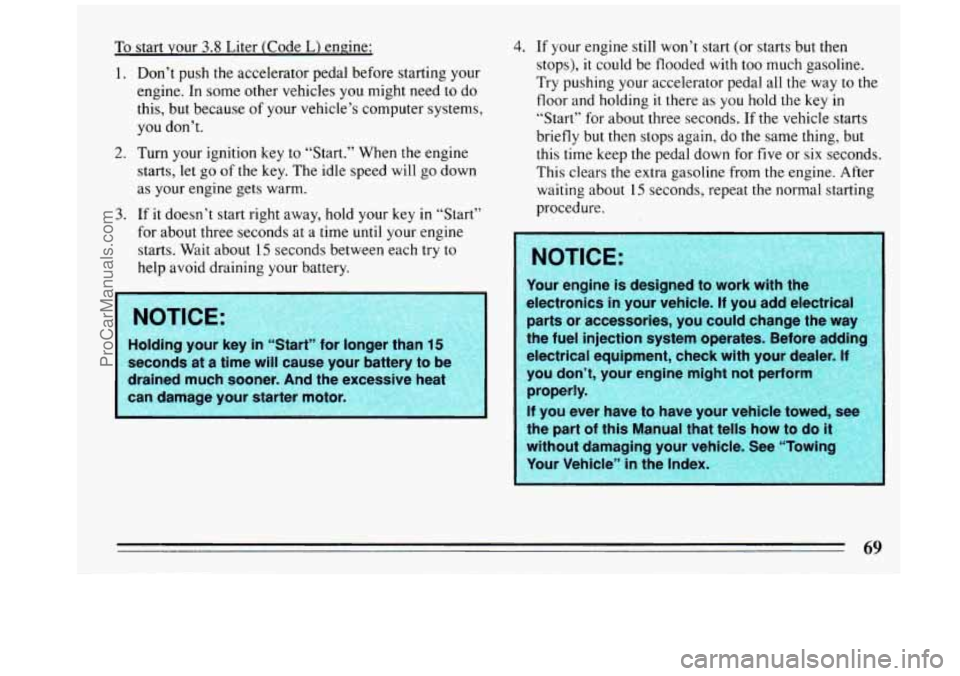
To start your 3.8 Liter (Code L) engine:
1. Don’t push the accelerator pedal before starting your
engine. In some other vehicles you might need
to do
this, but because of your vehicle’s computer systems,
you don’t.
2. Turn your ignition key to “Start.” When the engine
starts,
let go of the key, The idle speed will go down
as your engine gets warm.
3. If it doesn’t start right away, hold your key in “Start”
for about three seconds at
a time until your engine
starts. Wait about
15 seconds between each try to
help avoid draining your battery.
Holding your key in “Start” for longer than 15
seconds at a time will cause your battery to be
drained much sooner.
And the excessive heat
can damage your starter motor.
4. If your engine still won’t start (or starts but then
stops), it could be flooded with too much gasoline.
Try pushing your accelerator pedal all the way to the
floor and holding
it there as you hold the key in
“Start” for about three seconds.
If the vehicle starts
briefly but then stops again,
do the same thing, but
this time keep the pedal down for five or six seconds.
This clears the extra gasoline from the engine. After
waiting about
15 seconds, repeat the normal starting
procedure.
electronics in your vehicle. If you add electric
parts or accessories, you could change
the way
the fuel injection system operates. Before adding
electrical equipment, check with your dealer
‘I.
you don’t, your engine might not perform
properly.
If you ever
h h hicle towea,
the part
of this Manual that tells how to do it
without damaging your vehicle. See “To
Your Vehicle” in the Index, :, ’ .
69
ProCarManuals.com
Page 78 of 308
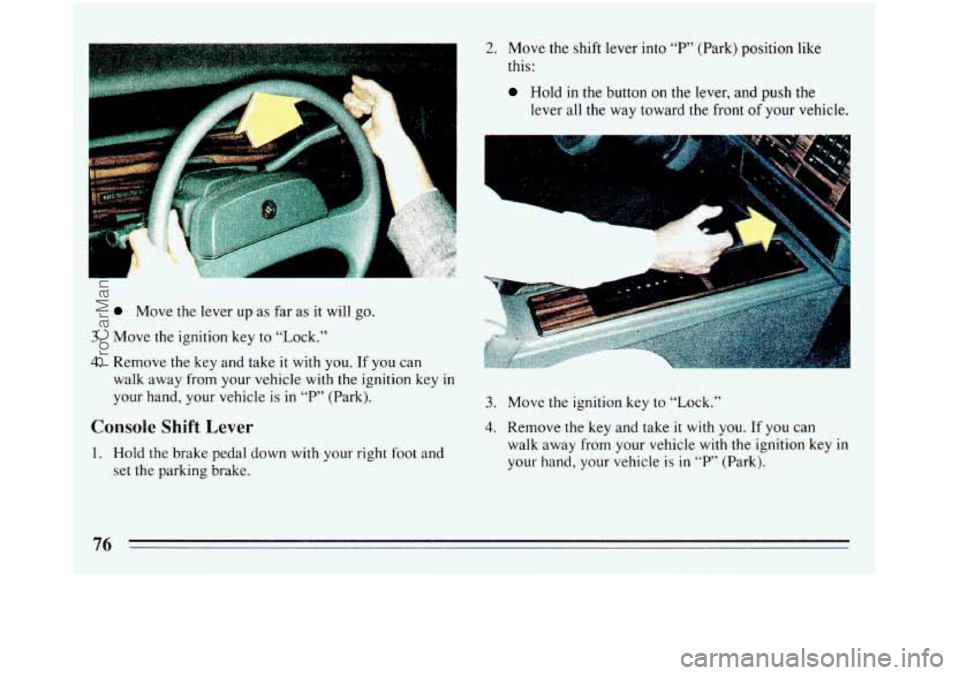
Move the lever up as far as it will go.
3. Move the ignition key to “Lock.”
4. Remove the key and take it with you. If you can
walk away from your vehicle with the ignition key in
your hand, your vehicle is in “P” (Park).
Console Shift Lever
1. Hold the brake pedal down with your right foot and
set the parking brake.
2. Move the shift lever into “P’ (Park) position like
this:
Hold in the button on the lever, and push the
lever all the way toward the front
of your vehicle.
-II
3. Move the ignition key to “Lock.”
4. Remove the key and take it with you. If you can
walk away from your vehicle with the ignition key
in
your hand, your vehicle is in “P’ (Park).
76
ProCarManuals.com
Page 102 of 308
the numbers, probably someone has tried to turn it back.
The numbers may not be true.
You may wonder what happens if a car has to have a
new odometer installed. If possible, the new one has to
be set to the same reading the old one had. If it can’t be,
then it’s set at zero, but
a label on the driver’s door must
show the old reading and when the new one was
installed.
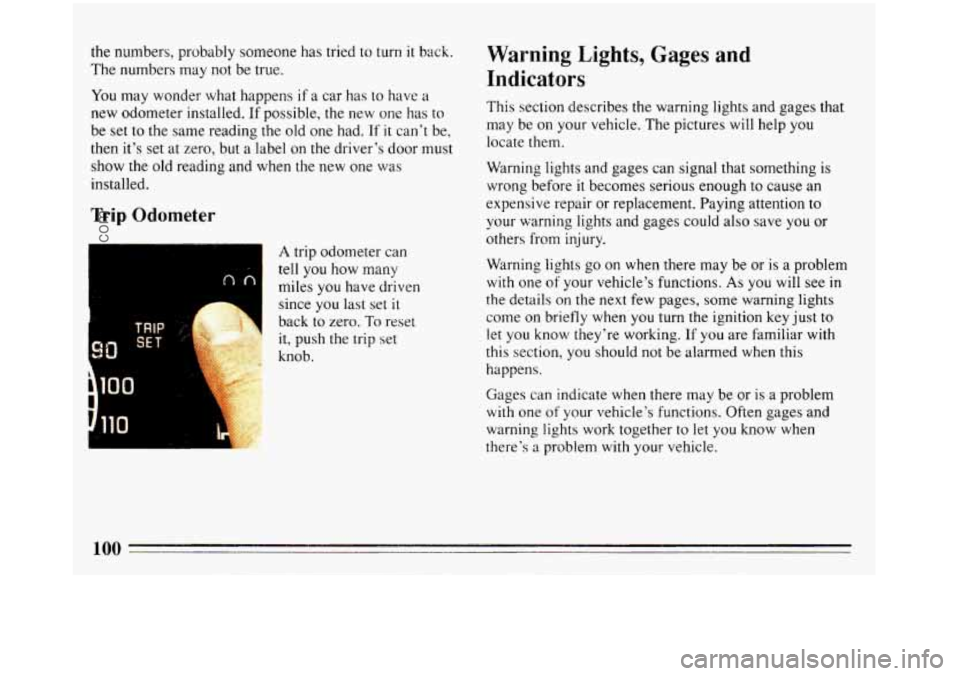
Trip Odometer
TRIP
SET 90
A trip odometer can
tell
you how many
miles you have driven
since you last set
it
back to zero. To reset
it, push the trip set
knob.
Warning Lights, Gages and
Indicators
This section describes the warning lights and gages that
may be on your vehicle. The pictures will help you
locate them.
Wdrning lights and gages can signal that something
is
wrong before it becomes serious enough to cause an
expensive re,pair or replacement. Paying attention to
your warning lights and gages could also save you or
others from injury.
Warning lights go on when there may be or
is a problem
with one of your vehicle’s functions. As you will see in
the details on the next few pages, some warning lights
come on briefly when you turn
the ignition key just to
let you know they’re working.
If you are familiar with
this section, you should not be alarmed when this
happens.
Gages
can indicate when there may be or is a problem
with one of your vehicle’s functions. Often gages and
warning lights work together
to let you know when
there’s a problem with your vehicle.
100
ProCarManuals.com
Page 105 of 308
Anti-Lock Brake System Warning Light
(Option) anti-lock brakes. If the regular brake system warning
light is also on, see “Brake System Warning Light”
earlier
in this part.
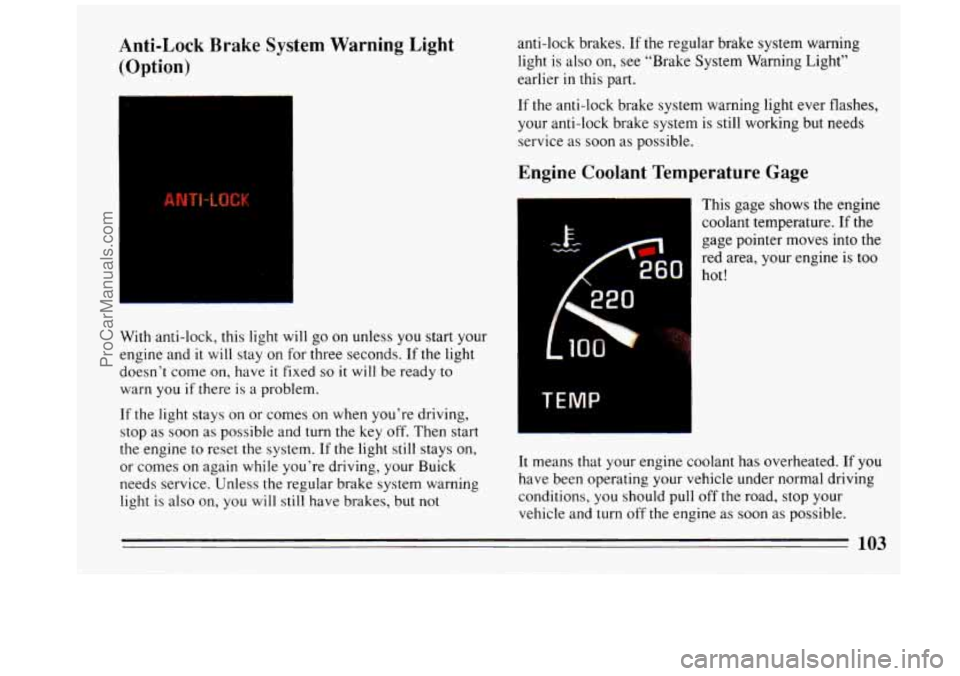
With anti-lock, this light will go on unless you start your
engine and it will stay
on for three seconds. If the light
doesn’t come on, have it fixed
so it will be ready to
warn you
if there is a problem.
If the light stays on or comes on when you’re driving,
stop
as soon as possible and turn the key off. Then start
the engine to reset the system. If the light still stays on,
or comes
on again while you’re driving, your Buick
needs service. Unless the regular brake system warning
light is also
on, you will still have brakes, but not If
the anti-lock brake system warning light ever flashes,
your anti-lock brake system is still working but needs
.service as soon as possible.
Engine Coolant Temperature Gage
TEMP
This gage shows the engine
coolant temperature. If the
gage pointer moves into the
red area, your engine is too
hot
!
It means that your engine coolant has overheated. If you
have been operating your vehicle under normal driving
conditions, you should pull
off the road, stop your
vehicle and turn off the engine as soon as possible.
103
ProCarManuals.com
Page 120 of 308
RCL STOP
Press RCL to see what track is playing. Press it again
within
5 seconds to see how long the CD has been
playing that track.
The track number also appears when you change the
volume or when a new track starts to play.
NEXT
Press NEXT to hear the next track now (instead of
waiting until the present track is finished.) If you hold
this button, or press
it more than once, the disc will
advance further.
PREV
If you press and hold the PREV button, or press it more
than once, the disc will return to previous tracks.
SCAN
Press SCAN to hear the first ten seconds of each track.
Press
it again to stop scanning. By
pressing STOP, the compact disc
will stop playing
and the radio will play.
PLAY
Pressing PLAY will cause the radio to stop and the
compact disc will play,
if there is one inserted.
COMP
Pressing the COMP button makes soft and loud passages
more equal
in volume.
E JCT
By pressing EJECT, the disc will eject and the radio will
play. The disc will start at track one when you reinsert it.
Press the OFF-VOL knob or turn the ignition key off to
stop the disc player. The disc stays
in the player and will
resume playing at the point where
it stopped.
118
ProCarManuals.com