service BUICK REGAL 1993 Owner's Manual
[x] Cancel search | Manufacturer: BUICK, Model Year: 1993, Model line: REGAL, Model: BUICK REGAL 1993Pages: 308, PDF Size: 16.35 MB
Page 195 of 308
If you get the overheat warning with no sign of steam,
try this for
a minute or so:
1.
2.
3.
Turn off your air conditioner.
Turn on
your heater to full hot
speed and open the window as
Try to keep your engine under
where the engine runs slower). at
the highest fan
necessary.
load (in a drive gear
If you no longer have the overheat warning,
you can
drive. Just to be safe, drive slower
for about ten minutes.
If the warning doesn‘t corne back on, you can drive
normally.
If the warning continues, pull over, stop, and park
your
vehicle right away.
If there’s still
no sign of steam, you can idle the engine
for two
or three minutes while you’re parked, to see if
the warning stops. But then, if you still have the
warning,
TURN OFF THE ENGINE AND GET
EVERYONE
OUT OF THE VEHICLE until it cools
down.
You may decide not to lift the hood but to get service
help right
away.
m .... ... ..
h 1
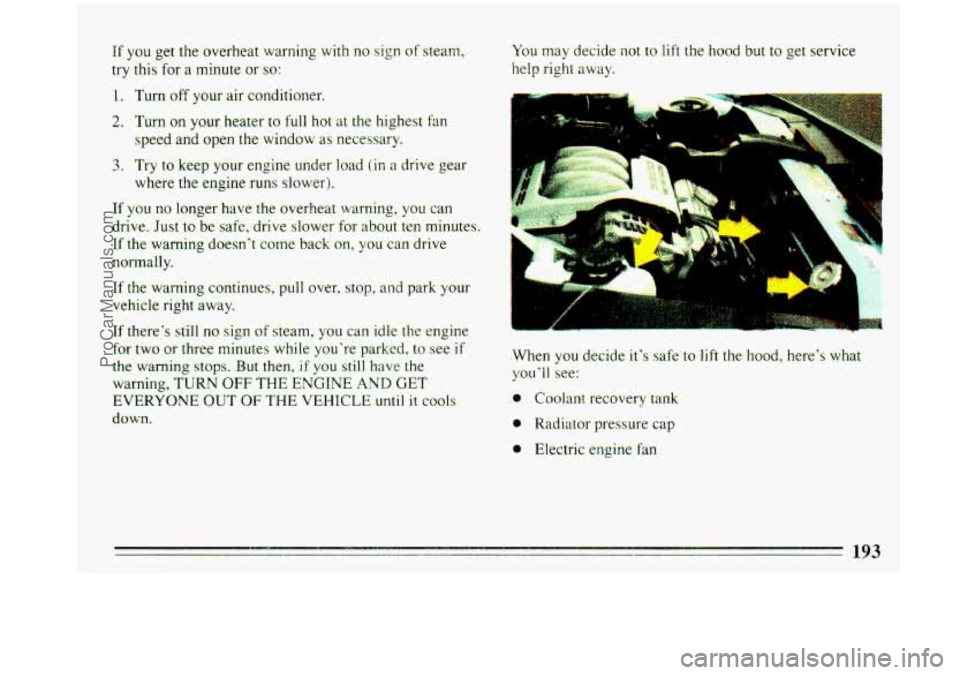
When you decide it’s safe to lift the hood, here’s what
you’ll
see:
0 Coolant recovery tank
0 Radiator pressure cap
0 Electric engine fan
ProCarManuals.com
Page 196 of 308
tder the hood can =&drt up even
is not running and can injure
--, clothing and tools away frnm
I nlcwtric fan-
~ ~~~~ ---
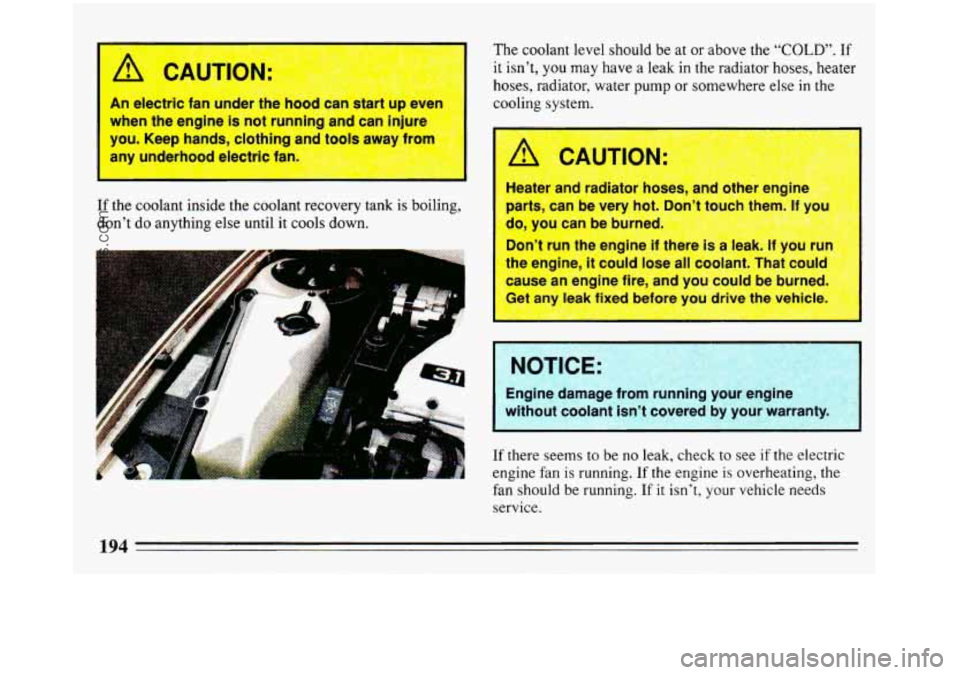
If the coolant inside the coolant recovery tank is boiling,
don’t do anything else until it
cools down. The
coolant level should be at or above the
“COLD”. If
it isn’t, you may have a leak in the radiator hoses, heater
hoses, radiator, water pump or somewhere else
in the
cooling system.
9
Heater and radiator hoses, and other englne
parts, can be very hot.
do, you can be burned.
Don’t run the engine
if there is a leak. If you r,,,
the engine, it could lose all coolant. That could
cause an engine fire, and you could be burned
my leak fixed before you drive +he vehicl,.
I U
If there seems to be no leak, check to see if the electric
engine fan
is running. If the engine is overheating, the
fan should be running.
If it isn’t, your vehicle needs
service.
194
ProCarManuals.com
Page 215 of 308
Part 6 Service And Appearance Care
vehicle, and a section devoted to its appearance care.
Part
6 includes:
ServiceTips
...................................................................... 214
Fuel ........................................................................\
.....
HoodRelease ..................................................................... 218
EngineOil ....................................................................... \
AirCleane r.. ..................................................................... 225
Automatic Transaxle Fluid ...........................................................
Enginecoolant .................................................................... 228
Power Steering Fluid .......................... % ....................................
Windshield Washer Fluid ............................................................ 232
Brakes ........................................................................\
...
Battery ........................................................................\
.. 235
BulbReplacement ................................................................. 236
LoadingYourVehicle ...............................................................
Tires ........................................................................\
....
Appearancecare ..................................................................
Vehicle Identification Number (VIN) ..................................................
FusesandCircuitBreakers ........................................................... 257
Capacities and Specifications ......................................................... 263
ProCarManuals.com
Page 216 of 308
Service
Your Buick dealer knows your vehicle best and wants
you to be happy with
it. We hope you’ll go to your
dealer for all your service needs. You’ll get genuine
GM
parts and GM-trained and supported service people.
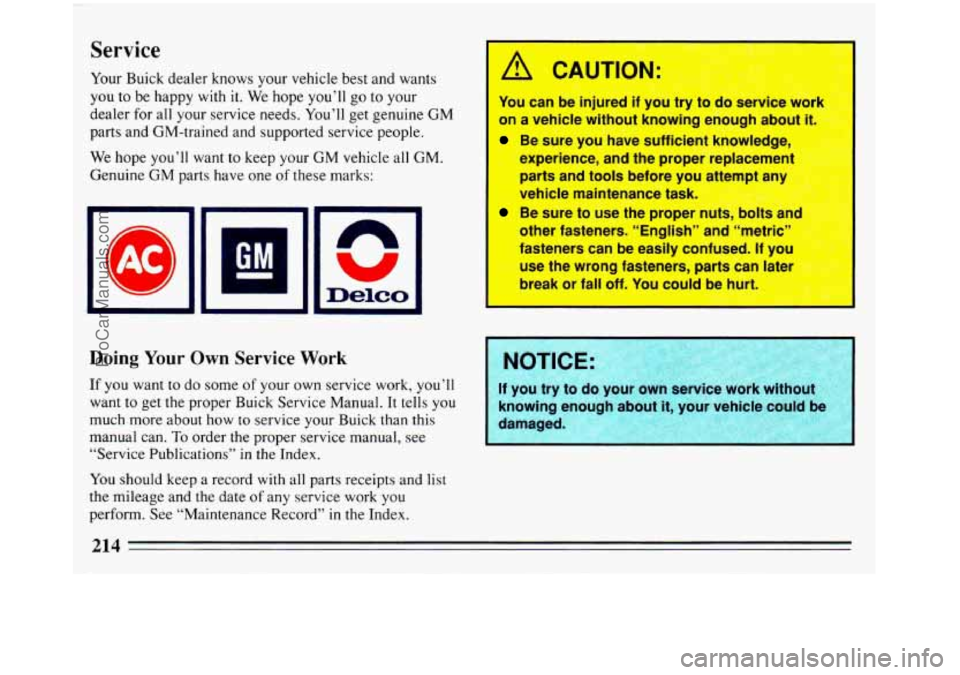
We hope you’ll want to keep your GM vehicle all
GM.
Genuine GM parts have one of these marks:
Doing Your Own Service Work
If you want to do some of your own service work, you’ll
want to get the proper Buick Service Manual. It tells you
much.more about how to service your Buick than this
manual can.
To order the proper service manual, see
“Service Publications” in the Index.
I A CAUTlvN:
You can be injured if you try to do service work
on a vehicle without knowing enough about it
Be sure you have sufficient knowledge,
experience, and the proper replacement
parts and tools before you attempt any
vehicle maintenance task.
Be sure to use the proper nuts, bolts ancI
other fasteners. “English” and “metric”
fasteners
can be easily confused. If you
use the wrong fasteners, parts can later
break or fall off. You could be hurt.
You should keep a record with all parts receipts and list
the mileage and
the date of any service work you
perform. See “Maintenance Record” in the Index.
214
ProCarManuals.com
Page 217 of 308
Fuel
Use regular unleaded gasoline rated at 87 octane or
higher. It should meet specifications ASTM D4814 in
the
U.S. and CGSB 3.5-92 in Canada. These fuels
should have the proper additives,
so you should not have
to add anything to the fuel.
In the
U.S. and Canada, it’s easy to be sure you get the
right kind of gasoline (unleaded). You’ll see
“UNLEADED” right on the pump. And only unleaded
nozzles
will fit into your vehicle’s filler neck.
Be sure the posted octane is at least
87. If the octane is
less than
87, you may get a heavy knocking noise when
you drive. If it’s bad enough, it can damage your engine.
If you’re using fuel rated at
87 octane or higher and you
still hear heavy knocking, your engine needs service.
But don’t worry
if you hear a little pinging noise when
you’re accelerating or driving
up a hill. That’s normal,
and
you don’t have to buy a higher octane fuel to get rid
of pinging. It’s the heavy, constant knock that means
you have a problem.
What about gasoline with blending materials that
contain oxygen, such as MTBE or alcohol?
MTBE is “methyl tertiary-butyl ether.” Fuel that is no
more than
15% MTBE is fine for your vehicle. Ethanol
is ethyl or
grain alcohol. Properly-blended fuel
that is no more than 10% ethanol is fine for your
vehicle.
Methanol is methyl or wood alcohol.
NOTICE:
Fuel that is more than 5% methanol is bad for
your vehicle. Don’t use it. It can corrode metal
parts in your fuel system and also damage
plastic and rubber parts. That damage wouldn’t
be covered under your warranty. And even at
5%
or less, there must be “cosolvents” and
corrosion preventers in this fuel to help avoid
these problems.
I
Gasolines for Cleaner Air
Your
use of gasoline with detergent additives will help
prevent deposits from forming in your engine and
fuel
system. That helps keep your engine in tune and your
emission control system working properly. It’s good for
your vehicle, and
you’ll be doing your part for cleaner
air.
Many gasolines are now blended with materials called
oxygenates. General Motors recommends that you use
215
ProCarManuals.com
Page 218 of 308
gasolines with these blending materials, such as MTBE
and ethanol. By doing
so, you can help clean the air,
especially
in those parts of the country that have high
carbon monoxide levels.
In addition, some gasoline suppliers are now producing
reformulated gasolines. These gasolines are specially
designed to reduce vehicle emissions. General Motors
recommends that
you use reformulated gasoline. By
doing
so, you can help clean the air, especially in those
parts of the country that have high ozone levels.
You should ask your service station operators
if their
gasolines contain detergents and oxygenates, and
if they
have been reformulated
to reduce vehicle emissions.
Fuels in Foreign Countries
If you plan on driving in another country outside the
U.S. or Canada, unleaded fuel may be hard to find. Do
not use leaded gasoline. If you use even one tankful,
your emission controls won’t work well or at all. With
continuous
use, spark plugs can get fouled, the exhaust
system can corrode, and your engine oil can deteriorate
quickly. Your vehicle’s oxygen sensor will be damaged.
All of that means costly repairs that wouldn’t be covered
by your warranty.
To check on fuel availability, ask an auto club, or
contact a major oil company that does business in the
country where you’ll be driving.
You can also write us at the following address for
advice. Just tell us where you’re going and give your
Vehicle Identification Number (VIN).
General Motors of Canada Ltd.
International Export Sales
P.O. Box 828
Oshawa, Ontario L1H 7N1, Canada
216
ProCarManuals.com
Page 227 of 308
properly disposing of your used oil, ask your dealer, a
service station or a local recycling center for help.
Air Cleaner
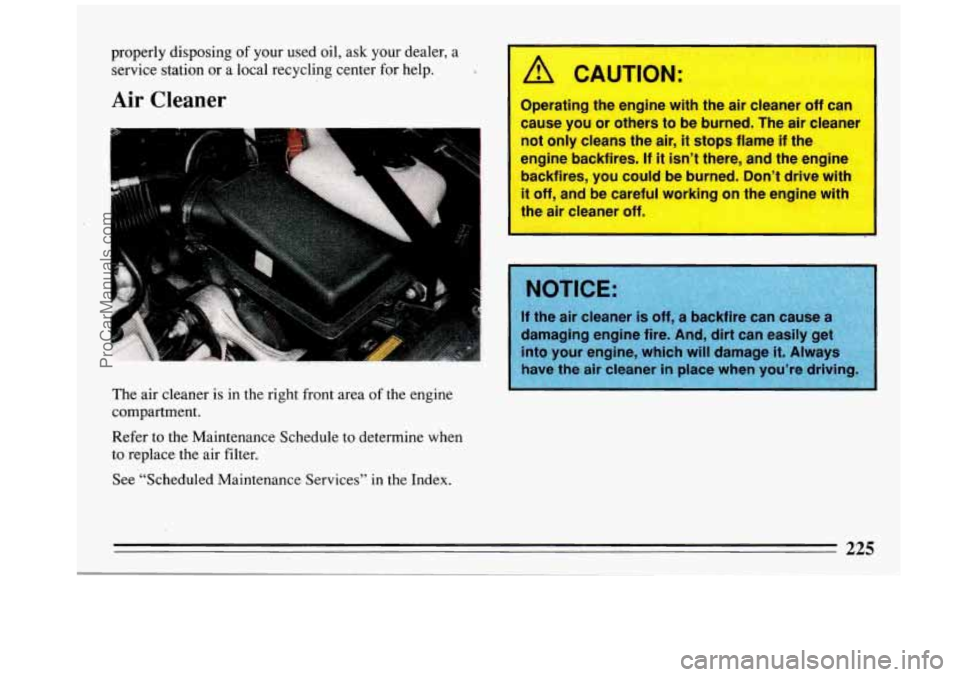
The air cleaner is in the right front area of the engine
compartment.
I A CAUTION:
Operating the engine with the air cleaner off can
cause you or others to be burned. The air cleaner
not only cleans the air,
it stops flame if the
engine backfires. If it isn’t there, and
the engine
backfires, you could be burned. Don’t drive with
it
off, and be careful working on the engine with
the air cleaner off.
I
Refer to the Maintenance Schedule to determine when
to replace the air filter.
See “Scheduled Maintenance Services’’ in the Index.
225
ProCarManuals.com
Page 228 of 308
Automatic Transaxle Fluid
When to Check and Change:
A good time to check your automatic transaxle fluid
level is when
the engine oil is changed. Refer to the
Maintenance Schedule to determine when to change
your fluid. See “Scheduled Maintenance Services” in
the Index.
How to Check:
Because this operation can be a little difficult, you may
choose to have this done at a Buick dealership Service
Department.
If you do it yourself, be sure to follow all the
instructions here, or you could get a false reading on the
dipstick.
NOTICE:
Too much or too little fluid can damage your
transaxle.
Too much can mean that some of the
fluid could come out and fall
on hot engine parts,
starting a fire. Be sure to get an accurate reading
if you check your transaxle fluid.
Wait at least 30 minutes before checking the transaxle
fluid level if you have been driving:
When outside temperatures are above 90°F (32 ” C).
At high speed for quite a while.
0 In heavy traffic -- especially in hot weather.
0 While pulling a trailer.
To get the right reading, the fluid should be at normal
operating temperature, which is
180 F to 200 F (82 C
Get the vehicle warmed up by driving about 15 miles
(24 km) when outside temperatures are above
50°F
(10°C). If it’s colder than 50°F (lO°C), you may have
to drive longer.
To check the fluid level:
Park your vehicle on a level place.
0 Place the shift lever in “F’ (Park) with the parking
0 With your foot on the brake pedal, move the shift
to
93
O C).
brake applied.
lever through each gear range, pausing for about
three seconds
in each range. Then, position the shift
lever
in “P” (Park).
0 Let the engine run at idle for three to five minutes.
226
ProCarManuals.com
Page 244 of 308
When to Check: Check your tires once a month or
more.
Don’t forget your compact spare tire. It should be at
60
psi (420 kPa).
How to Check: Use a good quality pocket-type gage to
check tire pressure. Simply looking at the tires will not
tell
you the pressure, especially if you have radial tires --
which may look properly inflated even if they’re
underinflated.
If your tires have valve caps, be sure to put them back
on.
They help prevent leaks by keeping out dirt and
moisture.
Tire Inspection and Rotation
To make your tires last longer, have them inspected and
rotated at the mileages recommended
in the
Maintenance Schedule. See “Scheduled Maintenance
Services”
in the Index.
I
I‘
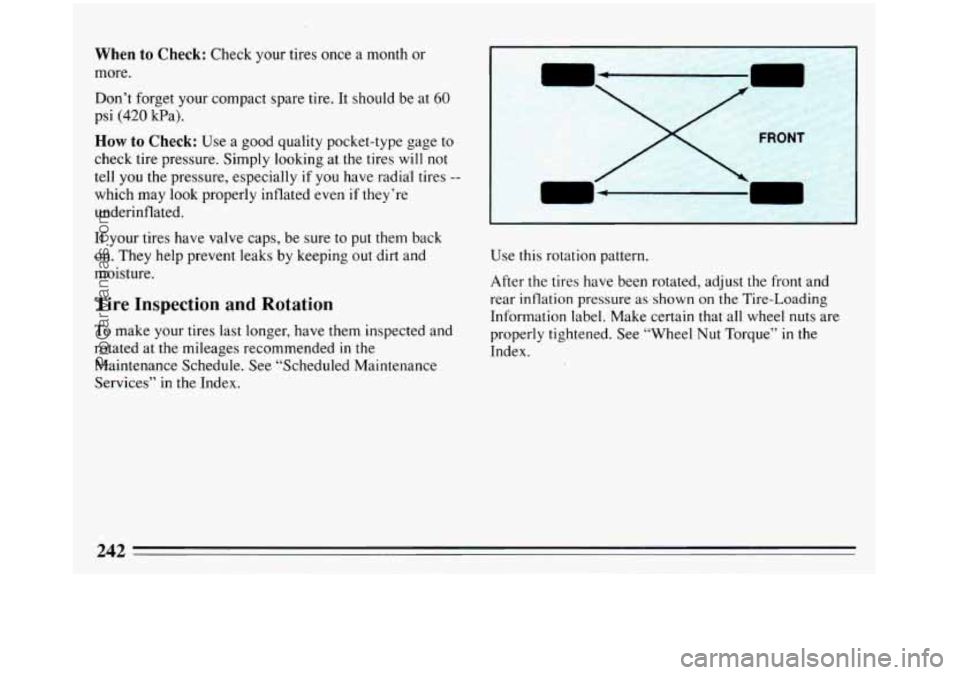
Use this rotation pattern.
After the tires have been rotated, adjust the front and
rear inflation pressure
as shown on the Tire-Loading
Information label. Make certain that all wheel nuts are
properly tightened. See “Wheel Nut Torque”
in the
Index.
242
ProCarManuals.com
Page 246 of 308
0 The tire has a puncture, cut, or other damage that
can’t be repaired well because
of the size or location
of the damage.
Buying New Tires
To find out what kind and size of tires you need, look at
the Tire-Loading Information label.
The tires installed on your vehicle when it was new had
a Tire Performance Criteria Specification (TPC Spec)
number on each tire’s sidewall. When you get new tires,
get ones with that same TPC Spec number. That way,
your vehicle will continue to have tires that are designed
to give proper endurance, handling, speed rating,
traction, ride and other things during normal service on
your vehicle.
If your tires have an all-season tread
design, the TPC number
will be followed by a “MS”
(for mud and snow).
If you ever replace your tires with those not having a
TPC Spec number, make sure they are
the same size,
load range, speed rating and construction type (bias,
bias-belted or radial) as your original tires.
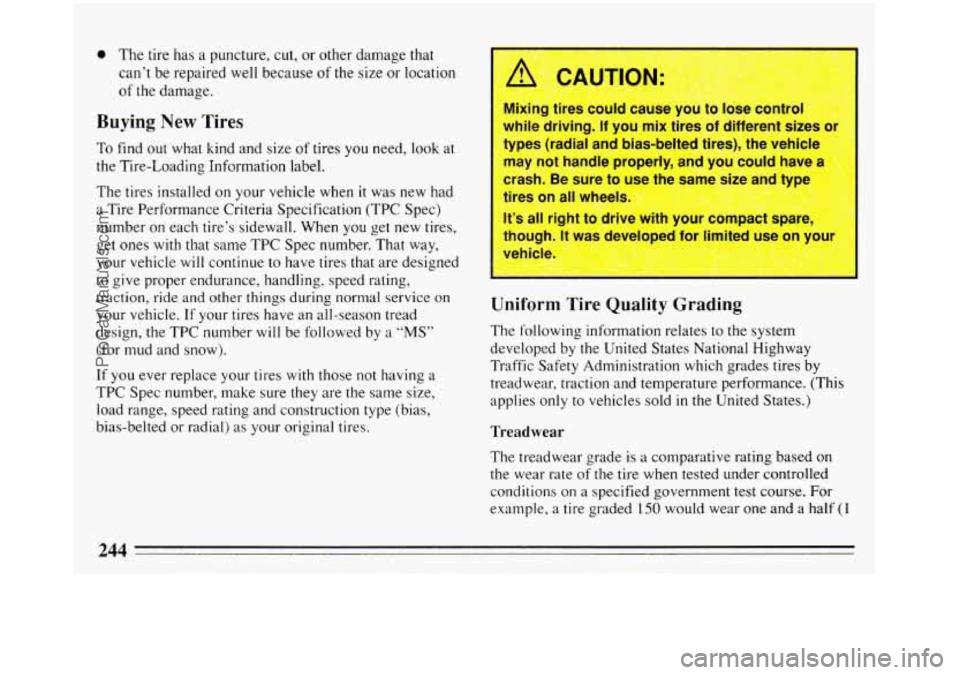
A CA
I Mixing ur
ITION:
coui4 au 1 you IO lose c
while driving. If you m~x tires of different sizes or
types (radial and bias-belted tires), the vehicle
may not handle properly, and you could have a
;k :.
crash. Be sure to use the .LLL same .n size and type ;:L*:..% , T.,-?<’
though. It was developed for limited use on YOUI‘..~
vehicle.
I
Uniform Tire Quality Grading
The following information relates to the system
developed by the United States National Highway
Traffic Safety Administration which grades tires by
treadwear, traction and temperature performance. (This
applies only to vehicles sold in the United States.)
Treadwear
The treadwear grade is a comparative rating based on
the wear rate of the tire when tested under controlled
conditions on a specified government test course. For
example, a tire graded
150 would wear one and a half (1
244
ProCarManuals.com