heater BUICK REGAL 1993 Owners Manual
[x] Cancel search | Manufacturer: BUICK, Model Year: 1993, Model line: REGAL, Model: BUICK REGAL 1993Pages: 308, PDF Size: 16.35 MB
Page 72 of 308
Driving Through Deep Standing
Water
If you drive too quickly through deep puddles or
standing water, water can come in through your
engine’s
air intake and badly damage your
engine. If you can’t avoid deep puddles or
standing water, drive through them very slowly.
Engine Block Heater (Canada Only)
In very cold weather, 0 F (- 18 C) or colder, the engine
block heater can help. You’ll get easier starting and
better
fuel economy during engine warm-up.
To use the block heater:
1. Turn off the engine.
2. Open the hood and unwrap the electrical cord.
3. Plug it into a normal, grounded 110-volt outlet.
I
Plugging the cord into an ungrounded outlet
could cause an electrical shock.
Also, the wrong
kind of extension cord could overheat and cause
a fire. You could be seriously injured. Plug the
cord into
a properly grounded three-prong
IlO-volt outlet.
If the cord won’t reach, use a
heavy-duty three-prong extension cord rated for
at least
15 amps.
I
I
x; NOTICE:
k After you’ve used the block heater, be sure to
:; store the cord as it was before, to keep it away
i from moving engine parts. If you don’t, it could
:: be damaged. .’, :.,* :>”!;.:,.”~ i” < .:-;:.&,a2% && ?3$?%7 -
How long should you keep the block heater plugged in?
The answer depends
on the weather, the kind of oil you
have, and some other things. Instead
of trying to list
everything here, we ask that you contact a Buick dealer
in the area where you’ll be parking your vehicle. The
dealer can give
you the best advice for that particular
area.
70
ProCarManuals.com
Page 111 of 308
@ Part 3 Comfort Controls And Audio Systems
~~
In this part you’ll find out how to operate the comfort control systems and audio systems offered with your Buick .
Be sure to read about the particular system supplied with your vehicle .
Part 3 includes:
Comfort Control System
............................................................ 110
Heater and Defroster
........................................................... 111
Airconditioner
............................................................... 111
RearWindowDefogger ........................................................ 113
Ventilation ................................................................... 112
AudioSystems
.................................................................... 113
SettingtheClock
.......................................................... 1.16,121
RadioControls
........................................................... 115, 119
Tape Player Controls ....................................................... 11 7, 121
CDPlayerControls
............................................................ 118
Understanding
Radio Reception .................................................. 113
Care of Cassette ‘hpe Player & l-hpes ............................................. 123
CareofCompactDiscs
......................................................... 124
Antennacare
................................................................ 124
109
ProCarManuals.com
Page 113 of 308
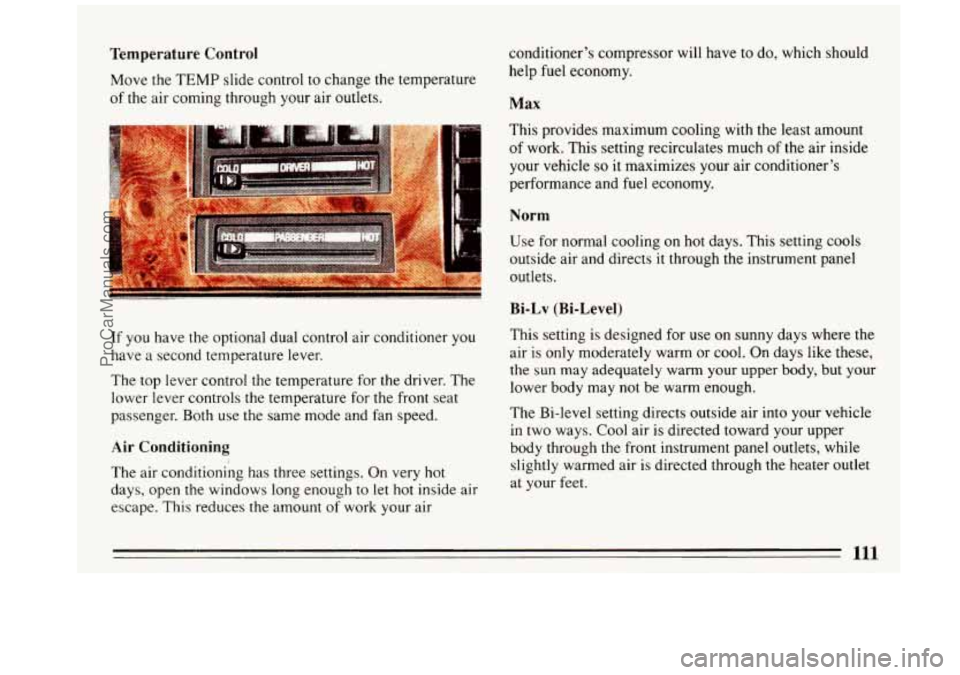
Temperature Control
Move the TEMP slide control to change the temperature
of the air coming through your air outlets. conditioner’s
compressor will have to do, which should
help fuel economy. Max
This provides maximum cooling with the least amount
of work. This setting recirculates much of the air inside
your vehicle
so it maximizes your air conditioner’s
performance and fuel economy.
Norm
Use for normal cooling on hot days. This setting cools
outside air and directs it through the instrument panel
outlets.
Bi-Lv (Bi-Level)
If you have the optional dual control air conditioner you
have a second temperature lever.
The top lever control the temperature for the driver. The
lower lever controls the temperature for the front seat
passenger. Both use
the same mode and fan speed.
Air Conditioning
The air conditioning has three settings. On very hot
days, open
the windows long enough to let hot inside air
escape.. This reduces the amount of work your air This setting
is designed for
use on sunny days where the
air is only moderately warm or cool. On days like these,
the
sun may adequately warm your upper body, but your
lower body may not be warm enough.
The Bi-level setting directs outside air into your vehicle
in two ways.
Cool air is directed toward your upper
body through the front instrument panel outlets, while
slightly warmed air is directed through the heater outlet
at your feet.
111
ProCarManuals.com
Page 115 of 308
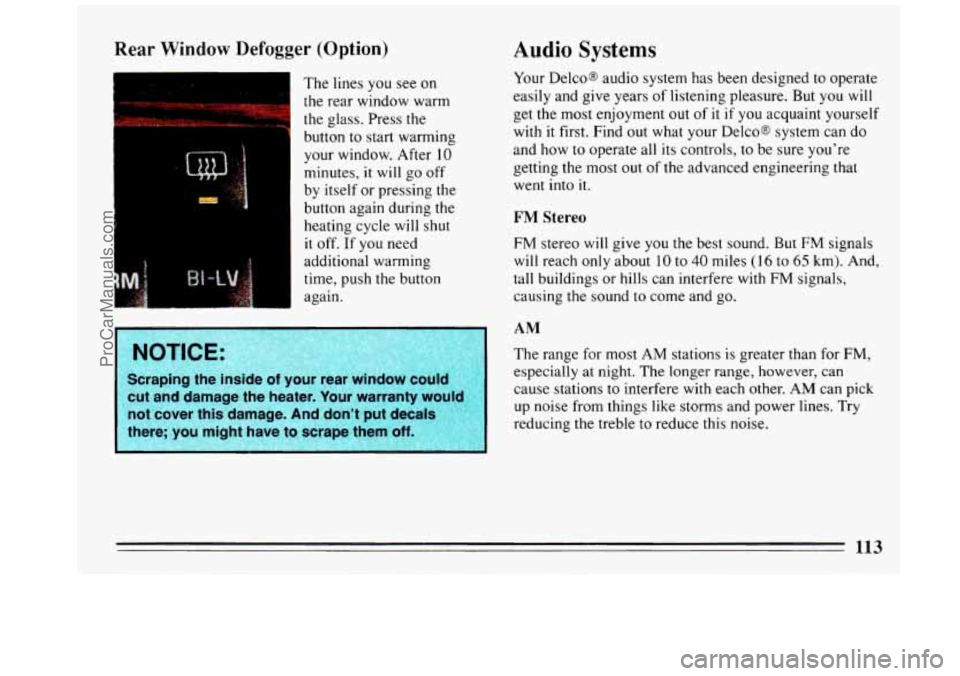
Rear Window Defogger (Option)
b
I -c
1 The lines you see on
I the rear window warm
the glass. Press the
button to start warming
your window. After
10
minutes, it will go off
by itself or pressing the
button again during the
heating cycle will shut
it
off. If you need
additional warming
time, push the button
again.
NOTICE:
Scraping the inside of your rear window could
cut and damage the heater. Your warranty would
not cover this damage.
And don’t plat decals
there; you might have to scrape them
off.
Audio Systems
Your Delcom audio system has been designed to operate
easily and give years of listening pleasure.
But you will
get the most enjoyment out
of it if you acquaint yourself
with it first. Find out what your Delcoa system can do
and how to operate all its controls, to be sure you’re
getting the most
out of the advanced engineering that
went into it.
FM Stereo
FM stereo will give you the best sound. But FM signals
will reach only about 10 to 40 miles (16 to 65 km). And,
tall buildings or hills can interfere with FM signals,
causing the sound
to come and go.
AM
The range for most AM stations is greater than for FM,
especially at night. The longer range, however, can
cause stations to interfere with each other. AM can pick
up noise from things like storms and power lines. Try
reducing the treble to reduce this noise.
113
ProCarManuals.com
Page 171 of 308
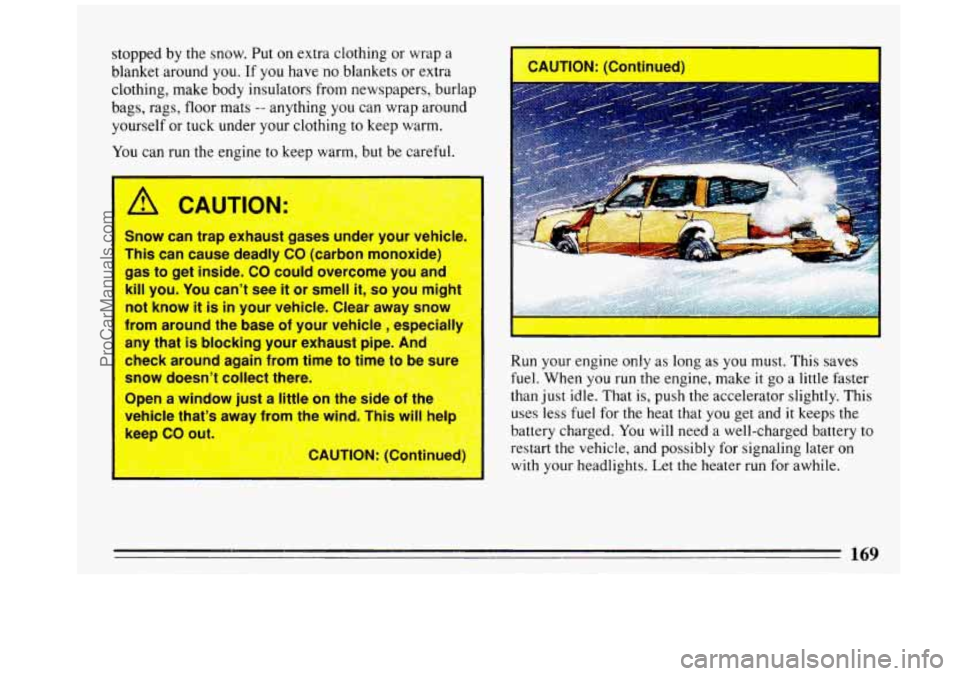
stopped by the snow. Put on extra clothing or wrap a
blanket around you. If you have no blankets or extra
clothing, make body insulators from newspapers, burlap
bags, rags, floor mats
-- anything you can wrap around
yourself or
tuck under your clothing to keep warm.
You can run the engine to keep warm, but be careful.
naust ases under your veh'ick
Snow can
trap 1
This can cause deadly CO (carbon monoxide)
gas to get inside.
CO could overcome you and
II you. You can't see it or smell it, so you mighl
not know
it is in your vehicle. Clear away snow
from around the base of your vehicle
, especial11
any that is blocking your exhaust pipe. And
r':.:%--l check around again from time to time to be surel ..,;I
. . ,;-< 4
Snow doesn't collect there. k, ..;:-- :,: -;-'-- , " ~ ' -. :< . . . ..',.;.L ,:--; .: ., ; ,&': - .. 1 .' . . . ,'--I -..
, , CA,UTION: (Continued)
I
Run your engine only as long as you must. This saves
fuel. When you run the engine, make
it go a little faster
than just idle. That
is, push the accelerator slightly. This
uses less fuel for the heat that you get and it keeps
the
battery charged. You will need a well-charged battery to
restart the vehicle, and possibly for signaling later on
with your headlights. Let the heater run for awhile.
169
ProCarManuals.com
Page 195 of 308
If you get the overheat warning with no sign of steam,
try this for
a minute or so:
1.
2.
3.
Turn off your air conditioner.
Turn on
your heater to full hot
speed and open the window as
Try to keep your engine under
where the engine runs slower). at
the highest fan
necessary.
load (in a drive gear
If you no longer have the overheat warning,
you can
drive. Just to be safe, drive slower
for about ten minutes.
If the warning doesn‘t corne back on, you can drive
normally.
If the warning continues, pull over, stop, and park
your
vehicle right away.
If there’s still
no sign of steam, you can idle the engine
for two
or three minutes while you’re parked, to see if
the warning stops. But then, if you still have the
warning,
TURN OFF THE ENGINE AND GET
EVERYONE
OUT OF THE VEHICLE until it cools
down.
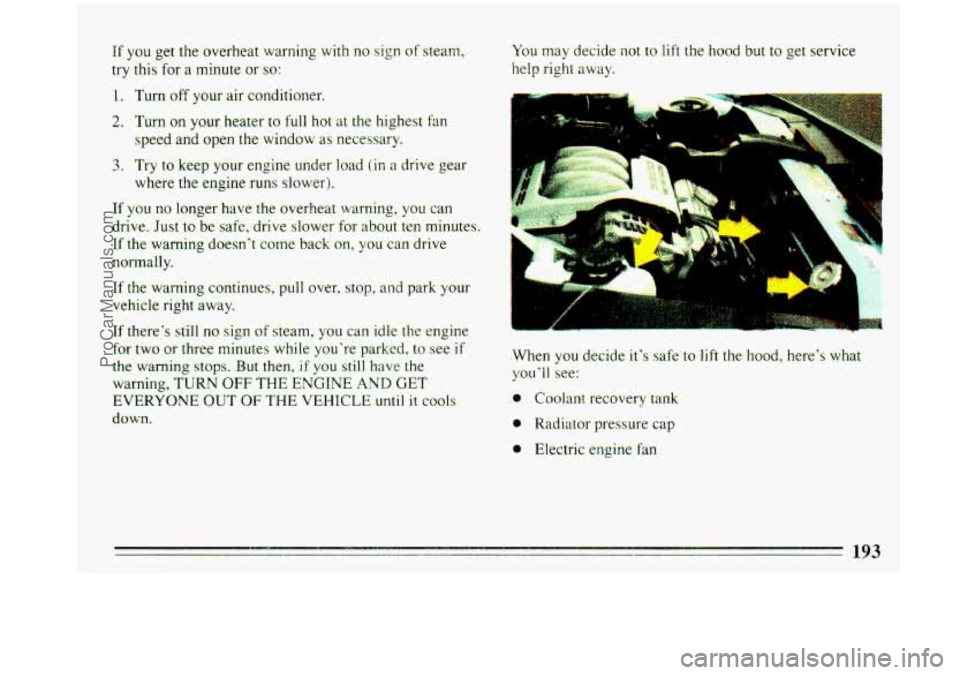
You may decide not to lift the hood but to get service
help right
away.
m .... ... ..
h 1
When you decide it’s safe to lift the hood, here’s what
you’ll
see:
0 Coolant recovery tank
0 Radiator pressure cap
0 Electric engine fan
ProCarManuals.com
Page 196 of 308
tder the hood can =&drt up even
is not running and can injure
--, clothing and tools away frnm
I nlcwtric fan-
~ ~~~~ ---
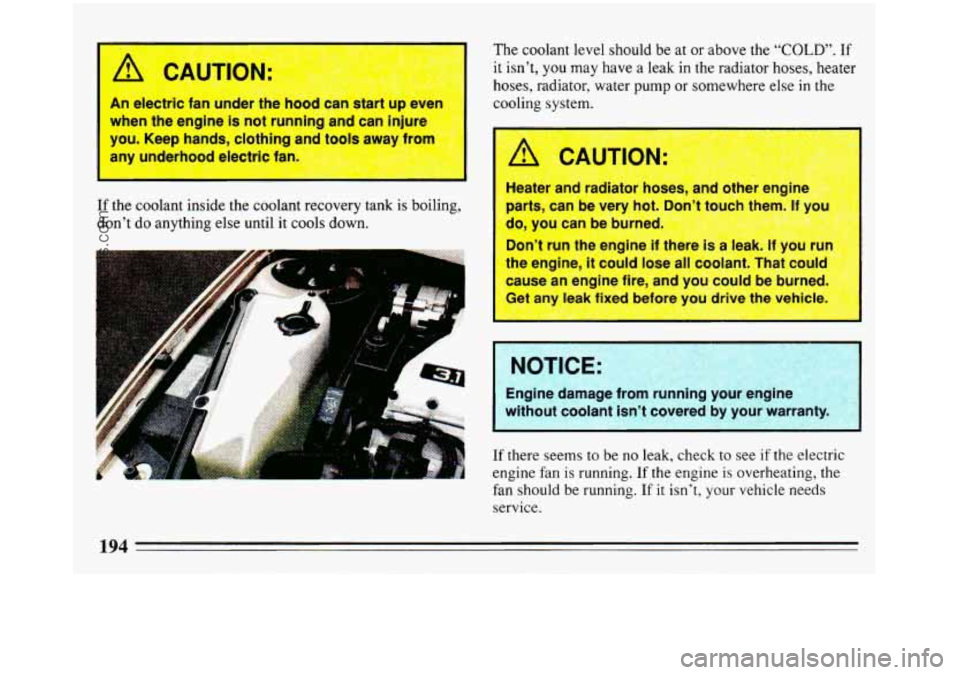
If the coolant inside the coolant recovery tank is boiling,
don’t do anything else until it
cools down. The
coolant level should be at or above the
“COLD”. If
it isn’t, you may have a leak in the radiator hoses, heater
hoses, radiator, water pump or somewhere else
in the
cooling system.
9
Heater and radiator hoses, and other englne
parts, can be very hot.
do, you can be burned.
Don’t run the engine
if there is a leak. If you r,,,
the engine, it could lose all coolant. That could
cause an engine fire, and you could be burned
my leak fixed before you drive +he vehicl,.
I U
If there seems to be no leak, check to see if the electric
engine fan
is running. If the engine is overheating, the
fan should be running.
If it isn’t, your vehicle needs
service.
194
ProCarManuals.com
Page 197 of 308
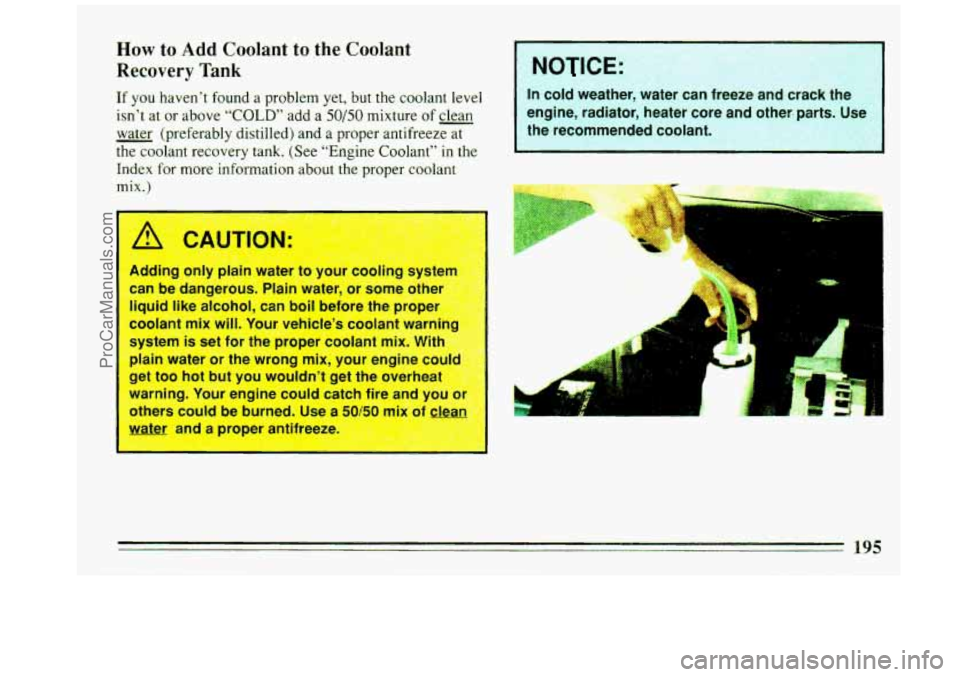
How to Add Coolant to the Coolant
Recovery Tank
If you haven’t found a problem yet, but the coolant leveI
isn’t at or above “COLD” add a 50/50 mixture of clean
- water (preferably distilled) and a proper antifreeze at
the coolant recovery tank. (See “Engine Coolant’’
in the
Index for more information about
the proper coolant
mix.)
can bedangerous. Plain water, or some othe
liquid like alcohol, can boil before the prope
coolant mix will. Your vehicle’s coolant warn
system
is set for the proper coolant mix. Wit
plain water or the wrong mix, your engine could
get too hot but you wouldn’t get the overheal
warning. Your engine could catch fire and you or
others could be burned. Use a
50/50 mix of clean
water and a proper antifreeze
m-u mw-.
In cold weath wate :an frc anc
engine, radiator, heater core and other- parts. Use
the recommended coolanl
ProCarManuals.com
Page 226 of 308
When to Change Engine Oil: See if any one of these
is true for you:
Most trips are less than 4 miles (6 km).
9 It’s below freezing outside and most trips are less
9 The engi.ne is at low speed most of the time (as in
door-to-door delivery, or in stop-and-go traffic).
You tow a trailer often. .-
9 Most trips are through dusty places.
If
any one of thes,e is true for your vehicle, then you
need to change your oil and filter every
3,000 miles (5
000 km) or 3 months -- whichever comes first.
If none of them is true, change the oil every 7,500 miles
(12
500 km) or 12 months -- whichever comes first.
Change the filter at the first
oil change and at every
other
oil change after that.
Engine Block Heater: An engine block heater can be a
big help if you have to park outside in very cold
than
10 miles (16 km).
weather,
-20 F (-29 C)
or colder. If your vehicle has
this option, see ”Engine
Block Heater” in the Index.
What to Do with Used Oil:
Used engine oil contains things that ha\, zaused
skin cancer in laboratory animals. Don’t let use6 oil stay on your skin for very long. Clean your
skin and nails with soap and water, or a good
hand cleaner. Wash
or properly throw away
4othing or rags containing used engine oil
Used oil can be a real threat to the environment. If you
change your own oil, be sure
to drain all free-flowing oil
from the filter before disposal. Don’t ever dispose of oil
by pouring
it on the ground, into sewers, or into streams
or bodies of water. Instead, recycle
it by taking it to a
place that collects used oil.
If you have a problem
224
ProCarManuals.com
Page 231 of 308
NOTICE:
If you use an improper coolant mix, your engine
could overheat and be badly damaged. The
repair cost wouldn’t be covered by
your
warranty. Too much water in the mix can freeze
and crack the enqine, radiator, heater
core and
other parts.
I
Adding Coolant
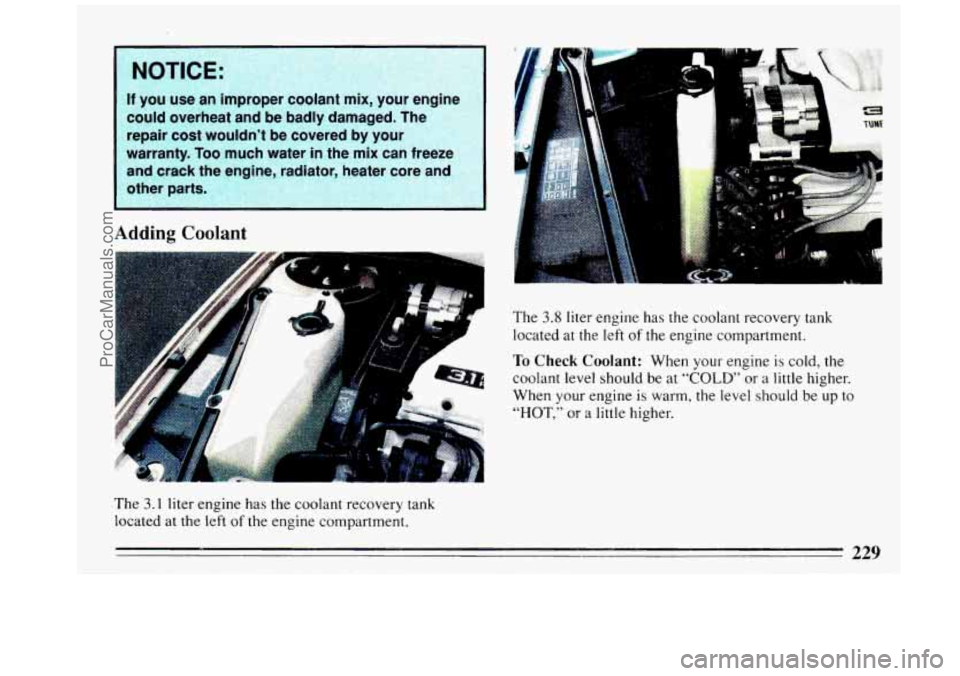
The 3.1 liter engine has the coolant recovery tank
located at the
left of the engine Compartment.
__./”
t
The 3.8 liter engine has the coolant recovery tank
located at the left of
the engine compartment.
To Check Coolant: When your engine is cold, the
coolant
level should be at “COLD” or a little higher.
When your engine is warm, the level should
be up to
“HOT,” or a little higher.
229
ProCarManuals.com