tire type BUICK REGAL 1993 Owners Manual
[x] Cancel search | Manufacturer: BUICK, Model Year: 1993, Model line: REGAL, Model: BUICK REGAL 1993Pages: 308, PDF Size: 16.35 MB
Page 150 of 308
0
0
0
0
0
you need only slow down and drop back again and
wait
for another opportunity.
If other cars are lined up to pass a slow vehicle, wait
your turn. But take care that someone isn’t trying to
pass you as you pull out to pass the slow vehicle.
Remember to glance over your shoulder and check
the blind spot.
Check your mirrors, glance over your shoulder, and
start your left lane change signal before moving out
of the right lane to pass. When you are far enough
ahead of the passed vehicle to see its front
in your
inside mirror, activate your right lane change signal
and move back into the right lane. (Remember that
your right outside
mirror is convex. The vehicle you
just passed may seem to be farther away from
you
than it really is.)
Try not to pass more than one vehicle at a time
on
two-lane roads. Reconsider before passing the next
vehicle.
Don’t overtake a slowly moving vehicle too rapidly.
Even though
the brake lights are not flashing, it may
be slowing down or starting to turn.
If you’re being passed, make it easy for the
following driver to get ahead of you. Perhaps
you
can ease a little to the right.
Loss of Control
Let’s review what driving experts say about what
happens when the three control systems (brakes, steering
and acceleration) don’t have enough friction where the
tires meet the road to do what the driver has asked.
In any emergency, don’t give up. Keep trying
to steer
and constantly seek an escape route or area of less
danger.
Skidding
In a skid, a driver can lose control of the vehicle.
Defensive drivers avoid most skids by taking reasonable
care suited to existing conditions, and by not
“overdriving” those conditions. But skids are always
possible.
The three types
of skids correspond to your Buick’s
three control system.s. In
the braking skid your wheels
aren’t rolling. In the steering or cornering skid,
too
much speed or steeri.ng in a curve causes tires to slip and
lose cornering force.
And in the acceleration skid too
much throttle causes the driving wheels to spin.
A cornering skid and an acceleration skid are best
handied by easing your foot off the accelerator pedal.
If your vehicle starts
to slide (as when you turn a corner
on a wet, snow- or ice-covered road), ease your
foot off
148
ProCarManuals.com
Page 174 of 308
curb weight of the vehicle, any cargo you may carry in Total Weight on Your Vehicle’s Tires
it, and the people who will be riding in the vehicle. And
if you will tow a trailer, you must subtract the tongue
load from your vehicle’s capacity weight because your
vehicle will be carrying that weight, too. See “Loading
Your Vehicle” in the Index for more information about
your vehicle’s maximum load capacity.
-
Be sure your vehicle’s tires are inflated to the limit for
cold tires. You’ll find these numbers on the Certification
label at the rear edge of the driver’s door (or see “Tire
Loading’’ in the Index). Then be sure you don’t go over
the GVW limit €or your vehicle.
Hitches
It’s important to have the correct hitch equipment.
Crosswinds, large trucks going by, and rough roads are a
few reasons why you’ll need the right hitch. Here are
some rules to follow:
0
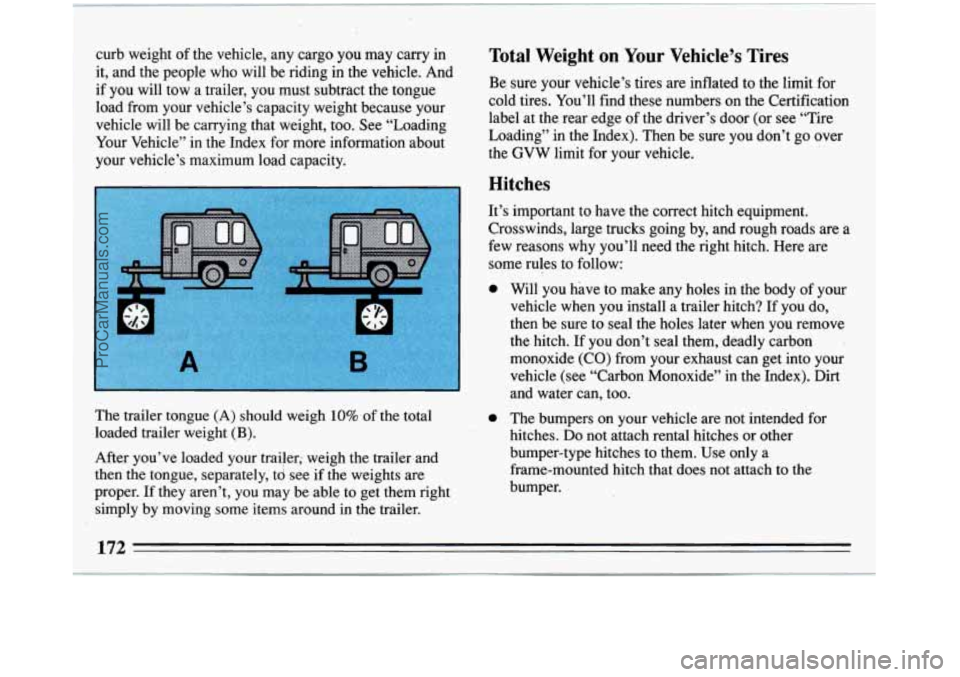
The trailer tongue (A) should weigh 10% of the total
,loaded trailer weight
(B).
After you’ve loaded your trailer; weigh the trailer,and
then the tongue, separately,
td see if the weights are
proper.
If they aren’t, you may be able to get them right
simply by moving some items around in the trailer.
0
Will you have to make any holes in the body of your
vehicle when you install a trailer hitch? If you do,
then be sure to seal the holes later when you remove
the hitch.
If you don’t seal them, deadly carbon
monoxide (CO) from your exhaust can get into your
vehicle (see “Carbon Monoxide’’ in the Index). Dirt
and ‘water can, too:
The bumpers on your vehicle are not intended for
hitches.
Do not attach rental hitches or other
bumper-type hitches to them. Use only a
frame-mounted hitch that does not attach to the
bumper.
172
ProCarManuals.com
Page 187 of 308
Towing Your Vehicle
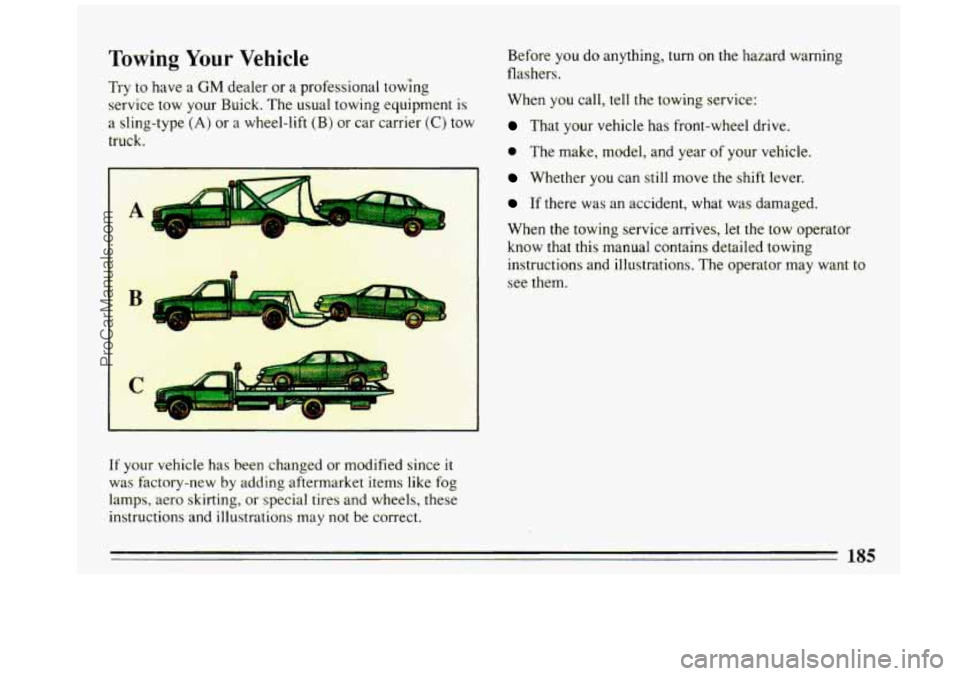
Try to have a GM dealer or a professional towing
service tow your Ruick. The usual towing equipment
is
a sling-type (A) or a wheel-lift (B) or car carrier (C) tow
truck.
If your vehicle has been changed or modified since it
was factory-new by adding aftermarket items like fog
lamps, aero skirting, or special tires
and wheels, these
instructions and illustrations may not
be correct. Before
you do anything,
turn on the hazard warning
flashers.
When you call, tell the towing service:
That your vehicle has front-wheel drive.
0 The make, model, and year of your vehicle.
Whether you can still move the shift lever.
If there was an accident, what was damaged.
When
the towing service arrives, let the tow operator
know that this manual contains detailed towing
instructions and illustrations. The operator may want to
see them.
ProCarManuals.com
Page 244 of 308
When to Check: Check your tires once a month or
more.
Don’t forget your compact spare tire. It should be at
60
psi (420 kPa).
How to Check: Use a good quality pocket-type gage to
check tire pressure. Simply looking at the tires will not
tell
you the pressure, especially if you have radial tires --
which may look properly inflated even if they’re
underinflated.
If your tires have valve caps, be sure to put them back
on.
They help prevent leaks by keeping out dirt and
moisture.
Tire Inspection and Rotation
To make your tires last longer, have them inspected and
rotated at the mileages recommended
in the
Maintenance Schedule. See “Scheduled Maintenance
Services”
in the Index.
I
I‘
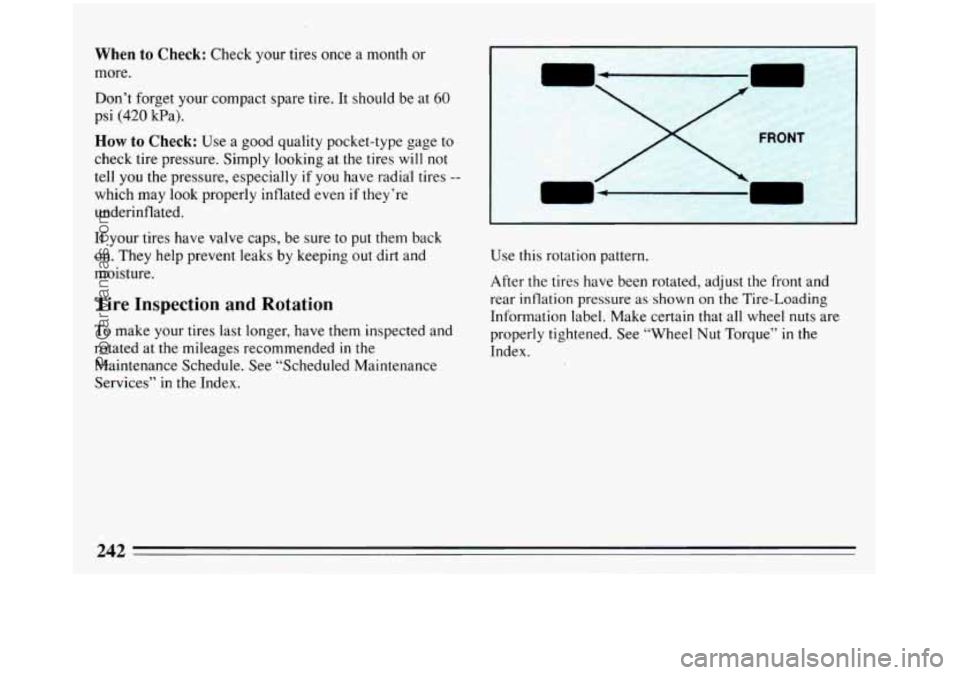
Use this rotation pattern.
After the tires have been rotated, adjust the front and
rear inflation pressure
as shown on the Tire-Loading
Information label. Make certain that all wheel nuts are
properly tightened. See “Wheel Nut Torque”
in the
Index.
242
ProCarManuals.com
Page 246 of 308
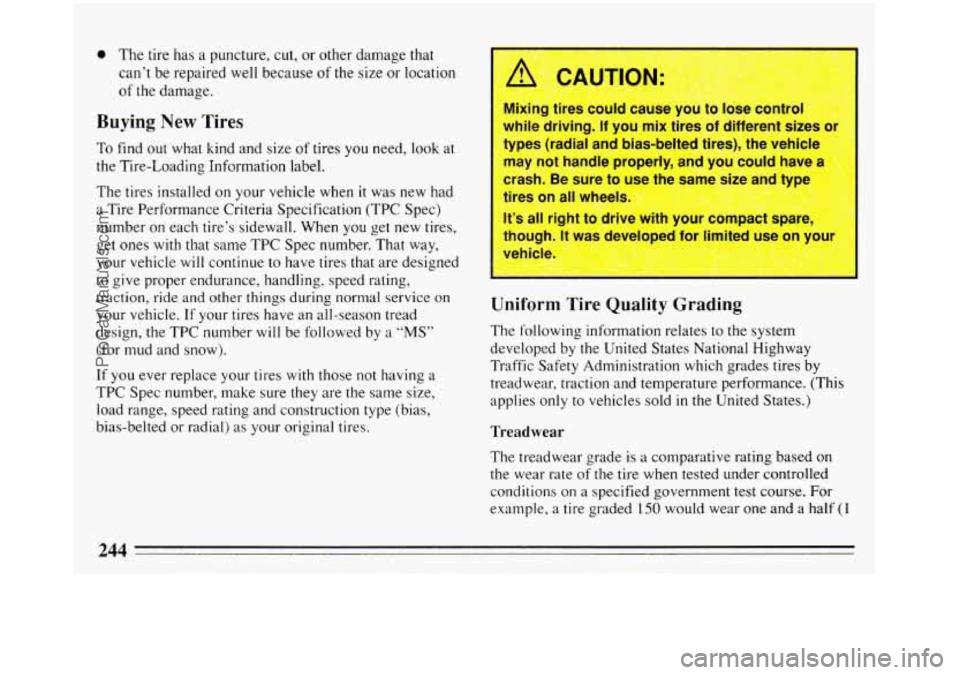
0 The tire has a puncture, cut, or other damage that
can’t be repaired well because
of the size or location
of the damage.
Buying New Tires
To find out what kind and size of tires you need, look at
the Tire-Loading Information label.
The tires installed on your vehicle when it was new had
a Tire Performance Criteria Specification (TPC Spec)
number on each tire’s sidewall. When you get new tires,
get ones with that same TPC Spec number. That way,
your vehicle will continue to have tires that are designed
to give proper endurance, handling, speed rating,
traction, ride and other things during normal service on
your vehicle.
If your tires have an all-season tread
design, the TPC number
will be followed by a “MS”
(for mud and snow).
If you ever replace your tires with those not having a
TPC Spec number, make sure they are
the same size,
load range, speed rating and construction type (bias,
bias-belted or radial) as your original tires.
A CA
I Mixing ur
ITION:
coui4 au 1 you IO lose c
while driving. If you m~x tires of different sizes or
types (radial and bias-belted tires), the vehicle
may not handle properly, and you could have a
;k :.
crash. Be sure to use the .LLL same .n size and type ;:L*:..% , T.,-?<’
though. It was developed for limited use on YOUI‘..~
vehicle.
I
Uniform Tire Quality Grading
The following information relates to the system
developed by the United States National Highway
Traffic Safety Administration which grades tires by
treadwear, traction and temperature performance. (This
applies only to vehicles sold in the United States.)
Treadwear
The treadwear grade is a comparative rating based on
the wear rate of the tire when tested under controlled
conditions on a specified government test course. For
example, a tire graded
150 would wear one and a half (1
244
ProCarManuals.com
Page 247 of 308
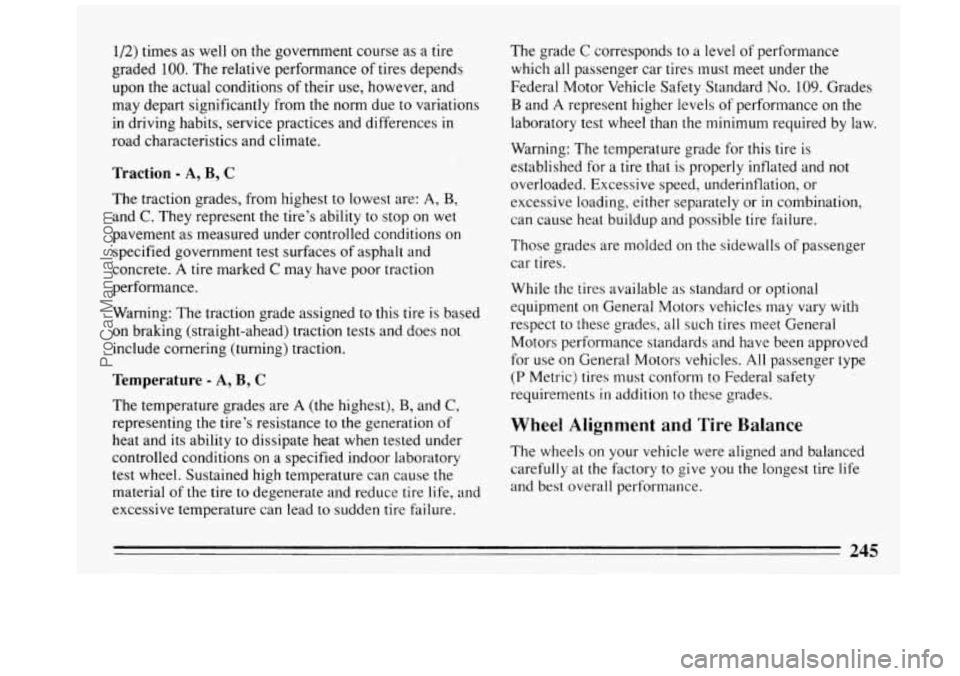
1/2) times as well on the government course as a tire
graded
100. The relative performance of tires depends
upon the actual conditions of their use, however, and
may depart significantly from the norm due to variations
in driving habits, service practices and differences
in
road characteristics and climate.
Traction - A, B, C
The traction grades, from highest to lowest are: A, B,
and C. They represent the tire’s ability to stop on wet
pavement as measured under controlled conditions on
specified government test surfaces of asphalt and
concrete.
A tire marked C may have poor traction
performance.
Warning: The traction grade assigned to this tire
is based
on braking (straight-ahead) traction tests and does not
include cornering (turning) traction.
Temperature - A, B, C
The temperature grades are A (the highest), B, and C,
representing the tire’s resistance to the generation of
heat and its ability to dissipate heat when tested under
controlled conditions on a specified indoor laboratory
test wheel. Sustained high temperature can cause the
material
of the tire to degenerate and reduce tire life, and
excessive temperature can lead to sudden tire failure. The
grade
C corresponds to a level of performance
which all passenger car tires must meet under the
Federal Motor Vehicle Safety Standard
No. 109. Grades
B and A represent higher levels of performance on the
laboratory test wheel than the minimum required by law.
Warning: The temperature grade for this tire
is
established for a tire that is properly inflated and not
overloaded. Excessive speed, underinflation, or
excessive loading, either separately or
in combination,
can cause heat buildup and possible tire failure.
These grades are molded
on the sidewalls of passenger
car tires.
While the tires available
as standard or optional
equipment
on General Motors vehicles may vary with
respect to these grades, all such tires meet General
Motors performance standards and have been approved
for use on General Motors vehicles. All passenger type
(P Metric) tires must conform to Federal safety
requirements
in addition to these grades.
Wheel Alignment and Tire Balance
The wheels on your vehicle were aligned and balanced
carefully at the factory to give
you the longest tire life
and best overall performance.
245
ProCarManuals.com
Page 249 of 308
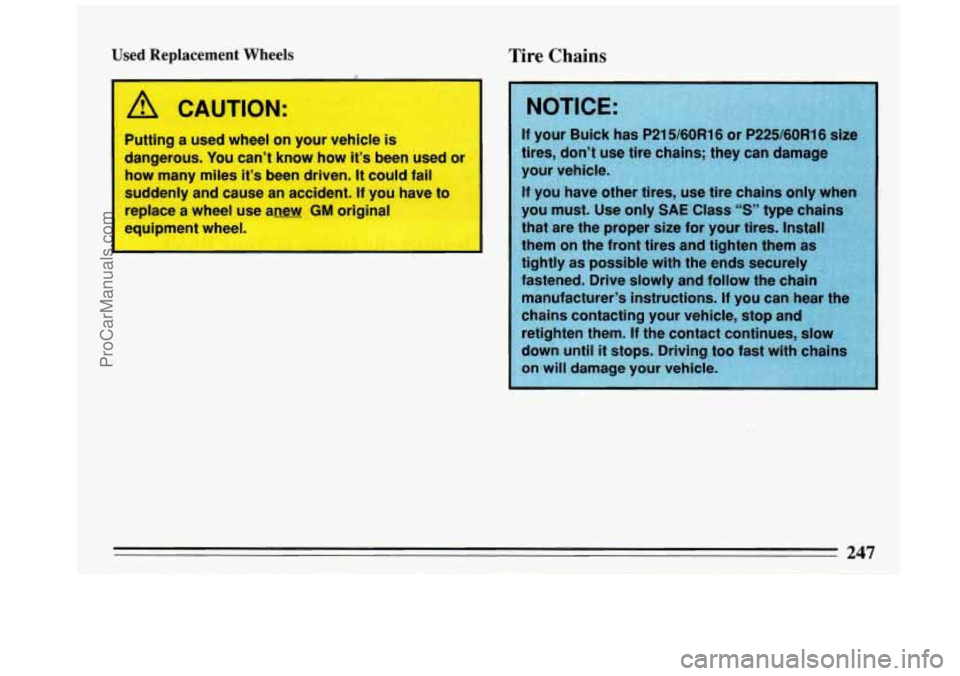
Used Replacement Wheels
A CAUTION:
Putting a used wheel on your vehicle is
dangerous. You can’t know how it’s been used or
how many miles it’s been driven.
It could fail
suddenly
and cause an accident. If you have to
equipment wheel.
~ replace a wheel use anew GM original
I
Tire Chains
If your Buick has P215160RI 6
tires, don’t us
your vehicle.
If you have other tires, use tire chains only when
you must. Use only
SAE Class “S” type chains
that are the proper size for your tires. Install
them on the front tires and tighten them as
tightly as possible with the ends securely
fastened. Drive slowly and follow the chain
manufacturer’s instructions.
If you can hear the
chains contacting your vehicle, stop and
retighten them.
If the contact continues, slow
down until it stops. Driving too fast with chains
on
will damage your vehicle.
ProCarManuals.com
Page 251 of 308
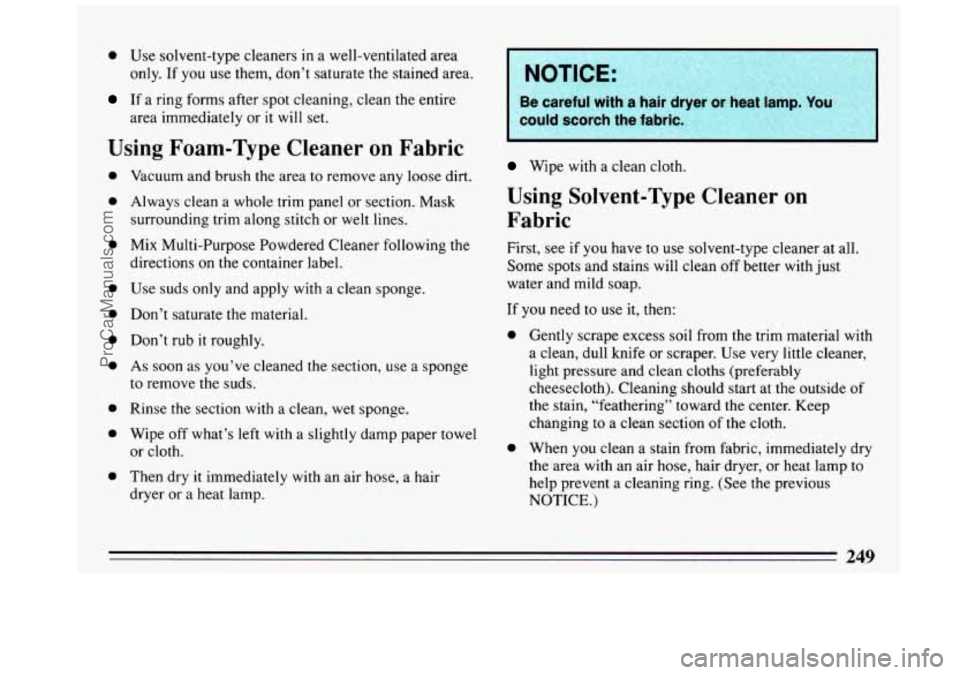
0 Use solvent-type cleaners In a well-ventilated area
only. If you use them, don’t saturate the stained area.
If a ring forms after spot cleaning, clean the entire
area immediately or it will set.
Using Foam-Type Cleaner on Fabric
0
0
0
0
0
0
0
0
0
0
Vacuum and brush the area to remove any loose dirt.
Always clean a
whole trim panel or section. Mask
surrounding trim along stitch or welt lines.
Mix Multi-Purpose Powdered Cleaner following the
directions
on the container label.
Use suds only and apply with a clean sponge.
Don’t saturate the material.
Don’t rub
it roughly.
As soon
as you’ve cleaned the section, use a sponge
to remove
the suds.
Rinse the section with a clean, wet sponge.
Wipe off what’s left with a slightly damp paper towel
or cloth.
Then dry it immediately with an air hose, a hair
dryer
or a heat lamp.
I NOTICE:
I
Be careful with a hair dryer or heat lamp. You
could scorch the fabric.
I
Wipe with a clean cloth.
Using Solvent-Type Cleaner on
Fabric
First, see if you have to use solvent-type cleaner at all.
Some spots and stains will clean off better with just
water and mild soap.
If you need to use it, then:
0 Gently scrape excess soil from the trim material with
a clean, dull knife or scraper. Use very little cleaner,
light pressure and clean cloths (preferably
cheesecloth). Cleaning should start at the outside
of
the stain, “feathering” toward the center. Keep
changing
to a clean section of the cloth.
the area with an air hose, hair dryer, or heat lamp to
help prevent a cleaning ring. (See the previous
NOTICE.)
0 When you clean a stain from fabric, immediately dry
249
ProCarManuals.com
Page 276 of 308
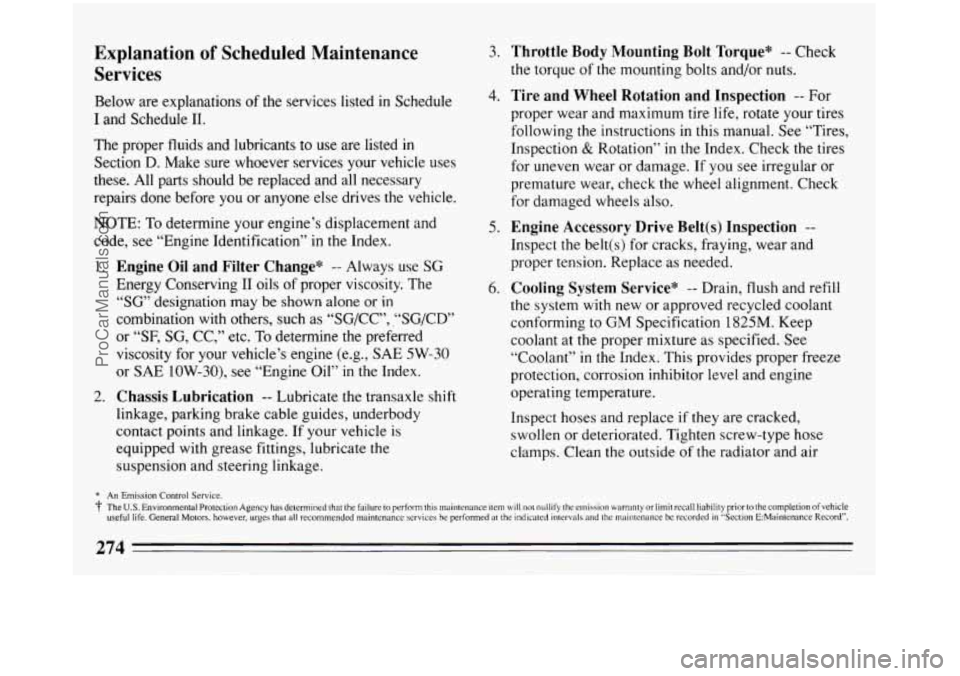
Explanation of Scheduled Maintenance
Services
Below are explanations of the services listed in Schedule
I and Schedule 11.
The proper fluids and lubricants to use are listed in
Section D. Make sure whoever services your vehicle uses
these. All parts should be replaced and all necessary
repairs done before
you or anyone else drives the vehicle.
NOTE: To determine your engine’s displacement and
code, see “Engine Identification” in the Index.
1. Engine Oil and Filter Change* -- Always use SG
Energy Conserving I1 oils of proper viscosity. The
“SG” designation may be shown alone or in
combination with others, such as “SG/CC”, ,“SG/CD”
or
“SF, SG, CC,” etc. To determine the preferred
viscosity for your vehicle’s engine (e.g., SAE 5W-30
or SAE 10W-30), see “Engine Oil”
in the Index.
2. Chassis Lubrication -- Lubricate the transaxle shift
linkage, parking brake cable guides, underbody
contact points and linkage. If your vehicle is
equipped with grease fittings, lubricate
the
suspension and steering linkage. 3.
Throttle Body Mounting
Bolt Torque* -- Check
the torque
of the mounting bolts and/or nuts.
4. Tire and Wheel Rotation and Inspection -- For
proper wear and maximum tire life, rotate your tires
following the instructions
in this manual. See “Tires,
Inspection
& Rotation” in the Index. Check the tires
for uneven wear or damage. If you see irregular or
premature wear, check the wheel alignment. Check
for damaged wheels also.
5. Engine Accessory Drive Belt(s) Inspection --
Inspect the belt(s) for cracks, fraying, wear and
proper tension. Replace as needed.
6. Cooling System Service* -- Drain, flush and refill
the system
with new or approved recycled coolant
conforming to GM Specification 1825M. Keep
coolant at the proper mixture as specified. See
“Coolant”
in the Index. This provides proper freeze
protection, corrosion inhibitor level and engine
operating temperature.
Inspect hoses and replace
if they are cracked,
swollen or deteriorated. Tighten screw-type hose
clamps. Clean the outside
of the radiator and air
* An Emission Control Service.
The
U.S. Environmental Protection Agency has determined that the failure to perform this maintenance item will not nullify the emission warranty or limit recall liability prior tothe completion of vehicle useful life. General Motors, however, urges that all recommended maintenance \
services he performed at the indicatcd intervals and the maintenance be recorded in ”Section E:Maintenance Record”.
274
ProCarManuals.com
Page 303 of 308
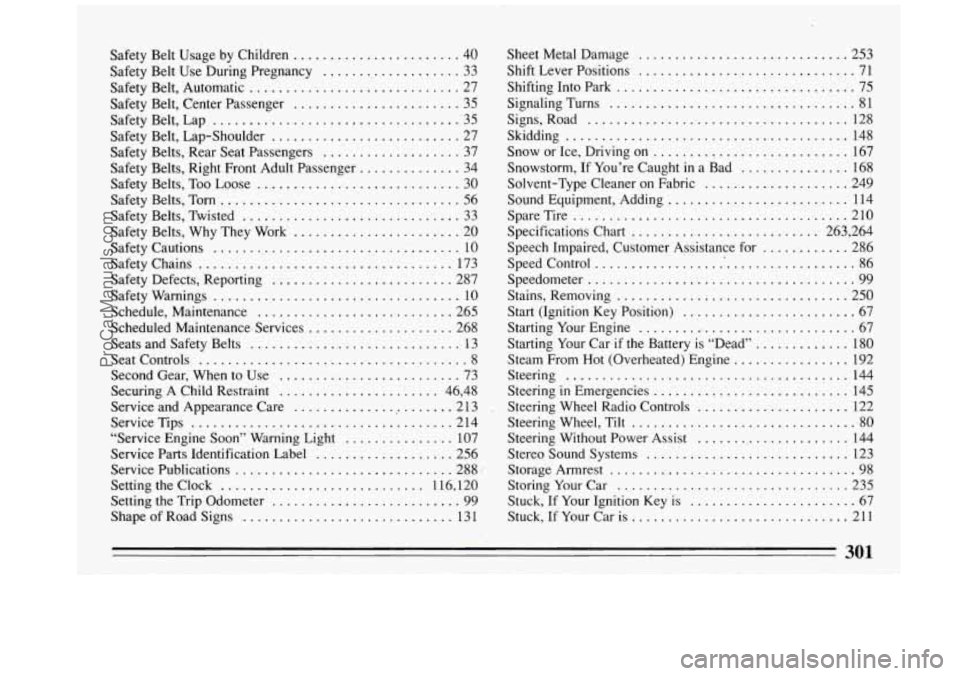
Safety Belt Usage by Children ....................... 40
Safety Belt Use During Pregnancy
................... 33
Safety Belt. Automatic
............................. 27
Safety Belt. Center Passenger
....................... 35
Safety Belt. Lap-Shoulder
.......................... 27
Safety Belts. Rear Seat Passengers
................... 37
Safety Belts. Right Front Adult Passenger
.............. 34
Safety
Belt. Lap
.................................. 35
Safety Belts. Too Loose
............................ 30
Safety Belts. Tom
................................. 56
Safety Belts. Twisted
............................... 33
Safety Belts. Why They Work’
....................... 20
Safety Cautions
.................................... 10
Safety Chains
................................... 173
Safety Defects. Reporting
.......................... 287
Safety Warnings
................................... 10
Schedule. Maintenance
........................... 265
Scheduled Maintenance-Services
.................... 268
Seats and Safety Belts
............................. 13
Seat Controls
..................................... 8
Second Gear. When to Use ......................... 73
Securing A Child Restraint
...................... 46. 48
Service and Appearance Care
............. ......... 213
Service Tips
................ : ................... 214
“Service Engine Soon” Warning Light
............... 107
Service Parts Identification Label
................... 256
Service Publications
.............................. 288 .
Setting the Clock ............................ 116. 120
Setting the Trip Odometer
.......................... 99
ShapeofRoadSigns
............................. 131 Sheet Metal Damage
............................. 253
Shift Lever Positions
.............................. 71
Shifting Into Park
.................................. 75
Signaling Turns
.................................. 81
Signs.. Road
.................................... 128
Skidding
....................................... 148
Snow or Ice. Driving
on ........................... 167
Snowstorm. If You’re Caught in a Bad
............... 168
Solvent-Type Cleaner
on Fabric ..................... 249
Sound Equipment. Adding
......................... 114
SpareTire
...................................... 210
Specifications Chart
.......................... 263, 264
Speech Impaired, Customer Assistance for
............ 286
Speed Control
..................................... 86
Speedometer
..................................... 99
Stains, Removing
................................. 250
Start (Ignition Key Position)
........................ 67
Starting Your Engine
.............................. 67
Starting Your Car
if the Battery is “Dead” ............. 180
Steam From Hot (Overheated) Engine
................ 192
Steering
........................................ 144
Steering
in Emergencies ........ ! .................. 145
Steering Wheel Radio Controls
..................... 122
Steering Wheel, Tilt
............................... 80
Steering Without Power Assist ...................... 144
Stereo Sound Systems
............................ 123
Storage Armrest
.................................. 98
Storing Your Car
................................ 235
Stuck, If Your Ignition Key is
....................... 67
Stuck. If Your Car is
.............................. 211
301
ProCarManuals.com